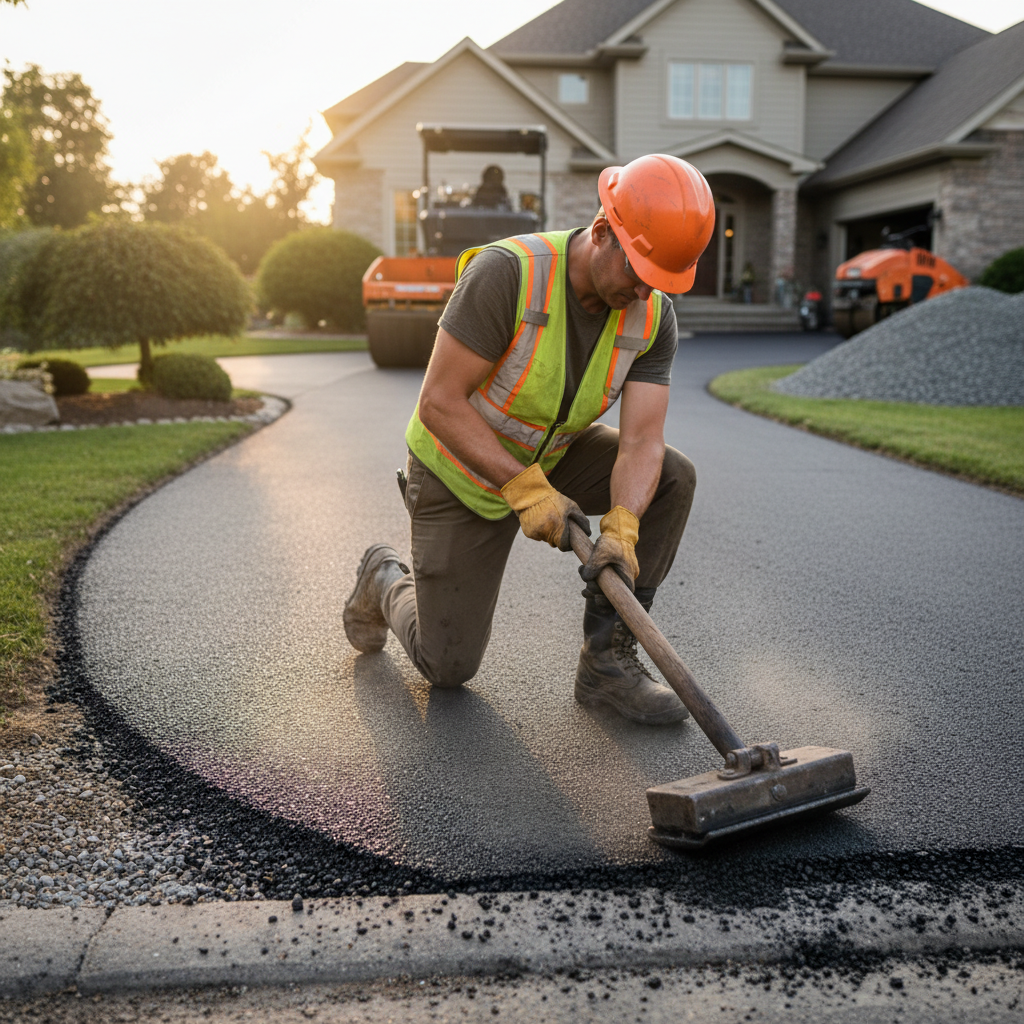
Driveway paving options and costs in Thunder Bay
In Thunder Bay, choosing a driveway paving option is really choosing how you want your property to perform through the North’s freeze–thaw cycles and the long, salt-and-plough winters that come with them. With 65.5% of local dwellings being single-detached homes, most private driveways connect to detached houses—so demand is steady in neighbourhoods that have mature housing stock. In fact, 72.9% of homes in the area were built before 1981, which often means older driveways, weaker foundations, and overdue base repairs when homeowners repave.
Northwestern Ontario’s climate plays a big role in cost. Frost can penetrate deeply, and the ground repeatedly expands and contracts as temperatures swing around freezing. That means contractors prioritize thicker compacted granular bases, aggressive drainage correction, and proper asphalt mix design rather than “quick top-ups.” At the same time, the paving season is shorter, so crews often book farther ahead and may price scheduling pressure and cold-weather protection into spring and early fall work. Neighbourhoods around Westfort and portions of the North End typically see heavy demand because many driveways were originally built in the same era and are due for upgrades.
Below are practical price ranges homeowners in Thunder Bay commonly see, assuming a sound subgrade, proper granular base, and typical access for equipment. Use the table as a baseline, then we can tighten the number once we measure your area and confirm what’s under the existing surface.
| Material |
Lifespan |
Maintenance |
Best For |
Price per sq ft |
| Asphalt (new installation, proper base) |
15–25 years |
Seal every 3–5 years |
Cost-effective, smooth ride, strong performance with correct base |
$7,00 – $14,00 |
| Asphalt (overlay on existing gravel base) |
8–15 years |
Seal every 3–5 years; monitor ruts |
Partial upgrades where base is stable |
$6,50 – $12,50 |
| Interlocking concrete pavers |
25–40 years |
Joint sand top-ups; occasional panel leveling |
High curb appeal and easier spot repairs |
$18,00 – $35,00 |
| Poured concrete (broom finish) |
20–30 years |
Seal periodically; patch spalls promptly |
Clean, durable surface for steady winter use |
$14,00 – $28,00 |
| Exposed aggregate concrete |
25–35 years |
Seal every few years; patch as needed |
Slip resistance and premium look |
$16,00 – $32,00 |
| Gravel / crushed stone (budget option) |
3–8 years |
Regrade and top-up annually; manage washboarding |
Lower upfront cost while you plan a longer-term upgrade |
$2,00 – $6,00 |
Prices are estimates only and vary by project scope, site access and material selection.
What affects the price of paving in Thunder Bay
Homeowners in Thunder Bay can see quotes for the “same” driveway that vary by 30–50% across the Northwest region because the hidden work changes—especially base thickness, drainage corrections, and how much tear-out is actually required. Two driveways can both measure, say, 600 sq ft, yet one sits on strong, well-drained fill while the other has clay, standing water, or an old asphalt that’s failed at the edges. In the Thunder Bay area, those differences tend to drive cost more than the choice of asphalt versus concrete.
Frost line depth and freeze–thaw cycles are decisive cost factors. In Northwestern Ontario, contractors typically design with frost protection around 4 feet as a minimum, and colder zones or poor drainage can push base designs toward roughly 5–6 feet in extreme cases. That translates into thicker compacted granular layers and careful moisture control during compaction. It also means hot-mix asphalt scheduling is tighter: asphalt compaction generally needs warm conditions (commonly above 10°C air temperature), so labour mobilization and scheduling premiums show up when weather windows shrink. Asphalt mixes are also specified to handle local freeze–thaw performance, which can increase material costs compared with “generic” mixes.
Concrete costs can climb when the site requires additional subbase stabilization or when we need proper air entrainment and curing for durability in northern winters. Pavers can cost more upfront in Thunder Bay due to the labour intensity of laying, cutting, and installing proper edge restraints, especially on sloped driveways common in older neighbourhoods. If a contractor can reuse an intact, well-drained gravel base, asphalt overlays may land closer to the lower end of the $7,00 – $14,00 band; if we must rebuild the base and correct drainage, you’ll more reliably see numbers nearer the top of the $14,00 – $28,00 concrete range or higher asphalt pricing.
| Price Factor |
Why It Matters |
Cost Impact |
| Driveway area in sq ft |
Labour and material scale directly with surface area |
Major |
| Base depth required |
Frost protection governs granular thickness and compaction effort |
Major |
| Grading and drainage work |
Fixing slope, ditches, and water shedding prevents premature failure |
Medium–Major |
| Tear-out of existing surface |
Removing old asphalt/concrete and hauling debris adds equipment time |
Medium–Major |
| Edge restraints and curbing |
Restraints keep pavers/edges from spreading and asphalt from raveling |
Medium |
| Sealing requirement |
Asphalt needs sealcoat after installation/seasoning to slow oxidation |
Low–Medium (ongoing) |
| Site access |
Narrow lots delay trucks and increase labour per hour |
Medium |
| Asphalt mix specifications |
Freeze–thaw-rated mixes and proper binders cost more but improve durability |
Medium |
Permits & regulations in Ontario
In Ontario, paving a private driveway within your own property typically does not need a building permit—especially when you’re replacing like-for-like surface (for example, removing old asphalt and installing new asphalt) and you’re not changing municipal infrastructure. That said, certain work can require municipal approval and coordination, mainly when your project affects the municipal right-of-way or storm drainage. For Thunder Bay homeowners, the common triggers are: creating or widening a curb cut, changing the boulevard grading around the driveway apron, relocating or modifying catch basins/culverts that handle municipal drainage, or any work that alters how stormwater flows in the roadway/ditch area.
Step-by-step, here’s how to verify a contractor in Thunder Bay before work starts:
- Confirm the contractor has the appropriate Ontario business credentials for paving work and that the quote reflects the correct scope for private property work.
- Request a current certificate of liability insurance showing the contractor is insured for property damage and injury to workers and the public.
- Verify workers’ coverage: ask for WSIB/WCB clearance or the applicable proof of coverage for the crew performing the work.
- Look for clear details in the proposal: quantities, waste/disposal handling, and whether permit/municipal approvals are included if your design impacts the boulevard.
- Ask where the materials will be supplied from and what standards the mix/concrete will meet for cold-weather performance.
Always call for utility locates before excavation. In Ontario, use Ontario One Call; then confirm lot-grading rules with the City of Thunder Bay if your driveway touches sensitive grading zones near property lines.
Asphalt vs pavers vs concrete for Thunder Bay driveways
For Thunder Bay, the “best” driveway material comes down to how you’ll maintain it through northern winter realities: deep frost, freeze–thaw cycling, and abrasive winter maintenance. Asphalt is usually the lowest upfront option, but it must be sealed to protect the surface and slow aging. In practice, many Thunder Bay homes get the best long-term performance when asphalt is sealed about every 3–5 years, especially where salt and sand are frequent.
Interlocking concrete pavers cost more up front, yet they’re often the most owner-friendly when repairs are needed. If a localized area shifts, pavers can be lifted, the base corrected, and the units reset without replacing the whole driveway—helpful on older properties where the base may be inconsistent. Poured concrete lands in the middle on price but needs the right mix design (including air entrainment) and proper curing to limit surface scaling and cracking from freeze–thaw. Exposed aggregate offers a grippier finish that can help with traction, while chip seal is typically used more for low-cost resurfacing or specific driveway types where a longer smooth-surface appearance isn’t the priority.
Base prep is where Thunder Bay projects succeed or fail. With frost protection needs commonly around 4 feet as a minimum, all three options depend on a thick, well-compacted granular base and good drainage to move water away from the structure. If drainage is poor or the soil is clay-heavy, the most expensive mistake is paving over it without rebuilding.
Concrete versus asphalt is often justified by lifespan and appearance. For example, if asphalt quotes fall near $7,00 – $14,00 per sq ft but concrete lands nearer $14,00 – $28,00, homeowners typically pay extra for a more rigid surface and a longer maintenance-free feel—provided the contractor gets the base and drainage right.
| Material |
Frost Resistance |
Curb Appeal |
Repair Method |
Lifespan |
Price Band |
| Asphalt (sealed regularly) |
Good with proper base + mix |
Medium |
Mill/patch or full overlay if widespread failure |
15–25 years |
$7,00 – $14,00 |
| Interlocking concrete pavers |
Very good with engineered base and drainage |
High |
Lift-and-reset localized units |
25–40 years |
$18,00 – $35,00 |
| Poured concrete (air-entrained) |
Good to very good when properly air-entrained |
Medium–High |
Patch spalls; possible slab repair or replacement |
20–30 years |
$14,00 – $28,00 |
| Exposed aggregate concrete |
Good with correct curing and sealer |
High |
Patch and repair localized areas |
25–35 years |
$16,00 – $32,00 |
| Permeable pavers (drainage grid) |
Very good where drainage is managed correctly |
High (modern look) |
Reset units and service drainage layer |
25–40 years (design-dependent) |
$22,00 – $38,00 |
| Chip seal / tar-and-chip |
Moderate; more surface wear over time |
Low–Medium |
Spot repairs; recoat/resurface over time |
5–12 years |
$5,00 – $10,00 |
How to choose a paving contractor in Thunder Bay
Choosing the right contractor in Thunder Bay comes down to proof, precision, and scheduling discipline—especially because the paving season here is shorter and freeze–thaw damage can reveal shortcuts quickly. Start by verifying Ontario licensing and asking for current liability insurance certificates. Then confirm workers’ coverage: request documentation showing WSIB/WCB coverage for the crew performing the work, or the clearance letter when applicable. A reputable paving contractor will provide these documents without hesitation.
Next, get 2–3 itemised written quotes. Not a single lump sum—ask for a breakdown that shows labour, excavation, base materials, asphalt/concrete quantity, disposal, edge restraints/curbs (if needed), and compaction/testing assumptions. Make sure you understand what’s excluded: for example, is tearing out existing concrete included, or is it “as required”? Is permit/municipal coordination included if your driveway apron or storm drainage is affected?
Warranty matters in northern climates. Ask for the workmanship warranty length and what it covers (surface cracking vs. base movement, labour-only vs. materials). Also confirm whether manufacturer product warranties apply and whether they’re transferable to the next owner—important for resale.
On payment, never pay more than 10–15% upfront. Hold back the remainder until the job is complete and cleanup is verified. Get a written start date and completion timeline, and ensure the contractor acknowledges cold-weather staging so compaction and curing standards are met.
- Request current insurance and WSIB/WCB clearance before signing anything.
- Ask for a detailed scope: excavation depth, base thickness, and drainage plan.
- Confirm disposal is included (dump fees and hauling), not “by homeowner.”
- Clarify whether utility locates are arranged by the contractor (or confirm you’ll do it).
- Ensure the quote includes edge restraints/curbs where needed to prevent spread or raveling.
- For asphalt: specify mix type and whether sealcoat is included after the correct cure period.
- For concrete: specify air entrainment and finishing method (broom finish, curing approach).
- For pavers: confirm joint sand material and how the base will be leveled and compacted.
- Ask how they handle soft spots—will they over-excavate, stabilize, or replace base?
- Get photos of recent similar Thunder Bay jobs (driveways like yours in similar condition).
- Require a written schedule: start date, key milestones, and weather contingencies.
- Set expectations for spring sealing/maintenance if you choose asphalt.
Red flags I see in Thunder Bay include: vague scopes that don’t mention base depth or drainage, refusing to provide proof of insurance/coverage, quoting unusually low numbers without explaining tear-out or disposal, starting work without utility locates, and only giving a verbal timeline with no completion estimate.
Frequently asked questions — paving in Thunder Bay
How do I get the most accurate paving quote in Thunder Bay?
For the most accurate quote in Thunder Bay, start with a site visit that includes measuring the driveway, checking slope and low points, and evaluating what’s under the existing surface. Many older driveways (and a large share of homes in the area were built before 1981) have weak or inconsistent foundations, so ask the contractor how they’ll confirm subgrade condition. Request an itemised quote with base depth, compaction expectations, drainage corrections, and whether tear-out/disposal are included. Because Northwest freeze–thaw performance depends on design, make sure the contractor specifies frost-suitable granular base thickness and appropriate cold-weather asphalt/concrete practices. A clear scope is what turns pricing into something comparable—otherwise two quotes can look similar while being fundamentally different.
How much does it cost to pave a driveway in Thunder Bay?
Cost depends heavily on size and on how much base and drainage work is required. As a starting point, homeowners commonly budget within the region’s asphalt and concrete bands: asphalt driveway paving often lands around $7,00 – $14,00 per sq ft when the base is built correctly, while poured concrete typically falls in the $14,00 – $28,00 per sq ft range depending on finish and preparation. Interlocking pavers generally cost more upfront, often in the $18,00 – $35,00 per sq ft range. If your driveway needs significant tear-out, stabilization, or drainage regrading, the price can move toward the upper end of the bands. Sealcoat for asphalt is an additional maintenance line item over time.
Asphalt vs interlocking pavers vs concrete — which is best in Thunder Bay?
In Thunder Bay’s freeze–thaw climate, all three materials can perform well if the base is engineered and drainage is right, but they shine differently. Asphalt is usually best when you want a lower upfront cost and a smooth driveway—provided you seal it regularly (often every 3–5 years) to slow oxidation and keep salt wear under control. Interlocking pavers are often the best choice if you value curb appeal and want easy, localized repairs: if a section shifts, units can be lifted and the base corrected without replacing the whole driveway. Poured concrete is strong and long-lasting when it’s air-entrained and cured properly, but it can crack with ground movement if base preparation is weak. If you’re comparing costs, the extra expense of pavers or concrete can be justified when drainage fixes and proper bases are included from day one.
How long does a paved driveway last in Thunder Bay?
Typical lifespans in Thunder Bay depend on base design, drainage, and winter maintenance practices. Asphalt installations with a proper granular base usually last about 15–25 years when they’re sealed periodically; the surface ages faster without sealcoat in our northern conditions. Interlocking pavers often last 25–40 years because repairs can be localized if future base settlement happens. Poured concrete commonly targets about 20–30 years, but freeze–thaw durability is very sensitive to air entrainment, curing, and jointing/finishing. If the driveway is built on weak or waterlogged soil, any material can fail early—sometimes within a few seasons—because frost heave doesn’t forgive poor base thickness or poor water management.
When is the best time of year to pave in Thunder Bay?
The best time to pave in Thunder Bay is when temperatures allow proper compaction and material performance. For hot-mix asphalt, contractors typically need air temperatures around 10°C or higher to achieve full compaction and uniform density. That’s why the paving season is compressed into late spring through early fall. Concrete needs appropriate conditions for finishing and curing, and cold snaps can affect strength gain. Winter can also undermine subgrade moisture, so avoid paving over wet, thawed soils that haven’t stabilized. If you’re planning the work, book early—scheduling pressure is real in the Northwest, and weather windows can be shorter than in southern Ontario.
How deep should the base be for Thunder Bay's frost?
In Thunder Bay and the broader Northwest region, frost protection design commonly uses a minimum foundation approach around 4 feet as a starting reference, with colder northern zones sometimes requiring deeper base designs (up to roughly 5–6 feet in extreme cases). The key point for homeowners is that base depth isn’t just “one number”—it depends on subgrade quality and drainage. If the soil is clay or tends to hold water, the contractor should plan for additional base thickness and potentially stabilization so water doesn’t freeze and expand under the pavement. Ask your contractor to state the granular base thickness in the quote and explain how they’ll handle soft spots and drainage so the finished driveway resists heaving and cracking through freeze–thaw cycles.