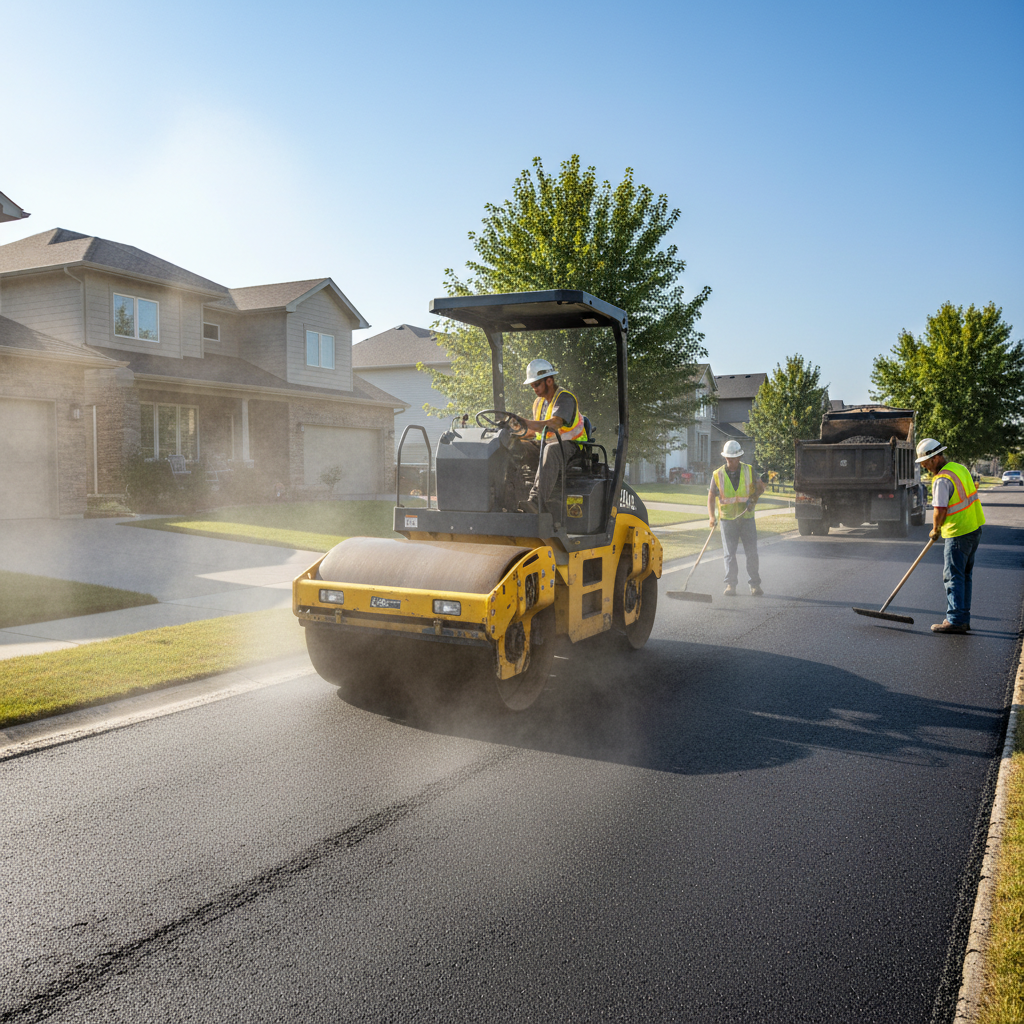
Driveway paving options and costs in Greely
Greely, Ontario is a great place to build a long-lasting driveway—but the cost depends heavily on how your contractor builds for winter. With Greely’s population at 9,049 (Statistics Canada, 2021 Census), most private driveways here serve single-detached homes and families who want a neat, finished look while keeping maintenance manageable. In practice, the Ottawa area climate drives the design: frost penetration is commonly modeled around 1.8 m, so paved surfaces need a deeper, well-compacted granular base and drainage that keeps water out of the frost zone.
That’s why you’ll typically see more excavation and thicker crushed-stone sections in Greely than in milder regions. Repeated freeze–thaw cycles also increase raveling, joint movement, and cracking risk for both asphalt and interlock when the base or drainage is undersized. On top of that, the paving season is shorter here—hot-mix asphalt requires air temperatures above 10°C—so contractor availability tightens in spring and early summer, which can push quotes toward the higher end of typical ranges.
In Greely, demand is especially noticeable around the newer residential pockets near the Greely area commercial strip and expanding subdivisions off regional roads, where homeowners want a clean finish before winters ramp up. Use the table below to compare common driveway surfaces, expected lifespan, maintenance needs, and realistic per-square-foot pricing for this Ottawa-region frost environment.
| Material |
Lifespan |
Maintenance |
Best For |
Price per sq ft |
Price Range |
| Asphalt (new installation, proper base) |
12–20 years |
Seal coat every 3–5 years; patching as needed |
Smooth, cost-effective driveways with good drainage |
~$5.50–$10.00 |
$4,500–$9,000 |
| Asphalt (overlay on existing gravel base) |
10–16 years |
Seal coat every 3–5 years; more frequent patching if base is uneven |
When you can keep costs down and the base is stable |
~$4.75–$8.75 |
$4,200–$8,500 |
| Interlocking concrete pavers |
20–30+ years |
Re-sanding joints; individual unit replacement |
High curb appeal and repairable, long-term surface |
~$10.00–$18.00 |
$6,000–$15,000 |
| Poured concrete (broom finish) |
20–30 years (with air entrainment) |
Crack filling and occasional patching |
Clean, minimal-maintenance look with engineered base |
~$9.00–$17.00 |
$7,000–$16,000 |
| Exposed aggregate concrete |
20–30 years |
Seal option for stain resistance; crack repair as needed |
Slip-resistant texture and decorative finish |
~$10.50–$20.00 |
$8,000–$17,500 |
| Gravel / crushed stone (budget option) |
3–7 years (depends on drainage) |
Re-grade and top-up; weed control; washboarding fixes |
Lowest upfront cost when drainage is well managed |
~$2.00–$4.50 |
$1,500–$4,000 |
Prices are estimates only and vary by project scope, site access and material selection.
What affects the price of paving in Greely
In Greely and the broader Ottawa area, two quotes for the “same” driveway can easily differ by 30–50% once you account for site conditions and how deeply the base is engineered for winter. The biggest driver is usually excavation and sub-base design: because Ottawa-region frost depth is commonly modeled around 1.8 m, contractors often specify a deeper, properly compacted granular base and improved drainage to keep frost heave from pushing the surface around. That means more crushed stone, more compaction passes, and often geotextile and edge restraint details that add labour and materials cost.
Seasonality matters too. Asphalt and concrete scheduling gets squeezed because hot-mix asphalt generally needs air temperatures above 10°C for reliable paving and compaction. When the schedule tightens in spring and early summer, crews and equipment can command premium availability, especially for larger driveways in neighbourhoods where demand is clustered.
Concrete and asphalt mix choices can also change price. Freeze–thaw-rated asphalt mix designs cost more than standard mixes, and air-entrainment is essential for concrete in Ontario winters. A driveway that needs extra grading—say, to create positive slope away from the garage—or one that requires tear-out of older concrete can move you toward the higher end of the region’s typical asphalt band (for example, closer to $4,500–$9,000), while a properly engineered base and drainage is what helps keep you from paying that “fix it next year” premium.
Concrete examples: if your existing slab is broken and must be fully removed, you’re paying for saw-cutting, haul-off, and base rebuild. If the old surface is stable and you’re overlaying asphalt over a well-prepared gravel base, costs can be lower—but only if drainage and compaction are verified. Likewise, a decorative exposed aggregate finish and added jointing details can raise concrete driveways toward $7,000–$16,000 depending on finish thickness and access.
| Price Factor |
Why It Matters |
Cost Impact |
| Driveway area in sq ft |
Material and paving time scale directly with surface area |
Typically 40–70% of total |
| Base depth required |
Frost line determines granular thickness to prevent heaving and cracking |
Can add 15–30% |
| Grading and drainage work |
Proper slope and drainage reduce trapped water and winter damage |
Often 5–25% depending on site |
| Tear-out of existing surface |
Breaking/hauling concrete or old asphalt increases labour and disposal |
Can add 10–35% |
| Edge restraints and curbing |
Prevents pavers from spreading and helps asphalt margins stay tight |
Often 3–15% |
| Sealing requirement |
Asphalt needs sealing after initial curing for best protection |
Ongoing cost; affects near-term budget |
| Site access |
Narrow lots slow equipment movement and increase labour hours |
Can add 5–20% |
| Asphalt mix specifications |
Freeze–thaw-rated mix design costs more but improves performance |
Can add 5–15% |
Permits & regulations in Ontario
In Ontario, paving a private driveway within your own property usually does not require a building permit. The details change when work touches the municipal right-of-way, such as altering how drainage runs across the boulevard, making a new curb cut, changing curb lines, or modifying storm infrastructure. If your plan includes any new driveway entrance adjustments on the street frontage, curb cut revisions, or changes that affect municipal drainage, you should expect that municipal approval may be required before excavation.
Some areas also enforce lot-grading and surface-water rules through by-laws, which can restrict how close hard surfaces can sit to property lines or how runoff must be managed. For Greely homeowners, the practical takeaway is simple: confirm lot-grading requirements with the local municipality if your driveway reshapes slopes, changes where water flows, or alters the swale near the property boundary.
Before any digging, always arrange utility locates through Ontario One Call. Step-by-step, here’s how to verify your contractor properly in Ontario: (1) confirm the contractor’s Ontario licence/registration where applicable using the appropriate provincial resources or their business registration documentation; (2) request a certificate of insurance showing liability coverage that lists your property address or project as applicable; (3) confirm WSIB coverage status (or provide proof of registration/clearance if the contractor qualifies). Ask for the certificate and clearance letter early, then keep copies with your contract so your project has clear accountability.
Asphalt vs pavers vs concrete for Greely driveways
For Greely’s freeze–thaw climate, asphalt, interlocking pavers, and concrete can all perform well—but each has a different balance of upfront cost, maintenance, and winter resilience. Asphalt is typically the lowest upfront option and suits homeowners who want a smooth, dark finish and are willing to plan for sealing every 3–5 years. Interlocking concrete pavers cost more initially, but they’re highly repairable: if a section heaves or a sub-base issue emerges, crews can lift and rebuild only the affected units instead of replacing the whole surface. Poured concrete sits in the middle cost-wise and can last decades when it’s properly designed with air entrainment and a deep frost-resistant base; however, concrete can still crack from movement, so jointing and base engineering matter.
In Ottawa-region winters, drainage is non-negotiable for all three systems. With frost penetration commonly modeled around 1.8 m, the granular base has to be deep enough and compacted enough to keep water from freezing in the pavement layers. Salt and sand from winter maintenance also affect surface wear: asphalt generally tolerates salt well with sealing, while concrete’s long-term durability depends on air entrainment, good finishing, and controlled cracking.
Where does the price difference make sense? For a typical driveway near the higher end of the asphalt band (around $4,500–$9,000), moving to pavers (often $6,000–$15,000) is justified if you want the best curb appeal and the ability to repair without full replacement—especially if your site has more variable grades near the garage apron. If you have a straightforward, well-drained site and want the cleanest long-term look, engineered poured or exposed aggregate concrete can be a strong value.
| Material |
Frost Resistance |
Curb Appeal |
Repair Method |
Lifespan |
Price Band |
| Asphalt (sealed regularly) |
Good when base/drainage are engineered for frost |
Medium (clean and consistent) |
Cut-out patching of localized areas |
12–20 years |
$4,500–$9,000 |
| Interlocking concrete pavers |
Very good; performs well with proper bedding sand and restraints |
High (pattern and colour options) |
Lift/replace individual pavers or small sections |
20–30+ years |
$6,000–$15,000 |
| Poured concrete (air-entrained) |
Good when air entrained and base is properly built |
Medium to High (finish options) |
Crack repair and patching with matching mix |
20–30 years |
$7,000–$16,000 |
| Exposed aggregate concrete |
Good when engineered and cured correctly |
Very High (decorative texture) |
Spot patching; may require blending for best match |
20–30 years |
$8,000–$17,500 |
| Permeable pavers (drainage grid) |
Very good for water management with sub-drainage design |
Medium to High (functional + neat look) |
Replace affected units and inspect drainage stone |
20–30 years (system-dependent) |
$7,500–$16,500 |
| Chip seal / tar-and-chip |
Moderate; depends on thickness and maintenance |
Lower (more utilitarian) |
Resurface/reseal sections as it wears |
6–12 years |
$3,500–$6,500 |
How to choose a paving contractor in Greely
When you’re hiring a paving contractor in Greely, Ontario, you want more than a low price—you want proof the crew is set up to build for frost and manage quality. Start by verifying Ontario business licensing (where applicable), then request current liability insurance and confirm WSIB coverage. Practical checks: ask for a certificate of insurance dated within the last year, and look for the named insured, coverage limits, and effective dates. For WSIB/WCB, request proof of coverage or a clearance letter before work begins. If they can’t produce paperwork promptly, that’s a warning sign.
Next, get 2–3 itemised written quotes. Itemised means a labour + materials breakdown (excavation, sub-base stone, geotextile if used, compacting, paving/pavers/concrete, finishing, and disposal). Avoid “lump sum with no scope” quotes; freeze–thaw performance depends on details like base thickness, compaction method, and drainage corrections. Check what’s excluded: permit pull responsibility (if needed for boulevard/right-of-way work), disposal of removed asphalt/concrete, trucking, and whether topsoil/grading restoration is included.
Warranty also matters. Ask for a workmanship warranty length and whether it’s transferable if you sell your home. For payment, never pay more than 10–15% upfront. Use a holdback until completion and final cleanup. Finally, get a start date and completion estimate in writing—Ottawa-area seasonality can shift timelines, but a good contractor will explain lead times and scheduling windows clearly.
- Provide proof of Ontario licensing/registration where applicable
- Supply a current certificate of liability insurance
- Confirm WSIB/WCB coverage with a clearance letter or proof of status
- Use itemised quotes (not just one line item for “driveway”)
- Show base design thickness and drainage/grading plan in the scope
- List removal and disposal included (concrete/asphalt haul-off)
- Clarify edge restraint/curb details for pavers and asphalt margins
- Specify asphalt mix design for freeze–thaw durability
- State concrete specs: air-entrainment and jointing approach
- Confirm warranty terms for workmanship and product/manufacturer components
- Agree on payment milestones with 10–15% max deposit and a holdback
- Put timeline, crew days, and cleanup responsibilities in writing
In Greely, common red flags include contractors who won’t provide insurance/WSIB documentation, quotes that ignore base thickness and drainage, deposits higher than 15% without a signed milestone plan, vague timelines during the short paving season, and scope wording that excludes excavation/disposal while still pricing near the low end.
Frequently asked questions — paving in Greely
Asphalt vs interlocking pavers vs concrete — which is best in Greely?
In Greely, the “best” choice usually comes down to what you value most: upfront cost, curb appeal, or repair flexibility. Asphalt is often the most budget-friendly path, commonly landing in the $4,500–$9,000 band for driveways when the contractor builds a proper frost-ready base and drainage. Interlocking concrete pavers cost more (often $6,000–$15,000), but they handle winter movement better because you can lift and replace only affected sections. Poured concrete is mid-range and can last decades if it’s air-entrained and jointed, but you should expect crack repair planning over time. For Ottawa’s freeze–thaw cycles, all three depend on a correctly engineered granular base and water management—without that, even the best material struggles.
How long does a paved driveway last in Greely?
With proper construction for Ottawa’s frost depth conditions, most driveways in Greely are designed for long service lives. Asphalt typically lasts around 12–20 years when the base is built for frost and you seal on schedule (often every 3–5 years). Interlocking pavers commonly aim for 20–30+ years because individual units can be replaced if movement occurs. Poured concrete can also reach 20–30 years if it’s air-entrained and built on a deep, well-compacted granular base. The biggest “lifetime breaker” is drainage—if water collects near the driveway edges or garage apron, freeze–thaw cycles accelerate heaving and surface deterioration. Homeowners who choose good base engineering usually get more consistent results than those who only compare surface material price.
When is the best time of year to pave in Greely?
The best time for paving in Greely is usually late spring through early summer, when conditions are consistently warm and dry. Hot-mix asphalt generally needs air temperatures above 10°C for proper paving and compaction, and crews also need stable weather to avoid trapped moisture. Because the paving season is shorter in the Ottawa region, scheduling can fill quickly—especially for larger driveways or neighbourhoods with clustered projects. If you’re aiming for asphalt overlays, it’s also important that existing surfaces are dry enough for proper bonding and that base moisture isn’t trapped. For concrete, curing conditions matter just as much. Plan ahead: get your site measured and your materials confirmed before the first strong run of warm weather.
How deep should the base be for Greely's frost?
Greely’s winter performance depends less on a single “magic number” and more on building a frost-resistant system: excavation depth, granular base thickness, compaction, and drainage away from the structure. In the Ottawa economic region, frost is commonly modeled around 1.8 m, which drives contractors to use deeper, well-compacted granular sections and strong drainage so the pavement system remains below the frost zone. In Ontario projects, base sections are often built in the range of 6–12 inches of compacted granular material (sometimes more depending on soil conditions and thickness of pavement system), and the total build-out can increase when drainage or grading is corrected. The right depth is best determined after a site evaluation—especially if you have soft subgrade, poor runoff, or previous frost heave.
How often should I seal my asphalt driveway?
For asphalt in Greely, sealing is a key part of long-term durability. Most contractors recommend a seal coat after the asphalt has cured—commonly within the first year—then reseal every 3–5 years depending on traffic, sun exposure, and how aggressively salt and sand are used during winter maintenance. Sealing helps reduce oxidation and water penetration, both of which speed up raveling and joint edge breakdown under Ottawa-area freeze–thaw cycles. If you wait too long, repairs often shift from surface maintenance to more expensive patching or even deeper reconstruction. A good contractor should include the sealing schedule in your maintenance plan and recommend a timing window that aligns with warm, dry weather for proper application.
Why does my driveway crack and heave in winter?
Cracking and heaving in Greely usually come from movement in the layers below the pavement, most often caused by water problems and insufficient frost protection. If water gets into the base (from poor grading, a low spot near the garage apron, or blocked drainage), it freezes and expands, lifting the surface. Over repeated freeze–thaw cycles, that movement can crack asphalt, shift paver joints, or cause concrete cracks. Another common cause is an undersized granular base or inadequate compaction—materials settle differently during winter loading. Finally, salt and sand can worsen surface wear, especially if the asphalt wasn’t sealed and the surface binder has oxidized. The fix is typically structural: correct drainage, rebuild base where needed, and reapply the right surface system for freeze–thaw performance—not just cosmetic patching.