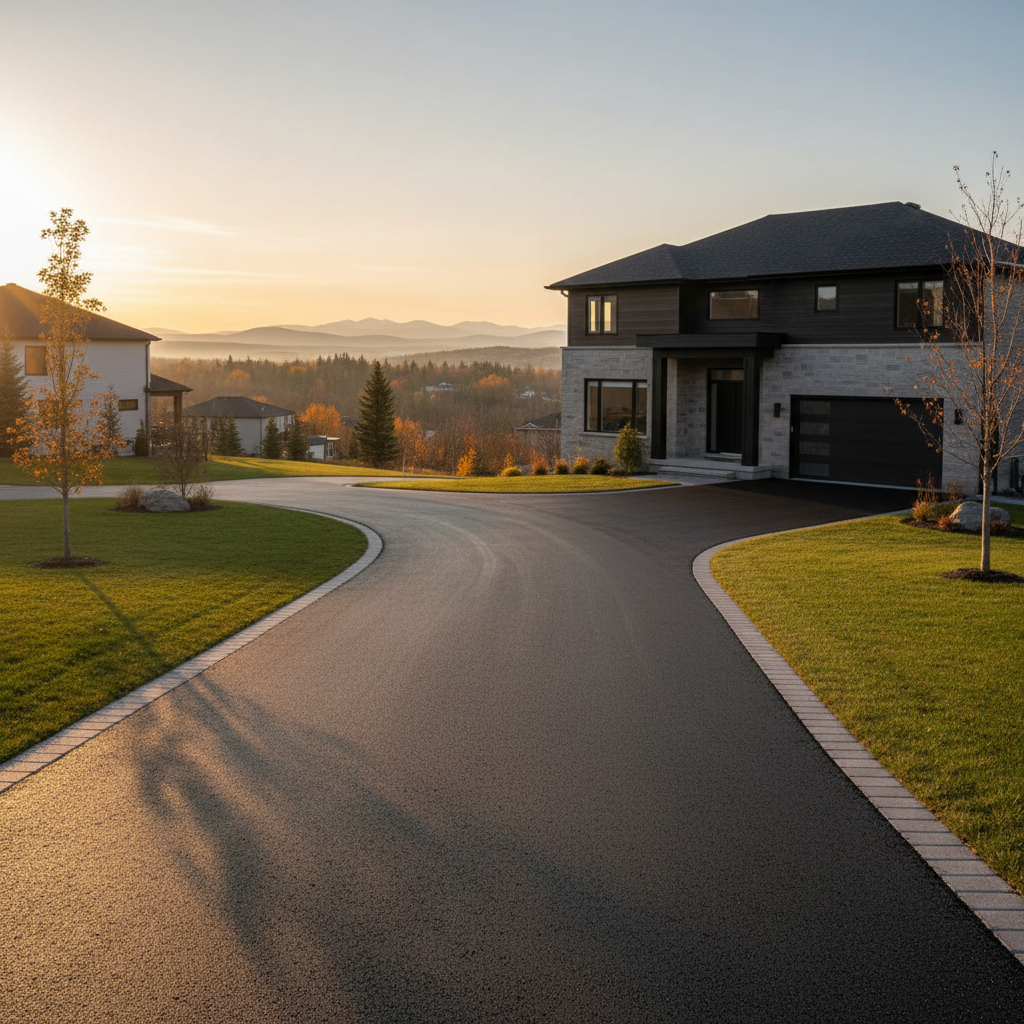
Driveway paving options and costs in Simcoe
Simcoe homeowners typically choose among asphalt, interlocking pavers, and concrete based on budget, winter maintenance habits, and how much disruption they can tolerate. With a 2021 population of 13,922 (Statistics Canada, 2021 Census), the town draws steady driveway work from the surrounding Hamilton–Niagara Peninsula, but the addressable demand is even larger because most private driveways are attached to detached homes. In practice, that means crews are regularly balancing driveway rehabs against curb-to-garage access in established neighbourhoods and newer subdivisions.
In the Hamilton–Niagara Peninsula’s moderate-to-cold climate, freeze–thaw cycles are a major cost driver. Driveways are commonly built with a deeper compacted granular base (often 6–10 in.) and reliable drainage to manage frost heave and surface cracking. That base and drainage work can represent roughly 35–45% of a driveway budget, which is why “same size” quotes can still differ materially. Also, asphalt paving is most effective during the April–October window when air temps are warm enough for proper compaction; when projects stack up in spring and early summer, scheduling pressure can push prices toward the higher end of the Ontario range.
In Simcoe’s East End (and similarly older pockets near downtown), demand is especially strong for tear-outs and re-bases where past drainage issues have caused settlement. Below is a practical comparison table to help you budget before you talk to contractors.
| Material |
Lifespan |
Maintenance |
Best For |
Price per sq ft |
Price Range |
| Asphalt (new installation, proper base) |
15–25 years |
Sealcoat every 3–5 years (typical) |
Best value with good drainage and a frost-rated base |
$6.50–$12.50 |
$3,000–$8,000 |
| Asphalt (overlay on existing gravel base) |
10–18 years |
Sealcoat every 3–5 years; monitor edges |
Budget option when base is already stable and well-drained |
$5.50–$10.50 |
$2,600–$6,500 |
| Interlocking concrete pavers |
20–30+ years |
Occasional leveling, replace individual stones as needed |
Curb appeal and repairs without a full replacement |
$12.00–$25.00 |
$9,000–$20,000 |
| Poured concrete (broom finish) |
20–30 years (air-entrained) |
Seal if desired; watch for scaling and joint maintenance |
Low maintenance look with correct base and joints |
$10.00–$22.00 |
$7,000–$18,000 |
| Exposed aggregate concrete |
20–30 years |
Seal periodically; clean to reduce freeze-thaw surface wear |
Premium look with good traction under winter |
$12.50–$24.00 |
$8,500–$20,500 |
| Gravel / crushed stone (budget option) |
5–10 years (varies with washout) |
Top-ups, grading, weed control |
Temporary or limited budget with good drainage |
$3.00–$6.00 |
$1,200–$4,000 |
Prices are estimates only and vary by project scope, site access and material selection.
What affects the price of paving in Simcoe
Even when you’re comparing the same driveway size in Simcoe, quotes can vary by 30–50% across the Hamilton–Niagara Peninsula and other parts of Ontario. The biggest driver is what’s underneath the finished surface: excavation depth, granular base type and compaction, and whether drainage repairs are included. In colder regions like this part of Southern Ontario, the “hidden” base work is not optional—freeze–thaw performance is decisive cost factor. When frost needs to penetrate deeper (local practice commonly plans around the 1.2–1.5 m range), contractors typically build a thicker, well-compacted granular base (often 6–12 in. of compacted material) and correct slopes so water can’t sit. That’s why a quote that looks “high” may actually include more base and proper drainage than a lower bid.
Seasonality also matters. Hot-mix asphalt generally needs air temperatures above 10°C for reliable paving and compaction, so the effective paving window is shorter here (often April–October). When spring demand is strong, scheduling pressure rises and crews price accordingly. On the concrete side, the frost and the use of de-icing salts can accelerate surface wear if concrete isn’t air-entrained and if joints and base aren’t designed to handle movement.
Concrete examples: a basement-with-water problem sometimes forces a larger drainage correction—adding geotextile, cleanout stone, or daylighting—before you pour, which can push a job toward the upper end of the $7,000–$18,000 range. Conversely, a straightforward asphalt replacement on an already-stable base can land near the $3,000–$8,000 band, especially when tear-out is limited and access is easy.
| Price Factor |
Why It Matters |
Cost Impact |
| Driveway area in sq ft |
Materials and labour scale with square footage, including tack and compaction passes |
Often 40–70% of total variance between quotes |
| Base depth required |
Frost line conditions in this region require thicker compacted granular layers to prevent heaving/cracking |
Commonly adds 15–35% when deeper base is needed |
| Grading and drainage work |
Slope corrections and drainage fixes reduce water pooling, a key cause of failures in freeze–thaw |
Can swing 10–25% depending on how much is required |
| Tear-out of existing surface |
Breaking and hauling concrete or milling old asphalt adds equipment time and disposal fees |
Typical swing: 5–20% (more if thick/slab is involved) |
| Edge restraints and curbing |
Proper restraints prevent paver spread and hold asphalt thickness to grade |
Often 3–12% depending on perimeter length |
| Sealing requirement |
Asphalt needs sealcoat after initial curing and then periodically to slow oxidation and raveling |
+1–4% to budget, but saves on early replacement |
| Site access |
Narrow gates, steep driveways, or long hose/haul distances slow equipment movement |
Can add 5–15% on residential sites |
| Asphalt mix specifications |
Freeze-thaw rated mix design and correct binder content costs more but holds up better in Ontario swings |
+2–8% for higher-spec materials |
Permits & regulations in Ontario
For paving in Ontario, the key distinction is whether you’re working on your private property only, or altering the municipal right-of-way. In most cases, paving a private driveway within your own property—such as replacing asphalt, installing interlock, or pouring concrete entirely on your lot—usually does not require a building permit. However, work that affects the street area or municipal services does require approval. Typical examples that generally do require municipal authorization include new or changed curb cuts, alterations to the boulevard, and any modifications tied to storm drainage (for example, changing catch basins, changing grades that direct runoff toward/away from municipal infrastructure, or adjusting drainage patterns at the road allowance).
Before any excavation, plan for utility locates. In Ontario, homeowners should call Ontario One Call (811) so underground utilities are marked before the contractor digs. Then, verify contractor compliance step-by-step:
- Licensing: confirm the contractor is properly registered for the work they advertise (your municipality and the contractor’s own documentation can help confirm scope).
- Liability insurance: request a current Certificate of Insurance naming the correct insured parties.
- WSIB coverage: ask for proof of WSIB clearance (or coverage number) so you’re not exposed if a worker is injured.
- Job-specific paperwork: ensure the quote references what’s included (excavation, base, drainage, disposal) so you can compare apples to apples.
Finally, check any lot-grading bylaw requirements with the municipality—some areas restrict how close a hard surface can come to property lines and how runoff must be managed.
Asphalt vs pavers vs concrete for Simcoe driveways
In Simcoe’s freeze–thaw climate, asphalt, interlocking pavers, and concrete can all perform well—but they do it differently. Asphalt typically has the lowest upfront cost and handles temperature swings with flexibility; in this area, it’s often the practical choice when homeowners want a smooth, fast install. The trade-off is maintenance: good asphalt should be sealed about every 3–5 years to protect the surface from oxidation and raveling, especially after multiple winters of salt and plowing.
Interlocking concrete pavers have the highest upfront cost, but they’re also the easiest to repair locally. If a sub-base spot settles, pavers can be lifted, re-leveled, and re-set without tearing out the entire driveway—an important advantage in older areas where underlying soil variability is common. Poured concrete sits in the middle for price and can look great, but it’s more susceptible to cracking if the base isn’t built to handle movement; that’s why air-entrained concrete and proper joint design matter. Exposed aggregate offers traction and curb appeal but still needs the same freeze-safe base and finishing discipline.
For Hamilton–Niagara Peninsula winters, base depth and drainage design are the “make-or-break” layer for all three options. If your driveway requires deeper granular base (often 6–10 in. compacted in Ontario practice) due to frost and drainage, the base will carry much of the cost regardless of surface material. As a concrete budgeting example: a well-prepped asphalt driveway might land in the $3,000–$8,000 range, while interlocking pavers on the same footprint often come in higher—commonly $9,000–$20,000—where the extra cost is justified by repairability and the premium look, not just the surface.
| Material |
Frost Resistance |
Curb Appeal |
Repair Method |
Lifespan |
Price Band |
| Asphalt (sealed regularly) |
Good when base is frost-rated and drainage is corrected |
Medium (clean black finish) |
Patch and overlay; sealcoat maintenance |
15–25 years |
$3,000–$8,000 |
| Interlocking concrete pavers |
Excellent with proper bedding and edging |
High (wide colour/pattern options) |
Lift/replace affected stones; re-level |
20–30+ years |
$9,000–$20,000 |
| Poured concrete (air-entrained) |
Good when joints and base are designed for movement |
Medium–High (broom finish) |
Crack repair/seal, possible partial patching |
20–30 years |
$7,000–$18,000 |
| Exposed aggregate concrete |
Good when properly air-entrained and sealed |
High (texture and custom look) |
Patch matching finish; sealing touch-ups |
20–30 years |
$8,500–$20,500 |
| Permeable pavers (drainage grid) |
Very good when underdrain/overflow design is correct |
Medium–High |
Lift/replace individual grid/pavers if needed |
20+ years (system-dependent) |
$10,000–$22,000 |
| Chip seal / tar-and-chip |
Variable; depends heavily on base and binder application |
Low–Medium |
Spot patching and re-seal/renewal cycles |
8–15 years |
$2,500–$6,000 |
How to choose a paving contractor in Simcoe
Choosing the right contractor in Simcoe is less about flashy photos and more about proof: credentials, clear scope, and realistic timelines. Start by confirming Ontario requirements. Ask for their Ontario business registration details and check that they carry current liability insurance—then request the Certificate of Insurance rather than just a verbal statement. Next, verify WSIB coverage: request either proof of WSIB clearance or a WSIB account/coverage confirmation, so you’re protected if a worker is injured during the job.
Then get 2–3 itemised written quotes. You want a breakdown that separates excavation and disposal, base material (type and compacted depth), granular bedding/sand where applicable, the surface (asphalt thickness or concrete specifications), and finishing. A proper quote should also tell you what’s excluded: removal of extras like topsoil/trees, any permit or municipal approval work, and whether the contractor includes saw-cutting, jointing, or tie-ins at the garage apron.
Warranty matters in cold climates. Ask for the workmanship warranty length and what it covers (for example, premature surface failure versus normal wear). Product/manufacturer warranties should be tied to specific materials. Clarify if the warranty is transferable if you sell the home.
Payment schedule is another safety check: never pay more than 10–15% upfront. Use a holdback until the job is substantially complete and cleaned up. Finally, get a start date and completion estimate in writing—during Ontario’s tight paving season, realistic scheduling reduces pressure-driven compromises.
- Ask for the confirmed asphalt/concrete spec (thickness and air-entrainment, where applicable).
- Confirm compacted base depth and granular material type (A/B, and bedding when needed).
- Ensure drainage/grading is described with clear slope direction and tie-in points.
- Verify disposal is included (hauling old asphalt/concrete, not just “tear-out”).
- Check how edges are restrained (curb/edging) to prevent spread.
- Request photos of prior similar Simcoe driveways—same access and soil conditions.
- Confirm insurance expiry dates and that the certificate is current.
- Confirm WSIB clearance/proof before work starts.
- Ask who pulls any needed municipal approvals (when right-of-way changes apply).
- Get a detailed materials list (not “assorted base” or “standard mix”).
- Clarify sealing responsibility for asphalt (timing, usually after curing).
- Make sure the contract includes cleanup and final surface tolerance/grades.
In Simcoe, red flags I commonly see are: vague “lump sum” quotes with no base depth; no WSIB/insurance paperwork provided; crews starting before utility locates are complete; promising “cheap” asphalt without sealcoat planning; and refusing to put scope and timeline in writing.
Frequently asked questions — paving in Simcoe
What causes potholes and how are they repaired?
Potholes in Simcoe usually start with water. When rain or meltwater gets into cracks, it weakens the granular base. Then Ontario freeze–thaw cycles expand and contract the damaged material until the surface breaks. Even a driveway built for frost protection can fail faster if drainage is off (poor slope, low spots, or clogged edges). Repairs typically involve cutting back to sound material, removing failed base, rebuilding with proper granular compaction, and then placing asphalt to match grade. For bigger failures, an asphalt overlay may be more cost-effective than repeated patches. If your driveway is otherwise sound, repair work is commonly positioned within the lower end of the $3,000–$8,000 driveway range; but if the base is compromised, you should expect the work to move closer to the higher end because the “hidden” base must be corrected.
How do I prepare for a paving project?
Preparation is mostly about access and information. In Simcoe, ensure vehicles, trailers, and landscaping items are moved from the driveway path. Mark any utilities/fixtures (outdoor lights, irrigation, and any low-voltage lines you know about) so the contractor can plan safe handling. Clear the work zone of garden beds that you don’t want disturbed and confirm where runoff should go—especially if you’ve noticed puddling after storms or during spring thaw. Before excavation, the contractor should complete utility locates via Ontario One Call (811). Ask that your quote includes tear-out and disposal, and confirm whether the contractor will manage grading and drainage corrections. If you’re considering asphalt, plan for sealcoat timing after curing; for concrete or pavers, plan for jointing/settlement tolerances and keep traffic off until fully cured.
How do I compare paving quotes fairly?
To compare quotes fairly in Simcoe (and across the broader Hamilton–Niagara Peninsula), look beyond the total price and compare the scope line by line. Confirm the driveway area in square feet, the thickness of asphalt or the concrete spec, and—most importantly—the base depth and material type. Ask whether drainage corrections are included (not just “we’ll grade it”). For overlays, determine if they’re actually resurfacing stable material or simply covering weak base. Make sure tear-out is defined: what’s removed, how much is hauled away, and whether the contractor includes disposal. Verify the edge restraint method (curb/edging for pavers, proper termination for asphalt/concrete). Finally, check warranty terms and payment schedule. A quote that lands near the $3,000–$8,000 asphalt band may be a true value if it includes correct base and drainage; a lower bid that skips that work can cost more in early repairs.
Can asphalt be laid in cold weather in Simcoe?
Ontario cold weather is a real limiter for asphalt. Hot-mix asphalt generally requires air temperatures above about 10°C for reliable placement and compaction. In Simcoe, that’s why your best results usually come during the April–October season when crews can maintain proper compaction and achieve the needed density. If a contractor tries to push asphalt during colder snaps, you risk poor compaction, early raveling, and accelerated cracking due to the freeze–thaw cycles you get through winter. That said, contractors can sometimes manage short windows with appropriate planning, but it should be discussed openly with a pavement engineer or experienced crew lead—especially if there’s cold weather risk. If you’re hearing “we can pave any time,” ask what temperature targets and compaction checks they’ll use, and whether the mix design is suitable for freeze–thaw performance in Southern Ontario.
What is a driveway apron and do I need one in Simcoe?
A driveway apron is the portion at the street-to-drive transition—often the area that helps guide water runoff and provides a smooth, properly finished connection where the driveway meets the road/municipal works. In many residential situations, homeowners think they only need the driveway surface on their lot, but the transition area matters for drainage and settlement. Whether you need an apron depends on your site: the condition of the existing curb cut/connection, grading changes, and how water is currently behaving during spring thaw. If you’re changing the curb cut or altering the boulevard/municipal drainage patterns, municipal approval is typically required. If your apron is only about tidying the transition on private property, it may be included as part of the driveway scope, but confirm it in the quote. It’s also an area where good base prep can affect how long your driveway stays crack-free, especially with freeze–thaw.
How do I maintain my driveway through Simcoe winters?
Winter maintenance in Simcoe is mostly about reducing water ingress and limiting surface damage. For asphalt, plan a sealcoat cycle after proper curing (often within the first year as recommended by the contractor, then roughly every 3–5 years). When plowing, avoid aggressive scraping on the surface and keep blade height adjusted—deep gouges can become crack starters after the next freeze–thaw cycle. Use sand strategically and use de-icing salts cautiously; too much salt can accelerate surface wear, and repeated chemical exposure can shorten lifespan on concrete if it’s not air-entrained. For pavers, sweeping snow and using appropriate ice melt helps prevent stone edge chipping. For all surfaces, keep an eye on low spots and edge settlement—small drainage issues can turn into larger failures quickly in Ontario’s spring thaw. Proper base and drainage during installation is what makes maintenance work actually effective.