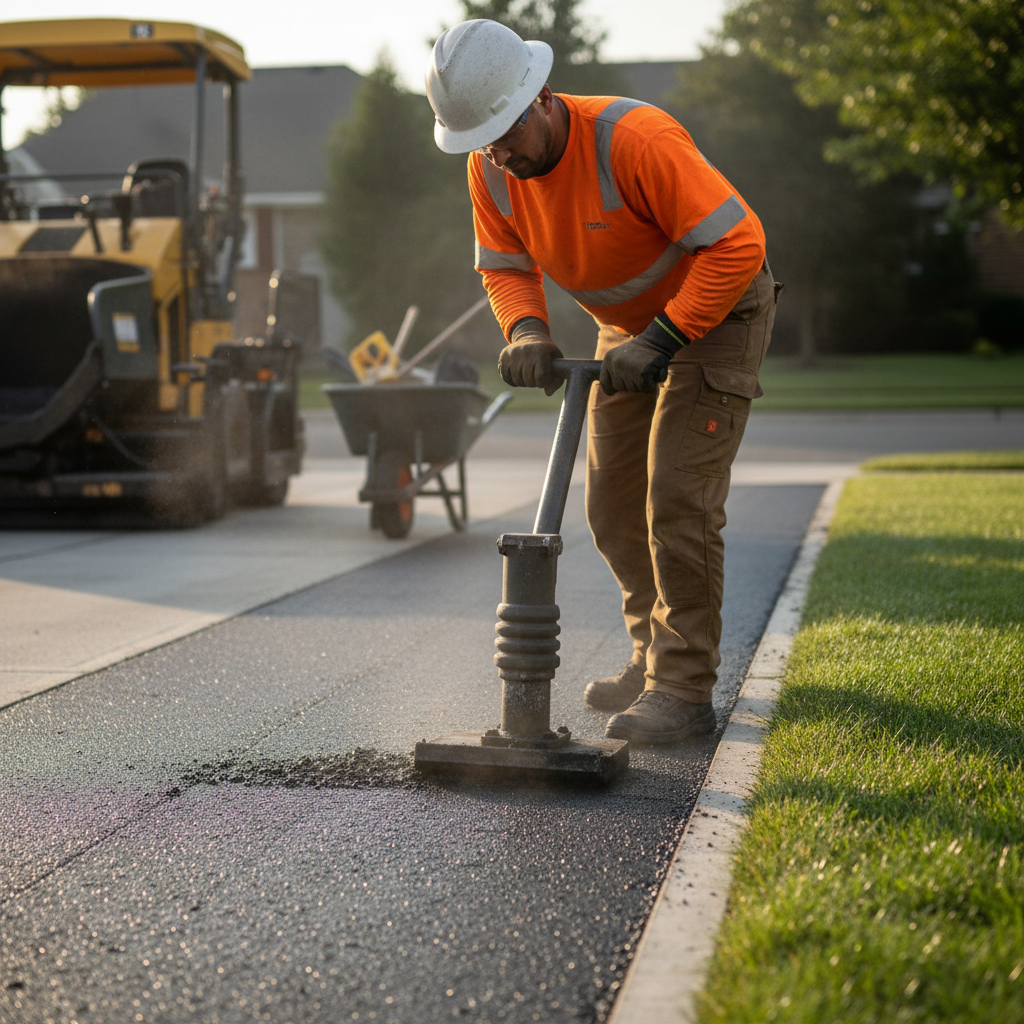
Driveway paving options and costs in Waterloo
Waterloo homeowners typically have a few driveway paths to choose from—most commonly asphalt, concrete, or interlocking pavers—because the majority of homes in the city are single-detached. In fact, single-detached dwellings account for 49.2% of homes, and 61.3% of households are homeowner households (Statistics Canada, 2021 Census). That matters because driveways in these neighbourhoods often need frost-resilient bases and good water management to handle our long winter and repeated freeze-thaw cycles.
In the Kitchener–Waterloo–Barrie corridor, pricing is shaped by frost depth and the practical need for deeper, well-compacted granular base layers with reliable drainage. Contractors also face a shorter paving season; asphalt production and placement require warm weather (hot-mix asphalt generally needs air temperatures above about 10°C), so crews can be busier in spring and early summer. If you’re in older pockets—32.9% of homes were built before 1981—many projects involve tearing out cracked slabs or failed asphalt and rebuilding the base, which raises total cost but improves long-term performance.
Demand is especially strong around Waterloo’s west and north ends where established residential streets see frequent driveway upgrades; areas like Westmount Road and nearby family neighbourhoods often have tight access and older base conditions, which can affect excavation and grading time. With that in mind, use the table below to compare typical material costs and what homeowners usually get at each price point.
| Material |
Lifespan |
Maintenance |
Best For |
Price per sq ft |
| Asphalt (new installation, proper base) |
15–25 years |
Seal every 3–5 years; patch minor failures as needed |
Lowest upfront cost with good durability when base is rebuilt and drainage is correct |
$3,500–$7,000 |
| Asphalt (overlay on existing gravel base) |
10–18 years |
Seal every 3–5 years; more frequent patching if the base is unstable |
When the existing surface is serviceable and you want to minimize tear-out |
$3,000–$6,000 |
| Interlocking concrete pavers |
25–40 years |
Re-sand joints as needed; lift-and-relay for targeted repairs |
Curb appeal and “repairable” performance—individual stones can be replaced |
$12,000–$22,000 |
| Poured concrete (broom finish) |
20–35 years |
Limited maintenance; sealing optional; repair joints/cracks early |
Clean, straightforward look with strong weathering when air-entrained |
$9,000–$16,000 |
| Exposed aggregate concrete |
20–35 years |
Periodic sealing; minor crack repairs as needed |
Enhanced texture and appearance; good traction in Ontario winters |
$10,000–$18,000 |
| Gravel / crushed stone (budget option) |
5–12 years |
Top up annually; re-grade; weed control |
Short-term solution or low-traffic areas; easiest to adjust seasonally |
$1,500–$4,000 |
Prices are estimates only and vary by project scope, site access and material selection.
What affects the price of paving in Waterloo
In Waterloo and across the Kitchener–Waterloo–Barrie market, two quotes for the same driveway can differ by 30–50% because frost-protection requirements and site conditions aren’t “one size fits all.” The big drivers are the thickness and quality of the granular base, the amount of excavation/tear-out needed, and how much drainage and grading work is required to manage water during spring melt and heavy rainfall. Labour availability can also swing pricing slightly because the colder season narrows the window for asphalt and concrete work, so scheduling pressure increases when crews are booked.
Frost line depth and freeze-thaw cycles are decisive cost factors in this region. Deeper frost requires a thicker compacted granular base to prevent heaving, settlement and reflective cracking. In practical Ontario terms, many driveways need deeper base work than a coastal or milder climate—think more like 6–12 inches of compacted granular layers in typical residential builds (exact thickness depends on soil and drainage), rather than the lighter assemblies you’d see where frost is less severe. Asphalt mix design matters too: Waterloo-area work typically requires a freeze-thaw-rated hot-mix spec.
Concrete costs can move up or down based on winter performance details. For example, poured concrete that’s properly air-entrained and finished with correct curing tends to crack less from freeze-thaw than non-compliant mixes. Conversely, if a driveway needs a full-depth replacement because old concrete has settled or the subgrade is saturated, you’ll pay more—especially if you’re already at a mid-range project budget like $9,000–$16,000 for concrete. On the asphalt side, a straightforward asphalt install with a rebuilt base often lands closer to $3,500–$7,000, while trying to overlay a poorly compacted base can force earlier patching, effectively raising your long-term cost.
| Price Factor |
Why It Matters |
Cost Impact |
| Driveway area in sq ft |
Material and labour scale directly with surface area |
Highest impact factor (often the majority of the quote) |
| Base depth required |
Frost-resilient granular thickness reduces heaving and cracking |
Can add significant cost when excavation increases |
| Grading and drainage work |
Correct slope and water routing prevents saturation and washout |
Moderate to high impact if subgrade is wet |
| Tear-out of existing surface |
Breaking concrete or hauling old asphalt/gravel off-site adds labour and disposal |
Moderate to very high depending on thickness |
| Edge restraints and curbing |
Edges lock the system in place and prevent paver spread |
Moderate add-on, but improves long-term performance |
| Sealing requirement |
Asphalt sealing helps protect against water infiltration and winter wear |
Lower than reconstruction; typically scheduled maintenance |
| Site access |
Narrow driveways slow equipment movement and reduce production speed |
Moderate impact, especially on busy residential streets |
| Asphalt mix specifications |
Freeze-thaw-rated mix designs cost more and require correct handling |
Small to moderate increase, big in durability |
Permits & regulations in Ontario
In Ontario, paving a private driveway within your own property usually does not require a building permit. However, work that affects the municipal right-of-way typically does require municipal approval. For Waterloo homeowners, that “right-of-way” trigger often includes new or modified curb cuts, changes to boulevard areas, altering storm drainage patterns, or connecting/adjusting catch basins and swales near the road. If you’re changing how water flows from your property to the street or you’re altering grading in the municipal frontage, assume you’ll need to confirm requirements before excavation.
Step one is utility locates. Call Ontario One Call prior to digging so contractors can locate gas, hydro, telecom and other underground services. Step two is to ask the municipality (or check their published driveway guidelines) whether your driveway modifications touch the right-of-way or require a lot-grading review. Some municipalities also have lot-grading rules that restrict hard-surface placement and control how close surfaces can be to property lines and drainage features.
Step three is verifying your contractor. First, confirm they carry the right general liability coverage and can provide a certificate of insurance before work starts. Next, ask about WSIB coverage for workers (or provide their WSIB clearance documentation where applicable). Finally, check their licensing/registration status through the appropriate provincial registry and verify the information on their quote matches the company name you’ll contract with. Don’t accept “we’re covered” without seeing documents.
Asphalt vs pavers vs concrete for Waterloo driveways
For Waterloo’s freeze-thaw climate, asphalt, interlocking pavers, and concrete can all perform well—provided the base is engineered for frost protection and water is managed. Asphalt is usually the lowest upfront option and is ideal if you want a smooth surface without major reconstruction, but it needs sealing roughly every 3–5 years to slow water infiltration that can lead to potholes and edge breakdown. Interlocking concrete pavers cost more up front, yet they’re the easiest to repair locally; a contractor can lift and reset a small section without tearing out the entire driveway—helpful when winter maintenance (plows, salt exposure at the edges, and heavy tire loads) creates spot failures over time.
Poured concrete sits in the mid-range in most Waterloo projects. With proper air-entrainment, correct curing, and good jointing, it handles salt and freeze-thaw reasonably well. The trade-off is that concrete cracking can be harder to “hide,” and once settlement or subgrade moisture issues develop, repairs may require more surface work.
In the Kitchener–Waterloo–Barrie market, base preparation depth is the same story across materials: drainage-first excavation and compacted granular layers help prevent heaving and settlement. If you’re choosing on budget, a realistic justification looks like this: many homeowners can get a durable asphalt build in the ballpark of $3,500–$7,000, while pavers often land in the $12,000–$22,000 band. Paying for pavers makes sense when curb appeal is a priority and you want the flexibility to repair individual stones after future utility work or localized failures.
| Material |
Frost Resistance |
Curb Appeal |
Repair Method |
Lifespan |
Price Band |
| Asphalt (sealed regularly) |
Good with freeze-thaw rated mix and deep, compacted base |
Moderate |
Mill/patch localized areas |
15–25 years |
$3,500–$7,000 |
| Interlocking concrete pavers |
Very good due to flexible, repairable surface system |
High |
Lift and replace stones; re-sand joints |
25–40 years |
$12,000–$22,000 |
| Poured concrete (air-entrained) |
Good when properly air-entrained and jointed |
Moderate |
Crack repair/seal; localized replacement when needed |
20–35 years |
$9,000–$16,000 |
| Exposed aggregate concrete |
Good to very good; textured surface helps traction |
High |
Repair cracks and patch sections |
20–35 years |
$10,000–$18,000 |
| Permeable pavers (drainage grid) |
Very good when the sub-base drainage is designed correctly |
Moderate to high |
Targeted stone/grate replacement |
20–35 years |
$13,000–$24,000 |
| Chip seal / tar-and-chip |
Moderate; needs periodic top-up in harsh winters |
Low to moderate |
Resurfacing overlay/patching |
6–12 years |
$2,500–$5,500 |
How to choose a paving contractor in Waterloo
Choosing the right contractor in Waterloo is mostly about verifying coverage and matching the scope to Ontario winter realities. Start with licensing/registration: ask for the contractor’s business details and confirm they’re in good standing for the type of work they’re doing. Then confirm liability insurance by requesting a certificate of insurance before work begins. For workers on the job, ask how WSIB coverage is handled and whether they can provide WSIB clearance documentation where applicable. If a company can’t produce documents or will only email them “after,” that’s a risk you don’t want when excavation and machine work are involved.
Next, get 2–3 itemised written quotes rather than one lump-sum number. A proper quote breaks out excavation, granular base thickness and compaction, forms/edges (especially for pavers), asphalt/concrete supply, labour, and disposal. Ask what’s included and what’s excluded: is the permit/approval work required by the municipality included if you’re doing right-of-way changes, and is concrete/asphalt disposal included? Also confirm whether the quote includes edge restraints and any drainage corrections.
Warranty matters. Look for a workmanship warranty length that’s clearly stated, and ask how it’s applied (for example, re-patching, settlement fixes, or replacement of failed areas). Clarify whether the product/manufacturer warranty is transferred to you or whether it’s only between the supplier and the contractor. Payment schedule should be conservative: never pay more than 10–15% upfront, and use a holdback until the final cleanup and punch-list are complete. Finally, insist on a start date and completion estimate in writing so seasonal scheduling doesn’t leave you waiting.
- Verify business details and licensing/registration status before signing.
- Request proof of general liability insurance (certificate of insurance).
- Confirm WSIB coverage/clearance documentation for workers.
- Ask for at least two references from similar Waterloo driveway jobs.
- Get 2–3 itemised quotes (labour + materials + base layers).
- Confirm stated base depth and compaction approach for frost protection.
- Ask what drainage/grading is included and who is responsible for water routing.
- Ensure tear-out and disposal are clearly listed (concrete/asphalt/gravel removal).
- Check if edge restraints or curbing are included for pavers.
- Confirm asphalt sealing schedule and whether first seal is recommended.
- Review warranty terms for workmanship and product, and ask what happens if failure occurs.
- Use a payment schedule with 10–15% maximum upfront and holdback on completion.
Red flags in Waterloo include quotes that don’t specify base thickness or compaction, a contractor who won’t provide insurance/WSIB documentation, “cheap” bids that skip tear-out or drainage corrections, unclear warranty language (no written scope of what’s covered), and requests for large upfront deposits without a signed contract and schedule.
Frequently asked questions — paving in Waterloo
How much does driveway crack repair cost in Waterloo?
In Waterloo, crack repair pricing typically depends on whether the crack is small and stable or whether there’s underlying movement from poor drainage or frost heave. For many asphalt driveways, a contractor will clean the crack, tack it, and seal it—small repairs often cost in the “sealing & repair” band, roughly $250–$1,500 for minor areas. If the crack is accompanied by surface breakup, you may need patching or a partial mill-and-repave section, which pushes the cost higher because labour and hot-mix quantities increase. For concrete, hairline cracks may be sealed, while wider cracks or settlement may require localized slab replacement. Because Waterloo’s freeze-thaw cycles drive movement, it’s important to ask whether the contractor is addressing drainage and base issues, not just filling the crack.
What base thickness do I need for pavers in Waterloo?
For paver driveways in Waterloo, base thickness is driven by frost protection and the condition of your subgrade. In practice, contractors commonly design with a frost-resilient granular system that’s deeper than you might see in milder climates, because repeated freeze-thaw can push water and expand soil. A typical approach is excavation to remove unsuitable material, followed by compacted granular layers (often including a larger-aggregate base and a separate bedding sand layer for pavers). The exact total thickness can vary based on soil stability, how your driveway drains, and how close you are to the road or low spots where water collects. The best quotes will state the granular thickness and compaction steps in writing so you can compare apples-to-apples—especially since many Waterloo homes were built before 1981 (Statistics Canada, 2021 Census), when drainage practices weren’t always the same as today.
How do I get the most accurate paving quote in Waterloo?
To get an accurate quote in Waterloo, start by ensuring the contractor actually measures and assesses the driveway—not just estimates from a quick look. Provide driveway dimensions, photos of any existing cracks/settlement, and tell them how water behaves during spring melt (puddling, runoff direction, or curb-edge flooding). Ask for an itemised breakdown that specifies excavation depth, granular base thickness and compaction, disposal, and drainage/grading corrections. For asphalt, ask about the freeze-thaw-rated mix and whether proper base is included; for concrete, ask whether air-entrainment and jointing are included. If you’re within the municipal frontage area, confirm whether right-of-way changes require approval so the scope doesn’t change later. Accurate quotes also include start date and a realistic completion window, which matters because the paving season is tighter when temperatures regularly drop below workable ranges.
How much does it cost to pave a driveway in Waterloo?
For Waterloo residential driveways, typical costs fall into material-dependent bands. Asphalt driveway paving is usually the lowest upfront option, commonly around $3,500–$7,000 depending on area, base reconstruction, and access. Concrete often lands mid-to-high, around $9,000–$16,000 for many driveway replacements, especially when you need full tear-out and proper frost-ready base. Interlocking pavers are the premium choice for curb appeal and repairability and often fall around $12,000–$22,000. If your plan is maintenance-focused instead of full paving, crack sealing or minor repairs generally sit in the $250–$1,500 range. The biggest cost swings usually come from excavation/tier-out, drainage corrections, and how much base thickness is required for your subgrade.
Asphalt vs interlocking pavers vs concrete — which is best in Waterloo?
In Waterloo’s freeze-thaw climate, the “best” choice depends on your priorities, but the base and drainage design are what truly make the system last. Asphalt is often best for homeowners wanting the lowest upfront cost and a smooth driveway—just plan on sealing every 3–5 years and expect localized patching if water gets in. Interlocking pavers are best for curb appeal and for repairs, since individual stones can be lifted and reset without replacing the whole driveway; they’re a strong fit if you anticipate future work or want easy spot fixes. Poured concrete (properly air-entrained) is a good mid-range option, but it can develop visible cracking if the base or moisture management isn’t right. A realistic example: upgrading to pavers can mean moving from a $3,500–$7,000 asphalt budget to the $12,000–$22,000 paver band—worth it if you value aesthetics and repair flexibility more than minimizing upfront cost.
How long does a paved driveway last in Waterloo?
With a properly built frost-resilient base, good drainage, and routine winter wear management, many Waterloo driveways reach long service lives. Asphalt typically lasts about 15–25 years when the base is correct and sealing is done every 3–5 years to protect against water infiltration. Concrete often lasts about 20–35 years, especially when air-entrained and jointing/curing are done properly to handle freeze-thaw movement. Interlocking concrete pavers commonly last 25–40 years because they’re flexible and can be repaired section-by-section if issues arise. Winter maintenance matters: consistent plowing, careful salt use (salt is hard on edges and joints), and addressing small failures early help prevent water from soaking into the base. Because many neighbourhoods have older housing stock (Statistics Canada, 2021 Census), it’s especially important to rebuild failing bases rather than simply overlaying.