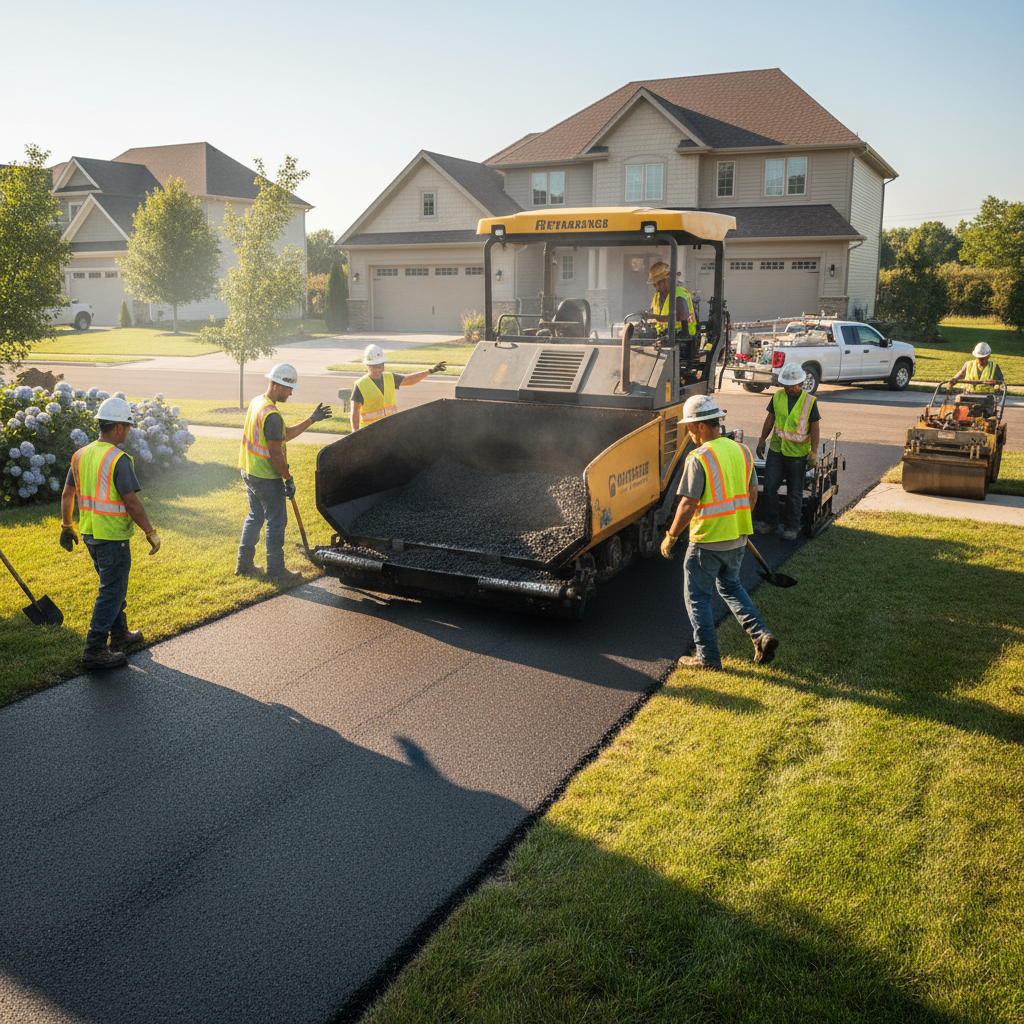
Driveway paving options and costs in Kapuskasing
Kapuskasing homeowners typically start with one goal: a driveway that survives winter without constant patching. With 62.1% of local dwellings being single-detached homes, most private driveways here connect directly to detached properties, so materials, drainage, and base preparation are usually high-impact decisions for your specific site. It also matters that 85.4% of homes were built before 1981—many lots were graded decades ago, and some existing subgrades are uneven, poorly drained, or have older fill that needs correction before any new surface goes down. Budget planning is easier when you know what each option is trying to accomplish.
In Ontario’s North, the Northeast winter reality is freeze–thaw pressure and deep seasonal frost. Asphalt and concrete both rely on a compacted granular base and positive drainage so water doesn’t sit under the surface and expand during cold snaps. When frost is stronger, crews often need more excavation and thicker granular layers; that work is a big part of why Northeast paving pricing runs higher than milder regions. Scheduling also tightens up: hot-mix asphalt generally requires warm, dry conditions (commonly air temperatures above 10°C), so mobilization and crew availability can carry a premium when the window is short.
In Kapuskasing, trade demand is especially common around downtown and the residential blocks off Main Street, where driveways are frequently tied to older housing lots and require careful grading and drainage fixes. Below is a practical cost comparison to help you talk through your quote.
| Material |
Lifespan |
Maintenance |
Best For |
Price per sq ft |
| Asphalt (new installation, proper base) |
15–25 years |
Seal every 3–5 years |
Strong value with a smooth, quiet ride and manageable upkeep |
$8–$14 |
| Asphalt (overlay on existing gravel base) |
10–18 years |
Seal every 3–4 years; monitor edges and drainage |
When you can’t remove much material and the base is already stable |
$6–$11 |
| Interlocking concrete pavers |
25–40 years |
Weed control; re-leveling of minor areas as needed |
Curb appeal and easier spot repairs without replacing the whole driveway |
$16–$24 |
| Poured concrete (broom finish) |
20–35 years |
Seal as needed every 5–10 years |
Clean, straight runs and a durable surface for ploughing |
$17–$26 |
| Exposed aggregate concrete |
25–35 years |
Sealing every 6–10 years |
Extra slip resistance in wet/snowy seasons and better surface character |
$20–$30 |
| Gravel / crushed stone (budget option) |
3–10 years |
Re-grade and top-up yearly; winter ruts are common |
Short-term solution or low budget with active maintenance |
$4–$7 |
Prices are estimates only and vary by project scope, site access and material selection.
What affects the price of paving in Kapuskasing
Even when two quotes look like “the same driveway,” Kapuskasing pricing can swing by 30–50% across Northeast projects—and across Ontario—because contractors aren’t only buying asphalt or concrete. They’re pricing site prep and risk: frost performance, drainage, compaction, haul distances for aggregate, and the weather-dependent schedule that dictates how crews can work. If one contractor includes full base rebuild, geotextile/insulation for weak subgrade, and disposal, while another assumes the existing base is “good enough,” the price difference is usually real and not cosmetic.
Freeze–thaw cycles are decisive in this Northeast context. Deeper seasonal frost requires a thicker compacted granular base than coastal climates. In colder Ontario conditions, many driveways need roughly 6–12 inches of properly compacted granular material (often structured in lifts) to resist frost heave and surface cracking; by comparison, milder BC coastal projects may sometimes use less thickness because frost depth is shallower. Asphalt mix must also be designed for local freeze–thaw durability, which can push material costs beyond the “generic” mix people assume.
Concrete costs can move up or down depending on whether air-entrainment and subgrade support are properly addressed. For Kapuskasing examples: (1) a lot that already drains well after spring melt may reduce grading and drainage corrections; (2) an older lot with soft spots or frost-susceptible fill often requires more excavation and replacement, adding thousands; (3) narrow lots near detached homes can require more handwork around edges and curb tie-ins. In practical terms, a typical asphalt driveway may land within the $4,500–$8,500 band, while pavers often sit in the $8,000–$16,000 range depending on excavation and restraints.
| Price Factor |
Why It Matters |
Cost Impact |
| Driveway area in sq ft |
The larger the surface, the more asphalt/concrete/pavers and finishing time you need. |
Highest driver; usually increases cost linearly with area. |
| Base depth required |
Frost pressure demands thicker, well-compacted granular layers to limit heave and cracking. |
Can change the job by thousands if full base rebuild is needed. |
| Grading and drainage work |
Proper slope and water control prevent saturated subgrade and early failures. |
Moderate to high impact when swales/ditches or regrading is required. |
| Tear-out of existing surface |
Old asphalt/concrete must be broken and hauled; disposal fees apply. |
High impact for thick slabs or multiple layers; can also add equipment time. |
| Edge restraints and curbing |
Restraints stop pavers from spreading and prevent asphalt/concrete edges from failing. |
Moderate; especially important for long, slightly curved driveways. |
| Sealing requirement |
Asphalt needs protection from oxidation and water infiltration after installation. |
Low to moderate; affects long-term cost and schedule planning. |
| Site access |
Narrow entrances slow compaction, limit equipment, and may require additional labour. |
Moderate; can add time and re-handling of aggregate. |
| Asphalt mix specifications |
Freeze–thaw-rated mixes are selected to improve durability in northern winter conditions. |
Moderate; material and QC can raise unit costs. |
Permits & regulations in Ontario
In Ontario, paving a private driveway within your property typically does not require a building permit. In practice, most homeowners in Kapuskasing can move forward with asphalt, pavers, or concrete so long as the work is entirely within their lot and does not interfere with municipal drainage or road structures. The line that matters is the municipal right-of-way—if your driveway work touches the boulevard, curb cuts, or storm infrastructure, approvals are usually required. That includes changing a curb opening, altering boulevard grading, connecting or modifying storm drainage, or doing any work that affects how water is managed between the roadway and your property.
Step-by-step, you can verify a contractor properly and confidently:
- Confirm the company’s credentials: check the relevant Ontario licensing/registration information through the appropriate public business/contractor listings and ask for the name and licence details used on the quote.
- Request a certificate of insurance before work starts and verify it includes commercial general liability.
- Ask for proof of coverage for workers: ensure WSIB coverage (or the applicable WCB status) is in place and current—contractors should provide documentation on request.
- Ask for documentation of crew coverage and the person responsible for site supervision.
- Verify whether any lot-grading rules apply: some municipalities restrict how close to property lines a hard surface or how runoff is directed. Ask what they will do to comply.
Always have utilities located before excavation (Ontario One Call). For anything in or near the right-of-way, confirm municipal approval requirements before the first skid of aggregate is delivered.
Asphalt vs pavers vs concrete for Kapuskasing driveways
For Kapuskasing’s freeze–thaw climate, each driveway material offers different trade-offs in upfront cost, winter durability, and how repairs are handled. Asphalt is usually the lowest upfront option and tends to be the easiest on your driveway budget, but it performs best when it’s sealed regularly—typically every 3–5 years—so water doesn’t penetrate and accelerate base weakening. Interlocking concrete pavers cost more upfront, but they’re also the most flexible choice for northern homeowners because you can remove and re-install individual sections if frost movement or a utility repair creates a localized problem. Poured concrete sits in the middle: it’s durable and plough-friendly, but it’s sensitive to freeze–thaw cracking if it isn’t air-entrained and properly supported by the granular base.
In Northeast Ontario, base preparation is the foundation for all three materials. Because frost can push against moisture under the slab or surface, drainage matters as much as depth. Good contractors build a compacted granular base (often 6–12 inches total granular thickness depending on site conditions), correct grading to shed water away from the driveway, and control edges so water can’t migrate into the subgrade.
Here’s a concrete example of where price differences can be justified: if an asphalt driveway comes in around the $4,500–$8,500 band but your lot has older, uncertain fill and you expect future repairs (or utility work), pavers in the $8,000–$16,000 range can make sense because future spot fixes are less disruptive than tearing out and re-pouring concrete or resurfacing large asphalt areas. That’s especially relevant for older neighbourhood lots where drainage paths were never designed for today’s heavier winter traffic and equipment.
| Material |
Frost Resistance |
Curb Appeal |
Repair Method |
Lifespan |
Price Band |
| Asphalt (sealed regularly) |
Good when base drainage and frost-rated mix are used |
Medium (clean finish; limited patterns) |
Mill/patch or full overlay if widespread wear |
15–25 years |
$4,500–$8,500 |
| Interlocking concrete pavers |
Very good with proper base and edge restraints |
High (multiple colours/patterns) |
Remove and re-install individual blocks or bands |
25–40 years |
$8,000–$16,000 |
| Poured concrete (air-entrained) |
Good when air-entrained and supported on a stable base |
Medium to high (smooth broom finish) |
Crack repair/patches; larger failure may require section replacement |
20–35 years |
$9,000–$18,000 |
| Exposed aggregate concrete |
Good with correct mix and freeze-thaw durability |
Very high (textured look) |
Patch-colour matching; smaller sections more manageable |
25–35 years |
$11,000–$20,000 |
| Permeable pavers (drainage grid) |
Excellent drainage control if designed correctly |
High (modern look) |
Re-level or re-set affected paver areas |
25–35 years |
$10,000–$20,000 |
| Chip seal / tar-and-chip |
Moderate; depends heavily on base and maintenance |
Lower to medium |
Re-surface as chips wear; patching possible but not always cosmetic |
7–12 years |
$5,500–$9,500 |
How to choose a paving contractor in Kapuskasing
Choosing the right contractor matters a lot in Kapuskasing because freeze–thaw failures often come from workmanship gaps, not the material itself. Start by verifying Ontario compliance and coverage. Ask for the contractor’s business credentials (licence/registration details as applicable), and confirm their liability insurance with a current certificate of insurance. Also ask for proof of worker coverage—WSIB in Ontario—and review that the certificate is active and matches the company name on the quote. If a contractor can’t provide clear documentation before starting, that’s a major risk signal.
Next, request 2–3 itemised written quotes. A fair quote breaks costs into labour and materials (excavation, base stone, geotextile/insulation if required, asphalt/concrete/pavers, compaction, edge restraints, and disposal). Avoid single “lump sum” quotes that don’t explain what’s included. Carefully read exclusions: Is tear-out disposal included? Are you paying extra for hauling? Is perimeter edging included? Is permit approval required for right-of-way work handled by them or by you?
Warranty should be spelled out: workmanship warranty length, whether it covers base issues or only surface defects, and whether product/manufacturer warranty transfers to you. For payment, never pay more than about 10–15% upfront; use progress payments and hold back until completion. Get start date and completion estimate in writing so you can plan around the short, warm window needed for asphalt work.
- Confirm insurance certificate is current and matches the contract party.
- Verify WSIB coverage documentation (active status) for workers.
- Request the exact scope in writing (base depth, drainage corrections, disposal).
- Ask whether utilities locates are included and how they manage locate markings.
- Require compaction testing/standard practice explanation (especially under base).
- Check if edge restraints are included (pavers need them; asphalt needs strong termination).
- For asphalt, confirm sealing plan and whether a first seal is recommended after curing.
- For concrete, confirm air-entrainment and how joints/crack control are planned.
- Ask how they protect your lawn/sidewalks/curbs during equipment movement.
- Verify start date and how weather delays are handled in the contract.
- Make sure warranty terms cover workmanship and specify exclusions.
- Use an itemised quote with unit pricing where possible (sq ft, linear ft, base depth).
In Kapuskasing, a few red flags show up repeatedly: contractors who won’t share insurance/WSIB details, quotes that ignore drainage correction or assume “existing base is fine,” no written warranty terms, no clear tear-out/disposal line item, and crews promising asphalt in conditions that are too cold without discussing thaw/curing measures.
Frequently asked questions — paving in Kapuskasing
Do I need a permit to pave my driveway in Ontario?
In Ontario, paving your private driveway within your own property usually does not require a building permit. The situation changes if the work touches the municipal right-of-way—like altering a curb cut, changing boulevard grading, or modifying storm drainage tied to how water flows near the street. In Kapuskasing, if your driveway plan involves any drainage connection work or adjustments near the road allowance, ask your contractor to confirm what approvals are needed before excavation starts. It’s also smart to check for lot-grading rules that may restrict how run-off is directed near property lines. Separately, always do utility locates before digging (Ontario One Call) so excavation is safe and compliant.
How long before I can drive on new asphalt?
After asphalt installation in Kapuskasing, the surface needs time to cool and set properly. Many residential driveways are ready for light vehicle traffic the same day once temperatures drop and the asphalt is stable, but “when you can fully drive normally” depends on weather, thickness, and whether the crew includes proper rolling/compaction. Contractors often recommend avoiding sharp turns, heavy loads, and parking on fresh asphalt for at least 24–48 hours, and keeping traffic minimal until it’s fully cured. If your project is in the northern schedule window, ask your installer about their curing timeline. Planning for a first maintenance seal later is also important—sealing is commonly done within a period after installation (often 6–12 months), then repeated every 3–5 years.
What causes potholes and how are they repaired?
Potholes usually form when water gets under the pavement, softening the base and causing voids. In Ontario’s Northeast, freeze–thaw cycles accelerate this process: water expands in cold temperatures, loosening the surface above, then traffic breaks it down further. A common scenario in older Kapuskasing neighbourhood lots is that drainage is slightly off, so meltwater pools along an edge where compaction is weakest. Repair depends on the cause: good contractors remove all loose material down to stable base, address drainage/grade issues if needed, then patch with properly compacted granular base and hot-mix asphalt. If potholes are widespread, an overlay may be more cost-effective than repeated patches—often within typical asphalt driveway budget ranges such as the $4,500–$8,500 tier depending on scope.
How do I prepare for a paving project?
Start by clearing the driveway path and surrounding work zone: remove cars, bikes, and any items that would block equipment access. If you have landscaping, ask about protection and how topsoil will be handled. Mark any sprinkler heads or utility runs and let the contractor know about known drainage issues (for example, where water collects after spring melt). Arrange for utility locates before excavation—your contractor should coordinate this, but you can confirm it’s scheduled. Also review site access: narrow lanes and tight turns can increase labour, so be ready to provide safe turning space for delivery and compaction equipment. Finally, review your written quote for tear-out/disposal, base depth, and whether grading or drainage corrections are included so there are no surprises mid-project.
How do I compare paving quotes fairly?
Comparing quotes fairly means you compare apples to apples. Ask each contractor for an itemised scope that includes excavation/tare-out, granular base depth and type, drainage/grading corrections, and disposal. Don’t compare only the bottom line—one lower quote may assume the existing base is adequate, while another includes a full base rebuild needed for frost performance. In Kapuskasing, the freeze–thaw environment makes base and drainage inclusion especially important, because those details drive long-term failure risk. Check whether asphalt mix is specified for northern durability and whether concrete is air-entrained. If one quote has pavers and another has asphalt, compare across objectives: pavers usually cost more upfront but allow easier spot repairs; asphalt is often within the $4,500–$8,500 range but typically needs sealing every few years.
Can asphalt be laid in cold weather in Kapuskasing?
Asphalt placement in cold conditions is possible only within limits, and Kapuskasing winters make it a scheduling challenge. Asphalt generally requires sufficiently warm temperatures for proper placement and compaction—commonly air temperatures above about 10°C for standard hot-mix paving—and the surface must not be frozen. If a contractor tries to pave too early or without managing the subgrade temperature, you can end up with poor compaction, reduced durability, and accelerated cracking under freeze–thaw. A reputable contractor should talk through how they’ll handle weather risk, including curing and whether thawing/heated materials are needed for your schedule. If the weather window is tight, ask for a written plan for delays, and don’t assume “cold weather asphalt” is automatically the same as standard work.