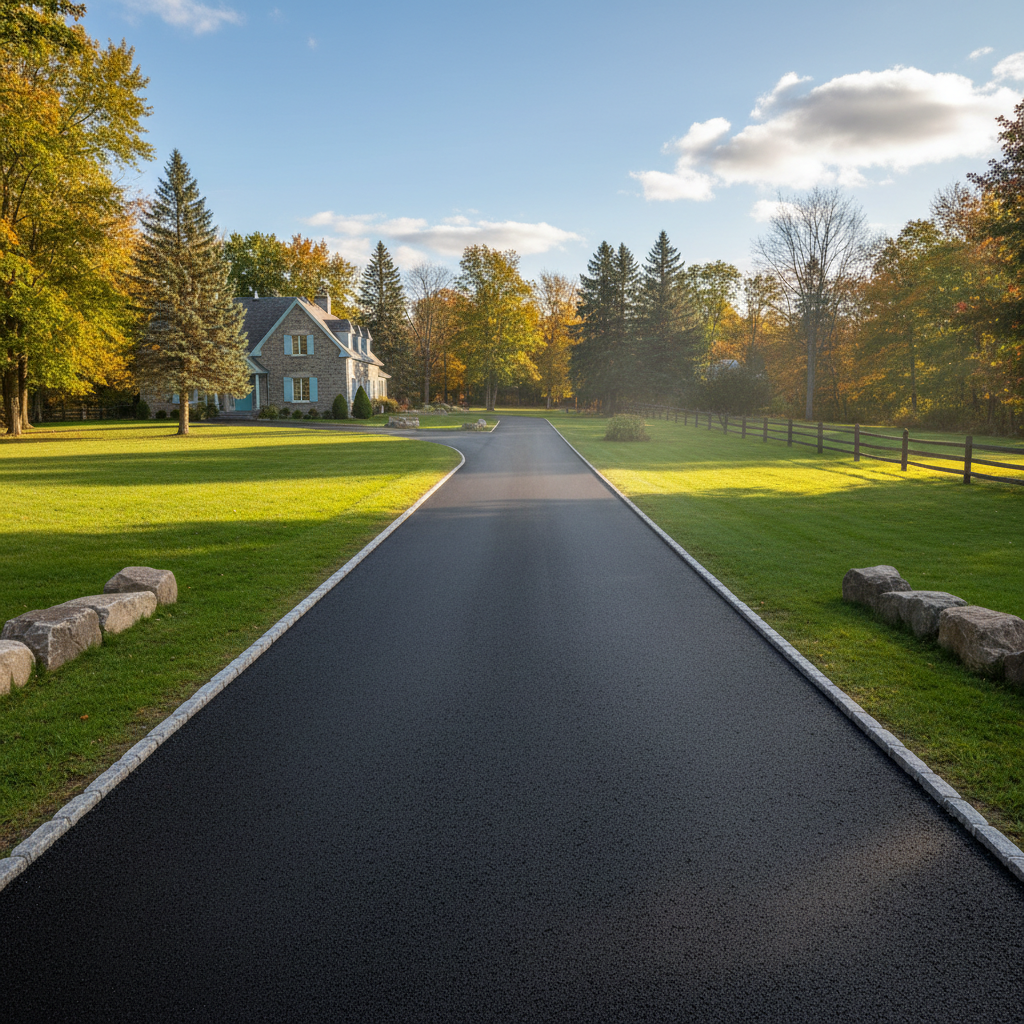
Driveway paving options and costs in Huntsville
In Huntsville, choosing the right driveway paving option is mainly about balancing upfront cost with winter performance. With 79.9% of dwellings being single-detached homes (Statistics Canada, 2021 Census), most private driveways here are tied to detached houses—so the market demand is steady in neighbourhoods that see lots of seasonal traffic. Huntsville also has a large base of older homes: 45.3% of dwellings were built before 1981 (Statistics Canada, 2021 Census), and many of those driveways were originally gravel or have undersized base, which can affect how long asphalt or pavers stay “tight” after freeze–thaw.
In the Muskoka–Kawarthas region, pricing is shaped by frost depth and freeze–thaw cycles. Local practice often assumes frost penetration around 1.2 m (≈4 ft), so a proper granular base typically needs to extend below frost influence, not just a thin lift at the surface. That pushes excavation and granular hauling, and it makes drainage details (crown/slope, edge containment, and any needed drains) much more important—especially on north-facing driveways and shaded lots where water lingers. Scheduling also matters: the paving season is shorter, and hot-mix asphalt work usually needs air temperatures above about 10°C, so spring openings can get booked quickly in Huntsville and nearby areas like Balsam Lake Road and the Dwight corridor.
Below is a practical cost comparison you can use when you’re comparing quotes—then we’ll break down what drives the biggest differences in Section 2.
| Material |
Lifespan |
Maintenance |
Best For |
Price per sq ft |
| Asphalt (new installation, proper base) |
15–25 years |
Seal every 3–5 years |
Most cost-effective all-round option in freeze–thaw |
$4.50 – $9.00 |
| Asphalt (overlay on existing gravel base) |
10–18 years |
Seal every 3–5 years; monitor soft spots |
When the base is already strong and well-drained |
$3.75 – $7.25 |
| Interlocking concrete pavers |
25–35 years |
Re-sand joints as needed; replace individual stones if damaged |
High curb appeal and easy localized repairs |
$7.00 – $15.00 |
| Poured concrete (broom finish) |
20–30 years |
Minimal; patch hairline cracks early if needed |
Clean look and long-term durability |
$8.00 – $14.50 |
| Exposed aggregate concrete |
20–30 years |
Low maintenance; occasional patching at edges |
Slip resistance and premium finish |
$9.50 – $16.00 |
| Gravel / crushed stone (budget option) |
2–5 years (needs regrading) |
Replenish and re-compact 1–2 times per year |
Short budget horizon or interim solution |
$2.00 – $4.25 |
Prices are estimates only and vary by project scope, site access and material selection.
What affects the price of paving in Huntsville
In Muskoka–Kawarthas, it’s common to see quotes for the “same” driveway swing by 30–50% once you account for frost protection, drainage, and how much prep work is truly required. Two driveways that both measure, say, 600 sq ft can price very differently if one lot is well-drained with firm subgrade and the other has soft, wet soil or an undersized base. That’s why your per-square-foot number is only part of the story—mobilization, excavation depth, hauling, and granular compaction often decide whether your asphalt lands closer to the lower end or nearer the top end of local bands like $4,500 – $9,000 for asphalt paving or $7,000 – $15,000 for interlocking pavers.
Frost line depth and freeze–thaw cycles are decisive here. In a region where frost penetration is commonly worked around 1.2 m (≈4 ft), deeper granular bases and careful subgrade prep are what prevent heaving and surface cracking. The base thickness discussion matters because deeper frost protection isn’t just a “nice-to-have”—it directly increases the amount of compacted granular (often 12+ inches for residential pavements in frost-prone Central Ontario) and can increase excavation and disposal costs. The paving season is also shorter: hot-mix asphalt typically requires air temperatures above about 10°C, so fewer workable weeks can tighten scheduling and increase crew demand.
In Huntsville, I see cost increases when: (1) there’s poor drainage (ponding before the driveway even reaches the garage), (2) the existing surface is failing and needs full tear-out (breaking and hauling concrete or old asphalt), and (3) access is tight or slopes are steep near the road. Costs can come down when your subgrade tests strong and you already have a stable, well-compacted base, making an asphalt overlay viable—while still requiring proper grading and edge support. With homes built before 1981, that’s often a variable: older lots may have drainage that wasn’t designed for today’s storm patterns, and the correction can add thousands.
| Price Factor |
Why It Matters |
Cost Impact |
| Driveway area in sq ft |
Materials and production scale with square footage |
High (primary driver) |
| Base depth required |
Frost protection dictates granular thickness and excavation volume |
High (can swing the quote significantly) |
| Grading and drainage work |
Correct slopes and water control reduce freeze–thaw damage |
Medium to high |
| Tear-out of existing surface |
Concrete/asphalt removal adds labour and hauling/disposal |
Medium to high |
| Edge restraints and curbing |
Prevents paver spread and keeps asphalt from raveling at edges |
Medium |
| Sealing requirement |
Asphalt needs seal coat to protect against water and surface aging |
Medium (ongoing budget item) |
| Site access |
Narrow lanes and long pushes slow equipment movement |
Low to medium |
| Asphalt mix specifications |
Freeze–thaw-rated mix designs can cost more but perform better |
Medium |
Permits & regulations in Ontario
In Ontario, paving a private driveway within your own property typically doesn’t require a building permit. In most cases, you’re simply improving your lot (for example: asphalt paving, interlocking pavers, concrete slabs, and standard landscaping-style drainage within your property). However, work that touches municipal infrastructure usually does require approvals. Specifically, you should expect to need municipal permission when you are: creating or changing a curb cut/driveway access in the municipal right-of-way, altering boulevard/grading in a way that affects drainage to the street, connecting or modifying storm drainage that serves the right-of-way, or changing municipal services near the curb.
Before excavation, always confirm utility locations—call Ontario One Call so buried services are marked. Then, verify your contractor in a homeowner-friendly way:
1) Ontario licence: check the contractor’s business registration/credentials and any required trade licensing information through official provincial resources and their business documentation. 2) Liability insurance: request a current Certificate of Insurance showing driveway/paving-type work coverage and the coverage limits. 3) WSIB/WCB: ask for proof of clearance or registration status for the crew performing the work. 4) Ask for the contractor’s written scope and confirm whether permits (if any) are included in their service. If they can’t explain who pulls approvals, that’s a red flag.
For Huntsville homeowners, also confirm any lot-grading or drainage expectations with the municipality—especially where your driveway grading could impact neighbouring properties or runoff direction.
Asphalt vs pavers vs concrete for Huntsville driveways
For Huntsville’s freeze–thaw winters and typical driveway salt/sand maintenance, the “best” material depends on how you want to pay over time and how much repair flexibility you need. Asphalt is usually the lowest upfront option: it gives you a smooth driving surface, but it performs best when it’s built on a proper granular base and sealed regularly (commonly every 3–5 years). In a Muskoka–Kawarthas climate, sealing helps slow water infiltration—important because freeze–thaw damage starts when water finds its way into the pavement structure.
Interlocking concrete pavers cost more up front, but they’re the most flexible to repair. If a section settles due to local subgrade issues (not unusual on older lots), you can lift and re-level that area without tearing out the entire driveway. Pavers also handle freeze–thaw well when installed with proper edge restraints and a compacted bedding layer. Poured concrete sits in the middle: with the right air entrainment and curing, it can last a long time, but it’s more sensitive to cracking patterns from frost movement and from de-icing chemicals—so specification and base prep matter.
On many Huntsville properties, the base must be designed for frost influence (often 12+ inches of compacted granular for residential pavements in frost-prone Central Ontario, plus drainage control). If your winter maintenance includes plowing and frequent salt use, asphalt and concrete both benefit from good drainage and prompt crack/edge maintenance.
Example: if your driveway runs near 600 sq ft, asphalt might land around $4,500 – $9,000 depending on excavation depth and base, while pavers can move into the $7,000 – $15,000 band. That price difference is often justified when you want the ability to repair small sections or you value curb appeal—particularly on homes in high-visibility areas like the Huntsville downtown fringe and cottage-style neighbourhoods where appearance matters.
| Material |
Frost Resistance |
Curb Appeal |
Repair Method |
Lifespan |
Price Band |
| Asphalt (sealed regularly) |
Good with correct base + drainage |
Moderate |
Mill and repave small sections; patch cracks |
15–25 years |
$4,500 – $9,000 |
| Interlocking concrete pavers |
Excellent when edge restrained and properly bedded |
High |
Replace individual pavers or lift/re-compact a zone |
25–35 years |
$7,000 – $15,000 |
| Poured concrete (air-entrained) |
Good with air-entrainment and proper thickness |
Moderate to high |
Crack repair/patching; localized resurfacing if needed |
20–30 years |
$8,000 – $16,000 |
| Exposed aggregate concrete |
Good when sealed and built on stable base |
Very high |
Patch/repair with matching mix where possible |
20–30 years |
$9,000 – $17,000 |
| Permeable pavers (drainage grid) |
Good; reduces water pooling if design is correct |
High |
Replace sections; maintain drainage system |
20–30 years |
$9,000 – $18,000 |
| Chip seal / tar-and-chip |
Moderate; depends heavily on maintenance |
Low to moderate |
Spot overlay; routine re-covering |
5–12 years |
$3,500 – $7,500 |
How to choose a paving contractor in Huntsville
Choosing a contractor in Huntsville is mostly about verifying capability before the first load of stone arrives. Start with Ontario licensing and your contractor’s insurance. Ask for a Certificate of Insurance (liability) showing they’re covered for driveway paving work, and confirm whether the company is registered and in good standing with WSIB/WCB coverage for the people performing the work. If they can’t provide documentation quickly, don’t “assume it’s fine”—get it in writing.
Next, get 2–3 itemised written quotes. You want a breakdown that separates excavation, granular base materials and compaction lifts, asphalt/paver/concrete supply, traffic control, edge restraints, and any drainage/grading corrections. Avoid a “lump sum” only quote unless the scope is extremely detailed. Confirm what’s included: permit pull (if required for right-of-way work), disposal/hauling of excavated material, utility locating coordination (Ontario One Call), and whether they remove topsoil/organic material.
Warranty matters too. Ask for workmanship warranty length and what it covers (settlement vs cracking vs surface raveling) and whether product/manufacturer warranties are separate. Also ask if the warranty is transferable if you sell the home.
For payment scheduling, keep it conservative. Never pay more than 10–15% upfront; use progress payments based on completed milestones, and hold back until substantial completion. Finally, require the timeline in writing: expected start date, curing time (concrete), and completion estimate—because the paving season tightness in Muskoka–Kawarthas can shift schedules.
- Ask for proof of insurance and a clear Certificate of Insurance before any work.
- Confirm WSIB/WCB coverage or clearance for the crew doing the installation.
- Get an itemised quote: excavation, base depth, materials, and compaction details.
- Ensure the quote states whether utility locates are included or coordinated by you/contractor.
- Verify edge restraints and sub-base prep are included (critical for pavers and asphalt).
- Check if drainage corrections (slope/crown/ditch tie-ins) are included.
- Confirm tear-out method and disposal are priced in (hauling can be expensive).
- Ask what asphalt mix specification is used for freeze–thaw performance.
- For concrete, require air-entrainment and finishing method (broom/exposed timing).
- Ask for warranty terms in writing, including workmanship coverage.
- Use a payment schedule with 10–15% max upfront and holdback until completion.
- Make sure the contract states start/completion dates and weather contingencies.
Red flags in Huntsville: a quote that won’t specify base depth, no discussion of drainage (just “we’ll pave it”), refusal to show insurance/WSIB clearance, pushing for large upfront payments, or claiming “freeze-proof” performance without explaining frost protection and granular compaction.
Frequently asked questions — paving in Huntsville
How much does it cost to pave a driveway in Huntsville?
In Huntsville, costs usually land in the material bands because excavation and base depth are often the swing factors for freeze–thaw protection. For asphalt, many residential driveways come in around $4,500 – $9,000, assuming proper base and drainage. If your driveway needs more tear-out, deeper granular rebuild, or improved slopes to stop ponding, asphalt can move toward the upper end. Interlocking pavers often start higher, commonly around $7,000 – $15,000, especially when edge restraints and thick bedding are included for long-term stability. Concrete and exposed aggregate generally sit higher too, often aligning with $8,000 – $16,000 depending on thickness, finish, and access.
Asphalt vs interlocking pavers vs concrete — which is best in Huntsville?
For Huntsville’s freeze–thaw climate, asphalt is a strong choice when you want the lowest upfront cost and are willing to maintain it with sealing every 3–5 years. Interlocking pavers are best when you want maximum curb appeal and repair flexibility—if a localized settlement happens, pavers can be lifted and re-set without replacing the whole driveway. Poured concrete (with air entrainment) can be durable and smooth, but it’s more sensitive to cracking patterns if the base and drainage aren’t done correctly. On many older Huntsville properties (45.3% of dwellings built before 1981, Statistics Canada, 2021 Census), the “best” option often depends on how much base rebuild is needed—because base preparation is what protects all three materials from frost movement.
How long does a paved driveway last in Huntsville?
With correct installation and frost protection, asphalt typically lasts about 15–25 years, but sealing strongly influences performance in our wet-to-freeze cycles. Interlocking pavers commonly last 25–35 years because individual units can be replaced if there’s any minor movement. Concrete often lasts 20–30 years, especially when air-entrained and installed over a stable base with proper drainage. The biggest longevity limiter in Huntsville is usually not the surface material—it’s water management and base performance. If your driveway ponds, freeze–thaw will accelerate raveling, cracking, or edge failures. That’s why many good quotes specify grading, edge containment, and granular compaction depth rather than just the top layer.
When is the best time of year to pave in Huntsville?
The best window is late spring through early fall in Ontario, when conditions consistently support compaction and curing. For asphalt, crews typically need air temperatures above about 10°C for proper placement and compaction, which is why early-season scheduling can tighten in Muskoka–Kawarthas. Concrete can be placed earlier than asphalt in some conditions, but it still needs proper temperature control for finishing and curing—especially with cool nights. If you’re planning work in Huntsville, it’s wise to book once you see stable warm weather, and to get a written schedule that includes weather contingencies. Avoid doing base prep too late in the year; leaving saturated base over winter without protection can create future settlement issues.
How deep should the base be for Huntsville's frost?
Because Huntsville experiences meaningful frost influence, base depth is usually designed to extend below frost influence rather than being “surface-thin.” Local practice commonly works with frost penetration around 1.2 m (≈4 ft), and that typically translates to a thicker compacted granular base for residential pavements than you might see in milder areas. In frost-prone Central Ontario, it’s common to plan for 12+ inches of compacted granular (with the exact section depending on subgrade condition, soil type, and drainage). If your site has poor drainage or soft subgrade, deeper rebuild and stronger separation layers may be needed. The most reliable quotes explain the base build-up and compaction lifts, not just the finished surface thickness.
How often should I seal my asphalt driveway?
For asphalt in Huntsville, sealing is typically done every 3–5 years after installation, depending on sun exposure, snowplowing practices, and how much water gets to the surface edges. Seal coats help reduce water infiltration, which is critical in our freeze–thaw cycle. If your asphalt is new, many contractors recommend waiting long enough for the surface to cure properly before the first seal—often within the first season or after the product has stabilized, depending on the mix and local practice. If the driveway is already showing raveling or significant surface cracking, sealing alone may not be enough; patching and base evaluation may be necessary. Use a contractor who specifies the right sealer for freeze–thaw performance and applies it at suitable temperatures.