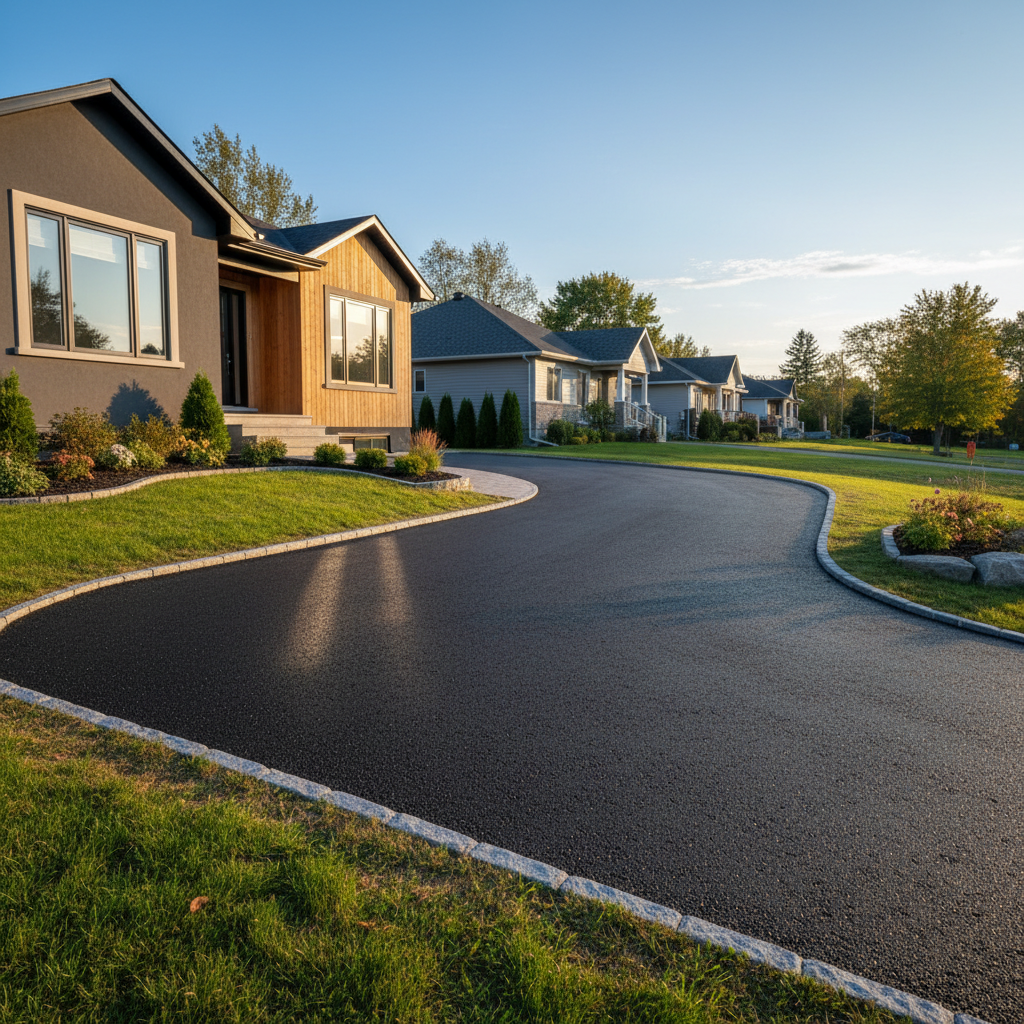
Driveway paving options and costs in LaSalle
LaSalle is a strong market for driveway paving because a large majority of homes there are single-detached houses, and that housing style typically comes with a dedicated driveway footprint. In the 2021 Census, LaSalle recorded 32,721 residents and 10,640 homeowner households (91.4% of households own), which translates to a steady stream of homeowners upgrading driveways rather than replacing them all at once. Windsor–Sarnia generally has milder winters than much of Ontario, but frost still drives how contractors design the base and drainage—because a wet subgrade that freezes is what leads to early cracking, surface break-up, and premature repairs. In practice, labour and equipment scheduling also matter: the paving season is tighter, so spring and late-fall work is priced with the reality that crews, rollers, and curing time must fit within shorter weather windows. That’s why two quotes for the “same driveway size” can differ a lot if one contractor includes deeper excavation, improved stone, and drainage corrections while another treats it like a simple surface swap.
You’ll see especially high demand in newer pockets and established residential corridors where driveways were poured or laid decades ago—often around the Lasalle area off Tecumseh Rd or near the Arbour Glen/McKee Ave vicinity—because many older installations now need base correction before a resurfacing. Below is a practical comparison of materials and typical pricing ranges in this part of Windsor–Sarnia, followed by the project variables that swing the final total.
| Material |
Lifespan |
Maintenance |
Best For |
Price per sq ft |
Price Range |
| Asphalt (new installation, proper base) |
15–25 years |
Seal every 3–5 years |
Value-focused driveways with good drainage |
$3.50–$6.00 |
$8,500–$14,000 |
| Asphalt (overlay on existing gravel base) |
10–18 years |
Seal every 3–5 years; watch for base softness |
When the base is already stable and drainage is good |
$2.75–$5.25 |
$7,000–$11,500 |
| Interlocking concrete pavers |
25–35 years |
Minimal; occasional re-leveling of a few units |
Repairability and curb appeal |
$7.00–$12.50 |
$14,500–$24,500 |
| Poured concrete (broom finish) |
20–30 years |
Crack sealing as needed; protective treatments if desired |
Straightforward, low-maintenance look |
$5.50–$8.50 |
$12,000–$19,500 |
| Exposed aggregate concrete |
20–30 years |
Seal occasionally; patch/repair if needed |
Slip resistance and an upgraded finish |
$7.00–$12.00 |
$16,000–$26,500 |
| Gravel / crushed stone (budget option) |
5–12 years |
Top up 1–3 times per year; grading required |
Temporary solution or drainage-first approach |
$1.75–$4.00 |
$3,500–$7,500 |
Prices are estimates only and vary by project scope, site access and material selection.
What affects the price of paving in LaSalle
In Windsor–Sarnia, it’s common to see driveway quotes swing by 30–50% for what looks like the same job, because the “hidden” work—excavation, base thickness, drainage corrections, and disposal—can be the difference between a driveway that stays solid for decades and one that needs early repairs. Frost is the key driver: the freeze-thaw cycle can lift weak bases, open cracks, and push water under pavement. Where the subgrade holds moisture, you typically need a deeper compacted granular base and better water management. While Ontario frost-protection design is often treated as needing roughly 3 to 5 feet of frost-protection excavation depending on soil and exposure, the practical takeaway is that contractors in LaSalle price for enough granular depth to prevent heave and to keep the asphalt or concrete supported. That’s why base and drainage details matter more than the surface material alone.
Season length also changes pricing. Hot-mix asphalt needs suitable air temperatures (often above 10°C) for paving and compaction, so limited weather windows can tighten scheduling. In real terms, a spring install in LaSalle might price closer to the high end of the $8–$14 asphalt band, while a job scheduled well ahead with confirmed curing conditions may land nearer the middle.
Concrete costs can also rise when older driveways require heavier tear-out. For example, removing a poorly supported slab can add breaking/hauling, and installing new edge restraints is often necessary to prevent pavers from spreading or to keep concrete from creeping under plough loads. Conversely, if your driveway has good site drainage and minimal removal, you may get pricing closer to the lower asphalt overlay range, or you might justify pavers at the higher end only when curb appeal and repairability are priorities.
| Price Factor |
Why It Matters |
Cost Impact |
| Driveway area in sq ft |
More square footage means more asphalt/pavers/concrete, stone, and labour hours. |
Highest impact (often 40–60% of total) |
| Base depth required |
Frost protection and heave prevention depend on compacted granular thickness and moisture control. |
Often +10–25% when deeper excavation is needed |
| Grading and drainage work |
Slope corrections and proper drainage keep water from freezing under the driveway. |
Often +5–20% depending on how much earthwork is required |
| Tear-out of existing surface |
Concrete breaking, asphalt milling, and haul-away time affect production rates and tipping fees. |
Often +8–30% |
| Edge restraints and curbing |
Edges lock in pavers and protect asphalt/concrete from creep and spreading under snowplough forces. |
Often +3–12% |
| Sealing requirement |
Asphalt should be sealed after the initial cure window to slow oxidation and water intrusion. |
Adds ongoing cost; typically $2–$6/sq ft equivalent over time |
| Site access |
Long carries, tight turns, and limited staging slow equipment and increase labour hours. |
Often +3–15% |
| Asphalt mix specifications |
Freeze-thaw-rated mix and proper binder selection help the surface resist cracking and raveling. |
Often +5–15% vs. basic mixes |
Permits & regulations in Ontario
For a private driveway on your own property in Ontario, most resurfacing or reconstruction does not require a building permit—especially when you’re not changing the location of the driveway, altering municipal infrastructure, or redirecting stormwater. However, work in the municipal right-of-way typically does require municipal approval. In LaSalle, that commonly includes new or modified curb cuts, changes to the boulevard, modifications that affect municipal drainage, or any work tied to the storm system near the frontage. If your plan includes altering drainage in a way that directs water toward or across neighbouring property without the proper routing, expect additional approvals or conditions before work starts.
Step one for homeowners is to have the contractor confirm what portion of the work is on private property versus within the right-of-way. Step two is utility locates: always request locates before any excavation through Ontario One Call, and ensure the contractor follows up with a field verification. Step three is contractor compliance: before signing, verify the contractor’s Ontario licence status (where applicable for the scope), request a certificate of liability insurance, and confirm whether they carry WSIB coverage or the appropriate WCB coverage for their workers. Finally, ask the contractor for a copy of their insurance certificate and any clearance/coverage letter they provide, then keep those documents for your records.
Asphalt vs pavers vs concrete for LaSalle driveways
Choosing between asphalt, interlocking pavers, and concrete in LaSalle comes down to how each material handles frost movement, winter maintenance, and how you want repairs to work. Asphalt is typically the lowest upfront cost, but it relies on consistent drainage and needs sealing every 3–5 years to protect the binder from oxidation and water penetration. If your base is properly built for Windsor–Sarnia frost conditions, asphalt can perform very well; if not, water can freeze under the pavement and accelerate cracking. Interlocking concrete pavers cost more up front, but they’re the most forgiving for localized repairs because individual units can be lifted, re-stabilized, and reset—useful if utility work or minor base settling occurs. Poured concrete sits in the middle for cost, but it can be more sensitive to freeze-thaw and de-icing salt without the right air entrainment and finishing details; cracking can happen if the base prep and drainage don’t control water under the slab.
In terms of base preparation, all three options benefit from a well-drained, properly compacted granular base designed to limit moisture freeze under the surface. For winter durability, edge restraint and correct slopes matter just as much as the top layer. On plough cycles and salt exposure, asphalt generally fares well when sealed and edges are locked, while pavers often hold up better visually because minor surface variations can be corrected without full replacement. Concrete can last 20–30 years with proper air-entrained concrete, but repairs are usually more involved once cracking starts.
For a typical LaSalle driveway upgrade where the asphalt new-install range lands around the $8–$14 band, moving to pavers can be justified if curb appeal is a priority and you want easy future repairs. If you’d rather keep long-term costs predictable and your drainage is strong, asphalt with proper base build-up often delivers the best value.
| Material |
Frost Resistance |
Curb Appeal |
Repair Method |
Lifespan |
Price Band |
| Asphalt (sealed regularly) |
Good when base is drained and compacted |
Medium (clean, dark finish; depends on texture) |
Patch with hot mix or full resurfacing later |
15–25 years |
$8–$14 |
| Interlocking concrete pavers |
Very good with proper bedding and base |
High (colour, patterns, borders) |
Lift-and-reset individual units or sections |
25–35 years |
$18–$32 |
| Poured concrete (air-entrained) |
Good with air entrainment and drainage control |
Medium-High (broom finish; can be upgraded) |
Crack sealing and patching; slab repairs are more involved |
20–30 years |
$12–$20 |
| Exposed aggregate concrete |
Good when base prep is correct and edges are restrained |
High (textured, premium look) |
Section patching; replacement is more difficult than pavers |
20–30 years |
$16–$26 |
| Permeable pavers (drainage grid) |
Very good when system is installed and maintained correctly |
High (modern look) |
Targeted repairs to paver units; verify drainage function |
20–30 years |
$20–$34 |
| Chip seal / tar-and-chip |
Fair to good; sensitive to base moisture issues |
Lower (texture-heavy, less uniform) |
Spot patching and re-sealing more often |
8–15 years |
$6–$10 |
How to choose a paving contractor in LaSalle
For LaSalle homeowners, the most reliable quotes come from contractors who can prove compliance and explain the build-up, not just the surface. Start by verifying Ontario licensing for the scope they’re doing (and confirm they’re insured). Ask for a certificate of liability insurance and check that it matches the work being performed and includes adequate coverage. Then confirm WSIB/WCB coverage: request their WSIB clearance letter (or the equivalent WCB documentation that applies to their coverage). You can also verify coverage status using the provider’s online tools if they offer public confirmation, but the certificate/clearance letter is what you should keep on file.
Next, request 2–3 itemised written quotes. A good quote breaks down labour and materials (excavation/haul-away, granular base and compaction, drainage/grading, geotextile if used, asphalt or concrete quantities, edge restraints, and disposal). Avoid lump-sum quotes that don’t specify what’s included. Clarify inclusions like permit pull responsibility (if municipal approval is needed), saw-cutting, bonding/prime coat, and whether debris removal and disposal are covered.
Warranty matters too. Ask for the workmanship warranty length, what it covers (e.g., premature cracking from settlement vs. normal wear), and whether the product/manufacturer warranty is separate and transferable. Payment should be controlled: never pay more than 10–15% upfront, and hold back a meaningful amount until the job is complete and the surface is accepted. Finally, get a start date and completion estimate in writing so you’re not left waiting on cure windows that are weather-dependent in Ontario.
- Confirm their insurance certificate before work begins, not after.
- Request WSIB/WCB clearance documentation and verify effective coverage.
- Ask who pulls any required municipal approvals if right-of-way work is involved.
- Require an itemised quote (labour, materials, disposal, drainage, compaction).
- Confirm base thickness and compaction targets in writing.
- Ask how they manage water: slope plan, swales, and tie-ins.
- Verify whether geotextile is included for weak/poorly drained subgrades.
- Check what edge restraints are included for pavers/asphalt/concrete.
- Confirm asphalt sealing responsibility and timing (typically after cure, then every 3–5 years).
- Get warranty details in writing, including exclusions and response timelines.
- Use a payment schedule with a holdback until final inspection/acceptance.
- Require a written timeline and weather-cure assumptions for Ontario work windows.
Red flags we see in LaSalle include contractors who won’t discuss base thickness and drainage, quotes that omit disposal/haul-away details, pressured payment requests with large upfront deposits, no written warranty terms, and crews that show up without confirming utility locates and right-of-way limits.
Frequently asked questions — paving in LaSalle
How much does it cost to pave a driveway in LaSalle?
Cost in LaSalle depends mainly on driveway square footage, how much excavation is required for frost protection, and whether the job includes drainage correction and tear-out. As a ballpark, asphalt driveway paving commonly lands in the $8–$14 price band for typical Ontario southern markets when proper base work is included. If your site needs deeper excavation and more granular stone due to a wet or clay-heavy subgrade, quotes can climb toward the upper end even for asphalt. If you’re comparing materials, interlocking pavers often sit higher (commonly in the $18–$32 band) because you’re paying for paver units, bedding sand, restraints, and a more involved base build-up. A simple gravel rebuild is the budget alternative, but it requires frequent re-grading to manage washboarding and water.
Asphalt vs interlocking pavers vs concrete — which is best in LaSalle?
If your priority is lowest upfront cost and you want a smooth, clean look, asphalt is usually the best first choice—provided the base is built for frost and drainage is right. In LaSalle, asphalt that’s sealed on schedule (often every 3–5 years) tends to stay tougher through winter salt and plough cycles. Interlocking pavers are best when curb appeal is important and you prefer a repair method that doesn’t require replacing the entire driveway if a localized issue appears. Pavers can be a strong fit for neighbourhoods around established residential areas where future utilities or minor settlement might happen. Poured concrete is a solid “middle” option if you choose air-entrained concrete and the base is properly prepared; otherwise cracking can show up earlier under freeze-thaw.
How long does a paved driveway last in LaSalle?
Lifespan varies, but in LaSalle you can plan around the material plus the quality of the base and drainage. Asphalt often lasts roughly 15–25 years when installed on a properly compacted granular base and sealed regularly; without sealing, surface oxidation and water intrusion can shorten that timeline. Interlocking concrete pavers commonly last 25–35 years because even if there’s minor movement, individual units can be lifted and reset, so small issues don’t necessarily become full replacement. Poured concrete typically performs well for about 20–30 years, with the important caveat that air entrainment, good base prep, and crack control details are crucial in Ontario’s frost environment. The biggest “early failure” driver is usually water under the surface—frozen moisture expands and lifts weak areas, leading to cracking or settlement.
When is the best time of year to pave in LaSalle?
In Ontario, the best time is when the air and base conditions support proper compaction and curing—generally late spring through early fall. Asphalt needs warm conditions for production and compaction (commonly air temperatures above about 10°C), so early spring work often prices higher due to weather risk and shorter scheduling windows. A mid-summer job that has consistent temperatures can come in closer to the mid-range of the $8–$14 asphalt band, while spring or late-fall paving may require tighter coordination for curing and could land toward the higher end. For concrete, crews also watch temperatures closely because freeze risk after placement can damage the surface and lead to early cracking. Ask your contractor for a written plan that includes weather contingency and curing time—not just a date.
How deep should the base be for LaSalle's frost?
There isn’t one “magic number” because frost protection depth and granular thickness depend on soil type, moisture, and exposure, but in Windsor–Sarnia the design intent is to prevent moisture from freezing under the driveway by using enough compacted granular base and correct drainage. Contractors commonly allow more granular depth when the subgrade is clay-heavy, poorly drained, or has a history of soft spots—because freeze-thaw risk rises with moisture. This is why quotes differ even on similar-looking driveways: one contractor may include deeper excavation and proper drainage correction, while another may not. In practice, many Ontario installations use granular base thickness on the order of several inches up to more substantial builds once excavation for frost protection is included. Your best next step is to ask for the proposed base build-up (depths and materials) written into your quote after a site inspection.
How often should I seal my asphalt driveway?
For asphalt in LaSalle, sealing is typically scheduled after the initial cure period—often after the first season once the asphalt has had time to stabilize—and then every 3–5 years depending on wear, sun exposure, and how much winter maintenance you do. If you frequently plough right up to the surface or you use heavier de-icing, earlier sealing can help protect the binder and reduce water penetration that contributes to cracking during freeze-thaw. Many homeowners find it easiest to budget sealing as part of driveway maintenance, not as an emergency repair. Your contractor should specify the sealing product type and the timing relative to the job’s completion date. If your driveway is in the $8–$14 asphalt paving band, sealing is the most important ongoing step to protect that investment over the long run.