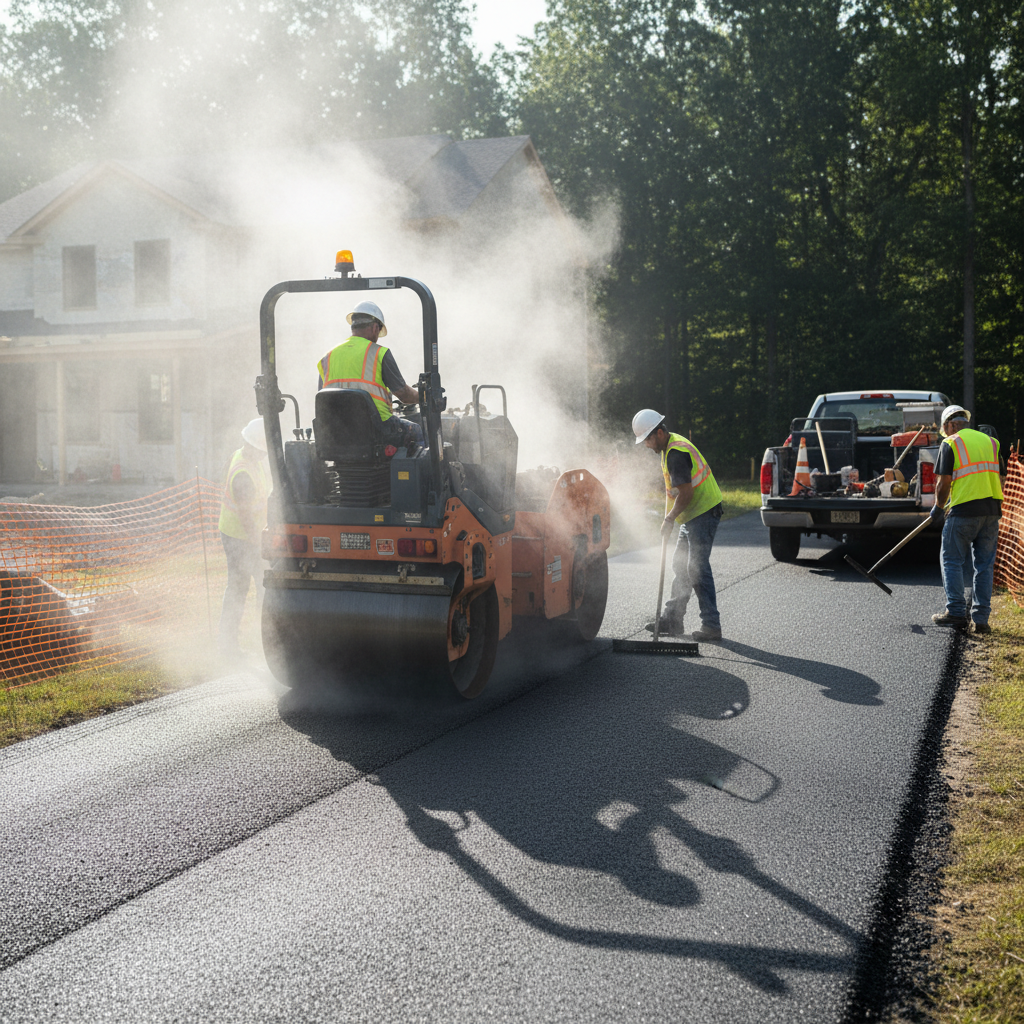
Driveway paving options and costs in Mattawa
Mattawa homeowners typically have a straightforward choice: build a new driveway surface, overlay what you have, or upgrade to a premium finish that handles northern winters better. In Mattawa, most housing stock is single-detached (69.2% of dwellings), and a large share of households are owner-occupied (64.9% of households own). That combination usually means driveways are a long-term investment, not a temporary fix.
Pricing in this area is shaped less by “material price” and more by how the Northeast climate punishes thin bases. Freeze–thaw cycles and deeper frost penetration mean contractors must excavate deeper, compact thicker granular lifts, and manage drainage carefully to reduce frost heave and surface cracking. On top of that, the effective paving season is shorter: hot-mix asphalt generally requires warmer, dry conditions (often air temperatures above 10°C), so crews may charge a scheduling premium for tight spring/summer windows. Availability can also be limited due to freight and labour constraints serving smaller northern communities.
In Mattawa, this work is especially in demand around established residential pockets like the downtown/core access roads where driveways see frequent plowing and heavier vehicle traffic. Once the base and drainage plan is set, the “right” finish depends on budget, how long you want to keep patching, and how important curb appeal is. Use the ranges below to compare your options before you request an itemised quote.
| Material |
Lifespan |
Maintenance |
Best For |
Price per sq ft |
Price Range |
| Asphalt (new installation, proper base) |
15–25 years |
Seal every 3–5 years |
Best all-around value with good base prep |
$6.00 – $10.00 |
$4,500 – $8,500 |
| Asphalt (overlay on existing gravel base) |
10–18 years |
Seal every 3–5 years; monitor settling |
When excavation must be limited and base is sound |
$5.50 – $9.00 |
$4,000 – $7,500 |
| Interlocking concrete pavers |
25–35 years |
Spot repairs; re-sand joints as needed |
Premium curb appeal and easy local repairs |
$12.00 – $18.00 |
$8,000 – $16,000 |
| Poured concrete (broom finish) |
20–30 years |
Seal selectively; manage hairline cracks |
Low-maintenance look and firm plow-friendly surface |
$10.00 – $15.00 |
$9,000 – $18,000 |
| Exposed aggregate concrete |
20–30 years |
Reseal occasionally; crack management |
Slip-resistant texture and a more decorative finish |
$12.00 – $18.00 |
$11,000 – $20,000 |
| Gravel / crushed stone (budget option) |
5–10 years (varies widely) |
Regrade and top up annually |
Short-term solution or waiting for a larger build |
$3.00 – $6.00 |
$2,500 – $6,000 |
Prices are estimates only and vary by project scope, site access and material selection.
What affects the price of paving in Mattawa
In Mattawa and across Northeastern Ontario, two contractors can quote the “same” driveway and still be 30–50% apart. The gap usually comes down to what’s included: excavation depth, subgrade treatment, drainage correction, haul-away, compaction testing, and the type of asphalt mix or concrete finishing used to survive freeze–thaw cycles. Contractors who price only surface materials can look cheaper at first, but they may carry more risk of early cracking or rutting—especially on older properties where the base may have settled over decades. With many homes built before 1981 (78.9%), it’s common to find compromised grading, poor ditching, and previous repairs that need to be uncovered before a proper rebuild.
In the Northeast economic context, deep frost and repeated freeze–thaw drives cost because frost heave control requires a thicker, well-compacted granular base. In many colder inland designs, that can mean substantially more granular thickness than you’d see in milder coastal regions. Even when the asphalt surface cost sits in the $4,500–$8,500 asphalt band, the underlying excavation and drainage work can push the total higher—especially if water needs to be redirected or if you’re dealing with a weak subgrade that requires geotextile, thicker lifts, or insulation in problem zones.
Concrete can swing too. For example, a broom-finished poured driveway that’s properly air-entrained and correctly jointed may land near the lower end of the $9,000–$18,000 concrete band, but if reinforcement, additional base depth, or extensive tear-out is required, it moves upward quickly. Overlaying asphalt over gravel may look like a savings move, yet if the base is unstable, long-term performance suffers and you can end up paying for repeated repairs.
| Price Factor |
Why It Matters |
Cost Impact |
| Driveway area in sq ft |
More surface area means more hot-mix, stone, and labour time. |
Major (often 50–70% of total cost) |
| Base depth required |
Deeper frost risk requires thicker, compacted granular lifts to resist heaving. |
Major (can change total by 15–30%) |
| Grading and drainage work |
Correct slope and add positive drainage to keep water from saturating the base. |
High (typically +10–25% when extensive) |
| Tear-out of existing surface |
Breaking, hauling, and disposing concrete/asphalt adds equipment and disposal fees. |
Medium to high (+8–20%) |
| Edge restraints and curbing |
Prevents paver spread and holds asphalt/corners square under plowing loads. |
Medium (+3–12%) |
| Sealing requirement |
Asphalt performance improves when sealed after the curing window (often 6–12 months). |
Low to medium (+$400–$1,800 later, project-dependent) |
| Site access |
Tight lots slow equipment movement and can require extra handling time. |
Medium (+5–15%) |
| Asphalt mix specifications |
Freeze–thaw-rated mixes cost more but reduce early cracking and surface breakdown. |
Medium (+5–15%) |
Permits & regulations in Ontario
For a private driveway in Mattawa, most paving on your own property typically does not trigger a building permit. In practice, if you’re resurfacing an existing driveway within your lot limits and you’re not changing how stormwater is managed, you usually won’t need municipal approval. However, work that affects the municipal right-of-way is where requirements commonly start. That includes new curb cuts, any change to boulevard/road-edge conditions, or alterations to storm drainage that could redirect water toward neighbouring properties or municipal infrastructure.
Homeowners should also consider lot-grading and drainage rules. Some municipalities have bylaws that restrict how close hard surfaces can be to property lines or require that surface drainage flows in a specific manner. Even when no permit is required, contractors should still document your drainage plan so the project doesn’t create ponding or erosion problems.
Before any excavation, call for utility locates through Ontario One Call so service marks are identified. Then, verify your contractor the practical way: first, check their Ontario business/licence status (or the relevant trade registration if applicable) using the appropriate online registry; second, request a current certificate of liability insurance showing your property as an insured/affected party where possible; and third, confirm WSIB coverage (or provide the correct proof of coverage status). Ask for a clearance letter if the contractor is required to provide one. A reputable contractor in Mattawa will provide these documents before work starts.
Asphalt vs pavers vs concrete for Mattawa driveways
For Mattawa’s freeze–thaw winters, the “best” driveway material is the one that matches your tolerance for maintenance and repairs while resisting frost-driven movement. Asphalt usually has the lowest upfront cost and can look clean with a smooth finish, but it performs best when sealed regularly—think every 3–5 years—so water doesn’t penetrate and accelerate cracking. In a Northeast freeze–thaw environment, asphalt also depends on correct base thickness and proper drainage more than many homeowners expect.
Interlocking concrete pavers cost the most up front, but they’re forgiving when things shift. If a section settles, crews can lift and re-level only the affected area instead of replacing the entire slab or widening the distressed zone. That repairability matters in Mattawa where older homes (78.9% built before 1981) may have inconsistent subgrade and past patches.
Poured concrete sits mid-range and can be durable if it’s air-entrained, properly jointed, and finished for traction. Still, concrete is more susceptible to hairline cracking when freeze–thaw stresses exceed what the base and jointing were designed for, and de-icing habits can accelerate surface wear if the mix is not appropriate.
Where you may see justified differences: a properly built asphalt driveway often fits the $4,500–$8,500 band, while pavers commonly land in the $8,000–$16,000 band. If your driveway gets heavy plow traffic, has minor base movement, or you value long-term curb appeal, pavers can be worth the premium. If you’re focused on managing winter costs and you’re willing to seal asphalt on schedule, asphalt is typically the better value.
| Material |
Frost Resistance |
Curb Appeal |
Repair Method |
Lifespan |
Price Band |
| Asphalt (sealed regularly) |
Good with thick base and drainage |
Moderate (clean, smooth finish) |
Mill/patch or overlay distressed areas |
15–25 years |
$4,500 – $8,500 |
| Interlocking concrete pavers |
Very good (flexible surface over base) |
High (custom patterns/colours) |
Remove & re-set individual stones |
25–35 years |
$8,000 – $16,000 |
| Poured concrete (air-entrained) |
Good when air-entrained and jointed |
Moderate to high |
Spot repair with patching/grout; sometimes section replacement |
20–30 years |
$9,000 – $18,000 |
| Exposed aggregate concrete |
Good (texture helps traction) |
High (decorative finish) |
Patch/crack repair is possible but more visible |
20–30 years |
$11,000 – $20,000 |
| Permeable pavers (drainage grid) |
Very good when installed over engineered drainage |
High (functional + attractive) |
Lift and re-level panels; repair grid connections if needed |
25+ years (system-dependent) |
$10,000 – $20,000 |
| Chip seal / tar-and-chip |
Fair to good (depends on base and placement) |
Low to moderate |
Top-up aggregate; occasional re-seal |
7–15 years |
$3,500 – $7,000 |
How to choose a paving contractor in Mattawa
Choosing the right contractor matters in Mattawa because the winters are hard on thin bases. Start by verifying Ontario licensing/registration for the trade and confirm they carry liability insurance that’s current (request the certificate and check dates). For workers, ask how they handle WSIB/WCB coverage—then confirm through the proper clearance documentation if required. Don’t accept “we’re covered” as a statement; request proof, and make sure it matches the legal company name on the quote.
Next, get 2–3 itemised written quotes. Ideally, each quote should break down labour and materials separately and describe scope items like excavation depth, base type and thickness, whether geotextile is included, how drainage will be corrected, and what exact surface finish you’re paying for (asphalt thickness and concrete finish type). Ask whether permit or municipal approval work—if it’s triggered for right-of-way changes—is included. Confirm disposal is included for removed asphalt or concrete, along with topsoil restoration if applicable.
Warranty should be clear: ask for workmanship warranty length (often the first target window for settlement and edge issues), whether the product/manufacturer warranty applies to materials used, and whether it’s transferable to future owners. For payment, keep it practical—never pay more than about 10–15% upfront and hold back until the job is substantially complete and the base/finishing is verified. Finally, request a start date and completion timeline in writing so weather delays and mobilization risk are understood upfront.
- Confirm Ontario trade/licence status and ensure the legal name matches the quote.
- Request a current certificate of liability insurance (with coverage limits) before signing.
- Verify WSIB/WCB coverage status with documented proof/clearance, not verbal reassurance.
- Ask for an itemised breakdown: excavation, base materials, paving, sealing, and compaction.
- Require the quote to state the asphalt/concrete thickness and the granular base depth.
- Confirm drainage plan: slope targets and how water will be routed away from the garage/house.
- Check whether geotextile, insulation, or additional base is included for unstable soils.
- Ask what happens to existing material: tear-out limits, hauling, and disposal fees included?
- For asphalt, confirm sealing timing (often after cure, commonly 6–12 months) and who does it.
- Confirm edge restraints/curbing are included where required to prevent paver spread.
- Get warranty details in writing: workmanship coverage, product coverage, and exclusions.
- Set a payment schedule with a holdback and define acceptance criteria for completion.
In Mattawa, common contractor red flags include: quotes that don’t specify base depth or compaction methods, promises to “skip drainage” to save money, missing insurance/coverage documentation, vague warranty language, and schedules that rely on paving in unsafe weather without contingencies for short seasons.
Frequently asked questions — paving in Mattawa
How do I maintain my driveway through Mattawa winters?
In Ontario winters around Mattawa, maintenance is mostly about managing water and preventing surface damage. Keep an eye on drainage ditches/side slopes so meltwater doesn’t pool near the driveway edge—this is one of the biggest causes of base saturation and spring soft spots. During plowing, avoid gouging: keep blade heights appropriate and don’t scrape the edges aggressively, especially on paver joints or asphalt corners. For asphalt, use de-icers sparingly; heavy salt application can accelerate surface wear over time. If you’re still within your first season, plan your sealing after the driveway has cured (commonly after 6–12 months for asphalt), which helps resist water penetration that fuels freeze–thaw cracking.
Is it worth sealing a new driveway right away in Mattawa?
Typically, you should not seal immediately after paving. New asphalt needs time to cure so the sealant bonds properly and doesn’t trap excess moisture. In Mattawa, that matters even more because freeze–thaw cycles can magnify early failures if water is trapped under the surface. A common approach is to wait roughly 6–12 months depending on weather and the specific mix. If you’re budgeting, sealing is usually an added line item that can fall within the $400–$1,800 range depending on driveway size and material. That said, sealing is often worth it because it extends the life of asphalt—helping you avoid deeper repairs that cost far more than a seal coat.
What is a chip seal driveway and is it suited to Mattawa?
Chip seal (tar-and-chip) is an asphalt binder sprayed onto the surface with aggregate broadcast over top, then rolled. It can be a practical choice for certain properties where you want a lower-cost, quicker-build surface—often sitting below typical full paving costs. In Mattawa’s freeze–thaw climate, chip seal can perform well when the base is correctly prepared and the surface is kept in good condition, but it generally isn’t as “premium” as new asphalt or pavers for long-term crispness. You can expect periodic maintenance such as adding aggregate to address wear. If your driveway sees heavy vehicle traffic, frequent plowing, or existing drainage problems, a full asphalt rebuild in the $4,500–$8,500 band or a more structured solution may last longer with fewer interventions.
How much does driveway crack repair cost in Mattawa?
Crack repair cost depends on whether you’re filling hairline cracks, sealing wider separations, or addressing a localized base issue. In Mattawa, small surface cracks are usually treated with cleaning and crack sealing; wider failures may require a mill-and-patch section to prevent the problem from spreading. As a rough budgeting lens, minor repairs are often a fraction of full paving, but if the crack is tied to drainage or weak base, the repair bill grows because the contractor must remove and rebuild a section properly. Many homeowners find it more economical to schedule maintenance early than wait until cracking transitions into raveling or potholes. If your goal is to compare across quote options, ask for an itemised quote that includes base assessment—not just a top-surface fill.
What base thickness do I need for pavers in Mattawa?
Paver base thickness isn’t one-size-fits-all in Mattawa; it’s driven by subgrade condition, drainage, and local frost behavior. The core idea for freeze–thaw is that you need enough compacted granular depth to resist movement and heaving, not just enough stone to cover mud. In practice, many installations involve removing unsuitable topsoil, building a compacted granular base in thicker lifts, and using bedding sand designed for paver joint stability. If the soil is soft or water collects, expect increased excavation and base depth (and sometimes geotextile or insulation strategies) to reach a more stable frost-resistant section. Ask your contractor to specify the granular layers (base vs bedding) and compaction targets in writing.
How do I get the most accurate paving quote in Mattawa?
To get the most accurate quote in Mattawa, start by asking for an on-site assessment rather than a phone estimate. Provide driveway measurements and photos of problem areas, but let the contractor verify base condition, drainage, and what needs tear-out. Request itemised pricing that clearly lists excavation depth, base thickness, materials, disposal, and finishing steps. For asphalt, ask what thickness and mix design they plan to use and whether sealing is included or scheduled after cure. For concrete, confirm air-entrainment and whether joints/reinforcement are part of the scope. A good comparison is to check whether the quote lands within a realistic band—commonly $4,500–$8,500 for asphalt and $9,000–$18,000 for poured concrete—while still being specific about scope. Finally, ensure insurance and WSIB coverage proof is available before the job begins.