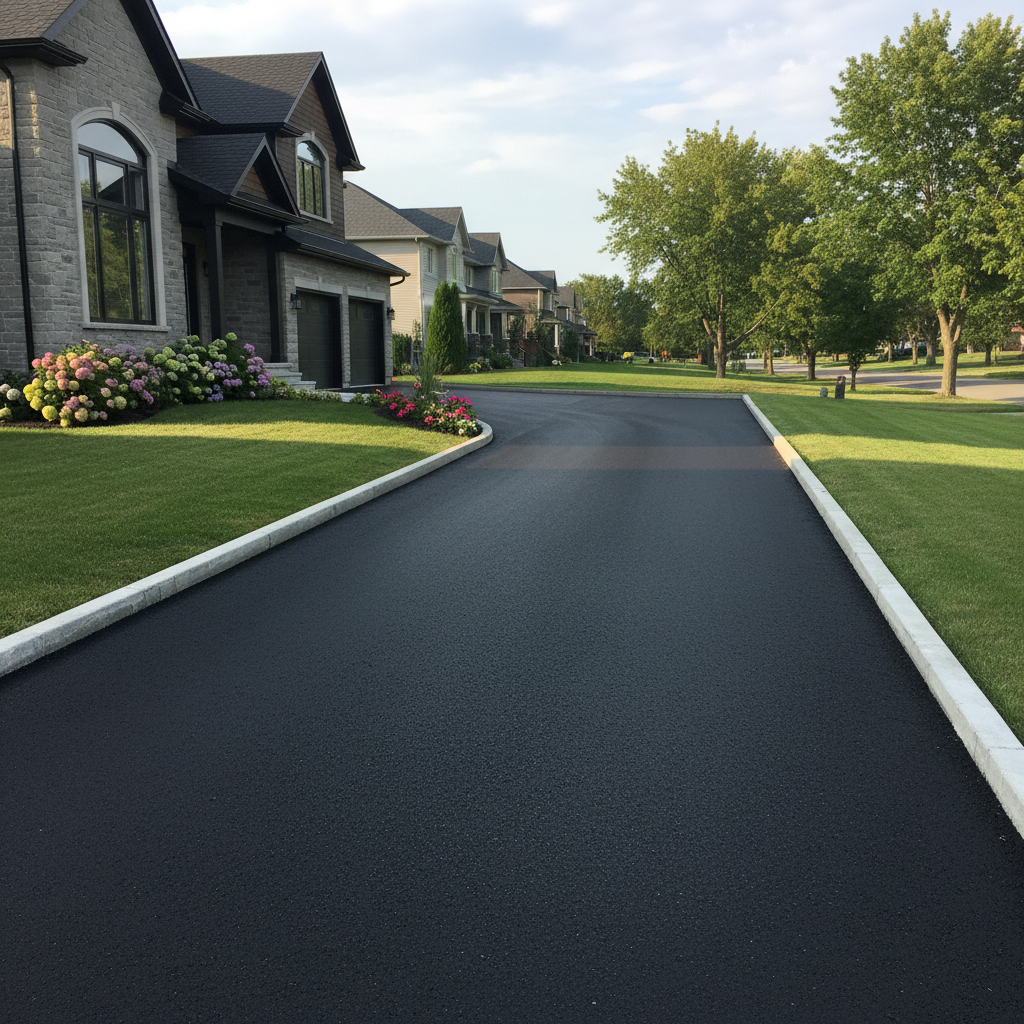
Driveway paving options and costs in Pembroke
Pembroke homeowners typically choose between asphalt, interlocking pavers, and concrete because driveways here get hammered by freeze–thaw cycles. With 57.8% of dwellings being single-detached homes (Statistics Canada, 2021 Census), there’s a steady demand for private driveway work—many properties have long rural approaches or older lanes that need a full rebuild, not just a surface top-up. In the Kingston–Pembroke economic region, pricing is shaped heavily by climate and soil: frost penetration is commonly around 4 feet (about 1.2 m), and spring shoulder seasons are wet. That means contractors spend more time on deep granular base, tight compaction, and drainage (ditches/swales and sometimes French drains) to limit heaving and later cracking.
It also affects contractor availability. Hot-mix asphalt requires air temperatures above 10°C, and the paving window tightens when daytime warmth is inconsistent—especially in early spring. In demand pockets, crews can be booked farther out, which can push pricing toward the upper end of the local bands. In Pembroke, work is especially common in areas with older housing stock—many driveways near Pembroke’s West End see rebuilds because homes built before 1981 make up 73.3% of dwellings (Statistics Canada, 2021 Census). When that older subgrade is clay or mixed fill, you often pay more for excavation and imported aggregate to reach below frost influence.
Use the comparison below as a budgeting baseline, then match the material to your base quality and drainage plan.
| Material |
Lifespan |
Maintenance |
Best For |
Price per sq ft |
Price Range |
| Asphalt (new installation, proper base) |
15–25 years |
Seal coat after 6–12 months, then every 3–5 years |
Best blend of cost and performance with good drainage |
$5.00–$8.50 |
$4,500–$9,000 |
| Asphalt (overlay on existing gravel base) |
8–15 years |
Earlier patching; seal when surface is stable |
When the base is solid and you’re limiting excavation |
$4.25–$7.25 |
$4,000–$8,000 |
| Interlocking concrete pavers |
25–40 years |
Weed control; re-leveling of individual stones if needed |
Curb appeal and easy repairs without full replacement |
$10.00–$16.50 |
$6,500–$14,000 |
| Poured concrete (broom finish) |
25–35 years |
Minor crack sealing as needed (after curing and stabilization) |
Low maintenance surface with a clean, modern look |
$9.00–$15.00 |
$7,000–$15,000 |
| Exposed aggregate concrete |
20–30 years |
Sealer may be recommended; patch cracks promptly |
Slip resistance and decorative appearance |
$10.50–$17.50 |
$8,000–$16,500 |
| Gravel / crushed stone (budget option) |
3–8 years |
Top-ups, grading, weed control |
Shortest payback when you’re not ready for paving |
$2.25–$4.50 |
$3,000–$6,000 |
Prices are estimates only and vary by project scope, site access and material selection.
What affects the price of paving in Pembroke
In Pembroke—and across the Kingston–Pembroke region—two driveways that look identical can land 30–50% apart in cost because the “hidden” work changes: excavation depth, subgrade quality, drainage repairs, and how much base material must be imported and hauled. In colder Ontario markets like this one, you’re not just buying asphalt or concrete; you’re buying the granular system beneath it that resists frost heave. That’s why a premium quote often reflects a bigger base and better drainage plan, not just higher labour rates.
Frost line depth and freeze–thaw cycles are decisive here. With frost penetration commonly around 4 feet (about 1.2 m), driveways typically need a deeper, well-compacted granular base so water can’t sit and expand during freeze. In practical terms, many Ontario installs come in with roughly 6–12 inches of engineered granular thickness above the native subgrade (exact design depends on soil). If the excavation is cut short, you can see cracking, raveling, and settlement earlier—meaning more patching later. Concrete also benefits from robust drainage and correct build-up; otherwise, the freeze–thaw pressure works through weak spots.
Concrete examples in Pembroke: an older lot with clay pockets often requires extra undercut and replacement, raising concrete costs because the contractor has to haul more stone and compact more lifts. On the other hand, if you’re overlaying asphalt in an area where the existing gravel base is already stable, you may stay closer to the lower side of asphalt pricing (often around the $4,500–$9,000 band for full paving). The paving season is also shorter—hot-mix asphalt generally needs air temperatures above 10°C—so scheduling pressure in spring can lift labour and mobilization costs even when materials prices are steady.
| Price Factor |
Why It Matters |
Cost Impact |
| Driveway area in sq ft |
Materials and paving labour scale mainly with surface area |
Often the biggest driver of total cost (can change the quote by thousands) |
| Base depth required |
Frost line determines granular thickness to limit heaving/cracking |
More excavation/imports can add substantial cost |
| Grading and drainage work |
Slope correction, ditching/swales, and French drains manage water |
Can swing the job by 10–25% depending on how much drainage is needed |
| Tear-out of existing surface |
Breaking, hauling, and disposal for old asphalt/concrete |
Disposal + equipment time commonly increases the estimate |
| Edge restraints and curbing |
Prevents paver spread or concrete edge failure |
Adds material and labour but reduces long-term movement |
| Sealing requirement |
Asphalt benefits from sealing after 6–12 months to slow oxidation/raveling |
Typically adds a planned maintenance cost within 1 year |
| Site access |
Narrow gates, slopes, or long runs slow equipment and affect haul time |
Can add mobilization time and higher equipment costs |
| Asphalt mix specifications |
Freeze-thaw-rated mixes help resist cracking/raveling in Ontario winters |
Better mix design often costs more but performs better |
Permits & regulations in Ontario
For a Pembroke homeowner, paving work usually falls into two categories: work within your own property limits (typically no building permit) versus work that affects municipal infrastructure. In most cases, paving your private driveway on your property does not require a building permit because you’re improving your own hard surface. However, work in the municipal right-of-way can require municipal approval—this includes creating or changing curb cuts, altering the boulevard, or making changes that affect storm drainage and runoff direction. If your driveway ties into an area where municipal drainage patterns matter, confirm requirements before excavation.
Even when permits aren’t required, do not start digging until you have utility locates. In Ontario, call Ontario One Call so underground services can be marked. After the locate, verify any lot-grading rules or hard-surface restrictions with the local municipality, because some communities regulate how close grading and surfaces can be to property lines and ditches to manage runoff.
To verify a contractor’s credentials in Ontario, follow a simple checklist: (1) confirm the contractor’s business details and any applicable Ontario registration, (2) request a current certificate of liability insurance showing adequate coverage for your job, (3) ask for proof of WSIB clearance (or confirm coverage status and documentation), and (4) verify the work is actually insured and not subcontracted without coverage. A reputable contractor will provide documentation before mobilizing and will be clear about who is responsible for disposal and any restoration in disturbed areas.
Asphalt vs pavers vs concrete for Pembroke driveways
In Pembroke’s Kingston–Pembroke freeze–thaw climate, the “right” choice comes down to how you want to balance upfront cost, long-term durability, and maintenance through winter. Asphalt usually has the lowest upfront cost, and when it’s installed with a deep, compacted base and good drainage, it performs well. The trade-off is that asphalt needs sealing after the first 6–12 months and then roughly every 3–5 years; salt and moisture make that maintenance more important here. In pricing terms, many homeowners budget within the asphalt driveway paving band of $4,500–$9,000, depending on excavation and drainage complexity.
Interlocking concrete pavers have the highest upfront cost, but they’re repairable: when a section settles or a spot fails, contractors can lift and re-lay individual stones instead of tearing out the whole surface. That’s a big advantage when you have drainage issues or subgrade variability—common in older properties like those built before 1981. Interlock typically lands around $6,500–$14,000, but that extra can be justified when curb appeal matters and you want localized repairs after winter. Poured concrete is mid-range and can be very durable when it’s properly air-entrained and finished for slip resistance; however, it’s more vulnerable to cracking if joints, base prep, or drainage aren’t done correctly. For the local winter routine—plowing plus sand/salt—concrete needs the right mix design and drainage to limit trapped water under slabs.
For most Kingston–Pembroke driveways, base preparation is the make-or-break step: deep, compacted granular layers and effective runoff control. Where the base is questionable, pavers often have the edge for future repair. Where you want a clean, straightforward surface and can maintain it properly, asphalt can be the best value; where you want maximum rigidity and longevity with correct construction, air-entrained concrete is strong.
Example: if your driveway needs drainage correction and deeper base, asphalt might start nearer $4,500–$9,000, while pavers can move closer to $6,500–$14,000. The difference is worth it when you want easy, section-level repairs after a freeze–thaw event rather than full resurfacing later.
| Material |
Frost Resistance |
Curb Appeal |
Repair Method |
Lifespan |
Price Band |
| Asphalt (sealed regularly) |
Good with deep base + proper drainage |
Medium (can be upgraded with edging) |
Patching/routing and re-sealing |
15–25 years |
$4,500–$9,000 |
| Interlocking concrete pavers |
Excellent when base is engineered and drained |
High (colour/pattern options) |
Lift-and-replace individual blocks |
25–40 years |
$6,500–$14,000 |
| Poured concrete (air-entrained) |
Good to excellent with proper mix and joints |
Medium (clean, uniform finish) |
Crack sealing; patching at joints |
25–35 years |
$7,000–$15,000 |
| Exposed aggregate concrete |
Good with correct base and drainage |
High (decorative, textured finish) |
Surface patching; crack sealing |
20–30 years |
$8,000–$16,500 |
| Permeable pavers (drainage grid) |
Good with engineered drainage layer below |
High (modern look) |
Individual block replacement and drain inspection |
25–35 years |
$9,000–$17,000 |
| Chip seal / tar-and-chip |
Moderate; depends on base and binder quality |
Low to medium (more utilitarian) |
Spot repairs; re-chip as needed |
6–12 years |
$4,000–$7,500 |
How to choose a paving contractor in Pembroke
Choosing the right contractor in Pembroke is mostly about paperwork plus details. Start by verifying Ontario requirements and coverage. Ask for proof of liability insurance (a current certificate of insurance with your project/address listed where applicable). Next, confirm WSIB/WCB coverage documentation: in Ontario, you want to see whether the contractor carries WSIB coverage and a clearance letter/status report you can keep for your records. If they won’t provide it, treat that as a serious warning. Also request the contractor’s business registration details so you know who is actually responsible if something goes wrong.
Then get 2–3 itemised, written quotes—not one-page estimates. The best quotes break down labour and materials separately (excavation, hauling/disposal, granular base, asphalt/concrete/pavers, edge restraints, compaction, and finishing/sealing). Check what’s excluded: disposal fees, snow removal during the work window, utility locating, permit/municipal approval handling (if required), and site restoration like topsoil/seed or sod beyond the paved area. For warranty, separate workmanship from product/manufacturer terms; ask how long the contractor stands behind grading/compaction and paving installation, and whether the warranty transfers to you if you sell the home.
For payment, never let a contract demand full payment upfront—aim for no more than 10–15% upfront, with a holdback until completion and punch-list items are fixed. Finally, insist on a written schedule with a start date window and an estimated completion date so you can plan around Pembroke’s spring weather and short paving season.
- Confirm WSIB clearance/status and keep the documentation.
- Request a current certificate of liability insurance before work begins.
- Ask who will do the excavation, compaction, and paving (no vague “we’ll handle it”).
- Get quotes itemized by base, surfacing, and edging/curbing—not just “driveway paving.”
- Verify disposal/haul-away is included for old asphalt or concrete tear-outs.
- Ensure utility locates are included or confirmed with Ontario One Call.
- Check drainage scope: ditching/swale/French drain work, not just “we’ll pave.”
- For asphalt, ask when the seal coat will be applied and whether it’s included.
- For pavers, ask about edge restraints, polymeric sand (if used), and re-stoning policy.
- Confirm compaction method (plate compaction/roller details) and lift thickness.
- Require start date and completion estimate in writing (seasonal weather affects timing).
- Read warranty terms in plain language, including exclusions for de-icing damage.
Red flags I see in Pembroke: contractors who refuse to show WSIB/liability paperwork, vague quotes that don’t list base thickness and drainage scope, promises of “cheapest” pricing without explaining excavation/haul costs, no written schedule for a short paving window, and pressure to pay most of the money upfront before compaction and base inspection.
Frequently asked questions — paving in Pembroke
How do I maintain my driveway through Pembroke winters?
In Pembroke and across Ontario, winter maintenance is about reducing trapped moisture and avoiding damage that speeds up deterioration—especially for asphalt. Start by keeping the surface clear during and after plowing; don’t let a deep snow bank sit against one side, because meltwater can funnel into low spots and worsen freeze–thaw heaving. For asphalt, use sand or a moderate amount of de-icer rather than heavy salt blasting, and avoid scraping with sharp metal blades that gouge the surface. If you have pavers, maintain the joint sand so stones stay locked, and fix any washing-out spot before it grows. For concrete, crack sealing early and prompt patch repairs help prevent water migration under the slab. If your driveway is older or built on clay pockets, schedule a spring inspection—small drainage issues become big problems quickly after multiple freeze–thaw cycles. (Statistics Canada, 2021 Census)
Is it worth sealing a new driveway right away in Pembroke?
For asphalt in Pembroke, sealing is usually worth it, but timing matters. Most reputable crews apply a seal coat after the asphalt has had time to cure and dry—commonly within the first 6–12 months, not immediately the same week as paving. Sealing helps slow oxidation and surface raveling caused by winter moisture and tire wear, and it complements a proper granular base and drainage design (the base is what protects you from frost heave). If you’re budgeting, asphalt new installs typically fall in the $4,500–$9,000 range, and sealing is a cost you should plan for in that first year. Ask your contractor whether sealing is included, what product they use, and what weather conditions they require so you don’t end up sealing too early (which can trap moisture).
What is a chip seal driveway and is it suited to Pembroke?
A chip seal (tar-and-chip) is an asphalt binder sprayed on the surface, followed by aggregate chips compacted into place. It’s sometimes chosen for budget driveway repairs because it’s quicker than full paving, and it can be a practical option when you’re trying to improve an existing gravel approach without full reconstruction. That said, in Pembroke’s freeze–thaw conditions, chip seal performance depends heavily on the base quality and binder rates. If drainage is poor or the base is unstable, chips can loosen and the surface can ravel sooner than homeowners expect. In the Kingston–Pembroke region, chip seal is best treated as a shorter-term improvement compared with new asphalt paving, with typical budgeting often landing around the $4,000–$7,500 band. If you want a longer warranty-like outcome and fewer touch-ups, asphalt or pavers with proper base prep are usually the safer long-term bet.
How much does driveway crack repair cost in Pembroke?
Crack repair pricing varies by crack width, length, depth, and whether it’s a surface crack or a reflection crack tied to base movement. In Pembroke, the freeze–thaw cycle can open cracks in spring and widen them after repeated cycles, so early sealing is usually cheaper than waiting for edges to break and ravel. For budgeting, many homeowners see repairs in the local “sealing & repair” range of $400–$1,800, with higher costs when prep is more involved (routing, cleaning, and hauling away failed material). If your asphalt is near the end of its life, repair may only be a temporary fix and a resurfacing plan could be more cost-effective. A good contractor should identify whether the issue is cosmetic or structural by checking drainage and the surrounding base condition before recommending repair.
What base thickness do I need for pavers in Pembroke?
For pavers in Pembroke, base thickness needs to resist frost movement and keep water from saturating the subgrade. While exact design depends on soil condition and your frost/heave risk, the general approach in Ontario frost environments is to excavate deeper than many homeowners expect and rebuild with compacted granular layers. Many installs target a combined engineered granular thickness roughly in the 6–12 inches range above native subgrade (with additional excavation/replacement where clay pockets or poor subgrade exist). Proper grading and drainage matter as much as thickness—if water ponds, frost action will still push upward. After base, you typically install a bedding layer (often a sand setting layer) and then edge restraints so the pavers can’t spread. Your contractor should explain how they determined thickness—through site assessment and excavation scope—rather than using the same build-up for every property.
How do I get the most accurate paving quote in Pembroke?
To get an accurate quote in Pembroke, start by making sure the contractor measures and documents the work area and existing conditions, not just “eyeballs” the driveway. Ask for a site visit that includes checking drainage patterns, slope, and signs of soft subgrade. Ensure utility locates are planned before excavation. When you request quotes, insist on itemized breakdowns: excavation/undercut and disposal, granular base thickness and compaction, whether drainage corrections (ditches/swales/French drain) are included, edge restraints/curbing, and the finishing details (including asphalt seal timing after 6–12 months if applicable). In budgeting terms, you can reference that full asphalt paving often sits around $4,500–$9,000, while pavers typically run higher at $6,500–$14,000; a quote should show why you’re in the low or high end. Finally, request the timeline in writing because Pembroke’s paving window is narrower, and delays can change costs and scheduling.