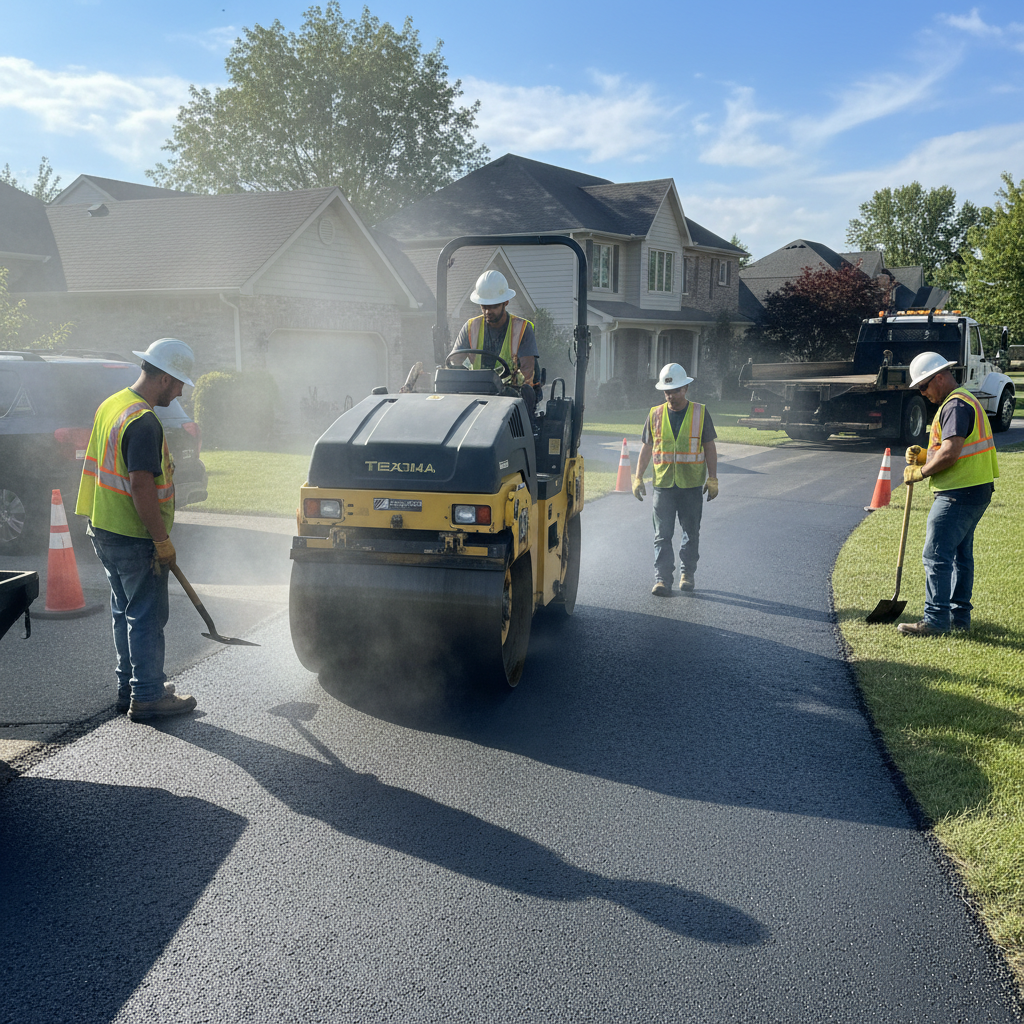
Driveway paving options and costs in Fort Frances
Fort Frances homeowners typically have three practical driveway paths—new asphalt, interlocking pavers, or concrete—with pricing tied directly to how much base and drainage work your site needs. Because 77.2% of local dwellings are single-detached homes, most private driveways are sized for detached-lot access and a standard residential footprint (Statistics Canada, 2021 Census). That matters because small changes in area, base depth, and tear-out can move the total project cost quickly. Also, Fort Frances has an older housing stock—74.6% of homes were built before 1981—which often means more likely settlement, poor drainage, and existing materials (old asphalt or gravel) that require additional prep before any new surface will last.
In the Northwest, pavement design is dominated by deep frost penetration and frequent freeze–thaw. Contractors commonly plan around roughly a 4-foot minimum protection mindset, which translates into thicker granular base and tighter compaction control. You’ll also feel it in the schedule: Fort Frances paving happens in a shorter window late spring through early fall, so mobilization and crew availability can be more limited than southern Ontario. If your soil is clay or holds water, expect additional grading, subdrainage, or upgraded base stone—these are the jobs that cost more now but prevent surface breakup later.
For planning, use the ranges below to compare options for a properly built driveway and then verify what your site requires with an itemized quote—see the cost table next.
| Material |
Lifespan |
Maintenance |
Best For |
Price per sq ft |
| Asphalt (new installation, proper base) |
15–25 years |
Sealcoat every 3–5 years; patching as needed |
Best value where subgrade drainage and base are done right |
$7,00 – $14,50 |
| Asphalt (overlay on existing gravel base) |
10–18 years |
Higher patch frequency; sealcoat every 3–5 years |
When the gravel base is stable and well-drained |
$6,50 – $12,50 |
| Interlocking concrete pavers |
25–40 years |
Re-sand joints; replace units individually |
Curb appeal and easier repairs without full replacement |
$18,00 – $35,00 |
| Poured concrete (broom finish) |
25–35 years |
Seal (if desired); crack control monitoring |
Clean, low-fuss look with good base preparation |
$14,00 – $28,00 |
| Exposed aggregate concrete |
25–35 years |
Seal periodically; minor joint/crack upkeep |
Better traction in snow/ice and a premium finish |
$16,00 – $32,00 |
| Gravel / crushed stone (budget option) |
3–8 years |
Re-grade and add stone yearly or seasonally |
Temporary solution or overflow parking |
$4,00 – $8,00 |
Prices are estimates only and vary by project scope, site access and material selection.
What affects the price of paving in Fort Frances
In Fort Frances and across Northwestern Ontario, it’s common to see the “same” driveway quote differ by 30–50% once the site realities are accounted for. A smaller driveway footprint can seem like a savings, but if your existing surface is failing due to poor drainage or frost movement, the prep work (base rebuild, grading, hauling, and disposal) drives the cost more than the paving material itself.
Two decisive factors are frost protection and freeze–thaw performance. When frost penetration is deep, contractors need thicker, well-compacted granular base to reduce heaving and cracking. In colder inland zones like ours, that often means base and subbase work in the 4–6 inch range for the asphalt layer plus additional granular thickness depending on your soil; more challenging clay can push designs toward the higher end and sometimes deeper base builds (local practice typically targets about 4 feet as a protection mindset, with extreme areas requiring deeper footing/base designs). Asphalt mix design also matters: freeze–thaw-rated mixes and appropriate binder choices cost more than generic asphalt.
Then there’s the shorter paving season. Hot-mix asphalt relies on workable temperatures (air and mat temps need to be high enough for compaction), so scheduling pressure can raise mobilization costs and limit the number of available crews in spring. Concrete jobs need proper air entrainment and curing practices to handle winter moisture and ice movement.
Concrete examples: if you have to tear out and haul away existing slabs, disposal and breaking cost increases quickly; if the subgrade is clay, you may need more granular replacement or improved drainage, which can also add hundreds to thousands of dollars. Where costs are lower—such as asphalt installed over a stable, well-drained gravel base—the per-square-foot number may fall toward the local asphalt band around $7–$14, while full paver builds often land in the higher range around $18–$35 because of excavation depth, bedding layers, and restraint work.
| Price Factor |
Why It Matters |
Cost Impact |
| Driveway area in sq ft |
Most labour and material quantities scale directly with surface area |
High (primary driver; small area changes matter) |
| Base depth required |
Frost protection depends on compacted granular thickness and stone quality |
High (thicker base can add major excavation/haul cost) |
| Grading and drainage work |
Slope, ditching, and water routing prevent freeze–thaw saturation |
Medium to high (more earthwork and sometimes subdrain) |
| Tear-out of existing surface |
Concrete breaking or asphalt removal requires equipment and disposal |
Medium to high (can add days and trucking) |
| Edge restraints and curbing |
Prevents paver spread and asphalt edge deterioration |
Medium (materials + extra installation time) |
| Sealing requirement |
Asphalt needs sealcoat within a defined window to manage oxidation and water ingress |
Low to medium (often $1–$4 per sq ft for sealing) |
| Site access |
Narrow lots and long pushes slow equipment movement and increase labour |
Medium (extra time for loaders/rollers/skidsteer) |
| Asphalt mix specifications |
Freeze–thaw-rated mixes and appropriate binders hold up better locally |
Medium (higher material cost, better longevity) |
Permits & regulations in Ontario
In Ontario, paving a private driveway on your own property typically does not require a building permit. Most homeowners in Fort Frances are simply upgrading the surface within their lot lines—new asphalt, concrete, or pavers placed on an engineered base—so the work is usually handled as private property improvement. The situation changes when you touch the municipal right-of-way or storm infrastructure.
Work that commonly DOES require municipal approval includes creating or modifying curb cuts, altering the boulevard, changing driveway access that affects municipal curb lines/sidewalk, or any work that impacts storm drainage patterns and outlets. If your grading redirects runoff toward or away from a ditch or culvert that the municipality maintains, expect an approval step. Some areas also have lot-grading rules that limit how close hard surfaces can be to property lines and how water must be directed to avoid nuisance or damage.
What typically does NOT require a permit is repaving within your property limits where you’re not changing the legal access point or drainage connection to municipal systems—assuming the contractor follows utility locating, excavation practices, and local grading requirements.
Step-by-step verification in Fort Frances: (1) Ask the contractor for their Ontario business number and licensing info used for contracting work, plus their WSIB/WCB clearance documentation. (2) Request a certificate of liability insurance—confirm it covers paving/asphalt or concrete work and shows adequate limits for the project. (3) Look for proof of WSIB (or applicable coverage) clearance letter. (4) Before any digging, confirm they book utility locates through Ontario One Call and coordinate locate marks on the day of excavation. You should also request their planned disposal/haul plan for old material and confirm whether permit-related approvals (if needed) are handled by them or by you.
Asphalt vs pavers vs concrete for Fort Frances driveways
Choosing between asphalt, interlocking pavers, and concrete in Fort Frances comes down to three things: upfront budget, how you want repairs handled, and how your driveway will survive freeze–thaw and winter maintenance (plowing, salt/sand, and repeated ice formation). In Northwestern Ontario, frost movement and water saturation are the enemies. That’s why base preparation, drainage, and edge restraint matter as much as the surface choice.
Asphalt is usually the lowest upfront option and suits homeowners who want a smooth, quiet ride and are comfortable with routine maintenance. With sealing every 3–5 years, properly installed asphalt typically performs well; without sealing, water can find its way into joints and voids, accelerating deterioration in freeze–thaw. Interlocking pavers cost more upfront, but they’re repair-friendly—if a section settles, a contractor can lift and re-lay individual units instead of replacing the entire driveway. Poured concrete often lands mid-range and provides a crisp look, but it can crack over time when base preparation and drainage aren’t right. For longevity here, concrete should be air-entrained and placed and cured to withstand winter moisture cycles; otherwise cracking can show up sooner.
In local terms, most clay or poorly drained sites add cost regardless of finish because they need more base and drainage correction. A common example: if asphalt is around $7,00 – $14,50 per sq ft and pavers are around $18,00 – $35,00, the extra paver cost can be justified when you expect utility access, you want easy spot repairs, or you prioritize curb appeal on a long, visible approach. If you’re planning heavy vehicles, long driveway spans, or you want the best balance of winter durability with predictable maintenance, asphalt with the right base and a seal schedule is often the practical pick.
| Material |
Frost Resistance |
Curb Appeal |
Repair Method |
Lifespan |
Price Band |
| Asphalt (sealed regularly) |
Good with thick, compacted granular base and sealing |
Moderate (clean black surface) |
Mill/patch failed areas; seal and resurface as needed |
15–25 years |
$7,00 – $14,50 |
| Interlocking concrete pavers |
Very good when bedding and drainage are correct |
High (variety of patterns and colours) |
Lift and replace individual units; re-sand joints |
25–40 years |
$18,00 – $35,00 |
| Poured concrete (air-entrained) |
Good with air entrainment and well-drained base |
Moderate to high (clean lines) |
Seal and manage cracks; sometimes patch panels |
25–35 years |
$14,00 – $28,00 |
| Exposed aggregate concrete |
Good with proper base and curing |
Very high (textured, slip-resistant look) |
Patch-replace small sections; manage cracks with sealers |
25–35 years |
$16,00 – $32,00 |
| Permeable pavers (drainage grid) |
Very good for water management where design is done right |
High (modern drainage concept) |
Replace affected units; maintain aggregate infill as needed |
20–35 years (depends on system maintenance) |
$20,00 – $40,00 |
| Chip seal / tar-and-chip |
Moderate (best on stable bases; can ravel in heavy traffic) |
Low to moderate |
Spot chip seal over worn areas; recoat cycles |
5–12 years |
$5,00 – $9,50 |
How to choose a paving contractor in Fort Frances
For Fort Frances homeowners, hiring the right paving contractor is about proof and clarity—not just the lowest number. Start by verifying Ontario coverage and professionalism: ask for their Ontario business information, their liability insurance certificate (and ensure it covers paving/asphalt/concrete work), and their WSIB/WCB clearance documentation. You can confirm coverage by checking the certificate details and ensuring the clearance letter is current for the period of the job. If they can’t provide these documents promptly, that’s a red flag.
Next, require 2–3 itemised written quotes. A fair comparison should include labour and materials separately—such as excavation, disposal, base stone, asphalt mix or concrete materials, compaction, edge restraints, and any sealing. Quotes should specify what’s included and what’s excluded: permit pull (if needed), disposal/haul, coring or saw cutting, subdrain work, and any geotextile fabric. In this climate, also ask how they’ll manage freeze–thaw vulnerability during construction (base compaction plan, drainage grading, and curing/air entrainment for concrete).
Warranty matters twice: you want a workmanship warranty for installation (commonly 1–5 years depending on scope) and confirmation of product/manufacturer coverage. Ask whether the workmanship warranty is transferable if you sell your home.
For payment, avoid paying large sums up front—never more than 10–15% is a reasonable cap—and use a holdback until the job is complete and any final sealing or clean-up is done. Get a written start date and completion estimate, and insist on weather contingencies since Fort Frances has short paving windows.
- Confirm they provide a current liability insurance certificate before work starts.
- Request WSIB/WCB clearance and verify it’s applicable to paving crews on site.
- Get a site visit and written measurement of driveway area (sq ft) before quoting.
- Demand itemised scope: excavation, disposal, base materials, compaction, surface, and finishing.
- Ask for base depth and stone type, not just “proper base.”
- Confirm edge restraints/curbs are included (especially for pavers).
- For asphalt, confirm sealing timing (after the required cure window) and sealing product type.
- For concrete, confirm air entrainment and curing plan are included in the scope.
- Clarify whether they handle utility locates and how they protect marked services.
- Verify disposal is included (what gets hauled away and where it goes).
- Ensure the quote includes drainage fixes if your driveway ponds or runs toward foundations.
- Ask for a written start date and a completion timeline with weather allowances.
In Fort Frances, watch for these red flags: (1) they quote without measuring square footage or assessing drainage; (2) they skip or minimize compaction/testing; (3) they can’t provide insurance/WSIB/WCB paperwork; (4) they offer “no sealing needed” for asphalt; (5) they use vague language like “concrete as needed” without specifying mix/air entrainment and finishing.
Frequently asked questions — paving in Fort Frances
Why does my driveway crack and heave in winter?
Cracking and heaving in Fort Frances usually come from water and frost working together. When the subgrade or base holds water (common with heavier soils or poor slope), that moisture freezes and expands, pushing the surface up and sometimes creating visible cracks and ridges. If the granular base isn’t thick and well-compacted enough for local frost depth and repeated freeze–thaw cycles, the pavement can’t “float” safely and the weakest spots fail first. Also, skipping proper drainage corrections—like restoring a crown, ditch outlet, or proper grading—often leads to the same problem returning year after year even after minor patching. In older homes built before 1981, the underlying drainage setup is often the culprit.
Do I need a permit to pave my driveway in Ontario?
Usually, paving within your property limits on a private driveway in Ontario does not require a building permit. However, you may need municipal approval when the work affects the municipal right-of-way—such as changing a curb cut, altering the boulevard, or impacting storm drainage connections. Fort Frances homeowners should also confirm any lot-grading rules before placing new hard surfaces near property lines. A good contractor will ask whether your driveway ties into a municipal drainage system and will coordinate the correct steps. If permits or approvals are required, ask whether they’re included in the scope and who is responsible for pulling them. When in doubt, call your municipality before excavation so the paving schedule doesn’t get delayed.
How long before I can drive on new asphalt?
With asphalt in Fort Frances, you can usually drive on it the same day once it cools sufficiently and the surface isn’t soft. Asphalt needs time for compaction temperatures to drop and for the binder to set after paving, so contractors often keep heavy vehicles off until the mat cools properly. If you’re planning a sealcoat (recommended after the correct cure window), your contractor should tell you the exact timing—generally within the first season and typically later than initial paving, depending on weather and mix. Even when the surface looks dry, sealing too early can trap moisture and reduce performance under freeze–thaw. If you’re budgeting, remember that sealing is commonly an additional line item, often in the local band of $1–$4 per sq ft, and it’s one reason asphalt can last longer here.
What causes potholes and how are they repaired?
Potholes form when water infiltrates weak spots—usually at cracks, failed joints, or areas with inadequate base support. In Fort Frances, freeze–thaw repeatedly expands and contracts moisture pockets, turning small failures into raveling and then full potholes. Common causes include drifting fines in a thin granular base, poor drainage that keeps water near the surface, and inadequate edge support that allows movement. Repairs typically involve saw-cutting or removing the damaged asphalt to reach stable material, then placing a properly compacted patch layer and compacting to match the surrounding grade. A good contractor will also identify why the failure started—otherwise the repair can come back in the same location after the next cold cycle.
How do I prepare for a paving project?
Start by clearing the driveway area so equipment can work safely and efficiently—move vehicles, grills, and plan for snow management around the work window (late spring through early fall is critical in Northwestern Ontario). Before any excavation, ensure utility locates are completed and keep markings visible; a reputable Fort Frances contractor will arrange Ontario One Call locates and protect services. Confirm access for a dump truck and compactor—tight lots can add labour time. Ask for a written plan that includes what will be removed, where it will be hauled, and whether drainage grading changes are expected. If your contractor recommends sealing (for asphalt), review the schedule so you aren’t surprised by the additional step later. Finally, line up payment timing with realistic project milestones (avoid large upfront payments).
How do I compare paving quotes fairly?
To compare quotes fairly in Fort Frances, don’t just compare totals—compare what’s inside each scope. Make sure every quote lists driveway square footage, base depth and materials (not “proper base”), grading and drainage work, and tear-out/disposal. For asphalt, confirm the mix spec is suitable for freeze–thaw performance and whether sealing is included, noting local budgeting where sealing is often $1–$4 per sq ft. For asphalt and concrete bids, also verify the price band: asphalt commonly lands around $7–$14 per sq ft and concrete around $14–$28 per sq ft depending on the finish. Check that warranties and timelines are written, and confirm whether permits (when needed for right-of-way work) are included. The best bids are itemised, consistent, and transparent—not vague.