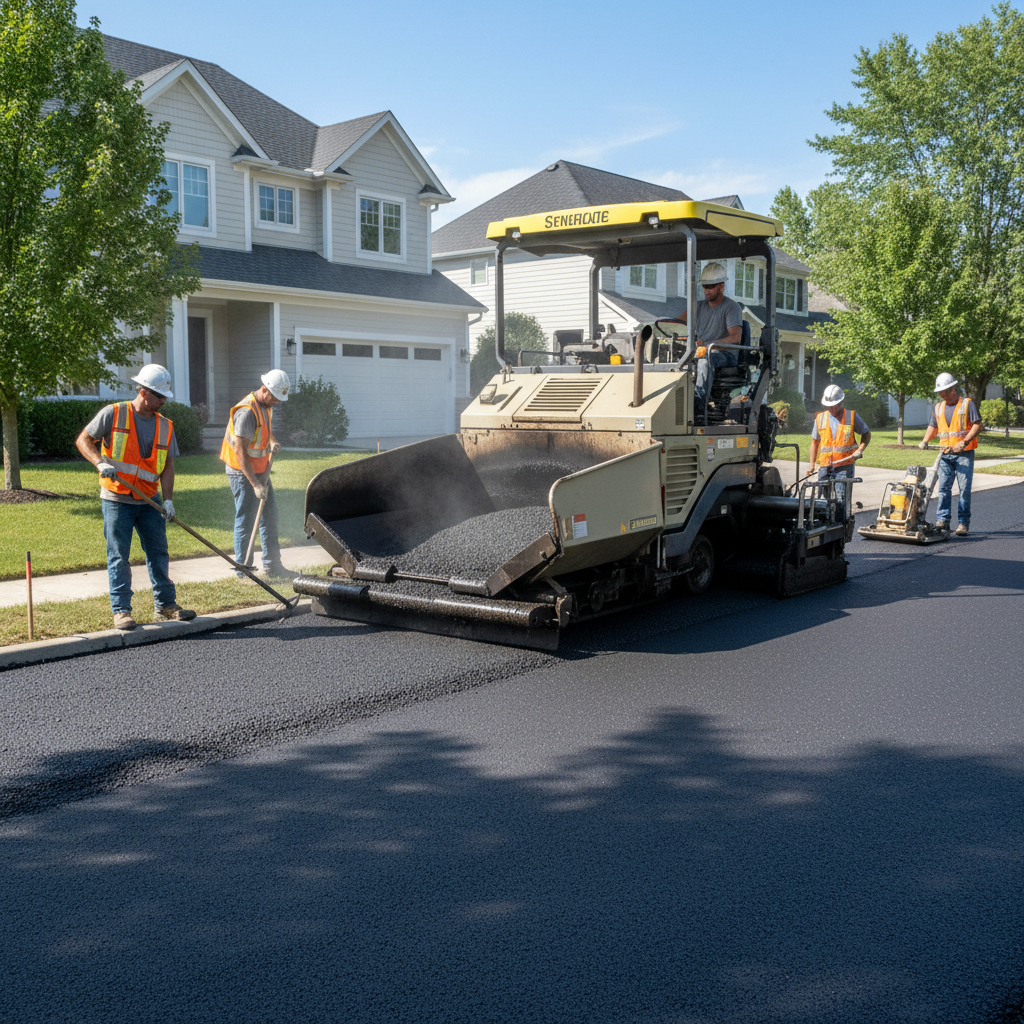
Driveway paving options and costs in Thorold
Thorold homeowners typically have three main choices when it’s time to resurface or replace a driveway: asphalt, interlocking pavers, or concrete. In Thorold specifically, many driveways are attached to single-detached homes—69.1% of local dwellings are that type—so the market is built around private residential approaches rather than wide commercial lanes. With 6,305 homeowner households (69.3% of households own) and a significant share of older housing stock (55.1% built before 1981), you’ll often see existing driveways on aging granular bases, sometimes with drainage issues that weren’t designed for today’s freeze–thaw intensity.
In the Hamilton–Niagara Peninsula region, pricing is shaped by the moderate-to-cold Southern Ontario climate zone and frequent freeze–thaw cycles. Contractors commonly plan for frost penetration in the 1.2–1.5 m range, which means deeper, well-compacted granular base and dependable drainage are key—those base and drainage steps can account for roughly 35–45% of a driveway budget. The paving season is also effectively April–October; asphalt compaction quality requires suitable temperatures, so spring and summer scheduling pressure can push quotes toward the higher end, particularly during peak months.
In Thorold, demand is especially steady in established areas like South Thorold, where lots are often narrower and older grades can lead to edge breakdown or water pooling. If you’re getting estimates, the best way to compare apples-to-apples is to match the base depth, drainage corrections, and whether it’s a full build or a partial overlay—those details drive the material price differences shown below.
| Material |
Lifespan |
Maintenance |
Best For |
Price per sq ft |
| Asphalt (new installation, proper base) |
10–20 years |
Seal every 3–5 years; crack fill as needed |
Most cost-effective all-round choice in Thorold |
$5 – $10 |
| Asphalt (overlay on existing gravel base) |
7–15 years |
Seal 3–5 years; more frequent crack patching if base is marginal |
When the base is in good shape and drainage is corrected |
$4 – $8 |
| Interlocking concrete pavers |
20–30 years |
Weed control; replace individual stones if needed |
High curb appeal and easier localized repairs |
$10 – $18 |
| Poured concrete (broom finish) |
20–35 years |
Seal if desired; patch hairline cracks |
Low ongoing maintenance and a continuous surface |
$8 – $15 |
| Exposed aggregate concrete |
20–30 years |
Seal every few years; manage small surface spalls |
Upgraded look with better traction than smooth concrete |
$10 – $18 |
| Gravel / crushed stone (budget option) |
3–8 years |
Top up 1–3 times per year; regrade; weed control |
Short-term solution or low-traffic areas |
$3 – $6 |
Prices are estimates only and vary by project scope, site access and material selection.
What affects the price of paving in Thorold
Two contractors can quote the “same” driveway in Thorold and land 30–50% apart because the real drivers aren’t just the surface material—they’re what’s underneath and what has to be corrected to make it last. Asphalt might be cheaper on paper, but if your existing base is soft, pumping water is present, or the driveway needs drainage adjustments, the cost quickly moves toward the mid-to-upper Ontario ranges. Similarly, pavers and concrete look higher upfront, yet they can be a better long-term value when localized repairs prevent full replacement.
In this moderate-to-cold Southern Ontario climate zone, frost line depth and freeze–thaw cycles are decisive cost factors. Local building practice often assumes frost penetration in the 1.2–1.5 m range, which means a driveway needs a deeper, well-compacted granular base—often 6–10 inches compacted, sometimes more depending on subsoil and drainage. As temperatures swing and water freezes in the voids, weak layers lose support, leading to heave and cracking. The paving season is also shorter here (typically April–October), and asphalt requires warm air temperatures above 10°C for proper placement and compaction. That compresses demand and tightens scheduling, which is why peak-spring installs can nudge pricing toward the higher side of the $3,000–$8,000 asphalt band.
In Thorold, two common conditions raise costs: (1) driveways on older clay or silty subsoils that trap water, which usually require more granular removal and drainage fixes; and (2) older neighborhoods with uneven grades where regrading is needed before any material goes down. Costs can be lower when the site is flat, access is straightforward, and the existing asphalt thickness is adequate for a true overlay. Still, if the driveway was built decades ago and performs poorly in winter, it’s often money well spent to rebuild the base—otherwise you can end up paying for earlier repairs within a band that starts near the $7,000–$18,000 concrete or $9,000–$20,000 paver options anyway.
| Price Factor |
Why It Matters |
Cost Impact |
| Driveway area in sq ft |
Material and compaction time scale directly with area |
Large impact; often the biggest line item |
| Base depth required |
Frost penetration drives granular thickness to prevent heaving |
Can swing cost by 15–30% depending on soil |
| Grading and drainage work |
Proper slope and drainage prevent water pooling under pavement |
Often 10–20% added if drainage corrections needed |
| Tear-out of existing surface |
Breaking and hauling concrete or old asphalt adds labour and disposal |
May add several hundred to over a thousand dollars |
| Edge restraints and curbing |
Pavers and asphalt need containment to stop lateral movement |
Can add 5–15% depending on border complexity |
| Sealing requirement |
Asphalt needs sealing to slow oxidation and protect against winter cycles |
Extra short-term cost; reduces long-term repairs |
| Site access |
Narrow lots slow equipment movement and increase setup time |
Can add 5–10% for tight access or long haul distances |
| Asphalt mix specifications |
Freeze-thaw rated mix can cost more but resists early raveling |
Typically pushes asphalt toward the higher end of the band |
Permits & regulations in Ontario
In Ontario, paving a private driveway within your own property usually does not require a building permit because it’s considered maintenance or a like-for-like improvement on private land. However, work that affects the public realm typically does need municipal approval. In Thorold (and across Ontario municipalities), that includes changes in the municipal right-of-way—for example, creating or altering a curb cut, changing the boulevard grading, or modifying storm drainage that ties into municipal infrastructure. If your driveway project involves water management that could change how runoff leaves your property, the municipality will want to review details before excavation begins.
Before any digging, confirm utilities are located. In Ontario, call Ontario One Call for a locate before excavation. Then, verify lot-grading or hard-surface restrictions that may be covered under municipal by-laws—some municipalities limit how close a hard surface can be to property lines or require specific drainage handling to protect adjacent properties.
To protect yourself, check your contractor in order: (1) Ontario licence/registration information through the contractor’s publicly available credentials (where applicable) and company details on their website and invoices; (2) liability insurance—ask for a current certificate of insurance showing you as an additional insured where available; (3) WSIB coverage—request WSIB clearance documentation (or WCB coverage proof depending on the nature of the work and employer status) before work starts. A legitimate contractor should provide documentation without pressure and should match the paperwork to the exact project scope in your quote.
Asphalt vs pavers vs concrete for Thorold driveways
For Thorold’s freeze–thaw winters, asphalt usually wins on upfront cost, interlocking concrete pavers win on curb appeal and flexible repairability, and concrete falls in the middle—if it’s built correctly and air-entrained for freeze conditions. Asphalt is typically the lowest-cost driveway paving option in the $3,000–$8,000 band, but it needs sealing every 3–5 years to protect from oxidation and the damaging cycle of water freezing beneath the surface. Interlocking pavers generally cost more (often within the $9,000–$20,000 range) because you’re paying for deeper construction, bedding sand, and edge restraint—yet individual stones can be replaced without tearing out the whole driveway, which matters when only certain sections settle or experience water intrusion. Poured concrete is often in the $7,000–$18,000 range, and while it’s durable, it can crack if joints aren’t spaced and sealed properly or if the mix isn’t air-entrained for freeze–thaw.
All three options rely on the same foundation principles in the Hamilton–Niagara Peninsula: deeper granular base to resist frost heave, and drainage that keeps water from staying under the slab or trapped in subgrade. In practice, pavers often tolerate minor movement better because of their segmental system, while concrete depends on joint design and proper subbase support to avoid reflective cracking. For households that do regular winter maintenance—salt, sand, and frequent plowing—pavers and well-installed asphalt tend to perform more forgivingly, while concrete requires correct mix design and jointing to reduce freeze–thaw surface deterioration.
A practical example: if your driveway quotes come in at the low end for asphalt (around $3,000–$5,000 depending on area) versus a paver install closer to $9,000–$14,000, the price difference is usually justified when you want long curb appeal, you’re in a high-visibility area, or you anticipate future localized repairs—especially on older lots where drainage and settling can be unpredictable.
| Material |
Frost Resistance |
Curb Appeal |
Repair Method |
Lifespan |
Price Band |
| Asphalt (sealed regularly) |
Good with proper base and sealing |
Medium (clean, modern finish) |
Crack fill and patch; overlays if needed |
10–20 years |
$3,000 – $8,000 |
| Interlocking concrete pavers |
Very good when bedding and restraints are correct |
High (wide design choice) |
Replace individual stones or small sections |
20–30 years |
$9,000 – $20,000 |
| Poured concrete (air-entrained) |
Good with correct air entrainment and jointing |
Medium to high |
Patch for small issues; deeper repairs may require sections |
20–35 years |
$7,000 – $18,000 |
| Exposed aggregate concrete |
Good with proper curing and sealing |
Very high (textured premium look) |
Localized patching; sometimes requires section work |
20–30 years |
$10,000 – $18,000 |
| Permeable pavers (drainage grid) |
Very good where water management is critical |
Medium to high |
Replace stones; address grid system locally if clogged |
20+ years when maintained |
$12,000 – $22,000 |
| Chip seal / tar-and-chip |
Moderate; sensitive to base quality |
Low to medium |
Spot repairs; periodic top-up |
6–12 years |
$4,000 – $10,000 |
How to choose a paving contractor in Thorold
Choosing the right contractor in Thorold starts with confirming they’re properly set up to work safely and legally. In Ontario, ask for their proof of liability insurance (current certificate, with your address listed where possible) and their WSIB coverage (or clearance documentation showing their current status). You should also confirm that any subcontractors are covered—don’t assume it’s automatic. For your documentation, look for a COI that includes policy dates and limits, and a WSIB clearance letter or equivalent proof that’s current at the time of quoting and before mobilization.
Next, get 2–3 itemised written quotes so you can compare apples-to-apples: line items for excavation/tie-ins, granular base materials (Granular A/B), compaction/testing, drainage corrections, geotextile where specified, asphalt or concrete supply, paving labour, edge restraints, and disposal. A lump-sum quote without scope detail can hide the real reasons costs jump later—especially in older Thorold neighbourhoods where tear-out and drainage work are common.
Read exclusions carefully. Are permits/approvals included if work touches the boulevard or storm drainage? Is disposal of excess material included? What’s excluded for unsuitable soil or unexpected underground conditions? For warranty, ask for (1) workmanship warranty length, (2) any product/manufacturer warranty, and (3) whether warranties transfer to a homeowner if you sell.
Payment schedule matters: avoid paying more than 10–15% upfront. Hold back a reasonable percentage until the job is complete, cleaned up, and any deficiencies are corrected. Also request a written timeline with an estimated start date and completion window so you’re not stuck waiting for spring weather delays.
- Confirm WSIB status with a current clearance document before work starts.
- Request a liability insurance certificate (policy dates and limits visible).
- Ask for Ontario contractor credentials/registration details tied to the quote.
- Use itemised quotes (labour + materials), not just one total number.
- Verify base depth and compaction plan (Granular A/B thickness and why).
- Confirm drainage and slope corrections are included or clearly excluded.
- Check whether tear-out is included (and how thick old asphalt/concrete is assumed).
- Confirm edge restraints/curbing details—especially for pavers and long drives.
- Ask if geotextile, tack coat, or prime coat are included where needed.
- Get warranty terms in writing (workmanship, material, and transferability).
- Request a written start date and completion estimate, plus weather contingencies.
- Keep deposits low (10–15% max); hold back until final walkthrough.
Concrete red flags I see in Thorold include: contractors who won’t provide COI/WSIB proof, refusing to itemize base and drainage work, quoting one price without discussing frost-depth-driven base requirements, demanding large upfront deposits, and starting excavation before utility locates are completed.
Frequently asked questions — paving in Thorold
How deep should the base be for Thorold's frost?
In Thorold and the wider Hamilton–Niagara Peninsula, the driveway base depth isn’t guesswork—it’s driven by freeze–thaw performance. Local practice typically assumes frost penetration around 1.2–1.5 m, and the driveway needs enough well-compacted granular base to keep water from freezing and losing support. For many residential driveways on typical subsoils, that means granular build-ups often land around 6–10 inches compacted, with more excavation and deeper replacement if clay/silty conditions trap water or if drainage is currently poor. The fastest way to get the right number is to include a subgrade assessment in your quote and specify base thickness plus drainage corrections. Cutting corners on base depth is one reason asphalt overlays and concrete slabs fail early in Ontario winters.
How often should I seal my asphalt driveway?
For Ontario asphalt, sealing is a key part of winter protection. Most homeowners plan to seal every 3–5 years after the asphalt is fully cured. If your driveway is heavily used, sees lots of tire turning, or receives frequent winter sanding/salting, sealing closer to the 3-year end is often smarter. If the contractor used proper tack coat, compaction, and a freeze–thaw rated mix, sealing still matters because it slows oxidation and helps resist surface brittleness during spring thaw and refreeze cycles. If your quote was near the asphalt band (for example, $3,000–$8,000 depending on size and scope), a planned sealing budget is the difference between “it looks good” and “it stays strong.” A reputable company can also crack-fill first to stop small faults from growing.
Why does my driveway crack and heave in winter?
Cracking and heaving usually point to water + insufficient support in Ontario’s freeze–thaw cycle. When water soaks into weak subgrade or an under-compacted granular layer, it freezes, expands, and pushes the pavement upward. On older Thorold properties—where 55.1% of homes were built before 1981—driveways can sit on foundations that don’t drain the way modern builds require. Common triggers include poor slope toward the street, a low spot where water collects, missing or inadequate edge restraint, or an overlay done without fixing the base. Salt and plowing can worsen surface damage, but they typically accelerate deterioration after the structural issue starts. If the driveway is heaving, the fix often needs drainage and base correction, not just surface patching.
Do I need a permit to pave my driveway in Ontario?
Often, no permit is required for paving your own private driveway within your property line in Ontario, assuming you’re not changing municipal infrastructure. The usual “yes, you may need municipal approval” situations include work in the municipal right-of-way—such as altering or creating a curb cut, changing boulevard grading, or modifying storm drainage that connects to municipal services. In Thorold, the simplest approach is to tell your contractor exactly where the paving limits are and whether any excavation touches the boulevard. Also, confirm lot-grading rules that may affect how close a hard surface can be to property boundaries. Regardless of permits, utility locates are essential—call Ontario One Call before digging. A good contractor will tell you upfront whether they expect municipal involvement and whether it’s included in the quote.
How long before I can drive on new asphalt?
After asphalt is placed, the exact “drive-on” time depends on the mix, weather, and whether tack coat was used. In typical Ontario residential projects, crews aim to make the surface available the same day, but you should plan to avoid turning loads and parking on it until it has cooled adequately to prevent marking and raveling. Many installers will restrict heavy traffic for several hours and then allow light use once temperature and set-up are complete. If you’re resurfacing or overlaying, the schedule can shift based on the number of lifts. If you’re budgeting in the asphalt range (for example, $3,000–$8,000 depending on scope), ask your contractor for a written traffic plan and cure guidance for the specific day’s temperatures. Don’t place anything on the surface (including snow) until the contractor confirms it’s ready.
What causes potholes and how are they repaired?
Potholes in Thorold are usually the end result of water getting under pavement. When freeze–thaw loosens material, tire loads pull the weakened area further apart. Common causes include cracked asphalt that wasn’t crack-filled early, an underbuilt base, drainage that funnels water to one spot, or areas where the surface settlement concentrates stress. In spring, potholes can appear quickly after the pavement cycles through thaw and refreeze. Repair usually starts with removing loose asphalt, cleaning the area, and addressing the underlying issue—often patching to a deeper level, then compacting with proper base layers. A true fix may include base correction; a surface-only “cap” can fail again in the next cycle. In quotes, ask if the contractor will remove and compact back to sound material rather than just filling the crater.