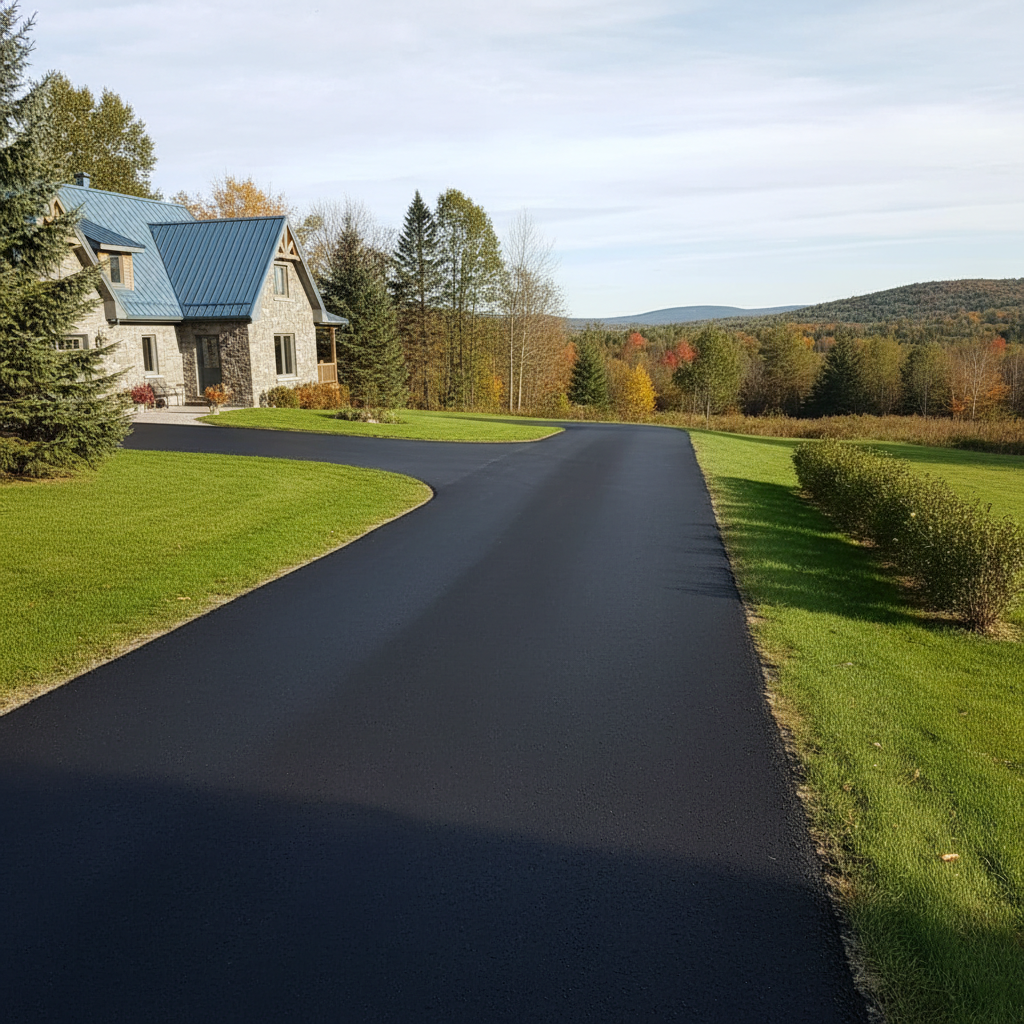
Driveway paving options and costs in Welland
Welland homeowners typically have three practical driveway paths: asphalt, interlocking pavers, and concrete (poured or decorative). With 55,750 residents and roughly 16,315 homeowner households (Statistics Canada, 2021 Census), most paving work here is tied to detached homes—single-detached dwellings make up 64.5% of the housing stock, so driveways are a steady, repeatable market.
Pricing in the Hamilton–Niagara Peninsula is shaped by the moderate-to-cold Southern Ontario freeze–thaw pattern. In practice, contractors plan for frost penetration in the 1.2–1.5 m range, which drives a deeper, well-compacted granular base and reliable drainage. That base and drainage work can make up about 35–45% of a residential driveway budget, especially where older lots have clay/silty subsoils or where grading has shifted.
Demand is also seasonal. Asphalt paving generally runs about April–October because hot-mix asphalt needs warm air temperatures and compaction conditions; when jobs pile up in spring and early summer, scheduling can compress and labour/equipment costs rise. You’ll often see the trade busiest in older, established neighbourhoods—particularly around north Welland near the Niagara-on-the-Lake Road and downtown/nearby core streets—where homes built before 1981 are common and existing surfaces often need tear-out and drainage correction.
Below is a practical comparison of typical options before we tailor it to your driveway size, base, and access.
| Material |
Lifespan |
Maintenance |
Best For |
Price per sq ft |
| Asphalt (new installation, proper base) |
15–25 years |
Sealcoat every 3–5 years; spot patching as needed |
Value + flexibility under Welland freeze–thaw |
$4.50–$7.50 |
| Asphalt (overlay on existing gravel base) |
10–18 years (depends on base) |
Sealcoat every 3–5 years; monitor settlement |
When subgrade is solid and only the surface needs improvement |
$3.75–$6.50 |
| Interlocking concrete pavers |
25–40 years |
Re-sanding; occasional panel lift/replace |
Curb appeal and repairs without full replacement |
$10.00–$18.50 |
| Poured concrete (broom finish) |
20–35 years (with air-entrainment) |
Joint/caulk upkeep; sealing as recommended |
Clean look and lower winter maintenance fuss |
$8.50–$15.50 |
| Exposed aggregate concrete |
25–35 years |
Sealer as needed; address small spalls early |
Slip resistance + decorative curb appeal |
$11.00–$18.50 |
| Gravel / crushed stone (budget option) |
3–8 years before major regrading |
Re-top yearly or as ruts develop |
Short-term access or temporary driveway |
$2.00–$4.50 |
Prices are estimates only and vary by project scope, site access and material selection.
What affects the price of paving in Welland
If you’re comparing quotes for the “same” driveway, it’s common to see swings of 30–50% across the Hamilton–Niagara Peninsula depending on how much base, drainage, and excavation the contractor includes. Two crews can both quote asphalt for the same square footage, but one may be pricing a true frost-rated base and proper granular thickness, while the other is assuming the existing subgrade is already stable. Also, older Welland properties—many built well before modern drainage standards—often require additional prep that isn’t obvious until excavation.
In Welland’s climate, freeze–thaw cycles are the decisive driver. Deeper frost means contractors typically plan for a thicker compacted granular base (often 6–10 inches compacted, sometimes more where subsoils are poor), along with drainage corrections and a consistent slope away from the home. In colder Southern Ontario, hot-mix asphalt production and placement are constrained by temperature, since asphalt placement usually requires air temperatures above 10°C; that shortens the effective paving season and concentrates demand. Asphalt mix design also needs to be appropriate for freeze–thaw performance, which can add cost compared with “budget” mixes.
Concrete pricing can rise in Welland when air-entrainment, joint layout, and subbase thickness are upgraded to reduce cracking risk. Paver costs jump when edge restraints, proper bedding, and regrading are required to prevent heaving and “walking” units. For a real comparison: many homeowners in the $7,000–$18,000 range for concrete end up there only after drainage and base improvements—yet an asphalt driveway can often stay nearer the $3,000–$8,000 band when the existing grade is salvageable.
| Price Factor |
Why It Matters |
Cost Impact |
| Driveway area in sq ft |
Materials and compaction time scale directly with square footage |
Largest variable; often drives most of the total |
| Base depth required |
Frost penetration and subsoil condition dictate granular thickness |
Can add substantial cost due to haul/placement/compaction |
| Grading and drainage work |
Correct slope and fix low spots to prevent water pooling |
Commonly increases scope by moving dirt, installing drainage fixes |
| Tear-out of existing surface |
Breaking and hauling concrete or old asphalt increases labour and disposal |
Often a mid-project cost jump when the base is damaged |
| Edge restraints and curbing |
Pavers need containment to prevent spreading; concrete needs stable borders |
More materials + more cutting and setting |
| Sealing requirement |
Asphalt typically benefits from sealcoat after installation/settling |
Ongoing cost; skipping it accelerates aging and oxidation |
| Site access |
Narrow driveways and tight turns slow equipment movement |
Higher labour hours for careful placement |
| Asphalt mix specifications |
Freeze–thaw-rated mixes and proper compaction targets reduce early failures |
Can raise per-ton pricing but improves long-term performance |
Permits & regulations in Ontario
In Ontario, paving a private driveway within your own property usually does not require a building permit. In most Welland residential situations, the work is confined to your lot—grading, base preparation, and applying asphalt or concrete on the driveway surface.
However, municipal approval is typically required when you change anything in the municipal right-of-way. That includes new curb cuts, altering the boulevard, modifying the storm drainage connection, or changing how water flows off your property in a way that affects municipal infrastructure. If your driveway ties into an existing drainage structure (or you plan to), it’s worth confirming the requirement before excavation.
Step one for any Welland driveway job: call utility locates (Ontario One Call) before digging. Even “small” base corrections can hit buried services, and locates protect you and the contractor.
Step two: verify the contractor you’re hiring. Ask for (1) proof of liability insurance (certificate of insurance showing the limits), (2) confirmation they carry WSIB coverage for their workers (or WCB equivalent documentation where applicable), and (3) their Ontario business details—many reputable paving companies are listed in public business registries. You should also request a written quote that clearly states what the contractor includes (disposal, compaction, drainage corrections, and any permit/municipal submission support if needed).
Asphalt vs pavers vs concrete for Welland driveways
For Welland’s freeze–thaw winters, asphalt is usually the lowest upfront option and performs well because it’s flexible under temperature swings. The catch is maintenance: sealcoat is typically done every 3–5 years to slow oxidation and surface wear. Interlocking concrete pavers cost more at the start, but they shine where homeowners want long-term serviceability—individual units can be lifted and reset if a section ever settles, without replacing the whole driveway. Poured concrete sits in the mid-range, but it is more sensitive to how it’s built: proper base, air-entrainment, and a joint pattern that accounts for movement are critical. In colder Southern Ontario, de-icing salts and repeated freeze–thaw can stress concrete surfaces, especially if joints aren’t detailed correctly.
Base preparation is the shared foundation for all three. In the Hamilton–Niagara Peninsula, contractors commonly target a frost-resistant granular base and strong drainage so water doesn’t sit and expand in winter. Where clay/silty subsoils are present, drainage correction and deeper base often become a must-have regardless of the surface choice.
Which holds up best to Welland’s winter routine (salt, sand, plowing)? Typically: pavers when installed on a properly engineered base and restrained edges; asphalt when sealed on schedule and patched early; concrete when air-entrainment and jointing are done correctly. A quick dollar example: if asphalt lands in the $3,000–$8,000 band for a typical residential driveway, interlocking pavers can land in the $9,000–$20,000 range. That extra cost is justified when you value repairability, crisp curb appeal, and the ability to address localized settlement without full replacement.
| Material |
Frost Resistance |
Curb Appeal |
Repair Method |
Lifespan |
Price Band |
| Asphalt (sealed regularly) |
Good when built on a frost-rated granular base |
Moderate (clean, uniform finish) |
Cut-out and patch; seal localized areas |
15–25 years |
$3,000–$8,000 |
| Interlocking concrete pavers |
Very good with proper bedding and edge restraints |
High (variety of colours/patterns) |
Lift, re-bed, replace affected units or sections |
25–40 years |
$9,000–$20,000 |
| Poured concrete (air-entrained) |
Good with air-entrainment, correct joints |
Moderate (depends on finish) |
Repair spalls/joints; larger issues may need partial replacement |
20–35 years |
$7,000–$18,000 |
| Exposed aggregate concrete |
Good to very good when cured and finished properly |
High (decorative texture) |
Limited patching; usually small repairs or partial rework |
25–35 years |
$9,000–$18,000 |
| Permeable pavers (drainage grid) |
Good when designed for local grading and subgrade |
High for modern drainage-forward looks |
Replace localized areas; check drainage layer maintenance |
20–35 years |
$10,000–$22,000 |
| Chip seal / tar-and-chip |
Fair to good; performance varies with prep and traffic |
Lower (more “textured” look) |
Spot renew with additional seal/chip; often re-coating |
7–15 years |
$2,500–$6,500 |
How to choose a paving contractor in Welland
Choosing the right paving contractor in Welland starts with documentation. In Ontario, confirm liability insurance by asking for a certificate of insurance and checking it lists appropriate coverage and your project address or at least the policy limits. Next, verify worker coverage: request proof they are registered for WSIB and that their workers are covered for the duration of the job. If you’re hiring subcontractors, ensure you’re not left holding the bag—ask who is doing the work and whether coverage is extended to those crews.
Then get 2–3 itemised written quotes. You want labour and materials broken down—base materials, asphalt/concrete placement, excavation/hauling, compaction, edge restraints, and any drainage corrections. A good quote should also state what’s excluded: removal of unsuitable soils, permit/municipal approvals, disposal fees, and whether traffic control is included if equipment enters the street/municipal boulevard.
Warranty matters. Look for a workmanship warranty length (and what it covers), plus the product/manufacturer warranty. Clarify if the warranty is transferable to future owners—important in a neighbourhood where homes may change hands.
Payment schedule: avoid paying more than 10–15% upfront. Hold back an amount until final completion and cleanup. Finally, insist on a written start date and a completion window, because weather and material lead times can shift during spring thaw.
- Confirm WSIB coverage with proof and check it’s valid for the job period.
- Request a current liability insurance certificate (limits shown).
- Ask who will be on-site (crew size, supervisor contact, subcontractors).
- Get itemised pricing for excavation, base depth, and compaction.
- Insist on drainage details: slope, tie-in points, and water control.
- Ask how they handle weak subgrade (geotextile, granular replacement, stabilization).
- Review the tender for exclusions: disposal, breaking concrete, utility protection.
- Ensure edge restraints are included (especially for pavers).
- Request compaction testing/verification (where applicable) and equipment list.
- Clarify asphalt thickness/lift count or concrete thickness and joint plan.
- Read warranty terms—workmanship vs product warranty, and coverage limits.
- Confirm payment terms and retainage in writing.
Specific red flags I see in Welland: (1) quotes that don’t mention base depth or drainage correction, (2) refusing to provide insurance/WSIB documentation, (3) lump-sum pricing with no breakdown for tear-out/disposal, (4) asking for most payment upfront, and (5) vague promises about “lifetime” asphalt or no need for sealcoat regardless of freeze–thaw.
Frequently asked questions — paving in Welland
How long does a paved driveway last in Welland?
In Welland, a well-built asphalt driveway typically lasts about 15–25 years when it’s installed over a frost-rated granular base and you seal it on schedule (often every 3–5 years). If the base was too thin or drainage is poor, freeze–thaw can trigger early cracking and settlement, shortening life noticeably. Interlocking pavers, when installed with proper bedding and restrained edges, often achieve 25–40 years and can be repaired locally without replacing the whole driveway. Poured concrete with air-entrainment and correct jointing usually lands in the 20–35-year range. Many older Welland homes were built before modern grading expectations; when excavation finds soft, water-prone subgrade, longer service life depends more on prep quality than on surface choice.
When is the best time of year to pave in Welland?
The best window for paving in Welland is generally late spring through summer, roughly April to October, because crews need stable temperatures for placement and compaction. Hot-mix asphalt placement typically requires warm air conditions (often above 10°C), and early spring can be too cold or wet. Summer works well, but heavy rain can still delay base compaction and drainage tasks, so good contractors schedule excavation and base first, then surface later when conditions are right. If you’re comparing quotes, try to book within the earlier part of the season; winter demand for materials and spring scheduling pressure can raise pricing during peak months. Plan for curing time for concrete and for the proper setting/compaction of base and paver bedding as well.
How deep should the base be for Welland's frost?
Because Welland sits in a moderate-to-cold Southern Ontario climate with frequent freeze–thaw, contractors usually design a deeper compacted granular base than you’d see in milder climates. In practice, many residential driveways target about 6–10 inches of compacted granular base, with adjustments based on soil condition, drainage, and the condition of the existing subgrade. The key is preventing frost heave by keeping water under control and maintaining a consistent, well-compacted layer. If excavation reveals clay/silty soils or a wet subgrade, base depth and/or granular replacement often needs to increase, which can move your project toward the mid-to-upper price bands. That’s also why two “similar” driveways can differ by thousands—base depth is one of the biggest cost drivers.
How often should I seal my asphalt driveway?
For asphalt in Welland, sealcoat is typically applied after installation once the asphalt has had time to cure and settle—often within the first year depending on weather and mix—and then every 3–5 years thereafter. Sealcoating helps protect against oxidation and surface wear that can worsen under freeze–thaw and winter sand/salt exposure. If you leave asphalt unsealed for too long, you may see surface raveling and increased cracking sooner, which can lead to earlier patching. When budgeting, include sealcoat as part of long-term ownership; it’s usually much cheaper than full replacement. Depending on the product used and driveway condition, sealing and repair work can fall into the general $400–$2,000 range. If your driveway is already failing, ask whether localized repairs and a sealer plan make sense before resurfacing.
Why does my driveway crack and heave in winter?
Cracking and heaving usually come down to movement under freeze–thaw. Water that gets trapped in low spots or in an inadequate base expands when it freezes, pushing upward and stressing the surface. If the granular base was too thin, poorly compacted, or missing proper drainage/grading, the frost can penetrate deeper and amplify expansion. In older Welland neighbourhoods—especially where the original driveway base was minimal—contractors often find that settlement and water migration start before you ever notice it on the surface. De-icing salts can also accelerate deterioration of asphalt binder and concrete paste over time, adding to the problem once cracks form. The fix isn’t just filling cracks; it’s correcting base and drainage so the driveway has fewer opportunities to move during winter.
Do I need a permit to pave my driveway in Ontario?
Usually, paving within your own property line in Ontario does not require a building permit, and that’s generally the case for a typical asphalt or concrete driveway replacement in Welland. Where permits or approvals can come into play is when work affects municipal right-of-way items—such as creating or changing a curb cut, altering the boulevard, or modifying storm drainage connections. If you’re planning anything that changes how water leaves your property, confirm municipal requirements before excavation. Also, always arrange utility locates (Ontario One Call) before digging. For peace of mind, verify the contractor’s Ontario business information, liability insurance, and WSIB coverage before work starts—these steps protect you even when the project itself doesn’t require a permit. Typical driveway budgets often sit in the $3,000–$8,000 asphalt range or $7,000–$18,000 for concrete, but the permit/approvals question is driven by location, not only price.