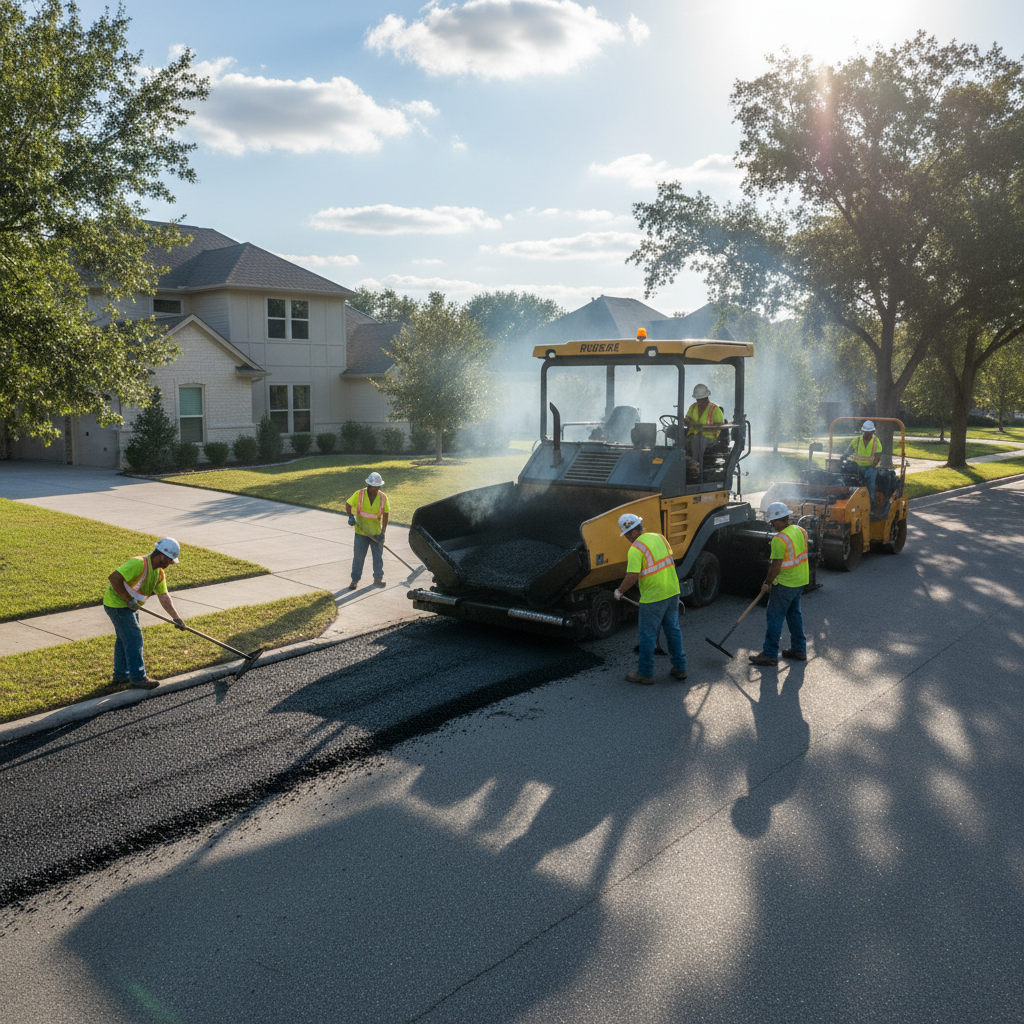
Driveway paving options and costs in Willowridge-Martingrove-Richview
Willowridge-Martingrove-Richview is a mix of older residential streets and newer infill, and that matters because most driveways are tied to private homes rather than multi-unit lots. With a local population of 22,156 (Statistics Canada, 2021 Census), there’s a steady flow of paving and re-paving work as homeowners upgrade worn asphalt, replace failing interlock, or correct drainage that’s letting water pool at the garage approach. The bigger the driveway footprint, the more you’ll feel Toronto’s pricing pressure during peak dates—especially when frost depth and freeze–thaw cycles are doing most of the damage beneath the surface.
In this part of Toronto, ground freezing to roughly 3–4 feet means driveways need deeper granular base, thorough subgrade compaction, and reliable drainage. That’s why two quotes for the “same-looking” driveway can differ: one contractor builds the base and handles water properly, while another tries to keep excavation minimal. Also, Toronto-area paving crews generally focus late spring through early fall, so scheduling in the May–September window can raise prices for rush work.
Work is especially in demand around the Humber Bay and Richview corridor where many homes face long driveway runs, uneven grades, and drainage issues at the curb line. Below is a side-by-side guide to common materials and typical installed cost ranges in Willowridge-Martingrove-Richview, so you can compare apples to apples before you request quotes.
| Material |
Lifespan |
Maintenance |
Best For |
Price per sq ft |
Price Range |
| Asphalt (new installation, proper base) |
15–25 years |
Seal every 3–5 years (weather-dependent) |
Best value, smooth ride, fast installation |
$8–$14 |
$3,500–$8,000 |
| Asphalt (overlay on existing gravel base) |
8–18 years |
Seal within 6–12 months; monitor for settlement |
Limited excavation budget; when base is sound |
$6–$11 |
$3,000–$7,000 |
| Interlocking concrete pavers |
25–35 years |
Re-sand joints; lift-and-replace if needed |
Premium curb appeal; repairable in sections |
$15–$30 |
$9,000–$20,000 |
| Poured concrete (broom finish) |
20–30 years |
Crack monitoring; joint/edge maintenance |
Low maintenance finish; strong for heavy vehicles |
$14–$24 |
$6,000–$15,000 |
| Exposed aggregate concrete |
20–30 years |
Sealer as recommended; occasional patching |
Decorative look with better texture for traction |
$16–$28 |
$7,000–$16,500 |
| Gravel / crushed stone (budget option) |
3–8 years |
Top-ups yearly; regrading as needed |
Temporary solution or low-traffic areas |
$3–$7 |
$2,000–$5,500 |
Prices are estimates only and vary by project scope, site access and material selection.
What affects the price of paving in Willowridge-Martingrove-Richview
In the Toronto economic region, the same basic driveway project can come in 30–50% apart because contractors price risk differently: one quote includes deeper excavation, engineered drainage, proper compaction testing, and long-term spec’d materials; another may “make it fit” with thinner base, less haul-off, or fewer labour hours. In practice, the difference shows up under the surface—where frost action and water movement determine whether your driveway performs or fails prematurely.
Frost depth and freeze–thaw cycles are decisive cost factors here. With ground freezing to about 3–4 feet, Toronto driveways need a thicker compacted granular base and a well-drained subgrade. If water can sit under the pavement, it expands when it freezes, pushing up (heaving) and creating cracking. The paving season is also compressed: hot-mix asphalt placement is best when air temps are reliably above about 10°C, so spring and summer schedules tighten. That short window can push pricing toward the upper end of the asphalt band (commonly around the $3,500–$8,000 range) when crews are booked.
Concrete costs can also swing with local conditions. For example, if your driveway approach has a steep slope, contractors may need extra subbase and formwork to control grade and drainage. If the existing surface is old asphalt with hidden gravel migration, tear-out and rebuild base can shift the job toward the higher concrete band ($6,000–$15,000). On the other hand, if you already have solid drainage and a stable subgrade, overlay or partial replacement can reduce excavation and lower the total ticket.
| Price Factor |
Why It Matters |
Cost Impact |
| Driveway area in sq ft |
Material and compaction time scale directly with size. |
Highest cost driver; small changes in dimensions add up fast. |
| Base depth required |
Toronto frost action requires adequate granular thickness to prevent heave. |
Deeper base increases excavation, hauling, and base material. |
| Grading and drainage work |
Proper slope, subdrainage, and water routing reduce freeze-related failure. |
Can add significant labour and additional pipe/gravel/grading. |
| Tear-out of existing surface |
Breaking concrete or removing old asphalt affects disposal and equipment time. |
Often a major line item when full-depth replacement is needed. |
| Edge restraints and curbing |
Pavers need restraints; asphalt needs stable edges to stop spreading. |
Improves longevity but adds forms, materials, and labour. |
| Sealing requirement |
Asphalt relies on sealing to slow moisture and oxidation. |
Typically adds a maintenance budget within the first few years. |
| Site access |
Narrow lots slow skid-steer movement and increase setup time. |
May require smaller equipment, more trips, higher labour time. |
| Asphalt mix specifications |
Freeze–thaw-rated mix design reduces early surface distress. |
Mix can cost more; overall job price increases accordingly. |
Permits & regulations in Ontario
In Ontario, paving a private driveway within your own property typically does not require a building permit, as it’s generally considered exterior work on private land. However, you may need municipal approval when the work touches the public right-of-way or changes municipal assets. For example, new curb cuts, changes to boulevard grade, adjustments that affect stormwater drainage connections, or any work that alters how water runs off toward the street commonly require permission. Some municipalities also have lot-grading or surface-drainage rules that limit how close hard surfaces can be to lot lines and how drainage must be directed.
Regardless of permits, utility locates are essential before excavation. Homeowners should call Ontario One Call (before-dig process) so locators can mark buried services. This protects you and the contractor from utility strikes and schedule delays.
To verify a contractor in Willowridge-Martingrove-Richview, ask for: (1) Ontario business registration details and contractor identification, (2) liability insurance certificate (with the property owner named where appropriate), and (3) confirmation of WSIB coverage (or the correct exemption documentation if applicable). Then check the insurance certificate for active dates and the coverage limits, not just a “stamp” page. Request a clearance letter or coverage confirmation if your contractor’s proof requires it. Finally, have them provide an itemised scope that clarifies whether they handle disposal, site cleanup, and any permit/approval support needed for curb or drainage-related work.
Asphalt vs pavers vs concrete for Willowridge-Martingrove-Richview driveways
Choosing between asphalt, interlocking concrete pavers, and concrete in Willowridge-Martingrove-Richview comes down to freeze–thaw performance, repair strategy, and how you manage winter maintenance (salt, sand, and plough/track damage). Toronto’s recurring freeze–thaw cycles are hard on any driveway that lacks proper drainage or base thickness. With frost action reaching roughly 3–4 feet, all three options need a correctly engineered granular base and compaction, plus edges and drainage that keep water from sitting beneath the surface.
Asphalt is typically the lowest upfront option and gives a smooth, quiet drive, but it performs best when sealed regularly—generally every 3–5 years. Interlocking pavers cost more to install, yet they’re the most flexible in repairs because individual units can be lifted and reset without replacing the whole driveway. Poured concrete is in the middle price range, but it needs air-entrained mix design, well-planned joints, and careful curing to manage cracking in freeze–thaw weather.
For a realistic example, if your driveway quote is $3,500–$8,000 for asphalt versus $9,000–$20,000 for interlock, the price jump can be justified when you value long-term curb appeal and want the ability to fix localized problems after settlement or utility work. If you want the simplest ongoing routine and your base/drainage are strong, asphalt or air-entrained concrete are often the practical choices. In most Toronto winters, the material that survives best is the one built with the right base and drainage first—not the one that’s simply cheapest at the start.
| Material |
Frost Resistance |
Curb Appeal |
Repair Method |
Lifespan |
Price Band |
| Asphalt (sealed regularly) |
Good with proper base and drainage; sealing helps protect against moisture |
Medium (clean, uniform look) |
Patch and re-surface; full overlay when needed |
15–25 years |
$3,500–$8,000 |
| Interlocking concrete pavers |
Very good; joints allow minor movement while keeping surfaces serviceable |
High (wide colour/style options) |
Lift-and-replace individual pavers; re-sand and re-level |
25–35 years |
$9,000–$20,000 |
| Poured concrete (air-entrained) |
Good if air-entrained and properly jointed/managed |
Medium to high (finish depends on broom or decorative) |
Crack repair and patch; partial replacement in sections |
20–30 years |
$6,000–$15,000 |
| Exposed aggregate concrete |
Good with proper mix and drainage; texture grips but needs quality curing |
Very high (decorative texture) |
Patch and resurface sections (visibility varies by patching) |
20–30 years |
$7,000–$16,500 |
| Permeable pavers (drainage grid) |
Good for water management; base design must be correct |
High (engineered look) |
Lift-and-replace; occasional base flushing/maintenance |
20–30 years |
$10,000–$22,000 |
| Chip seal / tar-and-chip |
Moderate; better for low-speed, lighter traffic if maintained |
Low to medium (utility look) |
Spot repairs; periodic re-seal/restock |
8–15 years |
$4,000–$9,000 |
How to choose a paving contractor in Willowridge-Martingrove-Richview
Start by verifying licensing, insurance, and worker coverage—because paving is excavation-heavy, and Ontario winters can turn minor issues into costly failures if work quality is poor. In Ontario, confirm your contractor has appropriate business identification and is operating legitimately (you can often cross-check business registration details online). Ask for a certificate of liability insurance showing active coverage dates and limits. For workers, request WSIB coverage confirmation (or the correct documentation if they’re exempt). Don’t accept a photo of a policy—ask for the current clearance letter or proof of coverage as required.
Next, get 2–3 itemised written quotes. Prefer a breakdown that lists excavation depth and materials, base type and thickness, drainage items (pipe/gravel/slope corrections), hauling/disposal, and the paving line (asphalt thickness or concrete thickness and reinforcement/joint plan). Avoid lump-sum quotes that don’t explain what’s included. Make sure you understand what’s excluded: permit pull support, disposal quantities, saw-cutting and jointing, restoring sod/landscaping, or patching beyond the limits of the new surface.
Warranty matters for workmanship—ask for how many years for paving/base labour. Also ask whether the manufacturer’s product warranty is included and if it’s transferable to you. Plan the payment schedule: never pay more than 10–15% upfront. Hold back a portion until the job is fully complete, including cleanup and final grading.
Finally, ask for a written timeline: proposed start date, weather-dependent paving dates, and a completion estimate. In Toronto’s shorter season, an organized schedule is a sign they’ve accounted for labour and material lead times.
- Ask for current liability insurance and confirm dates/coverage limits on the certificate.
- Request WSIB coverage confirmation (clearance letter/proof) for their paving crew.
- Get 2–3 itemised quotes—labour + materials, not one lump number.
- Confirm base build-up details (granular thickness, compaction approach, and drainage plan).
- Ask whether utility locates are arranged and who pays for marked locating if required.
- Clarify tear-out scope: full-depth removal versus milling/partial replacement.
- Check disposal inclusion (haul-away) and whether it’s priced by load or lump sum.
- Require edge restraints in writing (especially for pavers) and asphalt edge stabilization details.
- Confirm slope and drainage adjustments so water doesn’t sit at garage approaches.
- Verify whether a permit/municipal approval is required for curb cut or drainage changes and who handles paperwork.
- Review the warranty: workmanship length, exclusions, and whether it covers base-related issues.
- Set payment milestones: keep 10–15% upfront maximum and hold back until final acceptance.
Red flags to watch for: a contractor who won’t show you insurance/WSIB proof; quotes that ignore drainage or base thickness; “we always overlay” without inspecting the existing base; payment requests that demand most funds upfront; and vague timelines with no weather contingency plan for Ontario’s spring/fall temperature swings.
Frequently asked questions — paving in Willowridge-Martingrove-Richview
Asphalt vs interlocking pavers vs concrete — which is best in Willowridge-Martingrove-Richview?
In Willowridge-Martingrove-Richview, the “best” choice usually depends on whether you want lowest upfront cost or easier long-term repairs. Asphalt often wins for value and smooth driving, typically landing in the $3,500–$8,000 range when the base is built properly. Interlocking pavers are the premium option ($9,000–$20,000) but are very repairable—helpful if you ever need to access utilities or if a localized area settles. Poured concrete (often $6,000–$15,000) can be durable when air-entrained and jointed correctly for Toronto’s freeze–thaw cycles. In practice, drainage and base thickness matter more than the surface brand name.
How long does a paved driveway last in Willowridge-Martingrove-Richview?
Typical service life in this Toronto area depends on base quality, drainage, and how the surface is maintained through winter. A well-built asphalt driveway often lasts about 15–25 years, but performance drops faster if sealing is skipped or water pools near the garage approach. Interlocking pavers commonly last 25–35 years because individual units can be reset and re-sanded as joints shift. Concrete can also reach 20–30 years if air-entrained mixes and proper joints control freeze–thaw cracking. Regardless of material, driveways that shed meltwater effectively usually outlast those that hold water under the pavement during spring thaws.
When is the best time of year to pave in Willowridge-Martingrove-Richview?
For most homeowners in Ontario and specifically the Toronto area, the best paving window is late spring through early fall. Asphalt placement relies on warm conditions—hot-mix asphalt is best installed when air temperatures are reliably above about 10°C—so doing it too early can compromise compaction and bond. Contractors also need time for base stabilization and correct moisture conditions so the subgrade compacts evenly. Plan around schedule pressure: the season is effectively tighter here than in milder regions, so prime dates can fill quickly. If you’re replacing base and drainage, the ideal is to coordinate excavation and base work first, then asphalt or surface placement when temperatures are consistently favourable.
How deep should the base be for Willowridge-Martingrove-Richview's frost?
Toronto’s frost depth is roughly 3–4 feet, which is why base and drainage design matter. While exact thickness depends on your soil conditions and traffic loading, a solid driveway design in Ontario generally uses deeper compacted granular base than coastal climates to reduce heaving and cracking. The practical approach most contractors follow is: excavate to achieve stable subgrade, then install granular layers thick enough to resist frost penetration effects, compacted to spec, and add drainage so groundwater doesn’t sit under the slab or asphalt. If you tell a contractor your driveway has water pooling, a soft shoulder, or past settlement, you should expect them to justify (in writing) the proposed base depth and slope plan.
How often should I seal my asphalt driveway?
For an asphalt driveway in Willowridge-Martingrove-Richview, plan to seal it after it has properly cured—often within 6–12 months of installation—then repeat every 3–5 years. The freeze–thaw cycle accelerates moisture movement and oxidation, and winter maintenance (salt and sand) can also wear down the surface over time. Sealing is not a band-aid for poor base or weak drainage, but it helps slow water infiltration and keeps the asphalt binder from drying out. If your driveway is heavily ploughed or sees lots of traction sand, you may lean toward the shorter end of the schedule.
Why does my driveway crack and heave in winter?
Cracking and heaving in a Toronto-area driveway are usually caused by water and frost acting together. During freeze–thaw cycles, water trapped under the asphalt or concrete can expand when it freezes, pushing the surface up (heaving) and stressing joints and edges. Common triggers include insufficient granular base, poor compaction, weak drainage, low spots at the garage approach, or a missing/ineffective slope that lets meltwater sit. If the driveway was overlaid without confirming the condition of the base, it can fail sooner. In Willowridge-Martingrove-Richview, tight lots and older drainage patterns can make pooling more likely, so proper grading and subdrainage are critical to long-term performance.