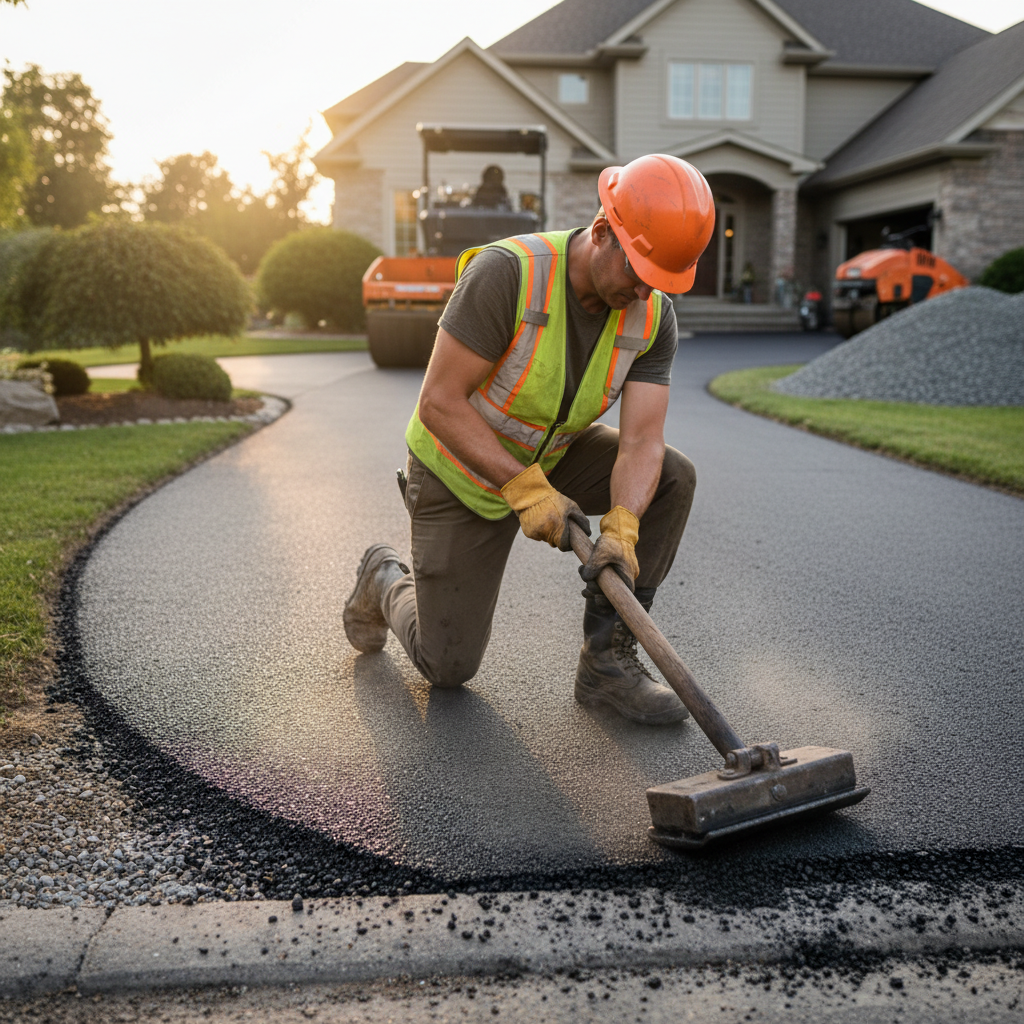
Driveway paving options and costs in Kingston
In Kingston, choosing the right driveway paving material comes down to budget, how much frost movement your base can handle, and how you plan to maintain the surface through winter. Most private driveways in the city serve single-detached homes—these make up about 48.0% of dwellings—so paving contractors often see similar driveway widths and service access needs across neighbourhoods. Kingston also has a large share of older housing stock; roughly 52.7% of homes were built before 1981, which often means you’ll be working around settled yards, older drainage patterns, and existing concrete that may need partial removal.
On the climate side, Kingston–Pembroke’s freeze–thaw cycles and typical frost penetration around 4 feet (about 1.2 m) are the main reasons quotes swing from one job to the next. When the ground is clay-prone or drainage is poor, excavation and imported aggregate to reach frost-influenced depth become a major cost driver, and the work often gets scheduled tightly because the paving window is shorter when temperatures stay below 0 °C. You’ll also feel labour and equipment pressure in high-demand areas—driveway replacements are especially busy around the West End (including neighborhoods near Princess Street and Sydenham area corridors) where access can be tighter.
Use the table below as a practical starting point for Kingston options, then we’ll narrow the estimate based on square footage, base depth, and whether there’s tear-out and drainage correction.
| Material |
Lifespan |
Maintenance |
Best For |
Price per sq ft |
Price Range |
| Asphalt (new installation, proper base) |
15–25 years |
Seal every 3–5 years; patch minor failures |
Good value with a smooth finish |
$5.00–$8.50 |
$4,500–$9,000 |
| Asphalt (overlay on existing gravel base) |
10–18 years |
More frequent sealing; watch for soft spots |
Lower upfront cost where the base is sound |
$4.75–$7.75 |
$4,000–$7,500 |
| Interlocking concrete pavers |
25–40 years |
Replace individual units as needed; joint sand upkeep |
Long-term curb appeal and easy spot repairs |
$9.00–$14.00 |
$6,500–$14,000 |
| Poured concrete (broom finish) |
25–30 years |
Seal selectively; repair spalls/cracks as they appear |
Strong, simple surface with steady performance |
$8.00–$13.00 |
$7,000–$15,000 |
| Exposed aggregate concrete |
25–30 years |
Seal every few years; manage joint/crack control |
Higher traction and decorative finish |
$10.00–$16.00 |
$8,000–$16,500 |
| Gravel / crushed stone (budget option) |
3–8 years |
Top up annually; manage rutting and washouts |
Temporary solution or low-cost overflow drive |
$3.00–$6.50 |
$2,000–$5,000 |
Prices are estimates only and vary by project scope, site access and material selection.
What affects the price of paving in Kingston
In Kingston–Pembroke, you can get quotes that differ by 30–50% for what looks like the same driveway because pricing is driven less by the “surface” and more by what’s underneath it—excavation depth, granular base quantity, compaction effort, drainage corrections, and how difficult the site is to work on. Even with the same asphalt choice, a clay pocket with poor drainage can force deeper base and more hauling than a flatter, rockier lot.
The frost line and freeze–thaw cycles are decisive in this region. Kingston commonly sees frost penetration near 4 feet, and that means your driveway design needs enough compacted granular thickness to limit heaving and cracking. In practice, base construction in Ontario is often thicker than in coastal areas to prevent movement—commonly in the 6–12 inch granular range depending on subgrade and whether you’re rebuilding from scratch. Asphalt also needs to be produced and laid to freeze-thaw specifications; a mix designed for local performance costs a bit more, but it helps reduce early surface raveling.
Timing matters too: hot-mix asphalt requires suitable air temperatures (often above 10 °C), and Kingston’s spring shoulder seasons can be wet. That tight paving window concentrates demand and can raise labour rates when schedules peak. For concrete, the cost impact shows up in finishing and reinforcement choices—air-entrainment and proper control-joint layout are critical to resist freeze damage.
To connect this to typical budgets: a properly built asphalt driveway often lands in the $4,500–$9,000 band, while interlocking pavers usually run higher due to the base, restraints, and unit setting—frequently in the $6,500–$14,000 range.
| Price Factor |
Why It Matters |
Cost Impact |
| Driveway area in sq ft |
The surface and base are priced per square foot; more width/length adds material and labour. |
Highest impact; can swing total by 40%+. |
| Base depth required |
Frost line determines granular thickness needed to prevent heaving and cracking. |
Higher depth often adds major excavation and import costs. |
| Grading and drainage work |
Slope correction, ditching, swales or French drains control water that otherwise softens subgrade. |
Can add several thousand dollars on wet/clayey sites. |
| Tear-out of existing surface |
Breaking concrete or milling old asphalt plus disposal increases labour and haul time. |
Often a top-3 variable cost item. |
| Edge restraints and curbing |
Restraints stop paver spread and keep asphalt from edge failures. |
Adds materials and installation time. |
| Sealing requirement |
Asphalt needs sealing after 6–12 months to protect against oxidation and moisture intrusion. |
Ongoing cost; impacts lifecycle value. |
| Site access |
Narrow driveways, slopes, soft lawns and long pushes slow equipment movement and add labour. |
Can raise unit costs even if materials are similar. |
| Asphalt mix specifications |
Freeze-thaw-rated mix costs more and is chosen for local performance in Ontario winters. |
Moderate increase; reduces early failures. |
Permits & regulations in Ontario
For most Kingston homeowners, paving a private driveway within your own property typically does not require a building permit. If you’re replacing or installing a surface entirely on your lot—new asphalt, pavers, or concrete in your driveway footprint—and you’re not altering municipal infrastructure, approvals are usually not required. However, work in the municipal right-of-way is a different story. If your project involves a new or changed driveway apron leading to the street, modifications to the boulevard area, adjustments to storm drainage, or changes that affect municipal curbing/road drainage flow, you should expect that municipal approval may be required. Kingston may also have lot-grading rules that restrict how close hard surfaces can be to property lines and how drainage must be managed.
Before any digging, step one is utility locates. Call Ontario One Call (and confirm all utility markings on-site) so the contractor can excavate safely. Then verify the contractor in three layers:
Step two: licensing. Ask for their Ontario paving contractor registration details (and confirm they’re operating appropriately for the work they’re doing). Step three: insurance. Request a current certificate of insurance (liability) showing adequate coverage for your project. Step four: WSIB/WCB coverage. Ask for proof of clearance or coverage so you’re not exposed if a worker is injured on your site.
Asphalt vs pavers vs concrete for Kingston driveways
In Kingston, the freeze–thaw climate makes base and drainage more important than brand names. That said, asphalt, interlocking pavers, and concrete each “answer” winter differently. Asphalt is the lowest upfront option in most cases, and it delivers a smooth ride, but it relies on a dense, well-built base and it needs sealing regularly—typically every 3–5 years—to limit oxidation and moisture penetration during Ontario winters. Interlocking concrete pavers have the highest upfront cost, but they’re very forgiving when one area fails: you can lift and re-set individual stones without demolishing the entire driveway, which matters if you ever see localized heaving after heavy spring melt. Poured concrete sits in the middle for upfront budget, but it must be air-entrained and properly finished and jointed to reduce cracking from freeze-thaw movement and from de-icing salts used during plowing.
For Kingston–Pembroke projects, you should plan on a frost-resistant granular base built to manage around that ~4-foot frost influence. With drainage, we typically look for positive slope away from the house and, when needed, add ditching or a French drain to prevent water from soaking the subgrade. If you’re in a neighbourhood with older drainage patterns—common in many pre-1981 properties—concrete and asphalt both can deteriorate faster unless the drainage correction is part of the scope.
Budget-wise, it’s easier to justify differences when you’re thinking long-term. For example, asphalt might fall around the $4,500–$9,000 band, while pavers could be $6,500–$14,000—the extra cost is often worth it if you want curb appeal and the ability to repair a small failed zone after a freeze-thaw season instead of replacing the whole surface.
| Material |
Frost Resistance |
Curb Appeal |
Repair Method |
Lifespan |
Price Band |
| Asphalt (sealed regularly) |
Good with proper base and freeze-thaw-rated mix |
Medium |
Patch or mill-and-replace small sections |
15–25 years |
$4,500–$9,000 |
| Interlocking concrete pavers |
Excellent if base and restraints are built correctly |
High |
Lift, rebuild base locally, reset pavers |
25–40 years |
$6,500–$14,000 |
| Poured concrete (air-entrained) |
Very good with air-entrainment and joints |
Medium–High |
Crack repair/seal; localized patching if needed |
25–30 years |
$7,000–$15,000 |
| Exposed aggregate concrete |
Very good with proper base and control joints |
High |
Localized patch or panel repair |
25–30 years |
$8,000–$16,500 |
| Permeable pavers (drainage grid) |
Good; helps manage surface water when designed right |
Medium–High |
Replace sections and refresh infill if needed |
20–35 years |
$7,500–$16,000 |
| Chip seal / tar-and-chip |
Moderate; depends heavily on base quality |
Low–Medium |
Rechip/overlay when worn |
7–12 years |
$4,000–$7,000 |
How to choose a paving contractor in Kingston
When you’re hiring a Kingston contractor, verify Ontario coverage and documentation first. For licensing, ask for their Ontario registration details relevant to the work being quoted and confirm they’re in good standing. For liability insurance, request a certificate of insurance showing your project address or job scope and adequate coverage. Next is WSIB/WCB: ask for proof of clearance or coverage before work starts so your home is protected if an incident happens on your driveway. Good paving companies keep these documents ready because they deal with municipalities and homeowners often.
Then get 2–3 itemised written quotes. I recommend quotes that break costs into labour and materials (excavation, base, geotextile if used, asphalt or pavers, compaction, forming, reinstatement, and disposal). Avoid “lump sum only” pricing unless the scope is extremely clear. Read what’s excluded: is disposal included? Is permit work included if a driveway apron or boulevard change is needed? Who replaces damaged sod or repairs lawn after equipment access? Warranty terms matter too—ask for workmanship warranty length and confirm whether the warranty is transferable to a future buyer.
On payment, never pay more than about 10–15% upfront. Hold back a portion until the job is complete and you’ve confirmed final grade, drainage, and clean-up. Finally, insist on a timeline in writing with a start date and estimated completion window; in Kingston, scheduling depends heavily on freeze–thaw timing and whether temperatures stay suitable for paving.
- Request WSIB/WCB clearance (or proof of coverage) before any equipment arrives.
- Verify liability insurance and ensure the certificate covers driveway paving work.
- Confirm the exact material specs (asphalt mix type; concrete air-entrainment; paver thickness).
- Make sure the quote states base depth targets and the compaction method.
- Ask whether geotextile is included for clay/soft subgrade.
- Check if drainage improvements (ditch swale/French drain) are scoped where needed.
- Confirm tear-out scope and whether broken material disposal is included.
- Ensure edge restraints are included (especially for pavers).
- For asphalt, confirm sealing is recommended and what timing is advised (often after 6–12 months).
- Get warranty details in writing: workmanship, exclusions, and duration.
- Clarify payment schedule and holdback amount.
- Require a written start date and completion estimate.
Red flags in Kingston include contractors who won’t provide WSIB/WCB clearance, quotes with no itemization (especially for base and drainage), pressure to take full payment upfront, vague warranty language, and promises that skip utility locates or imply they can dig “around” unknown services.
Frequently asked questions — paving in Kingston
What is a driveway apron and do I need one in Kingston?
A driveway apron is the paved portion that transitions between your driveway and the street/curb area—often at the location where your driveway meets the municipal roadway or boulevard. In Kingston, whether you need an apron and whether you need municipal approval depends on your exact setup: if you’re creating a new curb cut, changing the boulevard surface, or altering storm drainage around the street connection, approvals are commonly required. If you’re simply repaving within your property limits (your lot side), you may not need a permit, but you should still confirm drainage requirements. Either way, the most important point is drainage: water shouldn’t be directed toward the foundation or onto the boulevard.
How do I maintain my driveway through Kingston winters?
For Kingston winters, maintenance is mostly about preventing trapped moisture and limiting surface damage from plowing and de-icing. For asphalt, keep an eye out for small cracks and patch them early rather than letting water work under the surface. Use de-icing methods that protect the surface—salt can be harsh on some concrete mixes, so moderation and correct usage matters. Avoid scraping too aggressively with plow blades; sudden impact can break paver edges or spall concrete at corners. After spring melt, watch for soft spots or rutting—these are signs the base or drainage may need adjustment. If you’re budgeting, asphalt sealing is typically done after the initial set period and then every few years (timing varies), which helps protect against oxidation during freeze–thaw cycles.
Is it worth sealing a new driveway right away in Kingston?
Usually, it’s not worth sealing immediately “the day after paving” in Kingston. Asphalt needs time to cure so the sealer can bond properly and not trap moisture. Many contractors recommend sealing after the driveway has sufficiently cured—commonly within a 6–12 month window depending on weather and the specific product—then repeating on a cycle of roughly every 3–5 years. If your new asphalt project is in the typical $4,500–$9,000 range, sealing is part of protecting that investment, not an optional expense that you can skip forever. If you’re unsure, ask your contractor to specify the sealer product and schedule so you don’t accidentally seal too early or outside the correct conditions.
What is a chip seal driveway and is it suited to Kingston?
Chip seal (tar-and-chip) is a surface treatment where aggregate chips are bonded to a binder and then compacted. It’s more common for roads than private driveways, but it can be used on some properties if your site conditions and base are done correctly. In Kingston, chip seal can perform acceptably when drainage is strong and the base is stable, but it’s generally less durable than asphalt paving or pavers in the long run. Snowplowing impact and freeze–thaw movement can also affect how chips stay locked in place. If you want a lower upfront approach, a chip seal might fit within a $4,000–$7,000-type band, but it may require re-treatment sooner than a full asphalt install.
How much does driveway crack repair cost in Kingston?
Crack repair cost in Kingston depends on the type of crack, how far it has progressed, and whether water has already infiltrated under the surface. Small, stable cracks often cost less than full-depth repairs. For budgeting, many homeowners fall into the general “sealing & repair” planning range of $400–$1,800, but the final number changes with driveway length, access, and whether material removal (cutting/grinding) is needed. If the crack is associated with edge failure, poor drainage, or underlying base issues, sealing alone may not solve the problem—those jobs can shift toward a larger patch or partial rebuild.
What base thickness do I need for pavers in Kingston?
For pavers in Kingston, base thickness depends on your subgrade (clay versus well-draining soil), drainage, and how much frost influence you must resist. Given the region’s frost penetration often around 4 feet, you usually can’t rely on a thin base; you need a properly compacted granular layer and often additional depth if the subgrade is soft or holds water. In many Ontario driveway builds, homeowners should expect a granular foundation that totals in the rough range of 6–12 inches depending on soil conditions and whether you’re rebuilding from scratch. The best way to know your required thickness is a site assessment: look for pumping/rutting after melt, drainage direction, and any previous failures. A contractor should also include edging restraints so the base and paver structure aren’t undermined at the edges.