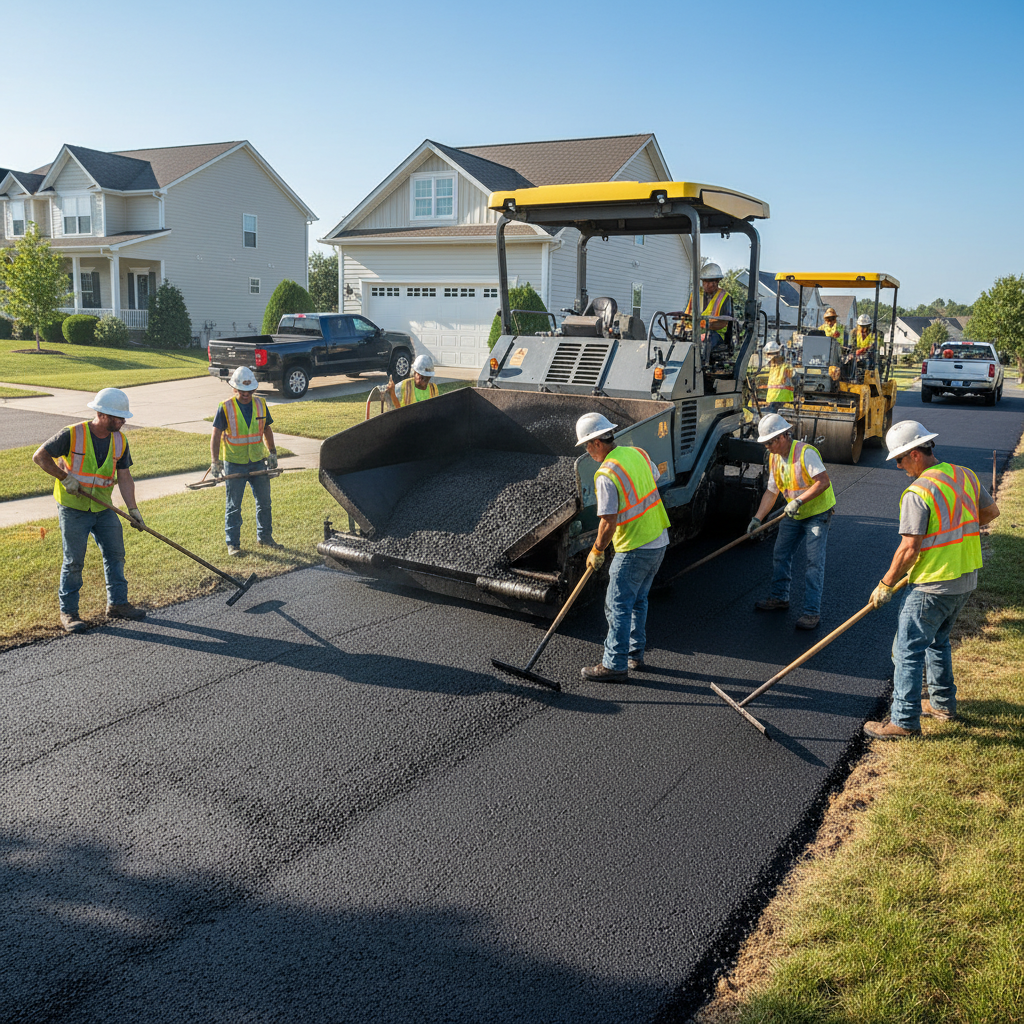
Driveway paving options and costs in Erin
In Erin, choosing a driveway surface is largely about balancing upfront cost with how well the material handles freeze-thaw weather. That matters here because 91.5% of dwellings are single-detached homes, and most private driveways serve cars year-round, not just in summer. Erin also has a significant older housing stock—58.2% of homes were built before 1981—so you’ll often see driveways with older granular layers, settled bases, or drainage issues that need correcting before any new asphalt or concrete goes down.
In the Kitchener–Waterloo–Barrie market, frost depth and freeze-thaw cycles are major cost drivers. Practically, that means more excavation, deeper, well-compacted granular base, and reliable drainage to reduce heaving, settlement, and cracking. Hot-mix asphalt also needs air temperatures above about 10°C for proper placement, so the paving season is tighter and crews/plants get scheduled quickly in spring—pricing can move when demand is high. That’s why two neighbours with “similar” driveways can see meaningfully different bids if one lot needs more tear-out, edge restraint, or drainage correction.
In Erin’s more actively developed pockets like the Erin Village area, we commonly see new curb cuts and driveway expansions that increase demand for dependable base prep and timely scheduling. The next step is comparing the typical options and price ranges for projects that start with a properly designed base and drainage.
| Material |
Lifespan |
Maintenance |
Best For |
Price per sq ft |
Price Range |
| Asphalt (new installation, proper base) |
15–25 years |
Seal every 3–5 years; patch minor cracks |
Lowest upfront asphalt option with good base |
$5.00–$10.00 |
$3,500–$7,000 |
| Asphalt (overlay on existing gravel base) |
12–20 years |
Seal every 4–6 years; watch for base movement |
When you keep a stable existing granular base |
$4.50–$9.00 |
$3,500–$6,500 |
| Interlocking concrete pavers |
25–40 years |
Joint sand top-ups; replace individual stones if needed |
Curb appeal and easy localized repairs |
$12.00–$22.00 |
$12,000–$22,000 |
| Poured concrete (broom finish) |
20–30 years |
Seal (optional but helpful); repair spalls/cracks |
Simple, durable surface with straightforward upkeep |
$10.00–$16.00 |
$9,000–$16,000 |
| Exposed aggregate concrete |
20–30 years |
Sealer every few years; minor crack sealing as needed |
Slip-resistant finish and decorative look |
$12.00–$18.00 |
$10,500–$18,000 |
| Gravel / crushed stone (budget option) |
3–8 years (surface layer) |
Top up annually; re-grade; weed control |
Lowest first cost and temporary driveway solution |
$3.00–$6.00 |
$2,000–$4,500 |
Prices are estimates only and vary by project scope, site access and material selection.
What affects the price of paving in Erin
In Kitchener–Waterloo–Barrie, it’s common to see driveway quotes swing by 30–50% for the “same” look on the surface. The most frequent reason isn’t the paver or asphalt itself—it’s what happens underneath. Two driveways can share the same square footage, but the price changes when one lot has soft subgrade, poor drainage, deeper frost-protection base requirements, or a tight access path that slows equipment and increases labour time. Labour rates and demand also tighten in spring; asphalt placement requires suitable conditions (air temperatures typically above 10°C), and when crews are booked, scheduling pressure can raise total project costs.
Frost line depth and freeze-thaw cycles are decisive cost factors in Erin’s region. Colder Ontario conditions usually require a deeper, well-compacted granular base to resist heaving and cracking—think about 6–12 inches of granular thickness in many residential driveway builds depending on soil and design, versus thinner coastal builds. That added depth means more aggregate hauled in, more compaction testing/effort, and more excavation, which directly increases the installed price. Asphalt mix design also needs freeze-thaw resilience; paying for the right mix and placement workmanship matters.
For concrete, local conditions can raise cost when older homes require significant tear-out and regrading to handle surface water. For example, if your driveway is built on material that has settled over time, re-levelling can add several hundred to a few thousand dollars before any new asphalt at $3,500–$7,000 levels can even start. On higher-end surfaces like interlocking pavers at $12,000–$22,000, the base and edge restraint are more substantial, so drainage and base correction often take up a larger portion of the budget.
| Price Factor |
Why It Matters |
Cost Impact |
| Driveway area in sq ft |
Materials and labour scale directly with surface area |
Large driver; typically 40–70% of total cost |
| Base depth required |
Frost protection requires more granular thickness in colder Ontario |
Can add thousands where soil is soft or drainage is poor |
| Grading and drainage work |
Correct slope and manage water reduces future cracking/settlement |
Often increases cost by 10–30% |
| Tear-out of existing surface |
Breaking and hauling concrete or old asphalt adds time and disposal |
Commonly adds 15–35% depending on thickness |
| Edge restraints and curbing |
Prevents paver spread and asphalt edge breakdown |
Moderate add; can be critical for long driveways |
| Sealing requirement |
Asphalt needs sealcoating after placement to protect binder |
Lower upfront; ongoing maintenance budgeted every 3–5 years |
| Site access |
Narrow lots slow equipment and increase labour hours |
Can add 5–20% based on staging distance |
| Asphalt mix specifications |
Freeze-thaw-rated mix holds up better in Ontario winters |
Small-to-moderate increase but improves longevity |
Permits & regulations in Ontario
In Ontario, most homeowners don’t need a building permit to pave a private driveway within their own property limits. Typically, you don’t require a permit for surface work such as overlaying asphalt on an existing drive, replacing worn-out driveway surfaces, or installing interlocking pavers where the work stays on private property and doesn’t alter municipal infrastructure.
However, you may need municipal approval when the work affects the area controlled by the municipality, especially the municipal right-of-way. This commonly includes new or modified curb cuts, changes to the boulevard, altering storm drainage patterns, or reworking the ditch/swale where runoff is supposed to go. Some municipalities also restrict lot grading and how close a hard surface can be to property lines or drainage swales to protect downstream lots and prevent ponding.
Step-by-step, here’s how Erin homeowners protect themselves before excavation starts:
- Call for utility locates through Ontario One Call before any digging; never assume lines are where they “look” to be.
- Confirm lot-grading rules with the Township/City office for your address, especially if you plan to raise the driveway height.
- Verify contractor licensing (if required for the work type) and request proof of liability insurance before work begins.
- Ask for WSIB/WCB coverage evidence and confirm it applies to the people on your job site.
- Request a clearance/COI that lists your address (or at least names the project/municipality as applicable) so you have documentation.
Asphalt vs pavers vs concrete for Erin driveways
For Erin’s freeze-thaw winters, asphalt, interlocking pavers, and concrete can all perform well when the base and drainage are done right—but they feel different over time. Asphalt is usually the lowest upfront option and offers smooth, quiet driving. In our Ontario climate, it needs regular maintenance: sealcoating typically every 3–5 years helps protect the binder from moisture intrusion that accelerates cracking.
Interlocking concrete pavers cost more to install, but they’re often the best choice if you value curb appeal and want repairs without tearing out the whole driveway. Because individual stones can be lifted and reset, localized settlement doesn’t force a full replacement the way some slab issues can. Their performance hinges on a well-compacted base, correct bedding sand depth, and proper edge restraints.
Poured concrete is mid-range to higher, and when air-entrained and properly finished, it can handle Ontario winters. The weak point is cracking—freeze-thaw movement and de-icing salt exposure can open hairline cracks if joints aren’t treated and the mix isn’t air-entrained.
In the Kitchener–Waterloo–Barrie market, most durable builds share the same underlying recipe: deeper granular base for frost resilience, positive drainage away from the home, and a slope that doesn’t trap water. If your driveway is priced near $3,500–$7,000 for asphalt, the savings can be justified if you’re comfortable with sealing and patching. If you’re considering a paver driveway around $12,000–$22,000, the added cost is often justified on long driveways, higher visibility locations, or when you expect future spot repairs.
| Material |
Frost Resistance |
Curb Appeal |
Repair Method |
Lifespan |
Price Band |
| Asphalt (sealed regularly) |
Good with proper base and freeze-thaw rated mix |
Medium |
Mill and patch; crack repair then seal |
15–25 years |
$3,500–$7,000 |
| Interlocking concrete pavers |
Very good when base is compacted and edges restrained |
High |
Lift/replace individual stones or small sections |
25–40 years |
$12,000–$22,000 |
| Poured concrete (air-entrained) |
Good if air-entrained and joints are done correctly |
Medium to High |
Concrete crack sealing; targeted patch repairs |
20–30 years |
$9,000–$16,000 |
| Exposed aggregate concrete |
Good with proper curing and sealing |
High |
Patch and resurface limited areas |
20–30 years |
$10,500–$18,000 |
| Permeable pavers (drainage grid) |
Very good for managing runoff if designed correctly |
High (often decorative) |
Replace sections; maintain infill/gravel layer |
20–35 years |
$13,500–$24,000 |
| Chip seal / tar-and-chip |
Moderate; relies on good stone embedment and weathering |
Low to Medium |
Spot chip topping and re-sealing |
5–12 years |
$3,000–$6,000 |
How to choose a paving contractor in Erin
When you’re hiring for an Ontario driveway in Erin, start with proof. Ask the contractor for (1) general liability insurance, (2) WSIB/WCB coverage evidence for their workers, and (3) the correct Ontario registrations/licences for the work they’ll perform. You can then verify the insurance certificate of insurance (COI) matches the company name on the quote, and confirm workers are covered for the dates of your project. If you’re working near municipal drainage or a curb cut, coverage and documentation matter even more.
Next, get 2–3 itemised written quotes, not just a lump sum. You want a breakdown that separates excavation, haul/disposal, granular base thickness, asphalt/paver/concrete supply, compacting, and surface finishing, plus the allowance for any drainage/grading changes. Make sure the quote clearly states whether permits/approvals are included (when applicable), and whether removal and disposal of the existing driveway are priced.
Warranty is your safety net: request the workmanship warranty length and whether it covers labour only or labour + materials. Also ask about the product/manufacturer warranty and whether it transfers to you if you sell your home. For payment, keep it sensible—never pay more than about 10–15% upfront, and hold back a portion until the job is complete and surfaces meet finish standards. Finally, confirm the start date and completion estimate in writing; in Erin’s colder season, schedule clarity reduces the risk of unfinished work through weather swings.
- Verify their company name on the quote matches the COI.
- Request WSIB/WCB evidence and confirm coverage applies to your job timeframe.
- Ask for recent local references in Erin or nearby communities.
- Confirm the proposed base thickness and granular specs in writing.
- Make sure drainage/slope correction is explicitly included or excluded.
- Get disposal details: what gets hauled away and where it goes.
- Check whether edge restraints/curbing are included for pavers/asphalt edges.
- Ask how cracks are handled: sealing plan and timing.
- Confirm the paving/curing schedule (especially for concrete) in the contract.
- Confirm asphalt sealcoat timing (often after a curing period) and whether it’s included as an optional line item.
- Review warranty terms in plain language, including exclusions for settlement.
- Require a written start/completion timeline and weather contingencies.
Red flags in Erin include “cheap” quotes that skip base thickness details, crews starting before utility locates are done, vague scope language like “patch and pave” without specifying tear-out and disposal, refusal to provide COI/WSIB/WCB paperwork, and contracts that demand large upfront payments or won’t include completion dates.
Frequently asked questions — paving in Erin
What is a driveway apron and do I need one in Erin?
A driveway apron is the transition section between the driveway and the street—often tied to the curb cut and how vehicles roll over the curb/boulevard area. In Erin and across Ontario, whether you need an apron depends on your exact location and how the driveway connects to the municipal boundary. If you’re creating a new curb cut, widening the driveway entrance, or changing drainage in the boulevard/ditch area, that’s typically where an apron (and sometimes municipal approval) becomes relevant because runoff and vehicle loading affect the curb and sidewalk edges. For purely private-area replacement on your property, homeowners commonly don’t need a municipal apron change. The safe approach is to ask your contractor to confirm the exact connection details and, if municipal right-of-way is involved, request approval before excavation.
How do I maintain my driveway through Erin winters?
In Erin, the goal is to prevent water from getting under the pavement and to limit surface damage from freeze-thaw. For asphalt, apply crack repairs and keep an eye on any small edge failures—patching early is cheaper than waiting for water to infiltrate the base. During winter, use sand for traction when possible, and keep de-icing salt off the surface as much as you realistically can; salt can accelerate binder wear and concrete deterioration. After plowing, try not to “lift” the edges with the blade—gentle, consistent plow technique matters. If you have pavers, clear snow carefully and avoid chipping the edges where stones meet restraints. Regular sealing (for asphalt) and prompt joint/surface repairs after the first few freeze-thaw cycles help protect your investment.
Is it worth sealing a new driveway right away in Erin?
Usually, you don’t seal immediately the day asphalt is laid. New asphalt needs time to cure so the sealer can bond properly and not trap moisture inside the pavement layers. In Erin’s Ontario freeze-thaw climate, properly timed sealing after installation is worth it because it slows moisture penetration and helps reduce surface oxidation that leads to cracking. Most homeowners plan for sealcoating after the asphalt has cured and the weather window is right—commonly a few months after install depending on temperature and product requirements. If your bid is in the asphalt range (often around $3,500–$7,000 for a typical residential driveway), ask whether sealing is included or priced as a separate line item so you can budget for it. Sealing is also usually lower-cost maintenance than full resurfacing.
What is a chip seal driveway and is it suited to Erin?
Chip seal (tar-and-chip) is a surface treatment that uses an asphalt binder sprayed on a prepared base, then followed by stone chips that get embedded and compacted. It can be a budget-friendly option in some Ontario settings, but it’s generally best suited for low-speed rural driveways or areas where appearance requirements are modest. In Erin, the freeze-thaw cycle can loosen chips over time if the base prep and drainage aren’t excellent, and sanding/plowing can change the look sooner than on thicker asphalt overlays. That said, if you want a cost-controlled surface and you’re comfortable with periodic re-treatments, a contractor can sometimes design it to perform reasonably. If you’re aiming for a longer-term driveway finish, asphalt paving or pavers typically provide better longevity; chip seal often wears faster, and you should treat it as a maintenance-scheduled surface.
How much does driveway crack repair cost in Erin?
Crack repair pricing in Erin usually depends on the type and size of the cracks, whether it’s a simple crack fill, a wider joint repair, or a localized patch to correct base movement. For many residential jobs, homeowners can expect repairs in the rough range of $250–$1,500 for sealing/crack fill and limited patching. If the crack indicates subgrade movement or drainage failure, the cost can rise because proper prep (cleaning out, stabilizing, and patching) is required to stop recurrence. That’s why it’s smart to get an on-site assessment instead of just sealing everything blindly—filling surface cracks can help, but it won’t fix ongoing settlement. When you’re quoted, ask what they’ll do to prevent water migration, especially in colder Ontario freeze-thaw conditions.
What base thickness do I need for pavers in Erin?
For interlocking pavers in Erin, base thickness depends on soil conditions, frost considerations, and whether you’re building over stable material or correcting an existing settlement/drainage issue. In the Kitchener–Waterloo–Barrie area, the deeper, well-compacted granular base helps resist heaving and cracking from repeated freeze-thaw. A contractor typically builds pavers on a compacted granular base designed for your driveway load and subgrade, plus a bedding sand layer that helps lock pavers in place. If your existing base is unstable, you’ll need more excavation and base replacement than if you have solid, well-draining soil. Because 58.2% of Erin homes were built before 1981, older driveways often need more prep when soil has shifted. The best way to confirm thickness is an on-site evaluation; a good quote should clearly state the proposed base layers and compaction approach rather than giving only a price.