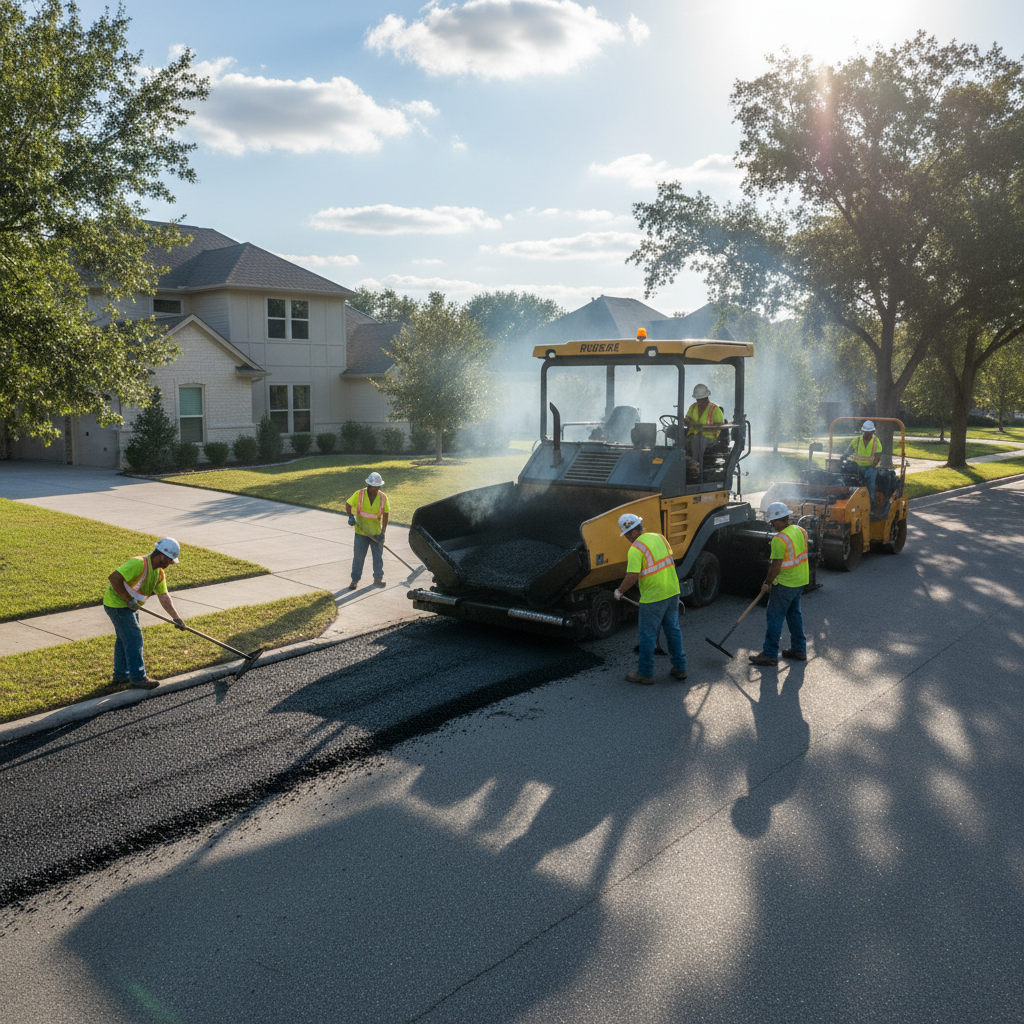
Driveway paving options and costs in Danforth East York
Danforth East York is a dense, established part of Toronto where driveways are common and access can be tight, especially around the Danforth corridor and side streets. With a 2021 population of 17,180 in the area (Statistics Canada, 2021 Census), there’s steady demand from homeowners maintaining older properties as well as upgrading driveways tied to detached homes in the neighbourhoods where a lot of private parking is still on-site. In practice, most driveway work here is designed around Toronto’s freeze–thaw reality: water that gets under pavement can freeze and lift the surface, so base thickness, compaction, and drainage details drive both performance and price.
Because frost depth in Toronto is commonly around 3–4 feet, contractors typically plan a deeper, well-compacted granular base and include reliable drainage so the driveway doesn’t “pump” during winter. At the same time, paving season is effectively limited to late spring through early fall, with hot-mix asphalt placement preferred above certain temperatures. That compressed schedule can concentrate bookings and increase pricing for prime dates.
Below is a practical cost comparison for common driveway choices in Danforth East York, including how they typically hold up and what maintenance you should plan for. Use this table to sanity-check proposals before you narrow down to the best material for your site conditions and budget.
| Material |
Lifespan |
Maintenance |
Best For |
Price per sq ft |
Price Range |
| Asphalt (new installation, proper base) |
15–25 years |
Seal coating every 3–5 years; minor patching as needed |
Smoother, cost-effective paved surfaces with good value |
$6.00–$11.00 |
$3,500–$8,000 |
| Asphalt (overlay on existing gravel base) |
10–18 years |
Seal coating as above; may require more frequent patching if base shifts |
Lower-cost upgrades when excavation is limited |
$5.50–$10.00 |
$3,200–$7,000 |
| Interlocking concrete pavers |
25–40 years |
Weeding/sanding as needed; re-leveling of sections if required |
Premium curb appeal and repairable, “replace-in-sections” design |
$14.00–$25.00 |
$9,000–$20,000 |
| Poured concrete (broom finish) |
20–30 years |
Crack monitoring; occasional patching; keep de-icing management tight |
Low ongoing fuss with strong structural performance |
$10.00–$18.00 |
$6,000–$15,000 |
| Exposed aggregate concrete |
20–30 years |
Seal occasionally; patching where needed |
Slip-resistant finish and higher-end look |
$12.00–$20.00 |
$7,000–$16,000 |
| Gravel / crushed stone (budget option) |
3–8 years (varies by drainage and base) |
Regrading and topping up yearly; weed control; washboarding prevention |
Lowest upfront cost when you’re prioritizing budget over permanence |
$3.50–$6.00 |
$1,500–$4,000 |
Prices are estimates only and vary by project scope, site access and material selection.
What affects the price of paving in Danforth East York
Even when you’re paving the same-sized driveway, Danforth East York quotes can swing by 30–50% across the Toronto region and Ontario because contractors price risk differently: how much excavation is required, what the existing base is like, how difficult access is for skid steers/rollers, and how much drainage correction is built into the plan. In a place where many driveways were originally laid decades ago, the “hidden” condition of the subgrade often determines how much work is truly needed.
In our market, frost depth and freeze–thaw cycles are decisive cost factors. With ground freezing around 3–4 feet in Toronto, you generally need a thicker, properly compacted granular base so the pavement doesn’t heave and crack when moisture freezes. Asphalt and concrete both perform better when the base is engineered to resist movement, but the base itself is where cost rises—more excavation, more imported stone, and more compaction passes. Asphalt placement is also time- and temperature-dependent; hot-mix asphalt typically needs air temperatures above about 10°C, so scheduling pressure in the late spring to early fall window can push prices toward the higher end of the bands.
Concrete can cost more than an entry asphalt job (often in the $6,000–$15,000 band) when air-entrainment, jointing, and drainage details are done correctly to manage winter salt and movement. Interlock may jump toward the $9,000–$20,000 band when a project includes curb/edge restraints, a larger bedding layer, and a more detailed layout (curves, soldier courses, or tight borders). A properly designed drainage swale or catch-basin tie-in can also add real money, but it often prevents repeat repairs.
Use these factors as a checklist: if two quotes both mention “good base,” ask for base thickness and drainage specifics—those details usually explain whether you land closer to the lower or higher pricing in the asphalt and paver bands.
| Price Factor |
Why It Matters |
Cost Impact |
| Driveway area in sq ft |
Material and labour scale directly with square footage |
Largest variable; commonly moves total cost by the most |
| Base depth required |
Toronto frost depth pushes designers toward deeper granular thickness and compaction |
Can add significant excavation and imported stone costs |
| Grading and drainage work |
Proper slope and drainage prevent water pooling and winter damage |
Often increases cost, but reduces long-term failure risk |
| Tear-out of existing surface |
Breaking concrete or removing old asphalt requires disposal and extra labour |
Can raise the project price noticeably versus “overlay” work |
| Edge restraints and curbing |
Prevents paver spread and asphalt raveling at the perimeter |
Moderate to major cost add depending on borders |
| Sealing requirement |
Asphalt in freeze–thaw climates needs seal coating to slow oxidation |
Typical maintenance budget; affects life-cycle cost |
| Site access |
Narrow lots and tight turns slow equipment movement and add labour time |
Can add “production time” charges and manual work |
| Asphalt mix specifications |
Freeze–thaw-rated mix design improves durability in winter conditions |
Higher material cost; often worth it in Toronto |
Permits & regulations in Ontario
In Ontario, paving your private driveway within your own property usually does not require a building permit. Where permits and approvals often come into play in Danforth East York is when the work touches the municipal right-of-way—for example, new or changed curb cuts, alterations to the boulevard, or changes that affect municipal storm drainage. If your project includes adjusting drainage patterns that tie into the city system, you should expect municipal approval requirements.
Another common issue is lot-grading rules. Some areas enforce bylaws or requirements around how water can be directed near property lines and how close hard surfaces can be built to boundaries. That’s why even small “cosmetic” changes—like raising an apron height—can require review.
Step-by-step, here’s how a homeowner in Danforth East York can verify a contractor:
- Confirm excavation plans using utility locates via Ontario One Call before any digging.
- Ask for the contractor’s Ontario business registration and, where applicable, paving/trade credentials used for contracting in Ontario.
- Request a certificate of insurance showing liability coverage.
- For worker protection and payroll coverage, ask for proof of WSIB/WCB coverage and confirm it matches the job site/work being performed.
- Get the proposed scope tied to who pulls permits (if needed) and who is responsible for inspections.
- Request the contractor’s written warranty terms before work begins.
When in doubt, ask the municipality directly about right-of-way impacts and lot-grading requirements, then ensure the contractor’s scope matches what’s allowed.
Asphalt vs pavers vs concrete for Danforth East York driveways
In Danforth East York, the best driveway material is the one that manages water movement and winter stress effectively. Asphalt is typically the lowest upfront cost—often landing in the $3,500 – $8,000 range depending on size and base work—but it requires regular sealing every 3–5 years. That protective layer is important here because Toronto’s freeze–thaw cycles and winter maintenance (salt, sanding, and frequent snow events) accelerate wear on the binder if you skip maintenance.
Interlocking concrete pavers cost more—commonly $9,000 – $20,000—but they offer excellent curb appeal and a practical repair advantage. If a section is damaged by soil movement or drainage issues, you can lift and re-lay that portion without demolishing the entire driveway. That matters in older Toronto neighbourhoods where unseen base issues can appear over time.
Poured concrete usually sits mid-range, often $6,000 – $15,000, and can be very durable when it’s air-entrained and properly jointed. However, freeze–thaw expansion and contraction can lead to cracking if drainage isn’t right or joints don’t allow controlled movement. Exposed aggregate improves slip resistance and looks, but it still needs the same base and drainage discipline.
For a simple example, if your asphalt quote is near the middle of the band (say roughly $4,800 – $6,500) and interlock comes back in the lower-to-mid portion of its band, that extra cost is usually justified when curb appeal, repairability, and long-term “no re-pour” flexibility matter to you—especially if your driveway access is tight and you want localized fixes instead of major resurfacing later.
| Material |
Frost Resistance |
Curb Appeal |
Repair Method |
Lifespan |
Price Band |
| Asphalt (sealed regularly) |
Good when base is engineered and drainage is correct |
Medium (clean, uniform look; less “stately” than interlock) |
Patch and compact localized areas; re-seal as part of maintenance |
15–25 years |
$3,500–$8,000 |
| Interlocking concrete pavers |
Excellent with proper bedding and edge restraints |
High (strong visual curb appeal) |
Lift/re-lay damaged pavers and re-level that section |
25–40 years |
$9,000–$20,000 |
| Poured concrete (air-entrained) |
Good when air-entrained and jointed for movement |
Medium (simple, modern finish options) |
Crack repair/patching; larger sections may require partial or full replacement over time |
20–30 years |
$6,000–$15,000 |
| Exposed aggregate concrete |
Good when properly cured and detailed at edges/joints |
High (premium texture and slip resistance) |
Patch with matching finish where feasible |
20–30 years |
$7,000–$16,000 |
| Permeable pavers (drainage grid) |
Very good for managing water if the underdrain is correctly designed |
High-to-very-high (engineered look; great for drainage-focused homes) |
Localized replacement of units; periodic inspection/cleaning of drainage system |
20–35 years |
$10,000–$22,000 |
| Chip seal / tar-and-chip |
Fair to good, but can be less consistent over severe Toronto winters |
Low-to-medium |
Spot re-chip and seal maintenance |
5–12 years |
$3,000–$6,500 |
How to choose a paving contractor in Danforth East York
Choosing the right contractor matters more in Danforth East York than in many warmer regions because your driveway must survive repeated freeze–thaw cycles and heavy winter maintenance. Start by verifying Ontario licensing (as applicable to their trade/contracting activity), then confirm liability insurance and WSIB/WCB coverage. How to check: request a current insurance certificate naming you (or showing it covers the work), and ask for a WSIB/WCB account confirmation or clearance letter that matches the period of the job. If a contractor won’t provide documents promptly, that’s a major warning sign.
Get 2–3 itemised written quotes rather than one lump-sum estimate. You want a breakdown that includes labour and materials: excavation, granular base (with thickness and compaction method), asphalt mix type, paving thickness, curb/edge restraints, and any drainage adjustments. Ask what’s included for disposal of existing material, and whether a permit or municipal right-of-way approval is necessary for your driveway approach.
On warranty, request both the workmanship warranty length and the product/manufacturer warranty, and whether the coverage is transferable to future owners if you sell. Payment should be controlled: never pay more than 10–15% upfront, and hold back a portion until the job is complete and you’ve done a final walkthrough.
Finally, insist on a written start date and an estimated completion timeline. In Toronto’s shorter paving season, this protects you from delays during peak scheduling.
- Ask for base thickness and compaction details (not just “we’ll do a good base”).
- Request a drainage plan for how water will leave the driveway.
- Confirm disposal: where old asphalt/concrete will be hauled.
- Get details on edge restraints/curbing for pavers or asphalt edges.
- Ensure utility locates are included before any excavation (Ontario One Call).
- Verify liability insurance certificate before work starts.
- Verify WSIB/WCB coverage for workers on-site (clearance letter/proof).
- Ask about crew experience with freeze–thaw-ready installation methods.
- Request a written warranty with what’s covered and for how long.
- Confirm whether materials have manufacturer certification/spec sheets.
- Clarify payment schedule and retainage (holdback until final sign-off).
- Make sure the quote lists exclusions clearly (what’s not included).
Red flags I commonly see in the Danforth East York market: contractors who quote over the phone without a site visit, quotes that omit base thickness and drainage, “cash discount” offers that skip insurance paperwork, unclear warranty terms, and timelines that don’t account for Toronto’s tight spring-to-fall paving window.
Frequently asked questions — paving in Danforth East York
How do I get the most accurate paving quote in Danforth East York?
To get a dependable quote in Danforth East York, insist on an in-person site visit where the contractor checks existing base conditions, drainage, and how water currently moves off your property. Ask for the base thickness proposed (especially important here because Toronto commonly has a deep frost line and repeated freeze–thaw cycles). Request an itemised labour/materials breakdown rather than a single lump sum so you can compare like-for-like: excavation, granular base depth, compaction method, asphalt thickness or concrete mix details, and edge restraints. Also confirm whether the contractor includes utility locates, disposal, and (if your driveway ties into municipal works) who handles any right-of-way approvals. Finally, share photos of prior repairs and any areas that heave, crack, or pond.
How much does it cost to pave a driveway in Danforth East York?
Cost mainly depends on square footage, how much excavation is needed, and whether drainage corrections are required. For asphalt new installation with a properly prepared base, Toronto-area projects often land in the $3,500 – $8,000 range. If you’re choosing interlocking concrete pavers, budgets commonly reach $9,000 – $20,000 depending on layout complexity and base prep. Poured concrete frequently falls in the $6,000 – $15,000 band, with air-entrainment and jointing details affecting price. Because Toronto’s paving season is shorter, prime scheduling can also nudge pricing upward compared with off-peak dates. The most reliable way to narrow your number is an itemised quote that addresses frost-resilient base design.
Asphalt vs interlocking pavers vs concrete — which is best in Danforth East York?
There isn’t one “best” option for every Danforth East York driveway—there’s the best fit for your priorities and site conditions. Asphalt is usually the most cost-effective upfront choice, but it requires seal coating every 3–5 years to protect the binder in freeze–thaw winters. Interlocking pavers usually cost more, yet they’re highly repairable in sections, which is valuable if localized base movement or drainage issues develop over time. Concrete (especially air-entrained mixes with proper jointing) can be durable, but it’s more sensitive to poor drainage and restrained movement; cracks can show where water infiltration and freeze–thaw stress aren’t managed. If you want curb appeal and easy partial repairs, pavers are hard to beat. If budget and a smooth finish matter most, asphalt often wins—provided your contractor designs the base for Toronto frost depth.
How long does a paved driveway last in Danforth East York?
With the right base, drainage, and installation approach, asphalt driveways commonly last 15–25 years, while concrete typically ranges around 20–30 years. Interlocking pavers often reach 25–40 years because damaged sections can be lifted and re-laid without replacing the entire surface. In Toronto’s climate, the difference between “average” and “excellent” longevity usually comes down to moisture management: if water gets under the driveway and freezes repeatedly, you’ll see heaving, cracking, and early edge failures. Maintenance matters too—seal asphalt on schedule (often every 3–5 years) and keep edges and joints in good condition for pavers. The presence of de-icing salt and how plowing is performed can also influence wear, especially on concrete surfaces.
When is the best time of year to pave in Danforth East York?
For Danforth East York, the practical paving window is late spring through early fall. Hot-mix asphalt placement is generally preferred when air temperatures are above about 10°C, and contractors also need the base to be dry enough for compaction and paving. That’s why demand spikes in the short Ontario season and why rush scheduling can increase pricing. The best time is typically a stretch after consistent warm weather arrives in spring, and before early fall cool-downs start reducing production. If you’re aiming to coordinate driveway work with other landscaping projects, plan your drainage grading and base prep first; then pave when weather conditions allow proper asphalt or concrete curing and finishing. Your contractor should provide a start date and a completion estimate in writing.
How deep should the base be for Danforth East York's frost?
In Danforth East York, base depth is driven by Toronto’s frost line and the freeze–thaw cycle severity, which is why deeper, well-compacted granular base design is common. While exact depths depend on soil conditions and engineering for your driveway, a typical approach in Ontario is a deeper base than many homeowners expect—often in the range of several inches of granular materials with total structural thickness built to resist heaving. If a quote doesn’t specify granular thickness, compaction passes, and drainage details, it’s a red flag because frost protection isn’t one-size-fits-all. The goal is simple: prevent water from sitting under pavement and freezing, which is what causes lifting and cracking. Have the contractor assess your existing subgrade, confirm drainage, and then document the proposed base depth in the written scope.