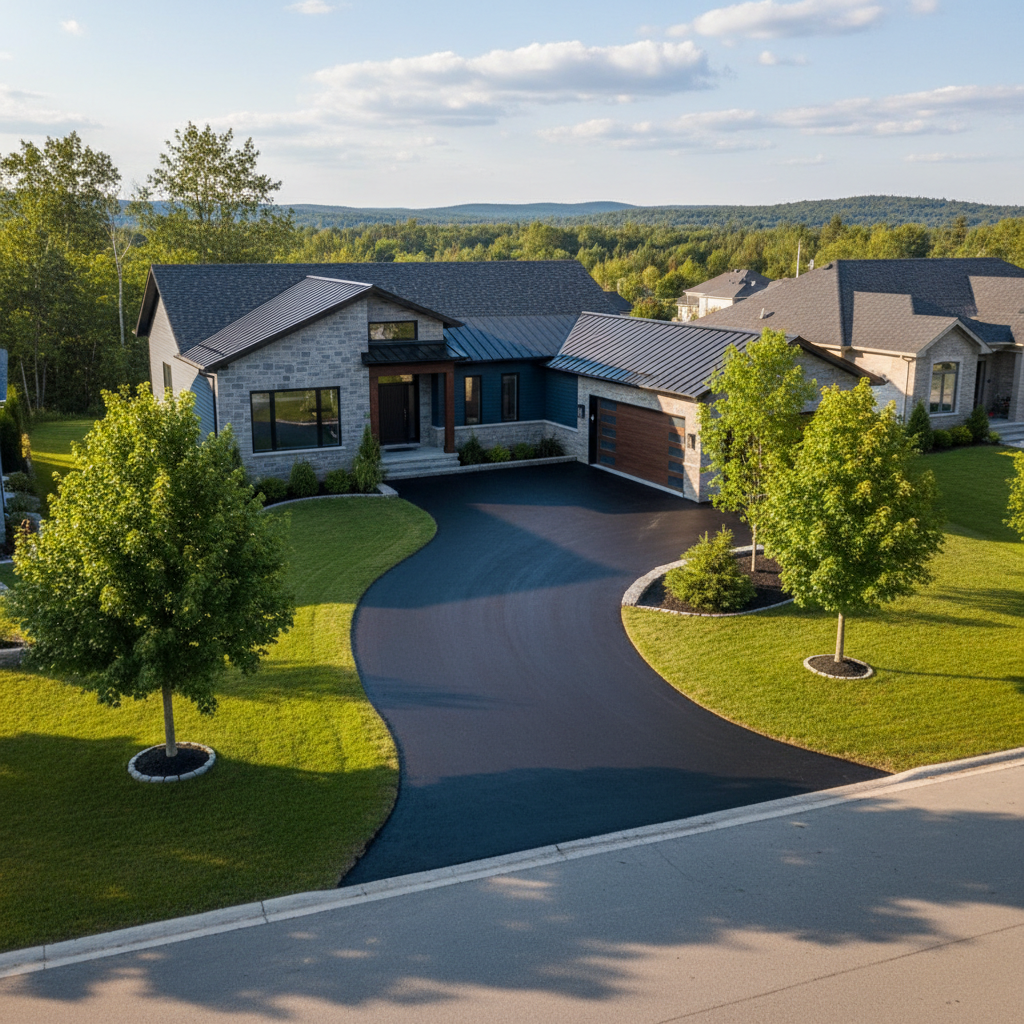
Driveway paving options and costs in Russell
Russell, Ontario driveways are built for a tough Ottawa-area climate, and that shows up in every quote homeowners receive. With 79.0% of local dwellings being single-detached homes (Statistics Canada, 2021 Census), most private driveways are tied to detached properties—meaning larger, heavier-duty residential entrances and frequent plough/snow-storage use. Russell’s housing mix also matters: 21.6% of homes were built before 1981 (Statistics Canada, 2021 Census), and older lots often have drainage challenges or regrading needs that add cost during prep.
In the Ottawa economic region, frost penetration is commonly modeled around 1.8 m. That depth, plus repeated freeze–thaw cycles, is why contractors spec a deeper, well-compacted granular base and focus on drainage away from the paved surface. In turn, more excavation, more crushed stone, and more labour go into getting the structure below the frost zone. The paving season is also shorter—hot-mix asphalt generally requires air temperatures above about 10°C—so spring work can be busy and scheduling windows tighten, which can raise labour and mobilization costs.
In Russell, demand is especially steady in areas like the Russell Village core where access is often tighter and driveways are more frequently widened or regraded for drainage. Once you’re ready to compare options, the table below gives realistic local cost ranges for common driveway builds—assuming proper base design and typical residential access.
| Material |
Lifespan |
Maintenance |
Best For |
Price per sq ft |
Price Range |
| Asphalt (new installation, proper base) |
12–20 years |
Sealcoat every 3–5 years; crack fill as needed |
Lowest upfront cost with good durability when base/drainage are engineered |
$6.00–$10.00 |
$4,500–$9,000 |
| Asphalt (overlay on existing gravel base) |
8–15 years |
Sealcoat; monitor ruts/edge movement |
When you can reuse a sound base but need a faster, simpler upgrade |
$5.50–$9.50 |
$4,000–$8,500 |
| Interlocking concrete pavers |
20–30 years |
Weed control; occasional joint sand re-leveling |
Maximum curb appeal and easy spot repairs without replacing the whole surface |
$10.00–$16.00 |
$6,000–$15,000 |
| Poured concrete (broom finish) |
20–30 years |
Joint sealant as needed; patching hairline cracks |
Long-term, low-maintenance look with solid base and proper jointing |
$9.00–$15.00 |
$7,000–$16,000 |
| Exposed aggregate concrete |
20–30 years |
Seal (if specified); routine cleaning/spot repairs |
Premium look with better skid resistance than smooth finishes |
$11.00–$18.00 |
$8,500–$18,000 |
| Gravel / crushed stone (budget option) |
3–7 years (typical) |
Re-grade; add stone yearly; edge management |
Lowest cost before redoing the full structural base later |
$3.00–$6.00 |
$1,500–$5,500 |
Prices are estimates only and vary by project scope, site access and material selection.
What affects the price of paving in Russell
Two driveways that look similar from the street can still come in 30–50% apart in the Ottawa area. In Russell (and surrounding communities like Ottawa proper, Cornwall, and Clarence-Rockland), the biggest reason is that “paving” isn’t just asphalt or concrete—it’s the engineered base, drainage corrections, tear-out, and protection of the edges. A quote may also shift based on how much grading is needed, whether geotextile and edge restraints are included, and whether crews can work efficiently within tight residential access.
Frost depth and freeze–thaw cycles are decisive cost factors here. With Ottawa-region frost often modeled around 1.8 m, contractors typically rely on a thicker compacted granular base to keep the structural layers below the frost zone. That commonly means deeper excavation and more crushed stone than in milder climates; in colder Ontario/Alberta designs, deeper base sections are frequently required compared with coastal areas. At the same time, asphalt must be produced and placed to freeze–thaw expectations; premium mix designs rated for local conditions can cost more but hold up better.
Timing matters too. Hot-mix asphalt placement generally needs air temperatures above about 10°C, so spring demand concentrates into a tighter window. When schedules compress, mobilization and labour rates often rise.
Concrete examples from local Russell jobs: (1) older driveways with poor swales can require regrading and storm connection work, which can push a “basic” concrete job closer to the higher end of the $7,000–$16,000 driveway band; (2) if your area has heavy vehicle traffic or frequent sanding/salting from winter, proper air-entrainment and joint detailing become non-negotiable—helping avoid early spalling. For asphalt, a proper new install often fits the $4,500–$9,000 range, but overlays on poor base or poorly drained lots can narrow that savings quickly.
| Price Factor |
Why It Matters |
Cost Impact |
| Driveway area in sq ft |
The more square footage, the more base, asphalt/concrete, and labour are required |
Typically the largest portion of total cost |
| Base depth required |
Frost protection depends on compacted granular thickness beneath the paved surface |
More excavation and stone; can add several thousand dollars |
| Grading and drainage work |
Correct slope and water run-off protect edges and subgrade from saturation |
Often increases labour and may require sub-drains |
| Tear-out of existing surface |
Breaking, hauling, and disposing old concrete/asphalt adds equipment time |
Can meaningfully change pricing, especially with thicker slabs |
| Edge restraints and curbing |
Prevents paver spread and asphalt edge failure during freeze–thaw movement |
Material + installation labour increases the total |
| Sealing requirement |
Asphalt needs sealcoat to reduce water intrusion and surface aging |
Scheduling and follow-up work adds recurring cost |
| Site access |
Narrow lots slow equipment placement, and extra handling adds labour |
Can raise cost due to time and logistics |
| Asphalt mix specifications |
Freeze–thaw-rated mixes improve durability in Ottawa-region temperature swings |
Higher material cost; often worth it for longevity |
Permits & regulations in Ontario
For most homeowners in Russell, paving a private driveway within your own property typically does not require a building permit. However, if your work touches areas overseen by the municipality—especially anything in the municipal right-of-way—approvals are often required. Common examples that generally need municipal approval include installing or changing a curb cut, altering the boulevard and sidewalk/curb interface, and making changes to storm drainage (for example, redirecting flows or tying into drainage infrastructure). Some municipalities also have lot-grading expectations that restrict how close hard surfaces and drainage patterns can be to property lines and neighbouring drainage systems.
Before any excavation, make sure utilities are located—call Ontario One Call so buried lines are marked. Then verify the contractor’s Ontario compliance and insurance: ask for their Ontario licence (where applicable to the type of work they provide), request a certificate of insurance showing current liability coverage, and confirm they carry WSIB (Workplace Safety and Insurance Board) coverage for their workers. A reputable contractor will also provide a clearance letter or proof documents promptly.
Step-by-step for you: (1) confirm the project boundaries on a sketch, (2) ask the contractor whether any right-of-way changes are involved, (3) request their insurance and WSIB proof, and (4) check municipal lot-grading rules before you start digging.
Asphalt vs pavers vs concrete for Russell driveways
In Russell, the “best” driveway material depends on how you park, how you maintain it in winter, and how your lot sheds water. With repeated freeze–thaw cycles and winter activity (ploughing and sanding/salting), the base and drainage design matters as much as the surface. Asphalt typically has the lowest upfront cost, but it needs regular sealcoat to slow water penetration and raveling; most homeowners plan on sealing every 3–5 years. Interlocking concrete pavers cost more up front, yet they’re often the best option for homeowners who want strong curb appeal and the ability to repair localized failures—one section can be lifted and reset without tearing out the entire driveway. Poured concrete sits in the middle on price and can last a long time when it’s air-entrained and properly jointed, but it can still develop cracks from freeze–thaw movement if the base isn’t right.
For Ottawa-area frost conditions often modeled around 1.8 m, all three systems rely on engineered drainage and a deeper granular base to reduce heaving and cracking risk. Asphalt can perform very well when the granular layers and compaction are done properly; pavers generally tolerate localized movement better, provided edge restraints are installed correctly; and concrete’s performance improves significantly with correct air entrainment and proper joint detailing.
Where price differences are justified: if you’re comparing asphalt in the $4,500–$9,000 range versus pavers in the $6,000–$15,000 range, pavers often become worth it when you want repairability after winter and a high-finish look. Concrete can be a strong choice if you want a durable, low-maintenance surface and you’re willing to pay for correct base preparation, air-entrainment, and joint work.
| Material |
Frost Resistance |
Curb Appeal |
Repair Method |
Lifespan |
Price Band |
| Asphalt (sealed regularly) |
Good when base/drainage are engineered for freeze–thaw |
Medium |
Crack fill and patch; occasional full resurfacing later |
12–20 years |
$4,500–$9,000 |
| Interlocking concrete pavers |
Very good with proper geotextile/base and tight edge restraints |
High |
Lift and replace affected stones; re-sand joints |
20–30 years |
$6,000–$15,000 |
| Poured concrete (air-entrained) |
Good when air-entrained and properly jointed |
Medium–High |
Patch with concrete repair products; crack control via joints |
20–30 years |
$7,000–$16,000 |
| Exposed aggregate concrete |
Good when air-entrained and sealed if specified |
High |
Patch and blend; occasional seal renewal |
20–30 years |
$8,500–$18,000 |
| Permeable pavers (drainage grid) |
Good to very good if base is correctly designed for infiltration |
High |
Replace affected blocks; maintain drainage path |
20–30 years (system-dependent) |
$7,000–$18,000 |
| Chip seal / tar-and-chip |
Moderate; best for certain applications and maintenance expectations |
Low–Medium |
Spot repairs; periodic re-coating |
6–12 years |
$3,500–$7,500 |
How to choose a paving contractor in Russell
Choosing a contractor in Russell is about more than price—it’s about proof and process. Start with licensing and coverage. In Ontario, ask for the contractor’s Ontario licence information where applicable, then request their certificate of insurance (liability coverage) and confirm WSIB coverage for their workers. You can usually verify business details through provincial business registries and check coverage documentation directly on the certificate of insurance; WSIB confirmation is typically provided as a current clearance letter or similar proof during quoting.
Next, request 2–3 itemised written quotes. You want labour and materials broken down (excavation/haul-away, base aggregates, geotextile, asphalt/concrete supply, compaction, finishing, edge restraints, disposal). Avoid “lump sum only” quotes that don’t say what’s included. Read the scope carefully: is permit work included if right-of-way changes are needed? Is disposal included for old asphalt/concrete? What’s excluded—topsoil, excavation beyond a certain depth, or regrading for drainage?
Warranty should be clear: ask for the length of the workmanship warranty, what it covers (base, surface, settlement), and whether it’s transferable to a new homeowner. On payment, never agree to paying more than about 10–15% upfront; hold back until completion and final walk-through. Finally, insist on a written timeline with start date and estimated completion, and get confirmation that the crew can schedule within the asphalt/concrete season constraints.
- Ask for proof of liability insurance and verify coverage dates
- Confirm WSIB coverage (or provide clearance proof) before work starts
- Verify business details and standing before signing
- Get 2–3 itemised quotes (not one “best guess” total)
- Ensure base and drainage specs are written (depth, material, compaction)
- Confirm whether geotextile and edge restraints are included
- Ask what the contractor will do for regrading and water run-off
- Clarify tear-out scope and whether disposal is included
- Check whether saw-cut joints (concrete) or restraint details (pavers) are included
- Ask for warranty terms in writing (workmanship and product)
- Agree on payment milestones and keep a completion holdback
- Get start/completion dates in writing and a weather contingency plan
Red flags in Russell include: (1) no written base specs or compaction expectations, (2) refusing to provide WSIB or insurance documents, (3) a quote that omits drainage corrections while claiming “same price either way,” (4) insisting on large upfront payments, and (5) vague timelines like “sometime this spring” without scheduling commitment.
Frequently asked questions — paving in Russell
How much does it cost to pave a driveway in Russell?
In Russell, driveway paving cost depends heavily on square footage and how much excavation and base work is needed for frost protection in the Ottawa region. For asphalt driveway paving with a properly built base, typical local estimates land in the $4,500–$9,000 range, while interlocking pavers often fall in the $6,000–$15,000 band due to thicker base requirements, restraint systems, and more labour. Concrete commonly sits in the $7,000–$16,000 range because of formwork, air-entrainment, and jointing details. Older lots in Russell (and the broader area) can also require drainage regrading, which can push a project toward the upper end even when the driveway “looks” average from the road. A solid quote should itemize base depth, tear-out, drainage, and access.
Asphalt vs interlocking pavers vs concrete — which is best in Russell?
There’s no single winner for every Russell homeowner, but the climate points you toward “engineered base + water management” first. Asphalt is often the best choice if you want a lower upfront cost and you’re comfortable with routine maintenance—sealcoat every 3–5 years helps protect the surface during freeze–thaw. Interlocking pavers are a strong option when curb appeal and repairability matter: if a small section shifts after winter, stones can be lifted and reset rather than replacing the whole driveway. Concrete can work very well long-term when air-entrained and correctly jointed, but it depends on the base and drainage to avoid early cracking. In pricing terms, moving from asphalt ($4,500–$9,000) to pavers ($6,000–$15,000) is usually justified when you expect to value spot repairs and a premium finish.
How long does a paved driveway last in Russell?
With proper base preparation for Ottawa-region freeze–thaw conditions, asphalt typically lasts about 12–20 years, provided you seal it on schedule and patch cracks early. Interlocking pavers commonly last 20–30 years because individual units can be replaced if there’s localized movement. Poured concrete can also reach 20–30 years, especially when joints are installed and maintained, and the mix is air-entrained for winter performance. The biggest early failure cause is usually not “the surface,” but inadequate base depth or drainage—water that sits under or beside the driveway can worsen heaving and cracking during cold cycles. Homes built before the early 1980s sometimes need extra regrading in Russell, which affects lifespan if the drainage pattern isn’t corrected during installation.
When is the best time of year to pave in Russell?
The best time is during warmer, drier periods when asphalt can be placed properly and compacted with correct moisture control. In this part of Ontario, hot-mix asphalt generally needs air temperatures above roughly 10°C, so crews plan work in late spring through summer. Concrete pours also prefer stable weather—extreme cold can affect finishing and curing. Because Russell and the Ottawa area have a shorter paving season than milder regions, scheduling can tighten in spring, especially when multiple crews are booking concurrently. If you’re planning ahead, request quotes early, confirm the start window, and ask about weather contingencies. A reputable contractor will not rush base compaction in poor conditions, because that’s a major driver of future cracking and surface raveling.
How deep should the base be for Russell's frost?
Base depth is determined by frost protection needs, but the practical answer is that your contractor should specify a compacted granular structure designed to protect against Ottawa-region frost penetration (often modeled around 1.8 m). In Russell, deeper excavation and thicker crushed stone layers are commonly used compared with milder climates, because freeze–thaw can cause heaving if the subgrade is exposed to cold. For a driveway, the quote should include base material type, approximate thickness, compaction requirements, and whether geotextile is used. If you see a quote that only states “we’ll pave” without written base specifications, that’s a concern. The right depth also depends on your soil condition, groundwater risk, and whether drainage corrections are needed to move water away from the driveway.
How often should I seal my asphalt driveway?
For Russell driveways, sealing is typically recommended after the asphalt has cured—often within the first 6–12 months—then every 3–5 years depending on traffic, weather exposure, and how much sand/salt abrasion your area sees in winter. Sealcoat helps reduce water infiltration, which is important because freeze–thaw cycles can accelerate raveling and joint movement when water gets into small surface voids. If you regularly plough close to the edges or you notice faster aging along the driveway borders, ask your contractor whether spot crack filling should be done before the next seal season. Even though your initial driveway might be in the $4,500–$9,000 asphalt range, maintenance choices strongly influence how long you get before resurfacing becomes necessary.