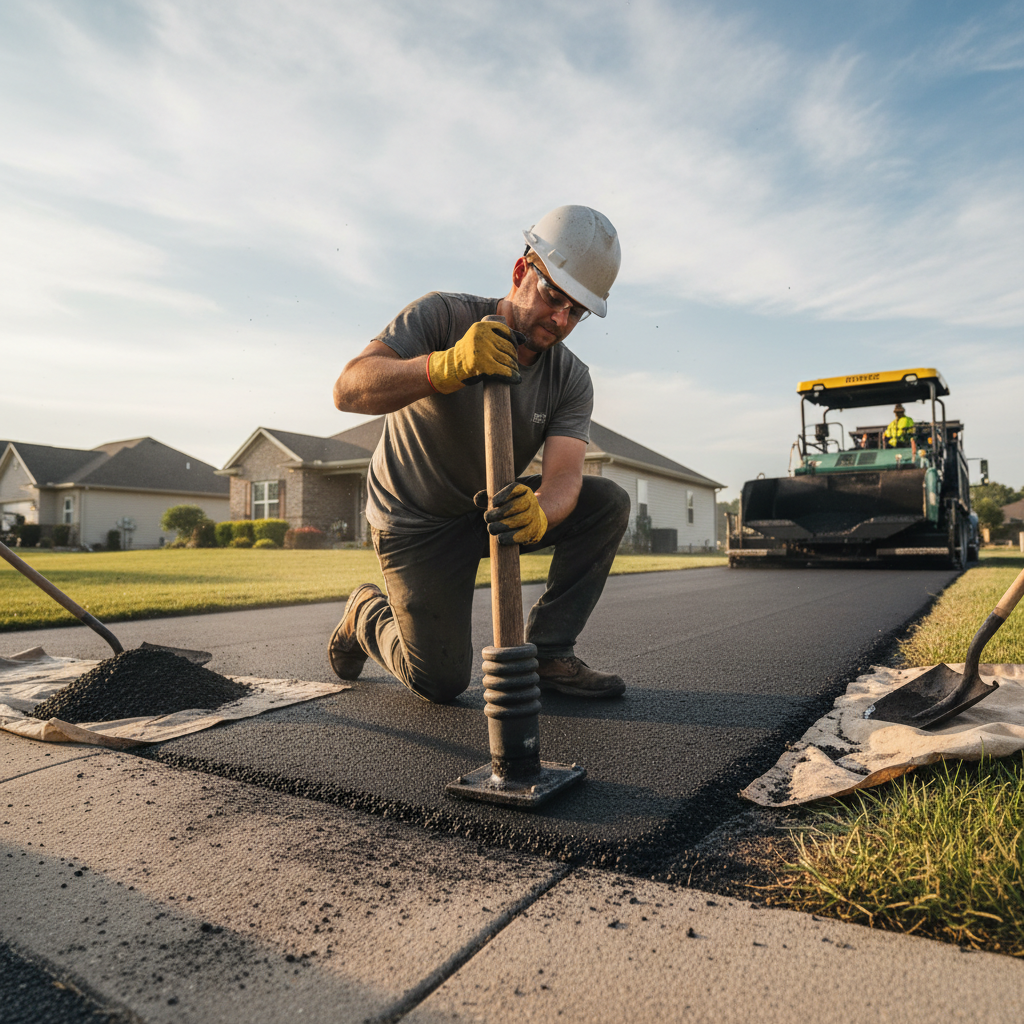
Driveway paving options and costs in Birchcliffe-Cliffside
In Birchcliffe-Cliffside, driveway paving choices usually come down to asphalt, interlocking pavers, or concrete—each with a different upfront cost and different performance in Toronto’s freeze–thaw cycles. With a population of 22,291 (Statistics Canada, 2021 Census), this neighbourhood has a steady mix of older residential lots and newer infill, and most driveways feed off long-established curb accesses. In practice, you’ll find a lot of detached-house driveways where homeowners want a smooth, low-maintenance surface that can handle winter salt, ploughing, and spring thaw.
Toronto’s frost depth and frequent freezing weather are decisive for what contractors need to build underneath your driveway. Local frost line studies show ground freezing to roughly 3–4 feet, so the subgrade often requires deeper granular base, proven compaction, and drainage that prevents water from sitting under the pavement. That’s why two quotes can both be “asphalt,” but one includes deeper base and better drainage engineering—costs rise noticeably when crews have to excavate farther and replace more granular material.
Also, the paving season is compressed into late spring through early fall, which concentrates contractor demand into peak months. Areas where this trade tends to be especially in demand include the Danforth corridor and the immediate side streets around Kingston Road, where driveways are busier and access can be tighter during daylight. Use the table below as a realistic budget comparison before you request an itemised estimate.
| Material |
Lifespan |
Maintenance |
Best For |
Price per sq ft |
| Asphalt (new installation, proper base) |
15–25 years |
Seal every 3–5 years; patch small raveling/cracks |
Smooth ride, best value, strong performance with drainage |
$10–$18 |
| Asphalt (overlay on existing gravel base) |
10–20 years |
Seal every 3–5 years; monitor settlement areas |
Budget upgrade when base is stable and properly built |
$9–$15 |
| Interlocking concrete pavers |
25–35 years |
Joint sand top-ups; occasional edge restraint checks |
Curb appeal and easy localized repairs |
$20–$32 |
| Poured concrete (broom finish) |
20–30 years (when detailed correctly) |
Minimal; seal if desired; control joints and drainage critical |
Clean look, long straight runs, steady support base |
$16–$26 |
| Exposed aggregate concrete |
20–30 years |
Periodic sealing (as recommended); keep edges maintained |
Slip resistance and decorative finish |
$18–$30 |
| Gravel / crushed stone (budget option) |
3–8 years (depends on base and grading) |
Re-grade and top up 1–2 times/year; weed control |
Short-term solution or waiting on a bigger project |
$4–$9 |
Prices are estimates only and vary by project scope, site access and material selection.
What affects the price of paving in Birchcliffe-Cliffside
In Toronto and across Ontario, it’s common to see quotes for the “same” driveway vary by 30–50% once you look at the hidden drivers: excavation depth, base build-up, drainage corrections, and how much tear-out is required. A contractor can price the visible asphalt or pavers fairly consistently, but the cost swings when one crew designs for Toronto’s freeze conditions while another tries to keep base work minimal. Site conditions also matter—Birchcliffe-Cliffside lots can have varying slopes, mature landscaping, and narrower access that slows down equipment and increases labour time.
Frost depth and freeze–thaw cycles are decisive cost factors in the Toronto economic region. With ground freezing to roughly 3–4 feet, deeper compacted granular base is required to prevent heaving and cracking. In practice, that means building thicker, well-compacted layers rather than simply “topping up.” This increases base material, hauling, and time on-site. The paving season is also shorter in colder regions: hot-mix asphalt placement depends on favourable air temperatures (commonly above about 10°C), so scheduling gets tighter in spring and early fall. Asphalt mixes must be freeze–thaw-rated, and that can add cost compared with generic mixes.
In Birchcliffe-Cliffside, concrete costs can move up when homeowners want exposed aggregate for slip resistance, because the finishing and curing requirements are stricter. Costs can come down when existing grading is already correct and drainage is functioning—less rework under the surface. Asphalt budgets often sit closer to the lower part of the local band (for example, $3,500–$8,000 for asphalt driveway paving overall), while pavers can push toward the higher range (up to $9,000–$20,000) when base reconstruction and edge restraints are extensive. Older housing-stock driveways—especially those from the era when drainage was simpler—often need more granular replacement, which can translate into hundreds to a few thousand dollars more.
| Price Factor |
Why It Matters |
Cost Impact |
| Driveway area in sq ft |
Most material and labour scale directly with square footage |
Major driver; can swing total cost by thousands |
| Base depth required |
Frost line conditions demand thicker, well-compacted granular base |
Moderate to major increase if excavation/replacement is deeper |
| Grading and drainage work |
Proper slope and outlet points prevent water from pooling under pavement |
Moderate; adds excavation, pipe, and labour |
| Tear-out of existing surface |
Removing old asphalt or concrete includes breaking, hauling, and disposal |
Moderate to major; can be time-intensive |
| Edge restraints and curbing |
Prevents paver spread and asphalt edge failure during freeze cycles |
Moderate; often required for long-term performance |
| Sealing requirement |
Asphalt performance in Toronto improves when sealed after initial curing |
Low to moderate over time (but important) |
| Site access |
Narrow/tight lots slow equipment movement and increase manual handling |
Low to moderate; labour hours increase |
| Asphalt mix specifications |
Freeze–thaw-rated mixes resist cracking and raveling better in Ontario |
Moderate; higher mix quality usually costs more |
Permits & regulations in Ontario
In Ontario, paving a private driveway within your own property typically does not require a building permit. What often does require municipal approval is anything that affects the municipal right-of-way or existing infrastructure between your property line and the street. In Birchcliffe-Cliffside, the common “yes” items include creating or changing a curb cut/driveway apron, modifying boulevard grading, or making storm drainage changes (for example, tying into or altering catch basins or re-routing downspout drainage away from the roadway). If your project involves curb cuts, altered storm drainage, or work that reaches into the municipal boulevard, confirm the requirements with the City of Toronto before excavation.
Before any digging, always call for utility locates through Ontario One Call to mark buried services. Then verify the contractor’s Ontario compliance in three practical steps: (1) confirm their business is properly registered and licensed for the work type they’re doing (you can check through relevant provincial/municipal listings depending on the scope); (2) request a current certificate of liability insurance showing adequate coverage for your address and job period; and (3) confirm WSIB coverage for workers (or the correct exemption/coverage documentation if applicable). Ask for clearance letters or proof documents—legitimate contractors will provide them readily.
Finally, confirm lot-grading rules with the local municipality, because some areas restrict hard-surface changes or drainage setups near property lines. This matters in freeze–thaw regions: if water is redirected incorrectly, the pavement can fail quickly.
Asphalt vs pavers vs concrete for Birchcliffe-Cliffside driveways
For Birchcliffe-Cliffside’s Toronto freeze–thaw climate, the “best” driveway material is usually the one that’s engineered around drainage and a thick, compacted granular base. Asphalt is typically the lowest upfront option and performs well when sealed regularly (usually every 3–5 years). Interlocking concrete pavers have the highest upfront cost, but they’re often the most forgiving long-term because you can lift and replace individual stones if a section settles or cracks. Poured concrete sits in the middle on cost, but it must be properly air-entrained and detailed with control joints to manage movement in winter and avoid cracking after freeze cycles and de-icing salt.
Base preparation depth is non-negotiable in Toronto: frost conditions mean deeper granular base and reliable drainage—water trapped under a slab or under asphalt will expand when it freezes and can lead to heaving and cracking. Asphalt can crack if the base isn’t stable, while pavers can open joints if edging restraints are weak. Concrete’s success hinges on air content, proper joint spacing, and drainage planning so freeze-related expansion doesn’t create uncontrolled movement.
As for winter maintenance, all three options handle ploughing, but asphalt depends on staying crack-free and properly sealed; pavers are more resistant to localized damage; concrete can survive for decades if joints and drainage are done right, but poorly detailed slabs tend to show cracking sooner.
A real-world budget example: many homeowners aiming for the local asphalt band (overall asphalt driveway paving roughly $3,500–$8,000) find that paying for paver-style edge restraint and deeper base narrows the performance gap. Choosing interlocking pavers may cost more overall (often closer to the $9,000–$20,000 range), but if you value curb appeal and the ability to repair a small section without re-pouring the entire driveway, the higher upfront cost can be justified.
| Material |
Frost Resistance |
Curb Appeal |
Repair Method |
Lifespan |
Price Band |
| Asphalt (sealed regularly) |
Good when base is deep and drainage is correct |
Low to moderate (clean, uniform look) |
Cut and patch localized areas |
15–25 years |
$3,500–$8,000 |
| Interlocking concrete pavers |
Very good; movement is accommodated by stone-joint system |
High (wide colour/shape options) |
Lift/replace individual pavers or re-level small zones |
25–35 years |
$9,000–$20,000 |
| Poured concrete (air-entrained) |
Good with air entrainment and control joints |
Moderate (clean lines; finish options) |
Section patching or full re-surface if widespread failure |
20–30 years |
$6,000–$15,000 |
| Exposed aggregate concrete |
Good when properly cured and jointed |
High (textured, decorative) |
Patch with matching aggregate finish where feasible |
20–30 years |
$6,500–$16,500 |
| Permeable pavers (drainage grid) |
Very good where outlet drainage is engineered |
Moderate to high (design-specific) |
Replace affected paver sections; maintain drainage layer |
20–30 years |
$10,000–$22,000 |
| Chip seal / tar-and-chip |
Moderate; performance varies with base quality and maintenance |
Low to moderate |
Resurface/recoat when stone loss occurs |
6–12 years |
$4,000–$7,000 |
How to choose a paving contractor in Birchcliffe-Cliffside
When you’re hiring a paving contractor in Birchcliffe-Cliffside, start by verifying Ontario compliance and proof of coverage. Ask for their WSIB documentation (clearance letter or proof of coverage) so you know their workers are protected. Request a certificate of insurance for liability and ensure the coverage is active for your project dates. For safety and workmanship accountability, also confirm they carry the right coverage for the scope (excavation, hauling, cutting/breaking) and that the policy lists your address properly as an interested party if applicable.
Next, insist on 2–3 itemised written quotes. The best quotes break down labour and materials separately—excavation depth, granular base quantities, asphalt/paver/concrete quantities, edge restraints, disposal fees, and compaction testing (if used). Avoid “lump sum only” proposals because Ontario’s freeze–thaw conditions make base and drainage details critical, and those are often where surprises happen.
Read the scope carefully: what is excluded (for example, tree-root removal, additional curb cut work, or replacing failed sections), whether permit pull/municipal approvals are included (when your driveway touches the right-of-way), and whether disposal is included. Clarify the warranty—ask for the workmanship warranty length and whether product warranties apply separately, and if those warranties are transferable to the next owner.
For payment, never pay more than 10–15% upfront. Use a holdback until the job is complete and any finishing items (clean-up, final grade checks, joint sand in pavers, and curing/sealing requirements) are done. Finally, get the start date and estimated completion written down—Toronto’s schedule pressure in late spring and early summer is real, and timelines can shift if base work isn’t sequenced properly.
- Request WSIB clearance/proof and confirm coverage dates.
- Ask for a current certificate of liability insurance (and confirm limits).
- Get 2–3 itemised quotes with line-by-line labour/material quantities.
- Confirm excavation depth, base layers, and compaction method—not just “proper base.”
- Verify drainage plan: slope direction, outlet point, and measures to prevent water pooling.
- Check whether tear-out, hauling, and disposal are included.
- Confirm edge restraints/curbing are included (especially for pavers).
- For asphalt: confirm tack coat requirements and sealing timeline (after curing).
- For concrete: confirm air entrainment and control joint layout.
- Clarify if permits/municipal approvals are included when working in the boulevard/right-of-way.
- Confirm warranty length, what it covers, and whether it’s transferable.
- Use a payment schedule with a holdback until final acceptance.
Red flags I see in Birchcliffe-Cliffside include: a contractor who won’t share a detailed base-and-drainage scope, vague warranties (“guaranteed” with no written terms), insisting on large upfront payments, skipping utility locate responsibilities, and offering an unrealistic “lowest price” with no allowance for frost-depth/granular base or disposal.
Frequently asked questions — paving in Birchcliffe-Cliffside
How much does driveway crack repair cost in Birchcliffe-Cliffside?
In Birchcliffe-Cliffside, crack repair pricing depends on whether the issue is minor surface cracking or movement from a failing base. Small asphalt crack sealing/patch repairs are often positioned in the local “sealing & repair” ballpark (roughly $300–$1,500) when the work is limited to cleaning, sealing, or a short patch area. If the cracks are tied to settlement, expect costs to rise because a proper repair may include saw-cutting, base correction, and a thicker patch. Concrete crack repair is similar in concept, but the contractor must address drainage and joint detailing to stop recurrence after freeze–thaw cycles. Always ask for a photo-based assessment and a written scope that states whether the repair is “seal only” or “base repair + patch,” because that’s where most variation comes from. (Statistics Canada, 2021 Census)
What base thickness do I need for pavers in Birchcliffe-Cliffside?
For pavers in Birchcliffe-Cliffside, the correct base thickness is driven by Toronto’s frost conditions and the likelihood of freeze–thaw movement. In practical terms, contractors typically excavate deeper and build a well-compacted granular base so water can’t sit underneath—because when frost expands, weak base layers can cause paver settlement and joint opening. While the exact thickness should be confirmed on-site (subgrade condition, soil type, and drainage outlet), you should expect a multi-layer base with proper compaction rather than a thin “sand only” build-up. The best quotes will state excavation depth and base layer thicknesses clearly, along with edging restraints and a drainage plan. If your existing subgrade is unstable or you have water pooling, base reconstruction usually costs more upfront, but it’s what protects paver performance for years in an Ontario winter.
How do I get the most accurate paving quote in Birchcliffe-Cliffside?
To get an accurate paving quote in Birchcliffe-Cliffside, ask for an on-site walk-through where the contractor measures square footage, checks drainage direction, and reviews whether the base is sound. Provide photos of problem areas (for asphalt or concrete), note how water behaves during spring thaw, and mention how the driveway is used (truck parking, frequent vehicle turns, etc.). Then request an itemised quote that includes excavation/tie-in work, granular base thickness and materials, compaction steps, disposal, and edging/curbing. For asphalt, ask whether the mix and placement plan is freeze–thaw rated and whether sealing is included or scheduled after curing; for pavers, confirm restraints and jointing sand; for concrete, confirm air entrainment and control joint plan. If municipal right-of-way work (like curb cut changes) is involved, confirm permit responsibility in writing. Most quote discrepancies come from missing base and drainage details, not the finish surface.
How much does it cost to pave a driveway in Birchcliffe-Cliffside?
Driveway paving cost in Birchcliffe-Cliffside typically depends on surface area, tear-out needs, base reconstruction depth, and drainage corrections. As a realistic guide, asphalt driveway paving is commonly budgeted in the local range of $3,500–$8,000 for many typical residential driveways (final pricing varies with scope and access). If you choose interlocking concrete pavers, the common local band is $9,000–$20,000, largely because of base build-up and polymeric or mechanical restraint details. Concrete driveway projects often fall in the $6,000–$15,000 range depending on finish and jointing complexity. If you’re resurfacing or repairing rather than full replacement, sealing and targeted repairs can sometimes start around $300–$1,500 for smaller scopes. Ask for line items so you can see whether price differences come from deeper excavation (frost protection) or just from the surface product choice.
Asphalt vs interlocking pavers vs concrete — which is best in Birchcliffe-Cliffside?
In Birchcliffe-Cliffside, “best” usually means the best match between performance needs and how you want to maintain the driveway through Ontario winters. Asphalt is the lowest upfront option in many cases (often near $3,500–$8,000), but it needs sealing every few years and depends heavily on a well-built granular base to resist freeze–thaw cracking. Interlocking concrete pavers cost more (commonly $9,000–$20,000), yet they handle localized settlement better because you can lift and replace sections without tearing out the entire driveway—this is valuable when Toronto soil and drainage conditions change over time. Concrete (often $6,000–$15,000) can be excellent if air-entrained and properly jointed, but it’s less forgiving for movement if joints/drainage aren’t designed well. With salt, ploughing, and spring thaw cycles, base and drainage engineering matter more than brand names—so compare quotes on the engineered layers, not only the top surface.
How long does a paved driveway last in Birchcliffe-Cliffside?
With correct installation for Ontario’s freeze–thaw cycles, paved driveways can last many years, but lifespan depends on drainage and base quality. Asphalt driveways commonly last around 15–25 years when the granular base is properly compacted and the surface is sealed regularly (often every 3–5 years). Interlocking pavers typically last about 25–35 years because localized repairs are possible and movement is managed through jointing. Poured concrete often lands around 20–30 years when it’s air-entrained, properly jointed, and protected from water pooling. Lifespan shortens if water sits under the driveway during spring thaw, if edging is missing, or if the contractor underbuilds the granular layers for frost conditions. If you already have cracking or settlement, addressing the cause (drainage/base) is usually more cost-effective than repeated surface patches.