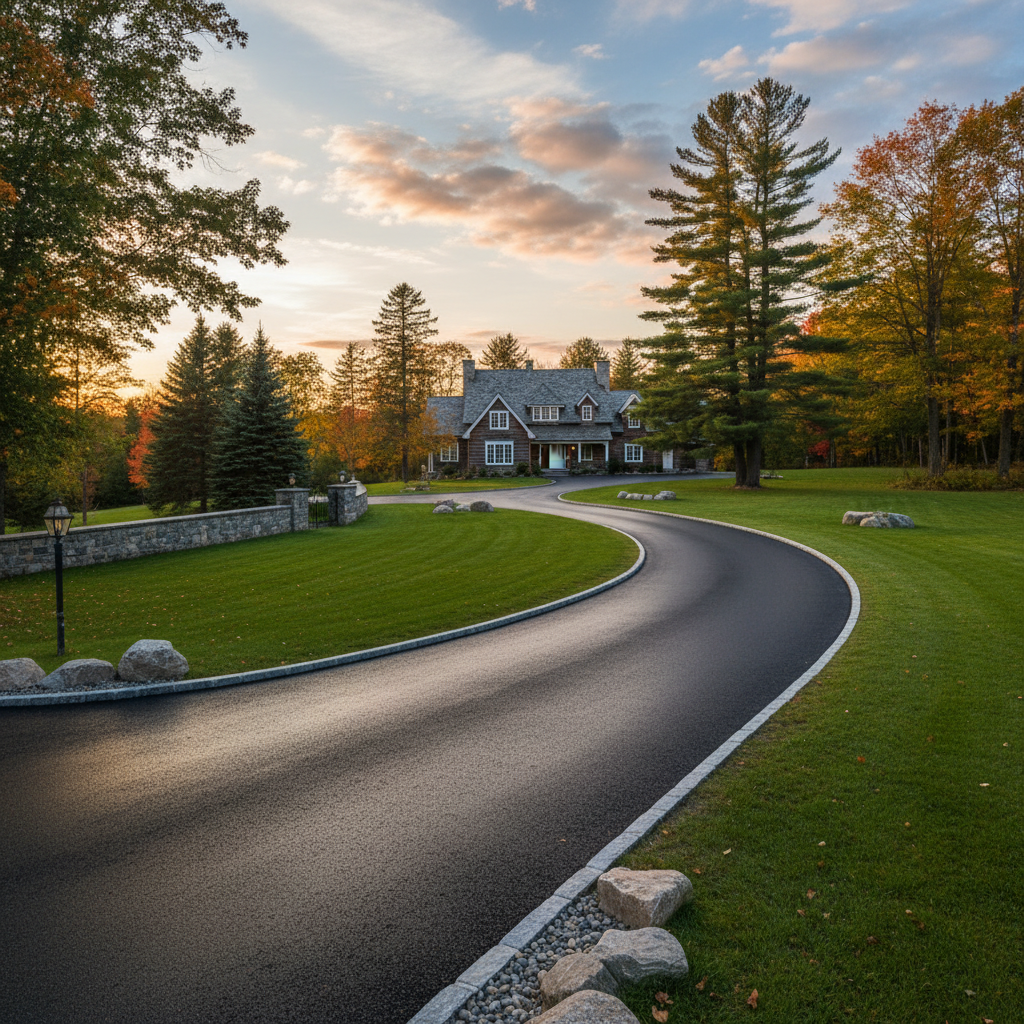
Driveway paving options and costs in Ancaster
Ancaster driveway paving is a practical upgrade for a neighbourhood that’s always balancing curb appeal with winter performance. With a 2021 population of 40,557 (Statistics Canada, 2021 Census), demand is steady for new installations and re-surfacing, especially along older streets where driveways were built with thinner gravel or dated asphalt. In this area, most private driveways are tied to detached-home lots, so the market is heavily focused on residential base build-up, drainage corrections, and durable finish coats.
In the Hamilton–Niagara Peninsula climate, freeze–thaw cycles are one of the biggest cost drivers. Contractors typically design for frost penetration around the 1.2–1.5 m range, which means deeper, well-compacted granular base and reliable drainage are essential to prevent frost heave and cracking. This base and drainage work can represent 35–45% of your driveway budget, and it’s why two quotes for the same square footage can differ so much. The paving season is also effectively April–October; hot-mix asphalt requires warmer air temperatures (often above 10°C) for proper compaction, so spring and early summer scheduling pressure can push pricing toward the upper end of typical ranges.
If you’re looking in the Highlands of Ancaster or around the MacNab Street West / Wilson Street area, you’ll often see more driveway replacements during peak months due to access constraints, mature trees, and older subsoils. Below is a clear comparison of common driveway materials so you can line up realistic expectations before you request your quote.
| Material |
Lifespan |
Maintenance |
Best For |
Price per sq ft |
| Asphalt (new installation, proper base) |
15–25 years |
Seal coat every 3–5 years |
Value + good winter flexibility |
$6 – $10 |
| Asphalt (overlay on existing gravel base) |
8–15 years |
Seal coat every 3–5 years; patch as needed |
Re-surfacing when base is still sound |
$5 – $9 |
| Interlocking concrete pavers |
25–35 years |
Weed control; occasional edge leveling |
Curb appeal and easier spot repairs |
$15 – $25 |
| Poured concrete (broom finish) |
20–30 years |
Crack monitoring; reseal as recommended |
Straight-edged, durable finish |
$12 – $22 |
| Exposed aggregate concrete |
20–30 years |
Periodic reseal; address small spalls early |
High-end look with traction |
$14 – $26 |
| Gravel / crushed stone (budget option) |
3–7 years |
Top up annually; re-grade and compact |
Lowest upfront cost; rural-style access |
$3 – $6 |
Prices are estimates only and vary by project scope, site access and material selection.
What affects the price of paving in Ancaster
In Ancaster and across the Hamilton–Niagara Peninsula, it’s common to see 30–50% swings in pricing for what homeowners believe is the “same” driveway. The reason is that quotes usually differ in base depth, drainage corrections, haul-off/disposal, and how much tear-out is needed—not just the surface material. Two contractors can both price “asphalt,” but one may include deeper Granular A/B with proper compaction and subdrain work, while another may assume existing gravel is already frost-stable.
Frost line depth and freeze–thaw cycles are decisive cost factors in this region. Where frost penetration is designed around 1.2–1.5 m, driveways typically need a deeper compacted granular base—often in the 6–10 inch range compacted, with the exact thickness depending on your subsoil and drainage. In colder Southern Ontario scheduling, hot-mix asphalt also depends on air and pavement temperatures; when the season is busy (April to October), crews may be booked tightly, and compaction requirements can shift work to higher-demand windows. That’s why a straightforward asphalt install can land anywhere from the mid to upper parts of Ontario pricing bands, while added base and drainage work can quickly push budgets toward the upper range.
Concrete and interlock can also change cost based on local site conditions. For example, a driveway over clay or silty subsoil often requires extra base and sometimes underdrain adjustments, increasing the poured concrete and paver scopes. On the flip side, if a lot has good fall to a functioning drainage area and you’re only resurfacing (not replacing the full base), asphalt overlay pricing can be closer to the lower Ontario band (often discussed around $3,000 – $8,000 for asphalt driveway paving projects). If you do full-depth replacement, interlocking can make sense despite the higher price band (commonly $9,000 – $20,000) because you can remove and replace sections later without tearing out the entire driveway.
| Price Factor |
Why It Matters |
Cost Impact |
| Driveway area in sq ft |
Surface and base quantities scale directly with area |
Typically drives most of the total cost |
| Base depth required |
Frost protection depends on granular thickness and compaction |
Often a major cost add-on in frost-prone soils |
| Grading and drainage work |
Correct slope and drainage reduce water infiltration and heave |
Commonly adds excavation, subdrain, and re-compaction time |
| Tear-out of existing surface |
Old asphalt/concrete removal requires breaking, loading, and disposal |
Can meaningfully increase labour and hauling expenses |
| Edge restraints and curbing |
Restraints stop paver spread and keep asphalt/concrete edges intact |
More materials and formwork; improves long-term performance |
| Sealing requirement |
Asphalt needs sealing after installation and periodically after |
Small but recurring cost over the first years |
| Site access |
Narrow driveways slow equipment movement and reduce production |
Extra labour and more time on site |
| Asphalt mix specifications |
Freeze–thaw-rated mix design improves flexibility and durability |
Higher material cost than basic mixes |
Permits & regulations in Ontario
In Ontario, paving a private driveway within your own property usually does not require a building permit—especially when you’re replacing the existing surface and not altering services. However, work that touches the municipal right-of-way typically needs municipal approval. That includes making or changing a curb cut/apron connection, altering boulevard grading, or changing storm drainage patterns that affect the road or municipal drainage system. Some municipalities also have lot-grading expectations or by-laws that restrict how close a hard surface can be to property lines and how drainage must be managed to avoid directing water onto neighbouring lots.
Before excavation, plan for utilities. In Ontario, homeowners and contractors should call Ontario One Call to get locates marked so you don’t hit buried services. Next, verify that your contractor can legally do the work and is properly insured. Step one: check the contractor’s licence standing through the appropriate provincial registration source (confirm the business name you’ll contract with matches what’s registered online). Step two: ask for a certificate of insurance (general liability) showing adequate coverage, and confirm the project is included. Step three: confirm their workers’ coverage for jobsite work—WSIB clearance or equivalent coverage documentation—so you’re not exposed if a worker is injured. Finally, ask for the details of disposal and any traffic control if the driveway ties into the municipal curb.
Asphalt vs pavers vs concrete for Ancaster driveways
For Ancaster’s moderate-to-cold Southern Ontario climate, the “best” driveway material usually comes down to how it handles freeze–thaw movement, how much base depth you can afford, and how you maintain the surface around plowing and winter de-icing. Asphalt is typically the lowest upfront choice within the quality installation band, because it flexes under temperature swings and provides a smoother ride. It does require regular sealing—generally every 3–5 years—to protect against moisture and oxidation.
Interlocking concrete pavers cost more up front (often aligned with the higher $9,000 – $20,000 interlock range), but they have a big advantage in Ontario: if a small area fails due to drainage or settling, sections can often be lifted and re-built without replacing the entire driveway. That’s valuable in older Hamilton-area neighbourhoods where subsoils can vary between parcels.
Poured concrete sits in the mid-range and can look crisp, but it’s more sensitive to freeze–thaw and de-icing salt if it isn’t properly air-entrained and detailed with joints. In practice, a driveway can crack even with good workmanship if base prep and drainage aren’t correct. For the Hamilton–Niagara Peninsula, you should expect deeper granular base design and careful drainage regardless of material; on clay/silty subsoils, base and drainage corrections are often what decide whether a driveway lasts 15 years or 25+.
Concrete and pavers can be justified when you want long-term longevity and better curb appeal. For example, if your asphalt scope is around $3,000 – $8,000 but your goal is a long-stay upgrade with potential for sectional repairs, spending toward the interlock range can make sense—especially where curb aesthetics matter. If you want the most predictable maintenance plan under typical plowing and salt use, asphalt with proper sealing is often the easiest to manage year-to-year.
| Material |
Frost Resistance |
Curb Appeal |
Repair Method |
Lifespan |
Price Band |
| Asphalt (sealed regularly) |
Good with correct base + drainage |
Medium (clean, uniform finish) |
Patch or mill/overlay |
15–25 years |
$3,000 – $8,000 |
| Interlocking concrete pavers |
Very good when base is engineered |
High (custom patterns and colours) |
Lift and replace affected units |
25–35 years |
$9,000 – $20,000 |
| Poured concrete (air-entrained) |
Good with air entrainment and joints |
Medium to high (clean lines) |
Crack repair/patch; overlays later |
20–30 years |
$7,000 – $18,000 |
| Exposed aggregate concrete |
Good with proper curing and sealing |
High (textured, premium look) |
Patch/spall repair; reseal |
20–30 years |
$8,000 – $20,000 |
| Permeable pavers (drainage grid) |
Excellent for managing water infiltration |
Medium to high |
Replace sections; clean channels |
20–30 years |
$10,000 – $22,000 |
| Chip seal / tar-and-chip |
Moderate; depends on base and maintenance |
Lower to medium (functional finish) |
Spot repairs and re-chipping |
6–12 years |
$2,500 – $7,000 |
How to choose a paving contractor in Ancaster
Choosing the right contractor in Ancaster starts with verifying the basics: Ontario licensing/registration (so you’re dealing with a legitimate business), liability insurance, and workers’ coverage (WSIB/WCB). Ask for documentation before the job is scheduled. For insurance, request a certificate of insurance with your project address listed or at least coverage details that clearly apply to the type of work they’re doing. For workers’ coverage, request a WSIB clearance letter (or equivalent proof of coverage). If a contractor won’t provide these on request, treat it as a serious warning.
Next, get 2–3 written, itemised quotes. Look for a breakdown that separates excavation, base material (Granular A/B), compaction, drainage corrections (if needed), tack coat/prime for asphalt, asphalt or concrete quantities, edge restraints/curbing, and disposal. A lump-sum quote without quantities usually hides scope gaps. Confirm what’s excluded: permit pull (if required), utility locates, concrete disposal, topsoil replacement, landscaping restoration, and whether crack filling or sealing is included.
Warranty matters too. Ask for the workmanship warranty length (what defects are covered and for how long), and whether there’s a separate manufacturer warranty on asphalt products or concrete admixtures. Clarify if warranties are transferable if you sell.
For payment, never pay more than 10–15% upfront. Hold back a portion until completion and walk-through. Finally, insist on a written timeline with a start date and an estimated completion date—because the effective paving window in Southern Ontario compresses scheduling and crews often plan around weather and plant production.
- Ask for proof of WSIB/WCB coverage (or clearance) before work begins.
- Verify general liability insurance and that coverage applies to driveway paving.
- Confirm the contractor’s registration/licence and that it matches the quote and invoice.
- Request 2–3 itemised quotes with quantities (sq ft and base thickness).
- Make sure drainage/grading is included if your lot sheds water toward the driveway.
- Confirm asphalt includes tack coat/prime where required and proper mix specifications.
- Check whether tear-out includes breaking, loading, and disposal—not “haul away” ambiguity.
- Verify edge restraints/curbing are included (especially for pavers and concrete edges).
- Ask for compaction test expectations or at least compaction methodology in the proposal.
- Clarify warranty details: workmanship vs product warranty, coverage period, and exclusions.
- Set a payment schedule with 10–15% maximum upfront and a holdback until close-out.
- Get the start/completion dates and weather contingencies in writing.
If a contractor in Ancaster gives vague scope language (“assumes base is fine”), can’t show insurance/WSIB documentation, won’t provide itemised quantities, schedules too quickly without site investigation, or pressures you to pay the full amount upfront, those are major red flags that commonly lead to early failures in frost-susceptible driveways.
Frequently asked questions — paving in Ancaster
Can asphalt be laid in cold weather in Ancaster?
In Ancaster, cold-weather asphalt placement is limited by temperature and compaction needs. Hot-mix asphalt generally requires warm air and pavement conditions—often air temperatures above about 10°C—so the mix can be properly spread, compacted, and achieve density before it cools too quickly. Ontario crews also have to manage freeze–thaw risk: if the base is near freezing or water is trapped in subgrade, you can get premature cracking or poor bond. If you’re planning a spring project, aim for April–May start dates when conditions are stable. If you have to work late in the season, a reputable contractor will explain how they’ll protect the subgrade and manage curing and compaction, or they’ll push the schedule to the next paving window.
What is a driveway apron and do I need one in Ancaster?
A driveway apron is the portion that transitions from the road edge to your driveway—often tied to the curb cut/boulevard area and sometimes your municipal connection. In Ancaster and across Ontario, whether you “need” an apron depends on how your driveway currently meets the curb and whether there’s a safe, properly graded transition for drainage and vehicle access. If you’re changing the curb cut or adjusting boulevard grading, that can fall under municipal approvals (and may require a permit/approval process depending on the scope). Practically, many homeowners don’t realize their driveway is missing the right apron profile until water pools at the curb line or the edge breaks down after plowing. A contractor should inspect the interface and discuss whether apron works are included in the quote and whether municipal approval is required.
How do I maintain my driveway through Ancaster winters?
Winter maintenance in Ancaster is mostly about reducing water and protecting the surface edges. Start by managing snow removal: use plow blades/attachments that don’t scrape the surface—especially on pavers where chipped joints can open. Avoid letting thick ice build directly on the asphalt or concrete; repeated chipping and salt blasting can accelerate oxidation and surface wear. For asphalt, sealing matters: while sealing is typically done after installation (and again every 3–5 years), good sealing reduces moisture penetration that can worsen freeze–thaw movement. For concrete, keep an eye on small cracks early and get repairs done before water finds its way under the slab or along joints. If you have drainage issues near the driveway, address them first—because no surface treatment fixes a base that’s staying wet.
Is it worth sealing a new driveway right away in Ancaster?
It can be worth it, but timing is everything. For new asphalt in Ontario, sealing is typically not done immediately—many contractors wait long enough for the asphalt to cure and for surface conditions to stabilize (often in the first season, depending on product and weather). Doing it too early can trap moisture and reduce performance. When scheduled correctly, a seal coat helps protect against water intrusion and oxidation, which matters in Ancaster’s freeze–thaw cycles. In real terms, sealing is usually a relatively small portion of your overall driveway budget compared to resurfacing or full replacement, and it can extend service life. Your contractor should specify when the driveway can be sealed and which product they’re using. If your asphalt installation is in the $3,000 – $8,000 band, sealing is one of the best “value-per-year” steps you can budget for.
What is a chip seal driveway and is it suited to Ancaster?
Chip seal (tar-and-chip) is a binder sprayed onto the road or driveway surface followed by aggregate broadcast and rolled. It’s sometimes used for lower-cost resurfacing where you want a textured, functional surface. For Ancaster, it can be suited on certain sites—particularly where drainage is good and the base is stable—because it can perform reasonably well under freeze–thaw when the underlying granular structure is correct. However, compared with a full asphalt installation, chip seal generally has a shorter lifespan and may require periodic maintenance (spot repairs and re-chipping) if aggregate loss occurs. If you’re seeking a long-term driveway aesthetic or maximum durability during heavy plowing and repeated winter salt/sand, asphalt or interlocking often makes more sense. A chip seal driveway is commonly priced around the lower end of driveway surfacing options (sometimes in the $2,500 – $7,000 range, depending on scope), but it’s not always the best choice for high-traffic or drainage-challenged lots.
How much does driveway crack repair cost in Ancaster?
Crack repair pricing depends on crack width, length, whether it’s isolated or repeating (often due to base issues), and the surface material. For asphalt, small cracks are commonly treated with routing and sealing, or sealant applied after cleaning—costs typically fall within the broader “sealing & repair” range of about $400 – $2,000 for many residential scenarios, assuming accessible cracks and limited area. If there’s edge failure, a pattern of cracking, or base movement, sealing alone may not solve the problem; you may need patching, an overlay, or deeper base corrections—costs then move up toward the wider driveway replacement pricing bands. For concrete, repairs may include crack sealing, crack repair systems, or localized patching; drainage and joint details matter. The best next step is a contractor inspection to confirm whether the crack is “cosmetic” or a symptom of frost-related base movement.