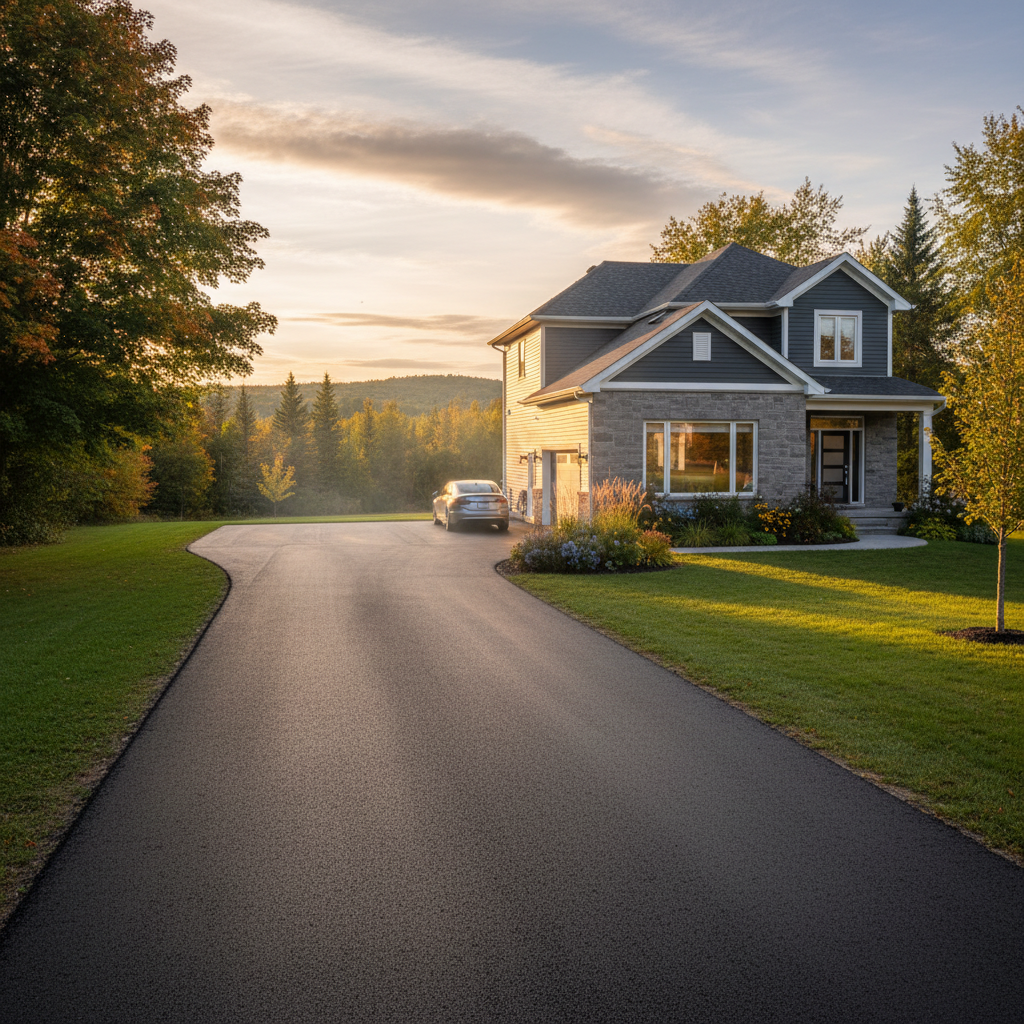
Driveway paving options and costs in King
Driveway paving in King, Ontario is a practical upgrade for homeowners, especially given that King’s housing stock is dominated by single-detached homes—87.2% of dwellings in the area. With 7,910 homeowner households (88.2% of all households), there’s a steady need for durable, good-looking surfaces that can handle Toronto-area freeze–thaw conditions. In 2021, King’s population was 27,333 (Statistics Canada, 2021 Census), and that translates to busy contractor demand during the late-spring to early-fall paving window.
In the Toronto economic region, frost depth and repeated freeze–thaw cycles are primary cost drivers. Ground freezing to roughly 3–4 feet means installers need deeper, well-compacted granular base layers and dependable drainage so water doesn’t sit beneath the asphalt (which can heave, ravel, and crack during winter). At the same time, asphalt placement is weather-dependent—hot-mix asphalt is typically placed when air and base temperatures are high enough—so the paving season compresses into a shorter workable window. That schedule pressure can push pricing toward the upper end for prime dates.
In King City and nearby areas like Nobleton, I often see driveways scheduled first for spring openings and again for late-summer repairs, because weather timing is everything. The right material choice also depends on whether you’re replacing the whole driveway, overlaying existing gravel/asphalt, or upgrading curb appeal with pavers.
Use the cost-and-performance guide below to compare options before you request itemised quotes.
| Material |
Lifespan |
Maintenance |
Best For |
Price per sq ft |
Price Range |
| Asphalt (new installation, proper base) |
15–25 years |
Sealcoat every 3–5 years; patch potholes quickly |
Best balance of cost and durability with correct drainage |
$8–$14 |
$3,500–$8,000 |
| Asphalt (overlay on existing gravel base) |
8–15 years |
Sealcoat when needed; monitor base settlement |
When existing base is stable and drainage is addressed |
$6–$11 |
$3,000–$6,500 |
| Interlocking concrete pavers |
25–35 years |
Re-sand and re-level as needed; replace individual pavers |
Curb appeal and easiest spot repairs |
$20–$35 |
$9,000–$20,000 |
| Poured concrete (broom finish) |
20–30 years |
Crack monitoring; keep joints sealed where specified |
Sleek finish and long straight runs |
$12–$22 |
$6,000–$15,000 |
| Exposed aggregate concrete |
20–30 years |
Low maintenance; occasional cleaning and joint care |
Better slip resistance and premium look |
$14–$26 |
$7,000–$16,000 |
| Gravel / crushed stone (budget option) |
3–8 years |
Top up annually; re-grade and re-compact |
Temporary solution or low-budget pull-in |
$5–$9 |
$2,000–$4,500 |
Prices are estimates only and vary by project scope, site access and material selection.
What affects the price of paving in King
Even when two King homeowners want “the same driveway,” quotes can vary by 30–50% across the Toronto region and Ontario. The difference usually comes down to excavation quantities, how much base and drainage work is required, disposal and hauling, and how tight the contractor schedule is in the busiest months. In a market with a compressed paving season, prime spring and early-summer dates can cost more because crews and equipment are booked.
For this region, frost depth and freeze–thaw cycles are decisive cost factors. When the ground freezes to roughly 3–4 feet, you generally need a thicker compacted granular base to prevent heaving and cracking. Practically, that means more excavation and more aggregate than in milder areas. It also means the asphalt mix design should be rated for local freeze–thaw performance. If drainage is off—poor slope, no sub-drain where needed, or water trapped at low points—the warranty risk increases and the installed cost goes up because correct re-grading and drainage add labour and materials.
Concrete costs can move both directions depending on planning. For example, a “simple rectangle” with proper control joints and well-draining subgrade can finish closer to the mid-range; but a driveway with significant slope correction or a lot of cutting around services typically costs more. I also see savings when homeowners choose asphalt with a well-built base rather than paying for premium paver labour—especially when curb appeal is already covered with landscaping.
As a planning reference, a driveway paving project often lands within the asphalt band of $3,500–$8,000, while interlock and full concrete upgrades commonly shift toward $6,000–$15,000 or higher depending on the finish and base depth. Homes built before 1981 make this even more important: older lots often have older drainage patterns, and correcting those can add thousands even before the “new surface” is installed.
| Price Factor |
Why It Matters |
Cost Impact |
| Driveway area in sq ft |
Larger surface means more asphalt/concrete/pavers and more base |
Highest driver; can change total price by thousands |
| Base depth required |
Frost determines granular thickness to prevent heaving and cracking |
More excavation + more aggregate; often a major quote difference |
| Grading and drainage work |
Proper slope and water routing reduces freeze–thaw damage |
Can add significant labour/material costs when corrections are needed |
| Tear-out of existing surface |
Breaking and hauling old concrete or old asphalt adds time and disposal |
Commonly increases cost, especially with rebar or thick slabs |
| Edge restraints and curbing |
Stops paver spread and keeps asphalt edges from breaking down |
Small area, but materials and set-up still add cost |
| Sealing requirement |
Asphalt needs sealcoat to protect from water and surface oxidation |
Ongoing maintenance; often planned after 6–12 months |
| Site access |
Narrow drives, steep approaches, or limited staging slow equipment movement |
More manual handling and time = higher labour |
| Asphalt mix specifications |
Freeze-thaw-rated mix performs better in Toronto-area winters |
Upgraded mix can raise unit cost, improving long-term performance |
Permits & regulations in Ontario
In Ontario, paving a private driveway within your own property typically does not require a building permit. That said, the rules change when you touch the municipal portion of the road allowance. In King, work usually does require municipal approval when it involves the municipal right-of-way—such as creating or changing a curb cut, altering the boulevard, changing catch basin connections, or modifying storm drainage so it affects how water flows from the street. Some properties also have lot-grading constraints that limit how close a hard surface can be to property lines or how runoff must be handled; your best move is to confirm with the local municipality if you’re doing major re-grading.
Before any excavation, always arrange utility locates through Ontario One Call. That step isn’t optional—driveway work frequently crosses hydro, gas, telecom, or low-voltage lines (especially in older subdivisions). Then verify your contractor the right way, step-by-step: first, confirm their Ontario licence/registration status using the relevant online registry for your trade class; second, ask for a current certificate of insurance naming you as additional insured where applicable; and third, request proof of WSIB/WCB coverage (or an exemption letter, if they genuinely qualify).
Finally, make sure the quote states what’s included: haul-away/disposal, cutback/tie-in details, and whether they handle any permit/municipal paperwork if required for a curb cut or drainage change.
Asphalt vs pavers vs concrete for King driveways
For King, the “best” driveway material is the one that survives Toronto-area freeze–thaw cycles with the correct base, drainage, and edges. Asphalt is usually the lowest upfront cost and can be very effective when installed with a proper granular base and sealed after it cures—typically within 6–12 months, then every 3–5 years. Interlocking concrete pavers cost more to install, but they shine in repairs: if a weak spot or settlement occurs, individual stones can be lifted, re-compacted, and reset without replacing the entire driveway. Poured concrete sits in the mid-range price-wise, but it must be properly air-entrained and designed with good joints to control cracking from winter expansion and contraction.
In Toronto’s colder conditions, you should plan for deeper excavation and reliable drainage rather than relying on the surface material alone. Frost depth around 3–4 feet means water management matters as much as thickness. If you routinely plow with steel blades and have salt exposure near the apron, pavers and well-detailed asphalt generally tolerate routine maintenance better—assuming the base is engineered and edges are restrained. Concrete can perform well, but if it’s not air-entrained and jointed correctly, freeze–thaw and de-icing impact can lead to cracking that’s more difficult to patch invisibly.
Here’s a real-world decision example: if your asphalt driveway is quoted in the $3,500–$8,000 band but pavers come in around $9,000–$20,000, the extra cost is usually justified only when you want long-term curb appeal, easier spot repairs, or a driveway layout with tricky grades. If your priority is lowest upfront cost with strong performance, asphalt with correct drainage is often the most cost-effective route.
| Material |
Frost Resistance |
Curb Appeal |
Repair Method |
Lifespan |
Price Band |
| Asphalt (sealed regularly) |
Good with proper base and drainage |
Moderate (clean, smooth finish) |
Patch sections; re-seal as needed |
15–25 years |
$3,500–$8,000 |
| Interlocking concrete pavers |
Very good with engineered base |
High (wide colour/style choices) |
Lift and replace individual pavers |
25–35 years |
$9,000–$20,000 |
| Poured concrete (air-entrained) |
Good with air entrainment + joints |
Moderate to high |
Patch cracks/sections; joint repair |
20–30 years |
$6,000–$15,000 |
| Exposed aggregate concrete |
Good with correct mix and curing |
High (textured premium look) |
Limited repair; patching visible |
20–30 years |
$7,000–$16,000 |
| Permeable pavers (drainage grid) |
Very good where water management is critical |
High (clean lines, engineered look) |
Replace modules; maintain drainage layer |
20–30 years |
$10,000–$22,000 |
| Chip seal / tar-and-chip |
Moderate (serviceable, less rigid) |
Low to moderate |
Re-surface; re-apply top stone |
5–12 years |
$2,500–$6,000 |
How to choose a paving contractor in King
Choosing a contractor in King is less about slogans and more about verification. Start by confirming Ontario licensing/registration relevant to the work they’re doing, then ask for a certificate of liability insurance and ensure the coverage limits are current. For workers, request proof of WSIB/WCB coverage (or a legitimate clearance/exemption letter if applicable). Don’t accept “it’s covered” verbally—ask to see documents and check the dates.
Next, get 2–3 itemised, written quotes. A fair quote breaks out labour and materials (excavation, hauling/disposal, base stone, geotextile if used, asphalt/paver/concrete, edging/restraints, and compaction). Ask what’s included for tear-out and disposal, and whether the contractor will fix drainage issues (slope corrections, channel drains, sub-drains) rather than simply laying a new surface over poor grading. Make sure the scope is clear: what’s excluded (snow hauling, replacing underground services, removing landscaping, tree roots)? Is a municipal permit included if a curb cut or drainage change is needed?
Warranties matter—workmanship warranties should be in writing with a clear start date. Also separate workmanship from product/manufacturer warranty. Payment schedules should protect you: never pay more than about 10–15% upfront, and hold back a portion until the job is complete and final grading/clean-up are done. Finally, insist on a written timeline with a start date target and an estimated completion date so you understand when winter weather could affect the last steps.
- Verify Ontario licence/registration relevant to the paving scope before signing.
- Request a certificate of insurance (liability) and confirm it’s current.
- Check WSIB/WCB clearance or exemption letter; keep copies for your records.
- Ask for an itemised quote (labour, materials, base, disposal, edging/curbs).
- Confirm base design details: thickness, compaction expectations, and drainage approach.
- Ensure tear-out scope is explicit (depth, disposal location, and backfill plan).
- Confirm whether geotextile is proposed and where it’s used.
- Clarify sealing: asphalt must be sealed after curing (often within 6–12 months).
- Review warranty length for workmanship and whether it covers future freeze–thaw cracking/heaving.
- Agree on payment milestones tied to measurable stages (base complete, surface complete, cleanup done).
- Ask for start date, weather contingency, and how delays affect pricing.
- Get photos of similar King-area projects and read online reviews carefully—look for base/drainage mentions.
Red flags I see in King: contractors who won’t discuss base and drainage in detail, quotes that omit disposal/tie-in work, “asphalt is asphalt” comments that ignore freeze–thaw-rated mix and compaction, unclear warranties (or only a material warranty with no workmanship coverage), and crews asking for large upfront payments before excavation and verification are complete.
Frequently asked questions — paving in King
What causes potholes and how are they repaired?
In King and the broader Toronto area, potholes usually form from water. Freeze–thaw cycles expand trapped moisture in asphalt or around weak base areas; once the surface starts to break down, traffic and ploughing accelerate the failure. Poor drainage, thin or poorly compacted base, and localized settlement around utility patches are common contributors. Repairs are typically a cut-and-remove process: we saw-cut a clean perimeter, remove deteriorated asphalt back to stable material, confirm base integrity/compaction, then patch with properly compacted asphalt and (for best results) a tack coat/binder at the interface. If the underlying base is failing, a simple patch won’t last; that’s when an overlay or deeper base correction is more economical long-term. For reference, driveway asphalt work often falls in the $3,500–$8,000 range depending on scope.
How do I prepare for a paving project?
Preparation makes the job faster and protects your finished surface. Clear the driveway and approach area so equipment can stage safely, and move vehicles, trailers, and portable basketball hoops out of the work zone. If you have landscaping near edges, flag any items you want protected. For projects in King where excavation is needed, plan for dust control and noise, and discuss disposal—good contractors include haul-away in the quote. If there’s existing drainage that you’ve noticed backing up or ponding, point it out before work starts so the contractor can engineer the correction. Also confirm utility locates have been requested through Ontario One Call before digging. Finally, review the timeline: in Ontario, cold snaps can compress the schedule, so ask for the planned start/completion window in writing.
How do I compare paving quotes fairly?
Compare quotes line-by-line, not just by the bottom number. Ask each contractor for an itemised breakdown: excavation/tie-in, base stone type and thickness, geotextile (if used), compaction method, disposal, edging/restraints, and the specific surface thickness/mix. Confirm tear-out scope and what happens to existing asphalt or concrete—overlaying on a weak gravel/asphalt base can shorten lifespan. For asphalt, ask when they plan the sealcoat; asphalt typically needs sealing after curing (often within 6–12 months). For concrete, ask about air-entrainment and how control joints are planned to manage freeze–thaw. In King, differences in drainage correction can easily shift totals by thousands—so a quote in the $6,000–$15,000 band may be more complete than a lower bid that skips drainage.
Can asphalt be laid in cold weather in King?
Asphalt should not be placed when conditions are too cold, because compaction and bonding suffer. In King, Ontario, late fall and early spring can bring freezing temperatures and moisture, which interfere with getting proper density and adhesion. That’s why installers watch air temperature, base temperature, and weather forecasts, and why the paving season is effectively late spring through early fall. If a driveway is scheduled too late and asphalt is laid on a frozen or overly cold base, you can see early raveling, cracking, or poor bond—especially with Toronto-area freeze–thaw cycles. A reputable contractor will either postpone until workable temperatures return or adjust the schedule appropriately. Always ask how they manage temperature and curing time, and how they plan the sealcoat after the asphalt has cured.
What is a driveway apron and do I need one in King?
A driveway apron is the transition area where your driveway meets the street/sidewalk/boulevard, often involving a curb cut and properly finished edges so water flows away from the driveway rather than pooling at the joint. In King, whether you “need” an apron depends on drainage, grade changes, and how the existing curb cut is shaped. If your driveway currently has a sharp edge, settlement near the street, or standing water at the interface, an apron/transition detail can improve performance during freeze–thaw and reduce edge breakdown. Creating or altering the curb cut or boulevard drainage typically falls under municipal approval, so the contractor should clarify if they’re including the required municipal steps in your scope. This can affect total costs, especially if re-grading and drainage corrections are required.
How do I maintain my driveway through King winters?
Winter maintenance is about protecting the surface while managing meltwater. For asphalt, plough carefully and avoid gouging—steel blades can break edges and accelerate water intrusion. Keep the driveway clear of debris and use sanding appropriately; heavy salt use can be harsher on surfaces and can contribute to deterioration over time, particularly near the apron where water cycles through. If cracks appear, patch early so water doesn’t get underneath. For sealed asphalt, plan sealcoat on schedule (often every 3–5 years depending on traffic and weather exposure). For pavers, re-sand the joints if you see migration and keep edging restrained so individual stones don’t shift. In any material, address ponding quickly: with Toronto-area frost depth around 3–4 feet, trapped water under a driveway is the fastest path to heaving and cracking.