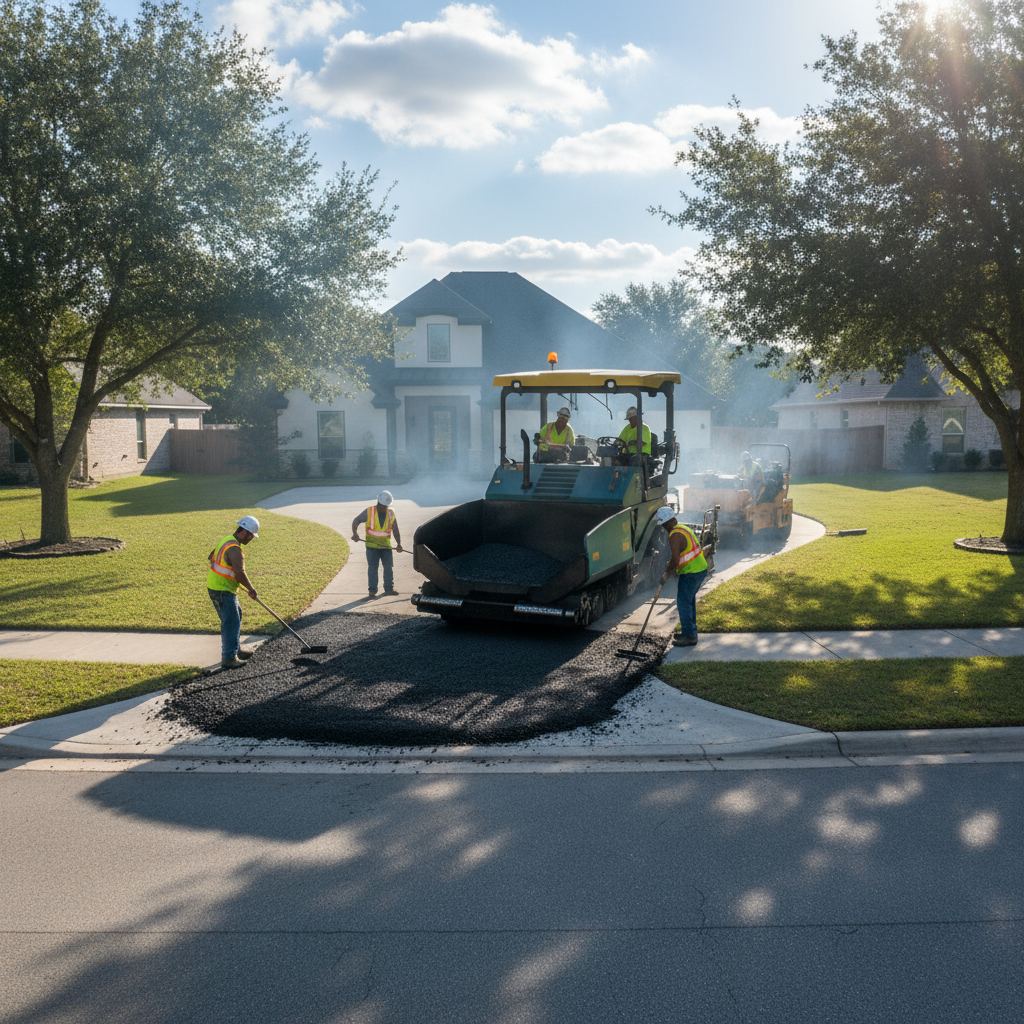
Driveway paving options and costs in Powassan
Powassan driveway paving is all about building a surface that can handle Northeast Ontario’s winter reality—long freeze–thaw seasons, snow cover, ploughing impacts, and thawed-in-mud periods that can soften subgrades. With about 90.9% of homes in the area being single-detached, most driveways are directly tied to detached-house lots, so demand is steady and project sizes vary from modest rural approaches to wide family driveways (Statistics Canada, 2021 Census). And because 60.2% of homes were built before 1981, you’ll often see older granular bases, settlement spots, and drainage issues that need correcting before any new asphalt or concrete goes down.
In Northeast Ontario, contractors price for frost protection and tight scheduling. The paving season is shorter because hot-mix asphalt generally requires warm, dry conditions (about 10°C+ air temperatures), and spring weather can force delays and re-mobilization. That means you’re not just paying for material—you’re paying for proper excavation, thicker compacted base, drainage improvements, and a crew that can place and compact everything quickly within the weather window.
In Powassan, many of the paving and repair jobs we see are concentrated around the main residential pockets near the town core—particularly where driveways connect to heavier winter traffic and where older lots have unclear drainage patterns. Once the base is sized correctly, your choice of surface comes down to budget, how you want it to look, and how easily you need future repairs to be done.
Use the table below to compare common driveway options and typical ranges in Powassan, then we can tighten the numbers with site measurements and subgrade inspection.
| Material |
Lifespan |
Maintenance |
Best For |
Price per sq ft |
| Asphalt (new installation, proper base) |
15–25 years |
Seal 6–12 months after paving, then every 3–5 years |
Best balance of cost and performance for most detached homes |
$5.50–$9.50 |
| Asphalt (overlay on existing gravel base) |
10–18 years |
Seal as required; monitor edges and low spots |
When the existing base is sound but the driveway surface needs improvement |
$4.75–$8.25 |
| Interlocking concrete pavers |
25–35 years |
Occasional joint sand, lift-and-replace repairs as needed |
Curb appeal and repairability (no full replacement after localized failure) |
$9.50–$15.50 |
| Poured concrete (broom finish) |
20–30 years |
Keep joints maintained; consider protective coating only if desired |
Clean look, strong winter wear resistance with proper air-entrainment |
$10.00–$16.50 |
| Exposed aggregate concrete |
20–30 years |
Low ongoing maintenance; seal only if specified for your mix |
High-end finish that hides minor surface wear |
$12.00–$18.50 |
| Gravel / crushed stone (budget option) |
5–10 years |
Re-grade and top up 1–3 times per season |
Lower initial cost where drainage is managed and traffic is light |
$3.00–$5.50 |
Prices are estimates only and vary by project scope, site access and material selection.
What affects the price of paving in Powassan
The same driveway can land 30–50% apart in quotes across Ontario because most costs aren’t driven by “asphalt vs concrete” alone—they’re driven by what the site requires before paving happens. Two contractors may both quote “asphalt,” but one finds poor drainage, soft spots, and inadequate granular thickness and prices the fix accordingly. Another may price what they can pave over, which can look cheaper upfront and cost more later when frost heave or edge failures show up.
In Northeast regions, frost line depth and freeze–thaw cycles are decisive. Where frost penetration is deeper, you need thicker compacted granular base (commonly 6–12 inches in Ontario/Alberta-style conditions compared with slimmer requirements in milder coastal BC). That extra base means more excavation, haul-away, compaction testing, and sometimes geotextile or insulation in challenging subgrade. Meanwhile, hot-mix asphalt generally requires air temperatures above 10°C to place and compact properly, so the effective paving season compresses. That concentrates demand, and contractors build weather-delay risk into mobilization, crew scheduling, and material delivery windows.
Powassan-specific examples that often move the number up or down include: (1) whether your driveway drains to a stable ditch or whether water ponds on the base—fixing a slope or adding drainage can add meaningful labour and aggregate; (2) whether the existing surface is alligator-cracked asphalt needing full tear-out versus a base that can be overlaid; and (3) how tight the access is, especially on narrow rural lots where equipment set-up costs extra time.
To put it in dollars, a properly prepared asphalt install often falls within the $4,500–$8,500 band, while paver projects commonly sit in the $8,000–$16,000 range because the base, restraints, and block-laying labour stack up. Older home lots (like the pre-1981 housing base that’s common locally) tend to need more grade correction, which is why you’ll see quotes swing even when driveway area is similar.
| Price Factor |
Why It Matters |
Cost Impact |
| Driveway area in sq ft |
More surface means more asphalt/concrete and more base material. |
Major driver (often the biggest portion of total cost) |
| Base depth required |
Frost protection relies on adequate compacted granular thickness. |
Higher base can increase material and excavation costs |
| Grading and drainage work |
Correct slope and positive drainage reduce ponding and frost heave. |
Can be a mid-to-high add-on if ditching or regrading is needed |
| Tear-out of existing surface |
Breaking/hauling old asphalt or concrete and disposing of it takes time and equipment. |
Often increases cost materially versus overlay-only work |
| Edge restraints and curbing |
Restraints keep pavers from spreading and keep asphalt edges from crumbling. |
Adds labour and materials for forms/blocks/stone |
| Sealing requirement |
Asphalt performance depends on sealing after initial curing to slow water intrusion. |
Small added job cost plus expected future maintenance budget |
| Site access |
Narrow lots slow equipment movement and complicate deliveries. |
Can raise labour hours and mobilization charges |
| Asphalt mix specifications |
Freeze–thaw-rated mix design and binder selection improve durability in winter conditions. |
Material cost increase, but typically worth it for longevity |
Permits & regulations in Ontario
For most homeowners in Powassan, paving a private driveway within your own property typically does not require a building permit. The common exception is when the work touches the municipal right-of-way or changes how the municipality manages stormwater and traffic access. That means permits/approvals are usually required for things like new or modified curb cuts, changes to boulevard areas, alterations to storm drainage that affect ditch flow, or any work that changes municipal infrastructure.
Before any excavation, start with utility locates—call Ontario One Call (and ensure the contractor is also registered where required). You want all buried services marked so the base and drainage work doesn’t risk utility strikes.
Then verify the contractor you’re hiring. Step-by-step, ask for and check: (1) Ontario business licensing/registration (where applicable locally) and whether they are operating legally as a paving contractor; (2) liability insurance—request a current certificate of insurance naming you as certificate holder when possible; and (3) WSIB/WCB coverage—ensure they’re covered for workers on-site. You should be able to request a clearance letter or proof of account coverage (not just a verbal assurance).
Finally, confirm lot-grading rules with the local municipality. Many areas have restrictions about how close hard surfaces can be to property lines and how water must be directed so it doesn’t drain onto neighbours.
Asphalt vs pavers vs concrete for Powassan driveways
In Powassan, your winter performance comes down to three things: base build-up for frost protection, drainage, and the right surface tolerance for ploughing and de-icing. Asphalt is usually the lowest upfront option and can look great when installed correctly, but it needs sealing regularly—typically every 3–5 years after the first seal. Interlocking concrete pavers cost more at the start, yet they’re often the most practical long-term choice when you anticipate future localized issues: if a spot settles or a utility repair happens, pavers can be lifted and reset without replacing the entire driveway. Poured concrete sits mid-range in cost, but it must be air-entrained and properly jointed; otherwise freeze–thaw movement and thawed-in water can contribute to cracking, especially if salts and sand are used heavily near entryways.
Northeast frost conditions also affect base thickness decisions. For most driveways, you should plan for a thicker compacted granular base than you’d see in milder southern areas, with positive slope so water doesn’t sit under the slab or asphalt. Drainage detail matters regardless of surface, but it’s especially important for concrete where water getting trapped under slabs can accelerate deterioration.
For a simple budget example: if your driveway quote is around the $4,500–$8,500 band for a properly built asphalt system, choosing pavers in the $8,000–$16,000 band is justified when you want long-lasting curb appeal and the option to repair sections without a full tear-out. If your subgrade is uncertain or drainage needs corrections, spending on the base (and doing it right) usually beats trying to “save” by using a cheaper surface.
| Material |
Frost Resistance |
Curb Appeal |
Repair Method |
Lifespan |
Price Band |
| Asphalt (sealed regularly) |
Good with thick base and seal maintenance |
Medium (clean, traditional look) |
Patch and re-seal localized areas |
15–25 years |
$4,500–$8,500 |
| Interlocking concrete pavers |
Very good when properly edged and bedded |
High (wide style and colour options) |
Lift, replace block(s), re-level and re-sand joints |
25–35 years |
$8,000–$16,000 |
| Poured concrete (air-entrained) |
Good with air-entrainment and correct joints |
Medium to high (clean finish) |
Slab repair or localized patching; full replacement if extensive |
20–30 years |
$9,000–$18,000 |
| Exposed aggregate concrete |
Good with proper mix and sealing/finishing choices |
Very high (texture hides minor wear) |
Limited localized repair; often patch and match finish or recoat |
20–30 years |
$10,500–$19,500 |
| Permeable pavers (drainage grid) |
Good when subgrade drainage is designed correctly |
High (modern drainage-friendly look) |
Lift-and-replace for localized maintenance; inspect drainage regularly |
25+ years (system-dependent) |
$9,500–$17,500 |
| Chip seal / tar-and-chip |
Moderate; relies on correct base and occasional top-ups |
Low to medium (more utilitarian) |
Spot patch or re-chip/tar as needed |
7–15 years |
$4,500–$7,000 |
How to choose a paving contractor in Powassan
Start by verifying the contractor’s legal and financial protection. In Ontario, ask for their business information and proof of liability insurance—then review the certificate for dates and coverage limits. Next, confirm WSIB coverage (or the applicable workers’ compensation coverage for the business). The practical way to check is to request proof such as a clearance letter (or similar documentation) and ensure it covers the workers who will be on your site. If the contractor can’t provide current documentation quickly, treat that as a red flag.
For pricing, get 2–3 itemised written quotes. You want a line-by-line breakdown of labour and materials: excavation, base material (and thickness), compaction/testing where applicable, paving, edge restraints/curbs, disposal, and any sealing. Avoid a “lump sum” quote that doesn’t say what’s included. Confirm whether permits (if needed for right-of-way or drainage changes) are included, and whether debris disposal is included or charged separately. Also ask about what happens if weather delays the scheduled pour or paving date—how they re-mobilize and how that affects completion.
Warranty matters: look for a clear workmanship warranty length (often covering base/paving workmanship issues) and separate product/manufacturer warranty details where relevant. Ask if the warranty is transferable if you sell your home. Payment schedule should be conservative: never pay more than 10–15% upfront; hold back a portion until the driveway is completed and cleaned up.
Then lock in the timeline: ask for a start date window and completion estimate in writing, with weather-related contingencies noted.
- Ask for proof of current liability insurance and confirm the certificate details before booking.
- Provide a WSIB/who-covered-proof document and confirm it covers the workers on your site.
- Request an Ontario-based business contact and confirm their legal name matches the quote contract.
- Get itemised pricing: excavation, base depth, paving lift thickness, restraints/edges, and disposal.
- Confirm whether a full tear-out is included or whether overlay is proposed—and why.
- Ask how they will handle drainage and grading to prevent ponding.
- Confirm compaction/testing approach for the base (or at least how they verify compaction).
- Clarify who supplies and installs edge restraints/curb cuts (pavers especially).
- For asphalt, ask about curing time, seal timing, and whether sealing is included or recommended as a follow-up.
- Review warranty in writing: workmanship coverage, exclusions, and claim process.
- Agree on a payment schedule: max 10–15% upfront; holdback until completion and punch list.
- Ensure schedule clarity: expected start, estimated duration, and weather re-mobilization terms.
Concrete red flags we see around Powassan include: (1) quotes that skip base thickness and drainage details, (2) contractors who won’t show insurance/WSIB proof or provide it late, (3) “we’ll pave over anything” statements without subgrade discussion, (4) unclear disposal or tear-out inclusions, and (5) no written warranty terms or vague warranty coverage language.
Frequently asked questions — paving in Powassan
Is it worth sealing a new driveway right away in Powassan?
In Powassan, sealing is usually worth it, but timing is the key. Asphalt needs time to cure after installation so the sealer can bond properly—most crews recommend sealing after the asphalt has cooled and cured (often in the 6–12 month window). If you seal too early, you can trap moisture and reduce the benefits. For a new asphalt driveway that lands in the typical $4,500–$8,500 range, sealing is a relatively small cost compared with extending service life in freeze–thaw weather. Practically, sealing helps slow water intrusion—one of the main drivers of winter damage—especially when ploughing and de-icing are frequent near detached homes built earlier in the housing stock (Statistics Canada, 2021 Census).
What is a chip seal driveway and is it suited to Powassan?
Chip seal (tar-and-chip) is a surface treatment where a binder (emulsion) is sprayed and stone chips are spread and compacted. It’s designed as a maintenance-friendly, cost-effective option, but it doesn’t perform the same way as a full asphalt build with a thicker compacted base. In Powassan’s Northeast Ontario winters, chip seal can work on some driveways where loads are light and the base is well-drained, yet it usually needs more monitoring and can wear faster in high-plough areas. If your site drains poorly or you already have frost-related movement, chip seal may not be the best long-term answer. If you’re considering chip seal, make sure the contractor explains base prep and expected service life (often less than asphalt) in the context of your driveway.
How much does driveway crack repair cost in Powassan?
Crack repair pricing depends on whether it’s a hairline surface crack, wider cracks that allow water penetration, or settlement-related cracking. For most homeowners in Powassan, sealing and targeted repair is often priced within the $400–$1,800 range for small to moderate areas, such as cleaning and crack sealing plus spot patching. If the crack is widespread or associated with base failure, the cost can rise because the fix may involve milling, deeper patching, or partial reconstruction. A good contractor will identify whether the crack is “surface-only” or driven by drainage and frost movement—because sealing over an underlying base issue usually only buys limited time in Northeast freeze–thaw conditions.
What base thickness do I need for pavers in Powassan?
For pavers in Powassan, the “right” base thickness depends on subgrade condition and drainage, but the general principle is frost protection plus stable support. Because freeze–thaw cycles in Northeast Ontario can be tough on unprotected soil, contractors typically build a thicker compacted granular base than you’d see in milder coastal conditions. In practice, homeowners should expect excavation and a compacted granular structure designed for frost heave resistance, often with total granular depth in the range that supports 6–12 inches of compacted granular thickness as a starting point for many Ontario/Alberta-style designs, adjusted for soil findings. The most accurate way to confirm is a contractor inspection of the existing base, drainage paths, and whether geotextile or additional frost mitigation is recommended for your lot.
How do I get the most accurate paving quote in Powassan?
To get an accurate quote in Powassan, ask for an on-site measurement and a scoped assessment of base and drainage—not just a price per square foot from rough dimensions. Provide driveway width/length, show where water pools after rain or thaw, and note any past repairs or utilities. Then request 2–3 itemised quotes listing excavation scope, base depth, compaction approach, whether the job is a full tear-out or overlay, and disposal. For asphalt, confirm whether sealing is included or scheduled later. Also ask the contractor to show proof of liability insurance and WSIB coverage and to state what’s excluded (for example, permit pulls for right-of-way impacts, if needed). This prevents the typical quote swings seen when one contractor includes the “invisible” drainage and frost-proofing work.
How much does it cost to pave a driveway in Powassan?
In Powassan, driveway paving costs depend mainly on driveway area, how much excavation is needed, and whether drainage and frost protection require extra granular base. As a ballpark, asphalt driveway paving typically lands in the $4,500–$8,500 range for many detached-home driveways once proper base work is included. Interlocking concrete pavers are commonly higher, often in the $8,000–$16,000 range due to base layers, restraints, and labour-intensive installation. Poured concrete commonly sits around the $9,000–$18,000 band depending on finish and site conditions. If you need sealing or repairs later, small “maintenance” jobs can fall roughly in the $400–$1,800 range. The best estimate comes after an on-site look at the subgrade, drainage, and access.