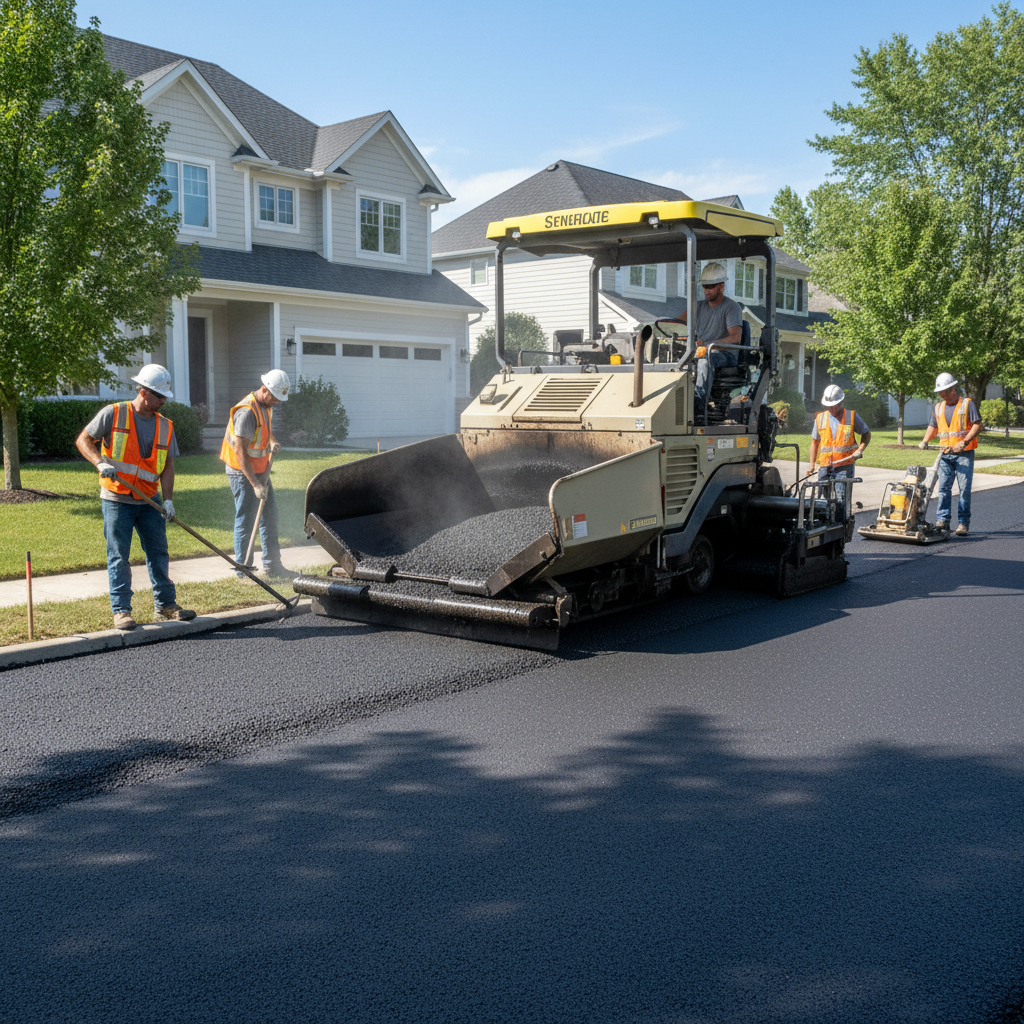
Driveway paving options and costs in L'Amoreaux
L’Amoreaux is a neighbourhood where driveways get tested hard—ice, snow, and freeze–thaw cycles arrive every year, and Toronto’s frost can push deep under pavement if water isn’t managed. With a population of 43,993 in 2021 (Statistics Canada, 2021 Census), there’s steady demand for new driveways and replacements. Most private driveway sites in this part of Toronto are tied to detached homes, and that matters because driveway size and access often drive labour and haul costs as much as the material itself.
In Toronto, pricing isn’t just about the finish. Frost depth and repeat freezing in late fall, winter, and early spring force a deeper, well-compacted granular base and reliable drainage so water can’t sit beneath the surface and cause heaving and cracking. Also, the paving season is effectively compressed into late spring through early fall when soil and air temperatures suit hot-mix asphalt placement. That scheduling pressure can raise costs for prime dates.
If you’re comparing options, the best approach is to match material to how you maintain it: asphalt is typically the most budget-friendly upfront, but it needs sealing on a schedule; pavers and concrete cost more initially, but they offer different maintenance and longevity advantages—especially where occasional repairs are needed. For a quick baseline before you request quotes, use the table below to compare typical lifespan and installed ranges for a properly built driveway (engineered base, drainage, and edging).
| Material |
Lifespan |
Maintenance |
Best For |
Price per sq ft |
Price Range |
| Asphalt (new installation, proper base) |
15–25 years |
Seal 3–5 years (then as needed) |
Lowest upfront cost with good curb integration |
$8–$15 |
$3,500–$8,000 |
| Asphalt (overlay on existing gravel base) |
10–20 years |
Seal and monitor edges/joints |
When you want to improve look without full tear-out |
$9–$16 |
$4,000–$8,500 |
| Interlocking concrete pavers |
25–40 years |
Re-sand joints as needed; replace individual stones |
High curb appeal and easier spot repairs |
$18–$30 |
$9,000–$20,000 |
| Poured concrete (broom finish) |
20–30 years |
Seal 5–7 years (recommended depending on salt exposure) |
Clean, durable surface with straightforward maintenance |
$14–$26 |
$6,000–$15,000 |
| Exposed aggregate concrete |
20–35 years |
Occasional cleaning/sealing; inspect joints |
Slip resistance and premium appearance |
$16–$30 |
$7,000–$16,500 |
| Gravel / crushed stone (budget option) |
5–12 years |
Top up seasonally; re-grade; weed control |
Short-term solution or low-traffic areas |
$5–$10 |
$2,000–$5,000 |
Prices are estimates only and vary by project scope, site access and material selection.
What affects the price of paving in L'Amoreaux
In the Toronto area, quotes for the “same” driveway can vary by 30–50% because the expensive part is usually what you can’t see: excavation volume, base thickness, drainage correction, and disposal. Two properties can both be 10–12 metres of driveway, yet one lot may need significant re-grading for positive slope, while the other drains naturally. When contractors get hit with extra haulage, longer equipment time, and labour to build the base correctly for freeze–thaw, the numbers move quickly.
In Ontario—the Toronto economic region—frost depth and freeze–thaw cycles are decisive cost factors. When ground freezing reaches roughly 3–4 feet in the Toronto region, you typically need a thicker compacted granular base to prevent heaving and cracking. In practical Ontario terms, base and stone thickness often lands in the 6–12 inch working range depending on subgrade conditions, and that includes allowances for excavation and compaction. Asphalt placement also depends on temperatures; hot-mix asphalt generally requires air temperatures above 10°C, which compresses workable season into late spring through early fall. That means more demand for prime dates, and the better crews price accordingly.
Concrete costs in L’Amoreaux can rise when rebar, air-entrained mix design, and tighter control joints are needed to manage Toronto’s winter stresses and salt exposure. Conversely, costs may drop when there’s an existing stable base suitable for an overlay or when access allows faster equipment movement. As a guide, many homeowners end up in the asphalt band of $3,500–$8,000 for a new build, while pavers commonly push into $9,000–$20,000 when full base and edging are upgraded.
| Price Factor |
Why It Matters |
Cost Impact |
| Driveway area in sq ft |
Materials and labour scale directly with surface area |
High (typically the biggest line item) |
| Base depth required |
Frost line determines granular thickness to prevent heaving |
High (more stone + more compaction time) |
| Grading and drainage work |
Slope corrections, swales, and drain routing reduce water under pavement |
Medium to high (excavation and extra stone/pipe) |
| Tear-out of existing surface |
Breaking concrete or milling old asphalt adds labour and hauling |
Medium (low vs high depending on disposal) |
| Edge restraints and curbing |
Prevents paver spread and keeps asphalt from deforming at edges |
Medium (often overlooked in low bids) |
| Sealing requirement |
Asphalt needs sealing after cure (often within 6–12 months) |
Low to medium over time (scheduled maintenance cost) |
| Site access |
Narrow driveways and tight turns slow down skid/roller/equipment movement |
Medium (extra time and staging) |
| Asphalt mix specifications |
Freeze–thaw-rated mix costs more and performs better in Ontario conditions |
Medium (material difference) |
Permits & regulations in Ontario
In Ontario, paving a private driveway within your own property typically does not require a building permit. Where permits and approvals become necessary is when you work in the municipal right-of-way—for example, creating or changing a curb cut, altering the boulevard, or modifying storm drainage that ties into municipal infrastructure.
Another common “paper” step is lot-grading. Some municipalities restrict how close a hard surface can be to lot lines and how water must flow. In L’Amoreaux (Toronto), it’s smart to confirm the lot-grading approach before excavation, especially if you’re adding thickness or changing the slope so you don’t push water toward neighbouring properties.
Step-by-step, here’s how a homeowner can protect themselves:
- Call utility locates through Ontario One Call before any digging.
- Ask your contractor whether the job stays fully on private property or touches the boulevard/right-of-way.
- Confirm whether a curb cut, storm connection, or municipal inspection is required for your scope.
- Verify contractor licensing: request the Ontario licence number (where applicable to their business type) and cross-check it with the appropriate provincial registry.
- Verify liability insurance: request a Certificate of Insurance naming you (or confirming your address as the insured interest if your municipality requires it).
- Verify WSIB/WCB coverage: ask for a clearance letter or equivalent proof of coverage prior to starting work.
When in doubt, your contractor should tell you exactly what approval is needed for your specific site and provide it before mobilization.
Asphalt vs pavers vs concrete for L'Amoreaux driveways
For L’Amoreaux driveways, the “best” material usually comes down to how you want to balance upfront cost, appearance, and long-term maintenance through Toronto’s freeze–thaw winters. Asphalt is typically the lowest upfront option and looks clean when new, but it relies on a properly engineered base and needs sealing every 3–5 years to protect against water and oxidation. In our climate, that maintenance matters because trapped moisture and winter salt can accelerate wear along edges and joints.
Interlocking concrete pavers cost the most upfront in many cases, but they’re the most repair-friendly: if a section settles due to local drainage issues, you can lift, re-bed, and reset pavers without replacing the entire driveway. That’s a big advantage in older Toronto neighbourhoods where underground conditions vary.
Poured concrete sits in the middle price-wise and can last a long time when it’s air-entrained, properly reinforced, and constructed with control joints. Still, concrete is more susceptible to cracking if drainage is off or if the slab isn’t detailed for Toronto’s winter movement.
Base preparation is the common requirement: with Toronto frost that can reach roughly 3–4 feet, drainage and compacted granular stone are non-negotiable for all three materials. Where salt and plough traffic are heavy, pavers and well-detailed asphalt typically tolerate ongoing winter maintenance better than untreated surfaces.
Example: if you’re looking at a typical driveway budget near $3,500–$8,000 for asphalt versus a paver range around $9,000–$20,000, the extra paver cost is usually justified when you want top curb appeal and the ability to do spot repairs. If your priority is staying within budget and you’re comfortable with sealing, asphalt often makes the most sense.
| Material |
Frost Resistance |
Curb Appeal |
Repair Method |
Lifespan |
Price Band |
| Asphalt (sealed regularly) |
Good with engineered base and drainage |
Good (dark, uniform finish) |
Patch and resurface; seal to protect |
15–25 years |
$3,500–$8,000 |
| Interlocking concrete pavers |
Excellent when bed and edging are correct |
Very high (colour and pattern options) |
Remove and reset individual stones |
25–40 years |
$9,000–$20,000 |
| Poured concrete (air-entrained) |
Good with joints and proper mix |
High (clean slab appearance) |
Slab repair/patch; often limited spot fixes |
20–30 years |
$6,000–$15,000 |
| Exposed aggregate concrete |
Good with correct mix and jointing |
Premium |
Patch matching finish (more visible than asphalt) |
20–35 years |
$7,000–$16,500 |
| Permeable pavers (drainage grid) |
Very good if drainage system is detailed |
High (modern look) |
Reset sections and clean drainage pathways |
20–35 years |
$10,000–$22,000 |
| Chip seal / tar-and-chip |
Fair to good; surface wear varies |
Limited (texture-driven) |
Respread aggregate; periodic recoat |
8–15 years |
$3,000–$7,000 |
How to choose a paving contractor in L'Amoreaux
Choosing a paving contractor in L’Amoreaux is about verifying paperwork, then verifying the scope. Start with Ontario licensing and insurance. Ask for the contractor’s Ontario licence information (and the licence number), and confirm it through the appropriate provincial registry if applicable. Next, request liability insurance—you should receive a Certificate of Insurance showing active coverage and the job address. Finally, confirm WSIB/WCB clearance (your contractor should be able to provide a clearance letter or equivalent proof) so you’re not exposed if a worker is injured.
From there, get 2–3 itemised written quotes—not lump sums. You want labour and materials broken out: excavation and disposal, base stone and compaction, asphalt/pavers/concrete supply, forms/edge restraints, and any drainage work. Read exclusions carefully: is permit work included (if any is triggered by your scope), and is hauling/disposal included in the price? A bid that’s cheaper often means it’s missing haulage, proper base depth, or the edge restraint system that keeps materials from moving with winter cycles.
For warranty, ask for the workmanship warranty length and whether it’s backed by a company guarantee. Distinguish workmanship from manufacturer warranties, and confirm if warranties are transferable to future owners if that matters to you.
On payment, keep it controlled: never pay more than 10–15% upfront. Use a holdback until completion (and ideally until you’ve had a final walkthrough). Also, insist on a written start date and a realistic completion estimate given the shortened Ontario paving season.
- Ask for the exact base thickness and compaction requirements in writing.
- Confirm drainage details (slope, ditch/swale solutions, and any weeping provisions).
- Get a line item for disposal/haul away of concrete/asphalt.
- Require edge restraints (asphalt curbing or paver edging) to prevent movement.
- Ask how existing materials are assessed (overlay vs full tear-out).
- Ensure sealing is covered for asphalt (timing after cure, typically within 6–12 months).
- Verify crew scheduling for prime dates and winter shut-down handling.
- Confirm you’ll receive site protection plans (mud tracking, driveway access).
- Check that the quote includes utility locate confirmation steps.
- Ask what happens if weather delays asphalt or concrete placement.
- Review the warranty in plain language: what’s covered and for how long.
- Confirm payment schedule and holdback terms in the contract.
Common red flags in L’Amoreaux include: no written scope for base depth and drainage, vague warranties (“best effort” language), refusing to show WSIB/WCB clearance or insurance documents, quotes that don’t include disposal/haul-away, and pressure to pay a large deposit upfront without a start-date agreement.
Frequently asked questions — paving in L'Amoreaux
Asphalt vs interlocking pavers vs concrete — which is best in L'Amoreaux?
In L’Amoreaux, the “best” choice usually depends on your maintenance comfort and how your property handles water. Asphalt (with a properly built base and good drainage) is typically the lowest upfront route—many projects land around $3,500–$8,000 for a new asphalt driveway. Interlocking pavers cost more upfront (often $9,000–$20,000) but excel in Toronto’s freeze–thaw because you can do targeted repairs without tearing out the whole driveway. Poured concrete is mid-range (commonly $6,000–$15,000) but must be air-entrained with proper control joints and drainage to limit freeze-driven cracking. For most homes, drainage and edging quality are what determine performance—material choice comes second.
How long does a paved driveway last in L'Amoreaux?
With Toronto’s winter conditions, driveway lifespan hinges on base prep, water management, and how the surface is maintained. Asphalt driveways typically last about 15–25 years when the granular base is built for frost conditions and you seal asphalt regularly (often every 3–5 years after the initial cure window). Interlocking pavers commonly reach 25–40 years because individual units can be reset if minor settlement happens. Poured concrete often lasts 20–30 years when it’s properly air-entrained and jointed. If a driveway was installed over poor drainage or shallow base, you’ll usually see cracking/heaving earlier, regardless of the material. That’s why two quotes with the same finish can behave very differently over time.
When is the best time of year to pave in L'Amoreaux?
For L’Amoreaux and the broader Toronto region, the best window is late spring through early fall when soil and air temperatures support installation quality. Asphalt placement generally needs air temperatures above about 10°C, and contractors also want base materials not to be frozen or saturated. That means weather delays can push schedules into peak periods, which is why pricing can be higher for prime dates. Concrete and pavers are more flexible than hot-mix asphalt, but excavation, compaction, and drainage grading still need workable conditions. If you’re planning ahead, aim to book in spring. If you wait until mid-summer, you may still be able to get work scheduled, but you’ll have fewer prime-date options.
How deep should the base be for L'Amoreaux's frost?
In the Toronto economic region, ground freezing can reach roughly 3–4 feet, which is why driveway base design can’t be “one size fits all.” Many Ontario projects use working granular thicknesses in the 6–12 inch range depending on subgrade stability, frost susceptibility, and drainage. The key is that the base must be compacted in lifts to reduce settlement and keep water from migrating upward when it freezes. If your driveway sits on wetter soils or has historically poor drainage, base thickness and drainage provisions often increase. A reputable contractor will assess your subgrade and explain the planned cross-section (excavation depth, stone layers, and slope/drain approach) in writing rather than guessing from the driveway’s surface dimensions alone.
How often should I seal my asphalt driveway?
Sealing asphalt is part of the cost of ownership—especially in Ontario winters where water exposure and salt accelerate wear. In L’Amoreaux, most homeowners should plan to seal after the asphalt has cured, often within a 6–12 month window depending on the product and weather. After that, a typical schedule is every 3–5 years, with adjustments based on traffic, sun exposure, and how aggressively sand/salt are used in your area. If you let seal-coat cycles slip, you may see surface oxidation, water penetration, and edge breakdown, which later leads to more expensive patching or resurfacing. Ask your contractor what sealing product they use and what their recommended inspection intervals are for your driveway.
Why does my driveway crack and heave in winter?
In L’Amoreaux, winter cracking and heaving usually point to moisture and frost movement. When water gets under the pavement—due to poor drainage, a low spot, inadequate slope, or a base that’s too shallow or not well compacted—it freezes and expands. That expansion can lift the asphalt or break concrete, creating cracks that widen over repeated freeze–thaw cycles. Another common contributor is missing or weak edge restraints, which let the surface move at the perimeter where freeze pressures concentrate. Heavy plough impacts can worsen minor movement, and salt can accelerate surface deterioration once cracks appear. The fix isn’t just patching the crack; it’s correcting drainage and confirming proper base build so the driveway can “stay put” through Toronto winters.