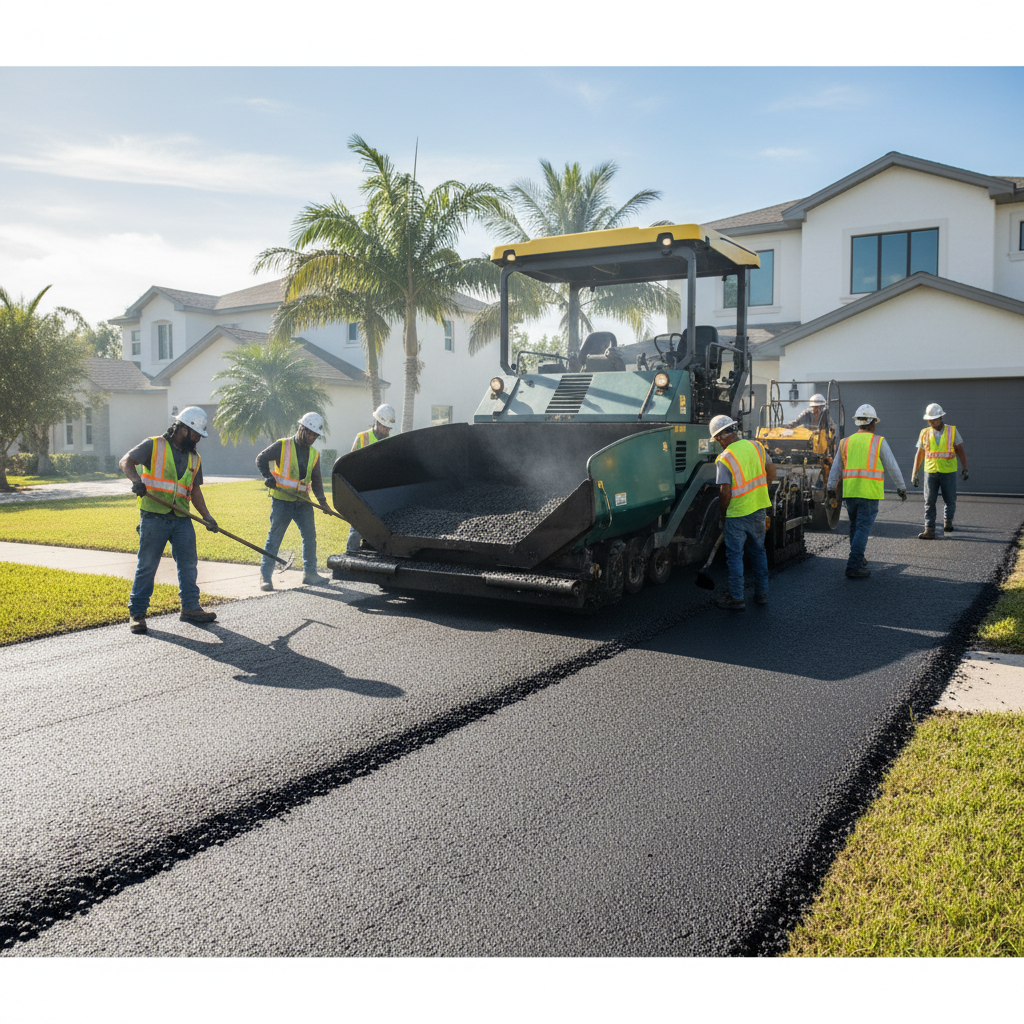
Driveway paving options and costs in Englemount-Lawrence
In Englemount-Lawrence, Ontario, your driveway choice usually comes down to balancing upfront cost, curb appeal, and how well the surface handles Toronto’s freeze–thaw winters. With a population of 22,372 in the area (Statistics Canada, 2021 Census), there’s steady demand for driveways and parking pads, especially around busy homeowner pockets where vehicles are parked year-round. Most private driveways are attached to single-detached homes, and the Toronto market has a lot of older neighbourhood housing where contractors are frequently doing overlays and full teardowns rather than brand-new pads. That matters because the condition of the existing base is one of the biggest determinants of whether you’ll land closer to the low or high end of a price range.
In the Toronto economic region, ground freezing to roughly 3–4 feet and frequent freeze–thaw cycles are primary cost drivers. Contractors typically need deeper, well-compacted granular base layers and reliable drainage so water can’t sit beneath the pavement and cause heaving and cracking. On top of that, the paving season is effectively compressed into late spring through early fall—so prime scheduling and rush work can push totals higher in spring.
If you’re comparing options, a proper base is the common denominator. The main differences are surface flexibility, how you maintain it, and how repairs are handled later. Below is a practical pricing snapshot for typical driveway work in Englemount-Lawrence to help you line up quotes by apples-to-apples scope.
| Material |
Lifespan |
Maintenance |
Best For |
Price per sq ft |
| Asphalt (new installation, proper base) |
15–25 years |
Seal every 3–5 years |
Best value with solid base prep |
$8 – $14 |
| Asphalt (overlay on existing gravel base) |
10–18 years (depends on base) |
Seal every 3–5 years; patching as needed |
When existing grade is stable |
$6 – $11 |
| Interlocking concrete pavers |
25–40 years |
Light joint sand re-topping as needed |
Curb appeal and easy spot repairs |
$18 – $28 |
| Poured concrete (broom finish) |
20–30 years |
Crack monitoring; sealing optional |
Lower maintenance, clean finish |
$14 – $22 |
| Exposed aggregate concrete |
20–30 years |
Seal if specified; crack control essential |
Slip resistance and premium look |
$18 – $28 |
| Gravel / crushed stone (budget option) |
3–10 years |
Regrade; top up annually |
Temporary solution or low budget |
$3 – $7 |
Prices are estimates only and vary by project scope, site access and material selection.
What affects the price of paving in Englemount-Lawrence
If you get multiple quotes for the same driveway area in Toronto, it’s not unusual to see differences of 30–50%. A lot of that is simply scope variation: one contractor may include full granular base replacement and drainage correction, while another assumes you’ll accept a thinner base or minimal grading. Labour availability also swings mid-season because frost work and asphalt placement both have weather cutoffs—so contractors who can start sooner often price higher for prime dates. Overlays on older driveways can look “similar” on the street, but the base condition underneath is what drives the real cost.
In this region, frost depth and freeze–thaw cycles are decisive. Ground freezing to roughly 3–4 feet means the granular layers have to resist water movement and heaving. Deeper frost typically requires a thicker compacted granular base—often in the 6–12 inch range in Ontario—plus proper slopes, subgrade compaction, and drainage detailing to reduce trapped moisture. On the asphalt side, hot-mix asphalt placement is best when conditions allow proper compaction; asphalt mix design also needs to be freeze–thaw rated for Toronto’s winters, which can affect material costs.
Concrete pricing can swing based on crack-control strategy. For example, a broom-finished driveway that includes air-entrainment and well-timed jointing usually costs more than a “basic pour,” but it reduces freeze–thaw cracking risk. Similarly, exposed aggregate costs more than standard concrete due to the finishing process and timing. On the asphalt side, if your driveway needs significant tear-out and base rebuild, you can move from the lower end of the asphalt band toward the upper end (or closer to interlock pricing). In practice, projects often land anywhere from around $3,500 – $8,000 for asphalt to well above that once you upgrade to interlocking, which commonly sits in the $9,000 – $20,000 band depending on size and base engineering.
| Price Factor |
Why It Matters |
Cost Impact |
| Driveway area in sq ft |
The bigger the surface, the more base, asphalt/concrete, and finishing labour required |
High (often the largest single driver) |
| Base depth required |
Toronto’s frost depth increases required granular thickness to prevent heaving and cracking |
High (major material + labour change) |
| Grading and drainage work |
Slope corrections and drainage prevent water sitting under pavement during thaw periods |
Medium to high |
| Tear-out of existing surface |
Breaking and hauling concrete or old asphalt adds labour, disposal, and sometimes subbase rebuild |
Medium to high |
| Edge restraints and curbing |
Interlock and even asphalt can spread without proper restraints, especially with freeze expansion |
Medium |
| Sealing requirement |
Asphalt typically needs sealing after initial curing to slow oxidation from moisture and salts |
Low to medium (recurring) |
| Site access |
Narrow/tight lots slow equipment and can increase manual handling |
Medium |
| Asphalt mix specifications |
Freeze–thaw rated mixes help performance in Toronto’s winter conditions |
Medium |
Permits & regulations in Ontario
In Ontario, paving a private driveway within your own property usually does not require a building permit. Where permits and approvals come in is when the work touches the municipal portion of the right-of-way. That means anything involving new curb cuts, changes to the boulevard, or alterations to storm drainage typically requires municipal approval before the contractor excavates or makes connections. If your driveway crosses over or changes how water drains from the public edge, expect additional review. Also, some municipalities have lot-grading rules that restrict how close a hard surface can be to property lines and how water must be managed during runoff events.
Step-by-step, here’s how a homeowner in Englemount-Lawrence can verify a contractor properly:
- Call Ontario One Call and confirm utility locates are arranged before any excavation.
- Ask for the contractor’s Ontario business/licence information and confirm it matches the company name on the quote.
- Request a certificate of liability insurance (and ensure it’s active for the current term and covers the scope).
- Confirm WSIB coverage (or obtain proof of clearance where applicable). If they tell you they’re “not registered” or “covered in-house,” ask for documentation in writing.
- Get written scope details showing whether permit/approval steps (when needed) are included or the homeowner must handle them.
If a contractor is vague about insurance, WSIB/clearance, or utility locates, treat that as a red flag. Proper compliance matters more in winter cities like Toronto because improper drainage and base work often shows up as heaving and cracking after the first couple freeze–thaw seasons.
Asphalt vs pavers vs concrete for Englemount-Lawrence driveways
For Englemount-Lawrence’s Toronto freeze–thaw climate, asphalt, interlocking concrete pavers, and concrete can all perform well—but they fail differently and at different costs. Asphalt generally has the lowest upfront price, and with a well-built granular base it moves slightly with winter expansion, which helps reduce big structural cracking. The trade-off is maintenance: asphalt typically needs sealing every 3–5 years to protect against moisture intrusion and oxidation, especially when sand and road salt are used after plowing.
Interlocking concrete pavers cost the most upfront, but they offer the best repairability. If a section settles or a drainage issue causes localized movement, pavers can be lifted, corrected, and reinstalled without replacing the entire surface. That’s a practical advantage for older Toronto properties where hidden issues in the base can emerge over time. Pavers also hold up well to winter wear when the base and edge restraints are engineered for movement.
Poured concrete is often mid-range, but freeze–thaw performance depends heavily on air-entrainment, proper curing, and crack control (joints and timing). If the base is not uniformly compacted and drainage isn’t addressed, concrete is more prone to cracking and spalling from freeze–thaw and de-icing exposure. Exposed aggregate looks premium and can improve traction, but it still depends on base engineering and correct mix design.
To see where the price difference can be justified: a driveway that costs about $3,500 – $8,000 in asphalt may jump into the $9,000 – $20,000 range for interlocking. If you plan to stay in your home long-term, care about curb appeal on a prominent frontage, and want the ability to do targeted repairs years later, interlock can be the better value. If you want the simplest maintenance routine and lowest initial cost, asphalt can make sense—provided the contractor designs for Toronto frost and water management from day one.
| Material |
Frost Resistance |
Curb Appeal |
Repair Method |
Lifespan |
Price Band |
| Asphalt (sealed regularly) |
Good with proper base and freeze–thaw-rated mix |
Medium |
Patch and re-seal; full overlay if needed |
15–25 years |
$3,500 – $8,000 |
| Interlocking concrete pavers |
Very good with engineered base + restraints |
High |
Lift, fix base/drainage, reset pavers |
25–40 years |
$9,000 – $20,000 |
| Poured concrete (air-entrained) |
Good if joints and air-entrainment are correct |
Medium to high |
Crack repair/patching; overlays for major issues |
20–30 years |
$6,000 – $15,000 |
| Exposed aggregate concrete |
Good with correct mix and curing |
High |
Limited patching; often localized replacement |
20–30 years |
$7,000 – $16,500 |
| Permeable pavers (drainage grid) |
Excellent drainage handling (when base is designed right) |
High (modern look) |
Replace affected grid/pavers; maintain infill |
25–35 years |
$10,000 – $22,000 |
| Chip seal / tar-and-chip |
Moderate; dependent on base and maintenance |
Low to medium |
Re-seal/redo surface layer |
5–12 years |
$3,000 – $6,500 |
How to choose a paving contractor in Englemount-Lawrence
Choosing a contractor in Englemount-Lawrence is about documentation and jobsite clarity, not just the lowest number. First, verify the contractor’s Ontario licensing/business registration that matches the company on the quote. Next, ask for a current certificate of liability insurance (and confirm it’s valid for the project dates and covers the scope: excavation, asphalt/concrete placement, and any concrete cutting). For worker protection, confirm WSIB/WCB coverage: request proof of coverage or a clearance letter and keep it with your contract documents.
Then, request 2–3 itemised written quotes—not a single lump sum. You want line items for labour and materials (excavation, granular base and compaction, asphalt lift(s), concrete mix, reinforcement/joints if applicable, and disposal/haul-away). Carefully review exclusions: is demolition included, is disposal included, and are utility locates part of the job? Ask whether permits/municipal approvals are included when the work affects the boulevard or storm drainage.
Warranty should be in writing with clear definitions. A workmanship warranty should specify duration and what’s covered (settlement vs cosmetic cracking vs material defects). Also ask if product/manufacturer warranties transfer to you if you sell the home. On payment, keep it conservative: never pay more than about 10–15% upfront; hold back the remainder until substantial completion and cleanup.
Finally, get the start date and an expected completion estimate in writing. In Toronto’s shortened paving window, a contractor who can’t commit to dates often isn’t planning around the right weather thresholds.
- Confirm Ontario business/licence details match the quote and contract.
- Request liability insurance certificate and verify coverage limits.
- Provide WSIB/WCB coverage proof or clearance letter.
- Ask for utility locate evidence (Ontario One Call) before excavation.
- Get an itemised breakdown: base, asphalt/concrete, forms/edges, disposal.
- Verify demolition scope: full tear-out vs partial milling vs overlay assumptions.
- Confirm base spec (thickness and compaction), not just “proper base.”
- Check drainage/slope plan: how water will be directed away from the slab/base.
- Ask about edging/restraints for pavers and proper border restraint for asphalt.
- Clarify sealing or curing requirements and who applies the product if included.
- Review warranty terms in plain language with coverage exclusions.
- Use a payment schedule with a holdback until final inspection and cleanup.
In Englemount-Lawrence, red flags include contractors who (1) won’t show insurance/WSIB documentation, (2) quote asphalt without specifying base thickness and compaction, (3) dismiss drainage as “not necessary,” (4) start excavation without confirming utility locates, and (5) offer vague “lifetime” warranties that don’t define workmanship vs materials.
Frequently asked questions — paving in Englemount-Lawrence
Is it worth sealing a new driveway right away in Englemount-Lawrence?
In Ontario and specifically around Englemount-Lawrence, sealing is worth it—but timing matters. Asphalt needs time to cure and cool so the sealant can bond properly. Most contractors will wait after placement (often season- and temperature-dependent) and will then apply sealing within the window that allows the asphalt to accept it without trapping moisture. If you seal too soon, you can lock in water and accelerate deterioration, which shows up as flaking or premature wear during Toronto’s freeze–thaw cycles.
If your contract includes sealing, confirm when it will be applied (and whether it’s a 1-time treatment or part of an ongoing plan). For many homeowners, the biggest value is doing it early in the life of asphalt, then resealing every 3–5 years to protect the surface from salts, sand, and winter moisture.
What is a chip seal driveway and is it suited to Englemount-Lawrence?
Chip seal (tar-and-chip) is a lower-cost surface treatment where asphalt binder is sprayed and topped with stone chips. It can be suitable for some properties in Englemount-Lawrence, especially where budget is the main driver and the driveway isn’t expected to be a high-traffic “daily wear” route. However, Toronto’s freeze–thaw cycles and the way salt/sand are used after plowing can shorten its performance if the base and drainage aren’t done well.
Chip seal typically performs best on well-prepared base with proper grading so water doesn’t pond. If you’re choosing between asphalt and chip seal, remember that asphalt is usually the more durable option for long-term ownership. Chip seal may land in a range around $3,000 – $6,500, while new asphalt with a proper base often falls around $3,500 – $8,000—the small step up often buys you better resilience for a Toronto winter.
How much does driveway crack repair cost in Englemount-Lawrence?
Crack repair in Englemount-Lawrence depends on whether you’re dealing with surface-only shrinkage cracks or wider issues that suggest base movement. For hairline asphalt cracks, contractors typically clean and seal them to prevent water infiltration, which is what leads to potholes during thaw periods. For concrete, repair may involve crack routing and filling, or localized patching if spalling has started.
In terms of typical budgeting, sealing and repair work often sits around $300 – $1,500 for smaller, localized fixes. Larger repairs—especially where sections are deteriorating or the driveway has multiple failed areas—can cost more because you may need additional saw cutting, removal, and thicker patching.
Always ask your contractor to explain what caused the crack (drainage, settlement, inadequate base, or freeze movement) because sealing alone won’t fix an underlying drainage problem.
What base thickness do I need for pavers in Englemount-Lawrence?
Paver base thickness in Englemount-Lawrence is primarily driven by frost depth and drainage. With Toronto freezing to roughly 3–4 feet, you generally need a well-compacted granular base that’s thick enough to prevent water from migrating and freezing under the surface. A common approach in Ontario is granular base in the 6–12 inch range depending on subgrade condition, soil type, and whether drainage is being improved.
What matters most is not the number alone—it’s the compaction quality and drainage design. If the subgrade is weak or water-saturated, contractors may recommend deeper excavation and replacement or additional drainage layers. On the other hand, if the existing base is stable and well-drained, the scope can be reduced.
In your quote, ask for the actual base build-up (material type, total depth, and compaction). If the contractor only says “proper base,” you should push back.
How do I get the most accurate paving quote in Englemount-Lawrence?
To get an accurate quote in Englemount-Lawrence, provide clear measurements and insist on an itemised scope. Start by measuring the driveway area (length x width) and letting contractors know whether you want an overlay or full tear-out. If there are known issues—standing water, settlement near garage entrances, or repeated cracking—tell them up front so they can design drainage and base corrections rather than applying a surface patch.
Ask for 2–3 quotes that break down labour and materials: excavation, granular base depth, compaction, asphalt lifts or concrete mix and finishing, and disposal/haul-away. Also confirm whether sealing is included for asphalt and what the timeline is for that first sealing coat.
Finally, verify the contractor’s Ontario documentation: insurance, and WSIB/WCB coverage proof. Better documentation usually means better planning—especially important in Toronto’s shorter paving window.
How much does it cost to pave a driveway in Englemount-Lawrence?
Driveway paving costs in Englemount-Lawrence typically follow the broader Toronto region pricing bands, but your final number depends heavily on driveway size, base condition, drainage work, and access. For many homeowners, new asphalt with a proper base commonly lands in the $3,500 – $8,000 range. Concrete options usually sit higher, often around $6,000 – $15,000 depending on finish and jointing. Interlocking pavers can be the premium choice and often fall into $9,000 – $20,000 depending on thickness, restraint details, and overall area.
In Toronto’s freeze–thaw climate, deeper granular base and drainage corrections can move a project toward the upper end. That’s why two quotes for “the same driveway” can differ—one may include base rebuild while the other assumes the existing foundation is already adequate.