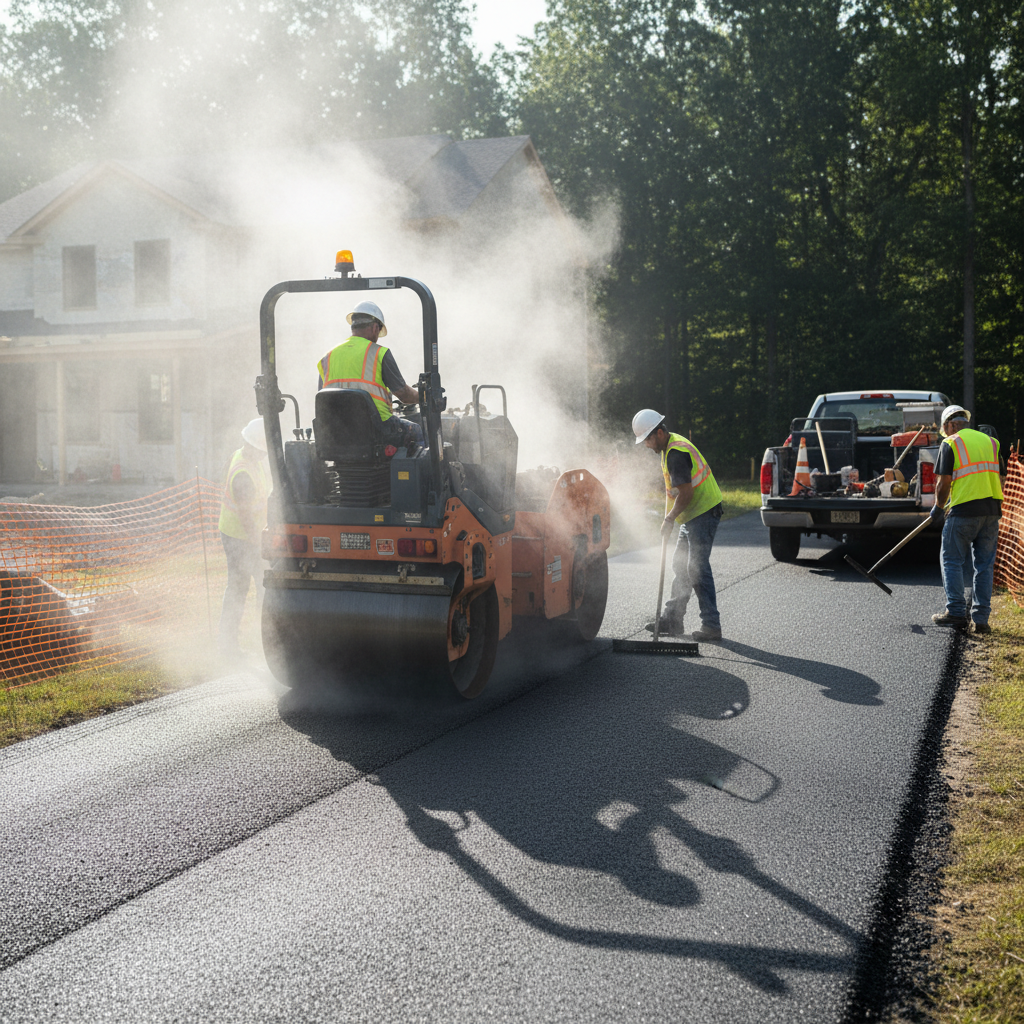
Driveway paving options and costs in Prescott
Prescott homeowners have a few solid driveway paving routes, and the right choice usually comes down to how much freeze–thaw movement you expect, how you maintain in winter, and what you can budget for up front. With 57.7% of households in Prescott owning their homes and 57.7% of dwellings being single-detached homes, most private driveways here tie directly to detached properties—so demand is steady across neighbourhoods like the Prescott village core and nearby rural lanes where access can be tight. The Kingston–Pembroke economic region shapes pricing too: frost penetration is commonly around 4 feet (about 1.2 m), and that means asphalt and concrete both need deeper, well-compacted granular base and reliable drainage to control heaving, cracking, and surface raveling. Winter also hits hard and early, and spring shoulder seasons are often wet, so the paving window is shorter; contractors compress base prep, paving, and interlock work into a limited season, which can tighten schedules when demand peaks. Asphalt mix design in this climate matters as well—freeze–thaw-rated mixes cost a bit more but perform better.
Below are realistic cost bands you can use when comparing quotes in Prescott. Use them as a starting point, then confirm the scope (tear-out, base depth, drainage corrections, and edge restraints) because those items often explain why two bids for the “same driveway” can land far apart.
| Material |
Lifespan |
Maintenance |
Best For |
Price per sq ft |
| Asphalt (new installation, proper base) |
15–25 years |
Seal coat every 3–5 years; patch small failures |
Lowest upfront cost with good drainage and a new granular base |
$4.50 – $9.00 |
| Asphalt (overlay on existing gravel base) |
10–18 years |
Seal every 3–5 years; more frequent patching if base is weak |
Quicker upgrade when drainage and base are already solid |
$5.50 – $10.50 |
| Interlocking concrete pavers |
25–40 years |
Periodic joint sand top-up; replace individual stones if needed |
Curb appeal, modular repair, and tolerance for seasonal movement |
$7.50 – $16.00 |
| Poured concrete (broom finish) |
20–30 years |
Light sealing as needed; monitor and patch minor cracks |
Clean look and straight-line driveways with good subgrade prep |
$8.00 – $18.00 |
| Exposed aggregate concrete |
20–30 years |
Reseal periodically; spot repair of surface chips |
Higher-end appearance and better slip resistance than smooth concrete |
$10.00 – $22.00 |
| Gravel / crushed stone (budget option) |
3–8 years |
Re-grade and add stone as it migrates; control weeds and washouts |
Temporary surfacing or low-budget solutions with strong drainage |
$2.50 – $5.50 |
Prices are estimates only and vary by project scope, site access and material selection.
What affects the price of paving in Prescott
In Prescott and the broader Kingston–Pembroke region, even “similar” driveways can price 30–50% differently because the biggest costs aren’t the surface—they’re everything below it. Asphalt driveway paving often lands in the $4,500–$9,000 band, while interlocking can run $6,500–$14,000 depending on excavation, base build-up, and how much drainage correction is needed. Why the variance? Frost depth and freeze–thaw cycles are decisive: with frost penetration commonly around 4 feet (≈1.2 m) in much of Southern and Eastern Ontario, driveways typically need a deeper, well-compacted granular base to prevent heaving and cracking. In colder pockets, contractors may plan for closer-to-54 inches of effective frost influence, which pushes aggregate volume and compaction time upward. Hot-mix asphalt also has a practical placement limit—crews generally need air temperatures above 10°C—so the shorter paving window in colder regions concentrates demand, and scheduling can tighten in spring and early summer. That also affects labour availability.
Local conditions in Prescott can raise or lower cost quickly. For example, older homes built before 1981 (81.5% of dwellings) are more likely to have driveways with older, shallower base or poor drainage tie-ins, so tear-out and base rebuild becomes a larger portion of the budget. Clay pockets or low spots near ditches can require extra grading, culvert adjustments, or a French drain—often turning a “paving-only” job into a drainage project. On the flip side, driveways with already-stable base and clear access for a skid steer and roller can keep costs nearer the lower end of the $4,500–$9,000 asphalt range because you spend less time hauling aggregate and less time reworking subgrade.
| Price Factor |
Why It Matters |
Cost Impact |
| Driveway area in sq ft — the primary cost driver |
More surface area increases asphalt/concrete or paver quantities plus equipment time |
Often accounts for the largest share of the total; expect near-linear pricing with area |
| Base depth required — frost line determines granular thickness |
Deeper frost influence requires more compacted aggregate layers to prevent heave |
Can significantly increase material hauling and compaction labour |
| Grading and drainage work — slope or drainage corrections add cost |
Proper drainage reduces water infiltration and spring breakdown |
Common reason for 30–50% quote differences on “the same” driveway size |
| Tear-out of existing surface — breaking and hauling concrete or old asphalt |
Disposal, load counts, and backfill time add cost before you even pave |
Higher if the old base is unstable or undermined |
| Edge restraints and curbing — needed to prevent paver spread |
Restraints control lateral movement and maintain clean driveway lines |
Adds labour and materials; often essential for pavers |
| Sealing requirement — asphalt must be sealed after 6–12 months |
Sealing protects binder from oxygen and UV, slowing raveling |
Small extra cost now prevents earlier surface repairs later |
| Site access — narrow or tight lots slow equipment movement |
Slower equipment movement increases time for excavation, compaction, and paving |
May raise labour costs and change equipment size/plan |
| Asphalt mix specifications — freeze-thaw-rated mix costs more |
Spec mixes include performance upgrades for local temperature swings |
Often adds moderate material cost but improves long-term durability |
Permits & regulations in Ontario
In Ontario, paving a private driveway within your own property typically does not require a building permit. If you’re resurfacing or replacing the driveway surface and doing the work wholly on your lot (for example, tearing out existing asphalt and rebuilding base then paving), that’s usually handled under general property maintenance rather than permit-heavy construction. The situations that do require approvals are mainly when you impact the municipal right-of-way or storm drainage system. Examples include creating or changing a curb cut/driveway access into the boulevard, altering storm drainage patterns, changing culvert locations or elevations, or any work that affects municipal infrastructure.
To verify a Prescott contractor is set up properly in Ontario, do it step-by-step and keep proof. First, ask for their certificate of insurance and confirm liability coverage limits match your project size and scope. Second, check workers’ compensation coverage through the WSIB (or WCB for the applicable work arrangement) so you’re not left exposed if a worker is injured on your site. Third, confirm their Ontario business credentials: the contractor should provide their company details and allow you to review their licensing status through appropriate provincial registry resources. If they can’t provide current insurance paperwork or they won’t share references, that’s a red flag.
Finally, before excavation, always request underground utility locates using Ontario One Call. Confirm any lot-grading constraints with the municipality as well, especially on older properties where drainage historically may have been informal.
Asphalt vs pavers vs concrete for Prescott driveways
For Prescott’s freeze–thaw climate, all three materials can perform well—if the base and drainage are built right—but they behave differently as the seasons move the ground. Asphalt is usually the lowest upfront option and is generally smooth and quieter under tires, but it needs sealing every 3–5 years to protect the binder. In the Kingston–Pembroke region, asphalt without adequate base depth and drainage is more likely to ravel at the surface after winter, particularly where water sits in low spots.
Interlocking concrete pavers typically cost more upfront (commonly within the $6,500–$14,000 driveway range), yet they’re highly repairable: if a section settles or a small area fails, you can lift and reset that portion instead of tearing out the full surface. That matters in Prescott where older driveways (many built during or before the late 20th century) may have inconsistent base under the edges. Pavers also handle seasonal movement well when restrained correctly with proper edge restraints.
Poured concrete sits in the middle for cost but needs a well-designed granular base and—ideally—air-entrainment to resist freeze–thaw scaling. Concrete is also more vulnerable to cracking if it’s not air-entrained or if drainage directs meltwater into the slab area, and de-icing salt can accelerate surface wear on top finishes.
Concrete and asphalt both rely on the same fundamentals here: granular base thickness driven by frost influence, firm compaction, and drainage that sheds water away from the driveway. A simple dollar example: if your asphalt quote comes in around the lower end of the $4,500–$9,000 band, but the contractor can’t clearly explain base depth and drainage corrections, you might end up paying for premature patching. In contrast, a properly built interlock job may justify the higher price because repairs are targeted, not wholesale—especially if you plow regularly and the driveway sees repeated traffic impacts during thaw cycles.
| Material |
Frost Resistance |
Curb Appeal |
Repair Method |
Lifespan |
Price Band |
| Asphalt (sealed regularly) |
Good with frost-rated mix, deep base, and drainage |
Good (clean, uniform surface) |
Cut-and-patch asphalt areas or seal system touch-ups |
15–25 years |
$4,500 – $9,000 |
| Interlocking concrete pavers |
Very good with compacted base and restrained edges |
Excellent (varied patterns and colours) |
Lift/reset sections; replace individual stones |
25–40 years |
$6,500 – $14,000 |
| Poured concrete (air-entrained) |
Good to very good when air-entrained and well-based |
Good (single slab look) |
Crack repair and patching; joint maintenance |
20–30 years |
$7,000 – $15,000 |
| Exposed aggregate concrete |
Good when properly air-entrained and drained |
High-end look (texture and slip resistance) |
Patch and resurface spot repairs (more visible than asphalt) |
20–30 years |
$9,000 – $18,000 |
| Permeable pavers (drainage grid) |
Very good where infiltration is managed correctly |
Good (modern design options) |
Lift/reset individual modules; clean the drainage layer |
20–35 years |
$8,500 – $16,500 |
| Chip seal / tar-and-chip |
Moderate; best for specific site conditions |
Fair (more rugged texture) |
Spot patching; periodic re-coat may be needed |
8–15 years |
$4,000 – $7,500 |
How to choose a paving contractor in Prescott
Choosing the right contractor in Prescott is mostly about verifying coverage, getting scope clarity, and confirming they build for our frost and drainage reality—not just the surface. Start by verifying Ontario licensing/business credentials, then request their liability insurance certificate (and confirm it covers driveway work on residential property). Next, confirm workers’ compensation coverage through WSIB (or the applicable provincial system for the contractor’s workforce). You should be able to see current clearance status or documentation before work begins.
Then get 2–3 itemised, written quotes. I recommend you ask for a breakdown that separates labour and materials, including excavation quantity, granular base thickness, compaction method, geotextile (if used), drainage repairs, disposal, and the paving surface. Make sure the quote addresses what’s excluded: for instance, is snow removal included during the project window, is existing surface tear-out included, and is disposal of broken concrete/asphalt hauled away? Ask whether permits or municipal approvals are included when curb cuts or boulevard drainage changes are involved.
Warranty should be specific: the workmanship warranty length (often longer than material-only promises), the manufacturer/product warranty terms, and whether warranties are transferable if you sell the home. For payment, don’t pay more than about 10–15% upfront; hold back a portion until the job is complete and you’ve reviewed final grading and surface finish. Finally, demand a timeline: get the start date and completion estimate in writing, especially because Prescott’s season limits can shift schedules quickly.
- Confirm Ontario business credentials and ask for a copy you can keep.
- Require a COI for liability insurance; match coverage to driveway scope.
- Verify WSIB coverage/clearance documentation for worker safety and your protection.
- Request itemised quotes (labour + materials), not a single lump sum.
- Ensure the quote states base depth and granular layers, not just “we’ll prep the base.”
- Ask how drainage is handled (ditch grading, swales, French drains if needed).
- Confirm tear-out and disposal are included (and how waste is hauled).
- Verify edge restraints/curbs are included where applicable.
- For asphalt, confirm sealing timing (typically after 6–12 months) and who does it.
- Get compaction details (equipment used and layer-by-layer compacting approach).
- Ask about temperature conditions and paving timing so they don’t rush spring work.
- Lock in a start date and completion window in the signed contract.
Concrete red flags I’ve seen in Prescott: contractors who won’t show insurance/WSIB documentation; quotes that skip base thickness and drainage details; “too-good-to-be-true” pricing that doesn’t include tear-out or disposal; no written warranty terms (or vague promises like “lifetime” with no scope); and crews that plan to pave in wet or cold conditions without discussing air-temp placement limits and curing time.
Frequently asked questions — paving in Prescott
When is the best time of year to pave in Prescott?
In Prescott, the best window is late spring through early fall when conditions support proper compaction and paving temperatures. Asphalt typically requires air temperatures above about 10°C to place and roll properly, and crews also need stable, non-saturated base conditions—spring shoulder-season rain can slow everything down. If your project includes deeper base rebuilds to control frost movement (frost commonly around 4 feet in Eastern Ontario), contractors often prefer a dry stretch so granular layers can be compacted layer-by-layer. Practically, that means aiming for mid-to-late May through September, with scheduling tight when demand peaks. If you’re comparing quotes, ask what temperature conditions they plan for and whether they have contingency days if wet weather hits.
How deep should the base be for Prescott's frost?
Base depth depends on your soil, how water drains off your site, and how your driveway subgrade behaves during thaw. In Kingston–Pembroke, frost influence is commonly around 4 feet (≈1.2 m), so contractors usually design for a deeper, well-compacted granular base rather than a thin stone layer. That typically means building granular depth in the range used in Ontario for frost protection—often about 6–12 inches of compacted granular layers plus any additional improvements based on subgrade and drainage corrections. If you have clay pockets, low areas, or poor ditch/culvert tie-ins, the required base build-up and grading work can be more. Your contractor should be able to explain their base design and show it clearly in the quote, not just mention “frost protection.”
How often should I seal my asphalt driveway?
For Prescott asphalt, sealing is usually done after the initial paving has properly cured—commonly after 6–12 months—then repeated about every 3–5 years depending on how hard it gets used. Heavy plowing traffic, frequent turning under tire loads, and areas exposed to more sun or water pooling can reduce the interval. Sealing helps slow down binder aging and reduces raveling, which is especially important in freeze–thaw cycles where surface texture can break down over winter. If your driveway is in the $4,500–$9,000 paving range, sealing may be a separate line item later; budgeting for a sealing and repair allowance (often around $400–$1,800 depending on extent) helps you maintain performance instead of reacting to potholes and edge failures.
Why does my driveway crack and heave in winter?
Cracking and heaving usually come from one of three issues: water infiltration, insufficient frost protection/base depth, or weak subgrade support. When meltwater can’t drain away—common on sites with low spots near ditches, clogged runoff paths, or driveways sloped toward the house—water freezes and expands, pushing the pavement up (heaving). Over time, freeze–thaw cycles open micro-gaps, letting more water in and accelerating raveling or cracking. Older driveways in Prescott are also more likely to have base that wasn’t designed for today’s performance expectations; many homes here are older (81.5% of dwellings built before 1981), so an asphalt “overlay” over poor drainage can fail quickly. A good contractor checks grading, compaction, and drainage before choosing material.
Do I need a permit to pave my driveway in Ontario?
Usually, paving or replacing a private driveway surface within your own property generally doesn’t require a building permit in Ontario. However, if your project affects the municipal right-of-way—such as changing a curb cut, altering boulevard drainage, or modifying storm drainage patterns—municipal approval may be required. In Prescott, the key is whether you’re touching access and drainage infrastructure tied to the street. A reputable contractor should tell you if they anticipate right-of-way work and whether a permit/approval is needed, then coordinate it. Regardless of permits, you should always have utility locates done before excavation using Ontario One Call, and confirm lot-grading rules locally so the new driveway doesn’t redirect water toward neighbouring properties.
How long before I can drive on new asphalt?
After asphalt paving in Ontario, the typical guidance is to avoid traffic long enough for the surface to cool and for rolling/compaction to settle. In many driveway jobs, light vehicle traffic may be allowed after a few hours once the asphalt is stable and cool enough, but crews often recommend waiting longer (or at least using caution) because shoulder-season moisture and cooler nights can slow curing. If you’re planning around other work, ask the contractor for their exact curing guidance based on weather conditions and mix used. Timing also affects when you should schedule sealing: sealing is usually planned after the driveway has cured properly—often after 6–12 months—rather than immediately. If your quote is in the $4,500–$9,000 range, make sure the schedule and staging for your access needs are included in the plan.