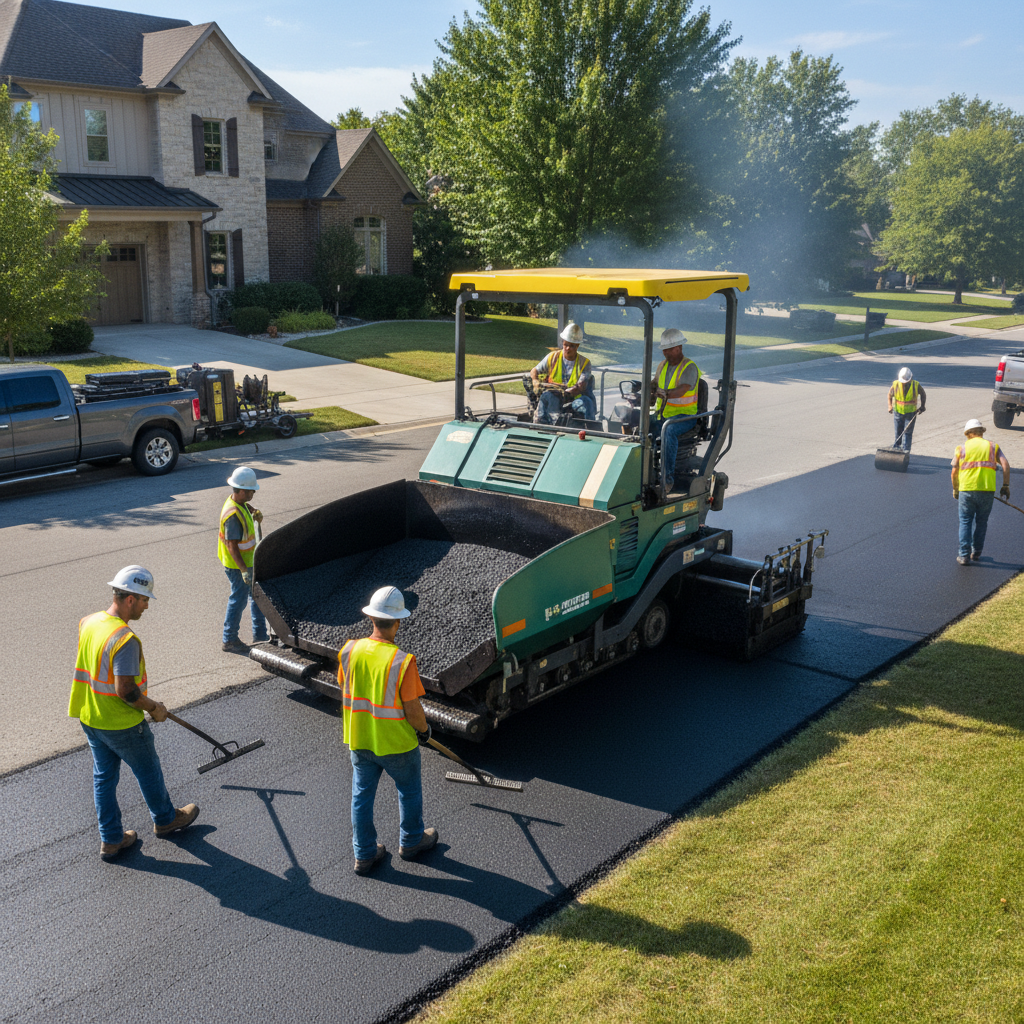
Driveway paving options and costs in Lawrence Park North
Lawrence Park North, Ontario is a beautiful, tree-lined pocket of Toronto where driveways often get heavy winter wear and frequent salt exposure. With a population of 14,607 (Statistics Canada, 2021 Census), demand for driveway renewals stays steady, especially on older residential streets where original surfaces are starting to fail. In this neighbourhood, most private driveways serve detached homes—so the job size can be significant, and small upgrades like better drainage or deeper base compaction can change the outcome for the next 10+ years.
In the Toronto economic region, frost depth and freeze–thaw cycles are primary cost drivers. Ground freezing to roughly 3–4 feet means paving needs a deeper, well-compacted granular base and reliable drainage so water can’t sit under the surface and expand when temperatures drop. That’s why you’ll often see differences of thousands of dollars between quotes for “the same driveway”: some contractors include proper excavation, base thickness, and edging restraints that prevent movement during winter.
Contractor availability also peaks from late spring through early fall. In Lawrence Park North—particularly around Yonge Street and the Lawrence Avenue East corridor—many homeowners call in spring for the best install dates, which can tighten scheduling and affect pricing.
Here’s a practical price-and-performance comparison to help you discuss scope and budget with your installer.
| Material |
Lifespan |
Maintenance |
Best For |
Price per sq ft |
| Asphalt (new installation, proper base) |
15–25 years |
Sealcoat every 3–5 years |
Best all-round value with the right granular base |
$8 – $14 |
| Asphalt (overlay on existing gravel base) |
10–18 years |
Sealcoat every 3–5 years; monitor settlement |
When subgrade is sound and drainage is corrected |
$7 – $12 |
| Interlocking concrete pavers |
25–30+ years |
Keep joints clean; re-level as needed |
High curb appeal and easy spot repairs |
$15 – $24 |
| Poured concrete (broom finish) |
20–30 years |
Seal as recommended; crack control required |
Clean, low-visual-maintenance driveway look |
$14 – $22 |
| Exposed aggregate concrete |
20–30 years |
Sealcoat every few years |
Slip resistance and upscale appearance |
$18 – $28 |
| Gravel / crushed stone (budget option) |
5–10 years |
Re-grade and top up as ruts form |
Lowest upfront cost; works best short-term |
$4 – $8 |
Prices are estimates only and vary by project scope, site access and material selection.
What affects the price of paving in Lawrence Park North
It’s common to see quotes for the “same” driveway in Toronto that vary by 30–50%. The gap usually comes down to what’s included in the base and drainage work, how much excavation is required, and whether the contractor accounts for freeze–thaw movement in their asphalt mix design or concrete jointing plan. Two crews can both propose asphalt, but if one includes proper granular thickness, geotextile separation, and edge restraints—and the other doesn’t—you’ll feel the difference in total installed cost and long-term performance.
In Lawrence Park North and across the Toronto economic region, frost line depth and freeze–thaw cycles are decisive cost factors. With ground freezing to roughly 3–4 feet, deeper compacted granular base layers are needed to prevent heaving and cracking. In practical terms, that means more excavation and more aggregate haul-off and placement compared to milder climates. It also compresses the paving season: hot-mix asphalt placement needs favourable temperatures (air and mix), so demand spikes late spring through early fall. When prime dates are limited, pricing can move upward, especially for larger driveways.
Concrete pricing can shift too. For example, a driveway with poor natural slope may require more subgrade regrading and drainage correction to prevent standing water—this adds labour regardless of whether you choose $6,000 – $15,000 concrete or asphalt. Conversely, a site that already has solid drainage and minimal elevation changes can reduce concrete and asphalt base adjustments. If your driveway is near the point where water pools at the bottom of the slope, expect costs to rise because “fix the cause” work is often the difference between a 10-year surface and a 20-year one.
| Price Factor |
Why It Matters |
Cost Impact |
| Driveway area in sq ft |
Material and base volumes scale directly with surface area |
Major driver; biggest line-item change |
| Base depth required |
Frost conditions in Toronto require adequate granular thickness |
Can swing total cost significantly |
| Grading and drainage work |
Correct slope and direct meltwater away reduces freeze damage |
Often adds labour and equipment time |
| Tear-out of existing surface |
Removing old asphalt or concrete affects disposal and downtime |
Moderate to major, depending on depth and thickness |
| Edge restraints and curbing |
Prevents paver spread and asphalt edge breakdown |
Moderate; small materials with big longevity benefits |
| Sealing requirement |
Asphalt needs sealcoat to protect binder from winter oxidation |
Ongoing cost; plan for it to protect the investment |
| Site access |
Narrow gates or long runs slow equipment movement |
Moderate; affects labour productivity |
| Asphalt mix specifications |
Freeze–thaw rated mixes can cost more but improve durability |
Moderate; can reduce future repairs |
Permits & regulations in Ontario
In Ontario, paving your private driveway within your own property usually does not require a building permit. Most driveway resurfacing, asphalt replacement, or interlock installation on private lots falls under routine private property maintenance. However, work that changes municipal infrastructure can trigger the need for approval. If your project includes new curb cuts, modifications to the boulevard, changes to storm drainage, or any altered grading that affects municipal property, you’ll typically need municipal consent before construction.
Ontario also has practical lot-grading considerations. While the exact rules vary by municipality, many require that you don’t redirect water onto neighbouring properties or toward the curb in a way that causes ponding or damage. This matters in Lawrence Park North because winter meltwater + freeze–thaw can quickly reveal drainage shortcuts.
Step-by-step, here’s how a homeowner should verify a contractor before excavation:
- Request the contractor’s Ontario licence information and confirm it through the appropriate provincial/online registry channels they provide (and match it to their legal name).
- Ask for a Certificate of Insurance showing liability coverage and that the policy is active for the project dates.
- Confirm WSIB/WCB coverage for workers (they should provide clearance letters or evidence of account status upon request).
- Use Ontario One Call for utility locates before any digging.
- Ask the contractor to state clearly what permits (if any) they will pull and who is responsible for compliance paperwork.
Asphalt vs pavers vs concrete for Lawrence Park North driveways
For Lawrence Park North driveways, the “best” choice usually depends on how you want the surface to behave through Toronto’s freeze–thaw winters and how you prefer to handle maintenance. Asphalt is typically the lowest upfront option. It performs well when installed on a properly engineered base and when you maintain it with sealcoat every 3–5 years. The trade-off is that asphalt repairs are often handled by patching or, when widespread failure occurs, mill-and-overlay—so the base quality matters a lot.
Interlocking concrete pavers cost more upfront, but they win in curb appeal and repairability. If a section is damaged by settlement or water issues, a crew can remove and relay that area without replacing the entire driveway—useful when drainage spots shift over time. In Toronto’s winter maintenance routine (ploughing, sanding, and occasional salt), pavers also benefit from proper edging and joint discipline so they don’t migrate.
Poured concrete sits in the middle on cost and is durable, but it’s more sensitive to cracking from freeze–thaw and de-icing chemicals if it isn’t air-entrained and detailed properly. Control joints, correct thickness, and drainage all affect whether it stays tight or shows fine cracking sooner.
Base preparation is similar in concept across options—deeper granular thickness and strong subgrade compaction are essential under Toronto frost conditions. A drainage-corrected design is what helps any material last. If you’re comparing budgets, a typical full asphalt driveway often falls within $3,500 – $8,000, while interlocking can land around $9,000 – $20,000. That extra cost is justified when you prioritize appearance, plan to repair localized areas over time, or want a surface that tolerates minor movement without dramatic replacement.
| Material |
Frost Resistance |
Curb Appeal |
Repair Method |
Lifespan |
Price Band |
| Asphalt (sealed regularly) |
Good with proper base and freeze–thaw-rated mix |
Good (clean black finish) |
Patch and re-compact; mill/overlay if widespread |
15–25 years |
$3,500 – $8,000 |
| Interlocking concrete pavers |
Very good with restrained edges and correct bedding |
Excellent (design flexibility) |
Remove/relay localized sections |
25–30+ years |
$9,000 – $20,000 |
| Poured concrete (air-entrained) |
Good when air-entrained and properly jointed |
Good (varies with finishing) |
Crack repair or section patching; replacement if severe |
20–30 years |
$6,000 – $15,000 |
| Exposed aggregate concrete |
Good with correct mix and drainage |
Excellent (textured, upscale look) |
Patch is possible but more visible; often replacement for large areas |
20–30 years |
$7,500 – $18,000 |
| Permeable pavers (drainage grid) |
Good when installed with engineered drainage |
Good (modern look) |
Spot removal/repair; requires maintenance of the drainage layer |
20–25+ years |
$10,000 – $22,000 |
| Chip seal / tar-and-chip |
Moderate; depends heavily on base and aggregate choice |
Fair to good |
Maintenance re-treatments; localized repairs |
5–10 years |
$3,000 – $6,000 |
How to choose a paving contractor in Lawrence Park North
Choosing the right paving contractor in Lawrence Park North is mostly about verification and clarity. Start with Ontario licensing: ask for the contractor’s legal business details and confirm any required trade registration/licence using the online registry channel they provide. Next, confirm liability insurance—request the Certificate of Insurance and ensure the coverage is current and matches the project scope. For worker coverage, ask for WSIB/WCB proof (clearance letter or account status evidence). If they won’t provide these documents up front, that’s a serious warning sign in Ontario.
Then get 2–3 itemised written quotes—not just a single lump sum. A good quote separates labour and materials (excavation, base, geotextile, asphalt tonnage, paver bedding sand, edging restraints, disposal, and reinstatement). Read the scope for exclusions: is permit/approval responsibility included if boulevard work is needed? Is saw-cutting, hauling, and disposal included? Are you getting new base depth specified in inches, and is drainage correction listed as a line item where required?
Warranty matters in freeze–thaw climates. Ask for the workmanship warranty length and whether it’s transferable if you sell. For asphalt, also ask about product/manufacturer warranty terms. Pay smart: never more than 10–15% upfront, and use a holdback until the job is complete and surface deficiencies are corrected. Get a written start date and estimated completion timeline; in Toronto, schedule reliability is part of the service because the paving window is limited.
- Confirm Ontario licence/registration details match their proposal and invoice name.
- Request liability insurance Certificate of Insurance before work starts.
- Verify WSIB/WCB coverage with a current clearance letter or proof.
- Ensure utility locates are arranged via Ontario One Call before digging.
- Ask for base design: granular thickness, compaction method, and separation fabric.
- Check that drainage (slope corrections, weeping/drainage adjustments) is included if needed.
- For pavers, confirm edge restraints/curbing details are specified.
- For asphalt, confirm sealcoat recommendations and any “first year” requirements.
- Use an itemised quote with quantities (sq ft) and material specs.
- Clarify what “tear-out” includes and disposal responsibilities.
- Review warranty: workmanship duration, exclusions, and transferability.
- Agree payment schedule in writing; keep a holdback until final walkthrough is done.
Red flags: a quote that omits base thickness and compaction details, vague warranties, no proof of insurance/WSIB/WCB, payment requests that exceed 10–15% upfront, and proposals that don’t specify drainage or edge restraint provisions for freeze–thaw conditions.
Frequently asked questions — paving in Lawrence Park North
Why does my driveway crack and heave in winter?
In Lawrence Park North, cracking and heaving are most often the result of freeze–thaw acting on water-saturated subgrade. When meltwater or surface runoff can’t drain away—because of poor slope, missing drainage corrections, or clogged edges—water moves into soil and base. As temperatures drop, it expands and pushes the pavement upward, leading to heaving, then cracking when traffic loads it back down. In the Toronto area, frost can reach roughly 3–4 feet, so base depth and compaction are crucial, not optional. If your driveway was overlaid on an inadequate base or without edge restraints, movement can show up faster, even if the top surface looks fine in summer. Addressing drainage and base engineering during the next replacement is usually what stops the cycle.
Do I need a permit to pave my driveway in Ontario?
Typically, paving within your property limits for a private driveway in Ontario usually does not require a building permit. Resurfacing asphalt, replacing concrete, or installing pavers on private land generally falls under homeowner/private work. However, you may need municipal approval if the job affects municipal property or infrastructure—commonly new or changed curb cuts, boulevard alterations, or changes to storm drainage. In practice, the key question for your Lawrence Park North contractor is whether any work touches the right-of-way. Ask them to clearly state whether they will pull approvals and who is responsible. Also confirm lot-grading expectations with the municipality so you don’t unintentionally redirect water toward neighbours or the curb, which can contribute to freeze–thaw damage.
How long before I can drive on new asphalt?
Most new asphalt driveways are ready for light vehicle traffic after it cools enough that tyres won’t pick up binder—often the same day, depending on weather and thickness. For full protection, installers commonly recommend restricting heavy loads for at least 24–48 hours and following their specific cure guidance. In Ontario winters, the bigger factor is temperature and scheduling: asphalt placement needs proper air and mix conditions, which is why the paving window in Toronto usually runs late spring through early fall. If your quote includes sealcoat, that’s typically done later, after the pavement has aged (often within the first year), not immediately. If you’re comparing budgets, a standard asphalt driveway often sits in the $3,500 – $8,000 band, but cure and sealing requirements still matter for longevity.
What causes potholes and how are they repaired?
Potholes usually start when water enters small failures—cracks, edges, or weak spots in the base—then freezes and expands or loosens the material. Traffic completes the damage, and you end up with a depression that collects more water, making the pothole grow. In Lawrence Park North, salt and ploughing can expose edges and accelerate the breakup if drainage isn’t right. Repairs typically involve cutting out the failed area, removing loose material down to sound base, rebuilding with proper granular compaction, and then resurfacing with asphalt to match grade. For larger or widespread deterioration, a mill-and-overlay may be a better long-term option than repeated small patch jobs. Good contractors also look for the root cause—often drainage or base settlement—so the repair doesn’t return next freeze season.
How do I prepare for a paving project?
Preparation makes the job smoother and reduces change orders. Before excavation in Lawrence Park North, clear vehicles, bikes, and planters from the driveway footprint and move cars off the street if the crew needs access for equipment. Mark any items you want protected (garage doors, window wells, landscaping). If utilities or landscaping are near the edges, ask for a quick walkthrough so the contractor can protect them during tear-out and grading. Confirm where downspouts drain—if water empties near the driveway, ask the contractor whether drainage correction is included. Also plan for timing: the Toronto season can be tight, so getting the schedule confirmed in writing helps. Finally, ensure you understand disposal, permit/approval responsibilities (if any), and the payment schedule—many good crews keep upfront payments around 10–15% and hold back until final walkthrough.
How do I compare paving quotes fairly?
To compare quotes fairly in Ontario, focus on scope and engineering details—not just the final number. Ask each contractor for an itemised breakdown: excavation and disposal, base depth (in inches), geotextile/separation fabric, compaction method, drainage/grading corrections, asphalt tonnage or concrete mix/air-entrainment details, and edge restraints/curbing. Confirm whether tear-out is included and whether pricing assumes “best-case” access. For asphalt, ask about freeze–thaw rated mix and sealcoat timing; for pavers, ask about bedding sand and restraint details; for concrete, ask about jointing and control plan. A quote that lands in the $6,000 – $15,000 concrete band might still be cheaper than asphalt if the base work is heavier, or vice versa. If one proposal is missing drainage or base specifics, it’s not an apples-to-apples comparison.