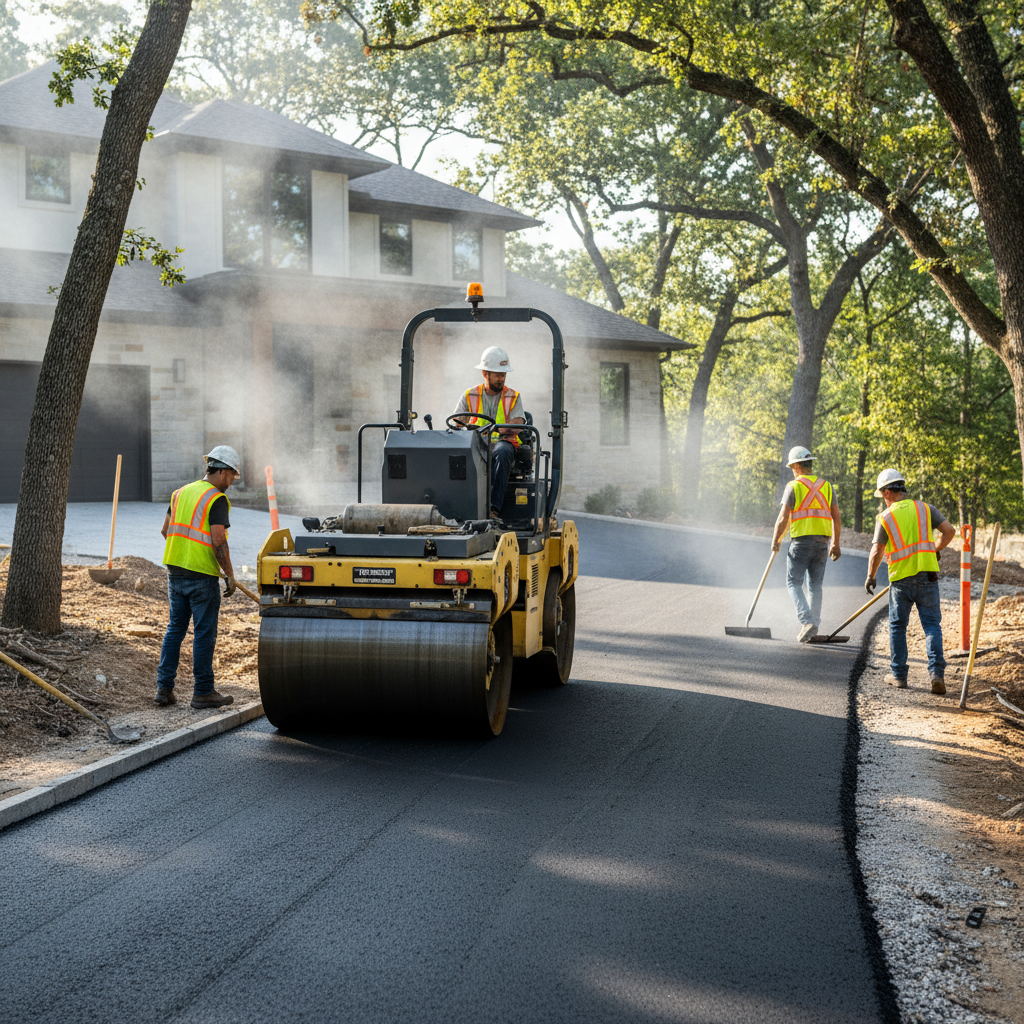
Driveway paving options and costs in Ingersoll
Ingersoll is a strong community for driveways, and with 71.2% of dwellings being single-detached homes, most paving jobs start as detached-house curb-to-garage projects. (Statistics Canada, 2021 Census) With 13,693 people in town, there’s enough demand to keep crews busy, but not so much that you can ignore seasonality when the ground is frozen. In the London economic region, our pricing reflects the local frost depth of roughly 1.0–1.2 m and aggressive freeze–thaw cycles that work water into weak spots. That means a driveway that looks “flat and simple” on a site visit can turn into a bigger excavation and base build when clay-heavy subgrades hold moisture. Scheduling also matters: cool nights and shoulder-season rain compress the hot-mix asphalt paving window, so spring demand can tighten and labour availability can change week to week. Material costs also respond to Ontario-wide fuel and cement/bitumen movements, but site access in Ingersoll—especially tighter lots near downtown and older mature neighbourhoods—can add labour time for hauling and compaction.
Here’s a practical comparison of common driveway materials and what homeowners typically budget in Ingersoll, Ontario. Use these ranges alongside your driveway size and access constraints to sanity-check your quote before you sign.
| Material |
Lifespan |
Maintenance |
Best For |
Price per sq ft |
Price Range |
| Asphalt (new installation, proper base) |
15–25 years |
Seal coat every 3–5 years |
Value-focused driveways with good drainage |
$5.50–$10.00 |
$4,500–$9,000 |
| Asphalt (overlay on existing gravel base) |
10–18 years |
Seal coat every 3–5 years; monitor settlement |
Budget upgrades when base is stable |
$6.00–$9.50 |
$4,500–$8,000 |
| Interlocking concrete pavers |
25–35 years |
Weed control; joint sand top-ups as needed |
Curb appeal and easier spot repairs |
$12.50–$20.00 |
$8,000–$16,000 |
| Poured concrete (broom finish) |
25–35 years |
Fill hairline cracks as needed; manage de-icing |
Clean, straightforward driveway looks |
$10.00–$16.00 |
$9,000–$18,000 |
| Exposed aggregate concrete |
25–35 years |
Periodic cleaning; manage freeze-thaw jointing |
Slip-resistance and premium appearance |
$12.00–$18.00 |
$10,000–$18,500 |
| Gravel / crushed stone (budget option) |
5–10 years |
Re-grade and top up; weed control |
Lowest upfront cost; temporary solution |
$2.50–$5.00 |
$2,000–$5,500 |
Prices are estimates only and vary by project scope, site access and material selection.
What affects the price of paving in Ingersoll
In Ingersoll and across Ontario, it’s common to see quotes for the same “typical” driveway come in 30–50% apart. The reason isn’t usually the asphalt or paver colour—it’s the hidden work underneath. Two contractors may both advertise “asphalt,” but one includes deeper excavation, better drainage, and full compaction testing while the other assumes the existing base is adequate. In London-area freeze–thaw conditions, that difference shows up fast: the frost line is roughly 1.0–1.2 m, so deeper frost demands a thicker compacted granular base to prevent heaving and cracking. In colder regions, the paving season is also tighter because hot-mix asphalt needs air temperatures above about 10°C, which concentrates demand and can raise unit pricing in late spring. Mix design matters too—Ontario projects typically require freeze–thaw-rated asphalt binder properties.
Concrete and pavers also change cost based on local site conditions. For example, Ingersoll homes built before 1981 make up 54.6% of the housing stock, and many of those properties have older grading and yard drainage patterns that channel water toward the driveway. (Statistics Canada, 2021 Census) If we find soft clay that pumps during excavation, base depth and aggregate replacement can add hundreds to over a thousand dollars even before materials are considered. On the flip side, a newer driveway replacement with straight access and stable soils can keep asphalt in the lower band of $4,500–$9,000 rather than pushing toward the upper end. Similarly, pavers often land between the $8,000–$16,000 range, but premium curb geometry and rework around steps/sidewalks can push higher.
| Price Factor |
Why It Matters |
Cost Impact |
| Driveway area in sq ft |
Most materials and paving time scale directly with area |
Largest swing, typically 40–70% of total |
| Base depth required |
Frost depth and clay subgrade require adequate compacted aggregate thickness |
Can add 10–30% depending on excavation depth |
| Grading and drainage work |
Slope corrections, swales, and French drains stop water under the slab |
Often adds 5–25% if drainage is deficient |
| Tear-out of existing surface |
Breaking/hauling concrete or old asphalt plus disposal costs |
Commonly adds 10–25% for full removals |
| Edge restraints and curbing |
Prevents paver spread and maintains asphalt/stone profile |
Can add 3–15% depending on layout |
| Sealing requirement |
Asphalt needs sealing after installation (and periodically) to reduce water damage |
Typically $400–$1,600 over the long term |
| Site access |
Narrow driveways slow equipment movement and affect haul logistics |
May add 2–12% on tight sites |
| Asphalt mix specifications |
Freeze–thaw-rated mixes cost more but resist cracking and raveling |
Often adds 5–10% for premium specs |
Permits & regulations in Ontario
For most homeowners in Ontario, paving a private driveway within your own property generally does not require a building permit. The typical “no permit” scope includes replacing or installing a driveway surface, re-building the base on private property, and adding work like asphalt, pavers, or concrete inside your lot line—so long as you’re not altering municipal infrastructure. That said, work in the municipal right-of-way usually does require municipal approval. Examples that commonly require a permit or approval include new or modified curb cuts, changes to a boulevard area, and any alterations to storm drainage (for instance, relocating catch basins or changing how ditch water leaves the property).
Before excavation, always start with utility locates. In Ontario you’ll typically use Ontario One Call to mark buried services so your contractor can excavate safely. Next, confirm lot-grading rules with the City/municipality—some municipalities restrict how close hard surfaces and drainage features can be to property lines or require specific grading so runoff doesn’t impact neighbours.
To verify a contractor in Ingersoll, do it step-by-step: (1) check their Ontario business/contractor eligibility where applicable using online resources, (2) request a certificate of insurance for general liability naming you as the certificate holder if possible, and (3) verify WSIB clearance/coverage details for workers on-site. Ask for the insurance certificate and WSIB clearance letter in writing before work begins.
Asphalt vs pavers vs concrete for Ingersoll driveways
For Ingersoll’s freeze–thaw reality, the “best” driveway material is often the one that matches your tolerance for upkeep and your site’s drainage needs. Asphalt usually wins on lowest upfront cost and smooth ride, but it needs sealing every 3–5 years to slow water penetration—water is the enemy during Ontario’s shoulder-season freezes. Interlocking concrete pavers cost more to install, yet they’re highly repairable: if a section settles, we can lift and re-set the affected area instead of tearing out the entire driveway. Poured concrete sits in the middle price-wise and looks crisp, but it must be properly air-entrained and joints must be planned to manage freeze-thaw stresses and curbside de-icing salt.
All three options require a frost-aware base build for the London region. In practice, that often means deeper granular base and careful compaction so the driveway stays below the active frost zone; if we’re dealing with clay-heavy subgrade, excavation and aggregate replacement may be more extensive than you’d expect. Drainage design—well-graded base stone, proper slope, and sometimes a French drain—can add cost upfront but protects the investment by keeping water from sitting under the pavement.
Here’s a concrete example: if your asphalt bid is in the $4,500–$9,000 band and the paver bid lands in the $8,000–$16,000 band, the price gap is justified when curb appeal matters or when you want the ability to repair localized areas without full replacement. If your priority is simplest maintenance and you’ll seal on schedule, asphalt can still be the most cost-effective long-term choice.
| Material |
Frost Resistance |
Curb Appeal |
Repair Method |
Lifespan |
Price Band |
| Asphalt (sealed regularly) |
Good with deeper base + proper drainage |
Moderate (clean blacktop finish) |
Patch cut-and-replace; seal cracks as needed |
15–25 years |
$4,500–$9,000 |
| Interlocking concrete pavers |
Excellent when installed over correct base |
High (varied borders and patterns) |
Lift and re-set individual units/sections |
25–35 years |
$8,000–$16,000 |
| Poured concrete (air-entrained) |
Very good with air-entrainment and jointing |
Moderate to high (smooth broom finish) |
Crack repair and patching; sometimes panel replacement |
25–35 years |
$9,000–$18,000 |
| Exposed aggregate concrete |
Very good with correct mix + drainage |
High premium look |
Patch with matched finish or replace sections |
25–35 years |
$10,000–$18,500 |
| Permeable pavers (drainage grid) |
High when engineered with proper outlet |
High (clean modern look) |
Replace affected units; maintain joints and outlet |
25+ years |
$10,000–$17,500 |
| Chip seal / tar-and-chip |
Fair to good; needs good base and maintenance |
Low to moderate (texture finish) |
Reseal/restock chips; localized patching |
6–12 years |
$3,500–$7,500 |
How to choose a paving contractor in Ingersoll
Choosing a contractor in Ingersoll is mostly about verification and clarity. First, confirm Ontario requirements and protection. Ask for a certificate of insurance for general liability (and ensure it’s current). For worker coverage, request proof of WSIB coverage/clearance, especially if the contractor is bringing crew members onto your property. If a company won’t provide documents, that’s a major warning sign—paving may look straightforward, but excavation and equipment use create real liability.
Next, get 2–3 itemised written quotes. You want labour and materials broken out, plus line items for base excavation, granular supply, compaction, drainage work, edge restraints, tack coat (if asphalt), and disposal. Avoid “one number” quotes where removals, grading, and drainage are vague. Read the scope for what’s excluded: is permit/municipal approval work included (when applicable), is equipment and trucking included, and is debris disposal or dumpster rental included?
Warranty matters too. Ask for the workmanship warranty length and what it covers (settlement, edge failure, paver movement, asphalt raveling). Also ask about any manufacturer/product warranty and whether it transfers if you sell the home.
For payment, use a schedule that keeps risk balanced—never pay more than 10–15% upfront. Hold back a portion until completion and cleanup. Finally, require a written timeline with a start date range and realistic completion estimate; in London-area weather, crews may need buffer time due to rain and cold nights.
- Verify WSIB coverage/clearance and request the letter or proof in writing.
- Request a current certificate of insurance for general liability.
- Confirm experience with frost-depth driven base builds in southern Ontario.
- Demand itemised pricing: excavation, granular base, asphalt/concrete, labour, and disposal.
- Ask how drainage is handled (slope, swales, base stone; French drain if needed).
- Check whether existing surface tear-out is included or “allowance” only.
- Confirm edge restraints/curbs for pavers and asphalt profile retention.
- Ask about compaction testing or at least compaction procedures used.
- Confirm asphalt mix specifications for freeze–thaw performance (not just “asphalt”).
- Ensure concrete is air-entrained if you choose poured concrete.
- Review warranty details: length, exclusions, and what evidence is needed for claims.
- Use a written payment schedule with a small deposit and a meaningful completion holdback.
In Ingersoll, watch for red flags like: skipping or downplaying base depth for clay soils, quoting a low price but calling drainage “optional,” refusing to provide insurance/WSIB documentation, vague warranties that don’t specify workmanship coverage, and telling you the job can start immediately with no weather plan despite the frost-and-rain season constraints.
Frequently asked questions — paving in Ingersoll
How do I maintain my driveway through Ingersoll winters?
In Ingersoll, winter care is less about “eliminating cold” and more about preventing water from getting trapped under your pavement. Use gentle snow removal—avoid aggressive scraping that gouges asphalt edges or paver joints. For de-icing, use sand or de-icer carefully; excessive salt can accelerate surface deterioration on asphalt and affect concrete over time. After freeze-thaw cycles, look for small ponding spots or soft areas along the edges—those are often drainage or base issues, not just cosmetic cracks. If you have asphalt, staying on schedule with sealing (typically every 3–5 years) helps reduce water penetration, which is crucial in a region with frost depth around 1.0–1.2 m. If your driveway is older (common in Ingersoll—many homes are pre-1981), consider an early drainage check in late spring.
Is it worth sealing a new driveway right away in Ingersoll?
Usually, “right away” isn’t the right approach. Fresh asphalt needs time to cure so the surface can accept the seal coating without trapping moisture. In southern Ontario schedules, sealing is typically done after the asphalt has cured—commonly within the first season window depending on weather and product recommendations—so it can be done once conditions are suitable. If your contractor offers immediate sealing the day after paving, ask questions; a quality seal requires the right surface temperature and curing time. For budgeting, sealing is a relatively modest line item compared with full re-paving; in local estimates, sealing and repair work often lands in the $400–$1,600 range depending on driveway size and repairs needed. Done at the right time, sealing extends asphalt life and helps limit freeze–thaw water damage.
What is a chip seal driveway and is it suited to Ingersoll?
A chip seal (tar-and-chip) uses a binder sprayed over a properly prepared base, then small aggregate is broadcast and rolled in place. It’s sometimes used for lower-cost surfacing or for properties where a full asphalt build isn’t the goal. In Ingersoll’s freeze–thaw climate, chip seal can perform acceptably when the base is built correctly and drainage is right, but it generally needs more maintenance attention than a fully built asphalt driveway. The biggest limitation is that it’s not as durable for heavy daily loads as asphalt or well-installed pavers. If you’re looking at chip seal, ask your contractor what base depth and compaction they’re using (especially on clay) and whether they’re planning on rework as part of the normal cycle. Pricing can be lower than full asphalt, often placing it around $3,500–$7,500, but long-term value depends on proper preparation and realistic maintenance.
How much does driveway crack repair cost in Ingersoll?
Crack repair costs vary widely in Ingersoll based on crack type (hairline vs. alligator cracking), whether water is getting underneath, and how much patching is required. For asphalt, small cracks are commonly addressed with cleaning, sealing, and sometimes a targeted patch—typical repair work may fall within the local “sealing & repair” budget of about $400–$1,600, depending on the driveway area and number of sections. If cracks indicate base movement or poor drainage, sealing alone won’t solve the underlying issue, and the cost can rise because base correction and heavier patch cuts may be needed. Because London-area freeze–thaw can widen cracks after moisture intrusion, the most accurate estimate comes after the contractor checks edge conditions and looks for signs of settlement or ponding.
What base thickness do I need for pavers in Ingersoll?
For pavers in Ingersoll, base thickness should be driven by frost and the condition of your subgrade, not a one-size rule. In southern Ontario’s frost depth region (roughly 1.0–1.2 m), the goal is to keep the pavement layers below the active frost zone with a properly compacted granular base. On clay-heavy soils, we commonly see deeper excavation and greater granular replacement than homeowners expect, sometimes adding significant depth and aggregate in problem areas where water is holding. The “sand setting layer” is separate from the engineered base; you still need a stable, well-graded foundation for the pavers to lock in and resist heaving. Because Ingersoll has a meaningful older home stock (many properties pre-date 1981), base conditions can vary a lot from street to street, so the best answer comes from a site inspection and a clear written base build-up.
How do I get the most accurate paving quote in Ingersoll?
To get an accurate quote in Ingersoll, prepare for a thorough site evaluation and insist on itemised pricing. Provide driveway measurements (length and average width) and tell the contractor what you’re trying to fix: cosmetic wear, drainage issues, or full replacement. During the estimate, confirm whether the contractor includes tear-out, base excavation, disposal, grading, and drainage—these are frequent causes of quote differences of 30–50%. For asphalt, ask about freeze–thaw-rated mix specs and whether a seal coat is included and when it will be applied. For concrete or pavers, ask about air-entrainment (for concrete) and the engineered base build-up (for pavers). Finally, compare quotes using the same scope. If one bid lands near $4,500–$9,000 and another is much higher within the $8,000–$16,000 paver band, make sure the base depth, drainage, and edge restraints match before deciding.