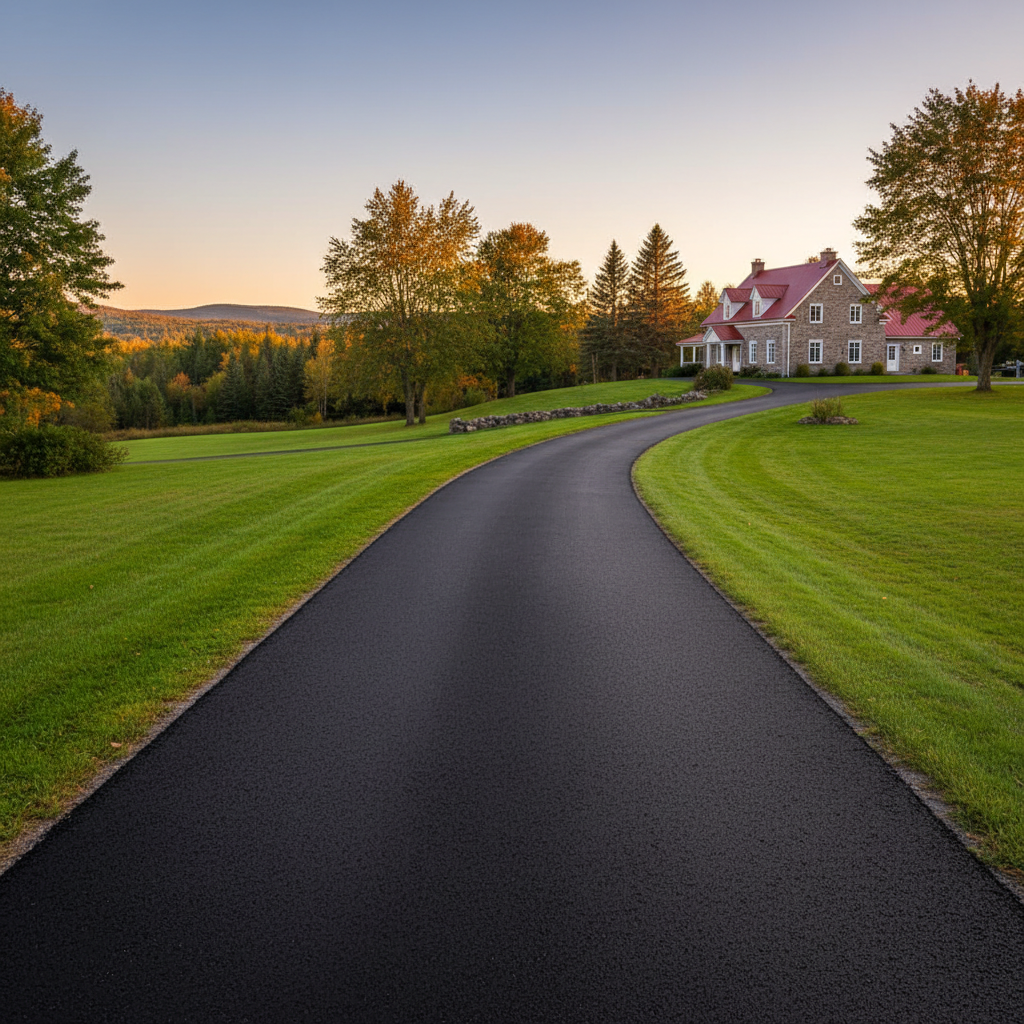
Driveway paving options and costs in Niagara-on-the-Lake
In Niagara-on-the-Lake, driveway paving choices usually come down to asphalt, interlocking pavers, or concrete—because most homes here are on residential lots where a new hard surface is visible year-round. With 79.2% of dwellings being single-detached homes, the addressable market for private driveways is huge, and many homeowners are updating older driveways to reduce winter maintenance. Niagara-on-the-Lake also has a significant older housing stock (38.1% of homes built before 1981), which matters because older subgrades and drainage layouts often need more excavation and regrading before any new surface goes down.
On the Hamilton–Niagara Peninsula, pricing is shaped by a moderate-to-cold Southern Ontario climate: frequent freeze–thaw cycles and frost penetration typically require deeper, well-compacted granular base and reliable drainage. In practice, base and drainage work can represent roughly 35–45% of a driveway budget when we’re dealing with clay/silty soils or historic drainage patterns. The paving season also runs effectively April to October; asphalt contractors need warm weather for compaction and mix performance, so spring work can be in higher demand and scheduled tightly.
In Niagara-on-the-Lake, areas near the older core and established residential streets—often around Queen Street and the Garden District—see steady demand because homeowners are trying to improve curb appearance and reduce winter ruts for repeat visitors, deliveries, and snow plowing. Once you know the material path you want, comparing ballpark costs per square foot makes it easier to evaluate contractor quotes side-by-side. Use the table below as a starting point before you book site measurements and base testing.
| Material |
Lifespan |
Maintenance |
Best For |
Price per sq ft |
Price Range |
| Asphalt (new installation, proper base) |
12–20 years |
Seal coat every 3–5 years |
Best overall value where base/drainage is corrected |
$5.50–$10.00 |
$3,000–$8,000 |
| Asphalt (overlay on existing gravel base) |
8–15 years |
Seal coat every 3–5 years |
When the existing base is sound and drainage is adequate |
$4.50–$8.50 |
$2,500–$7,000 |
| Interlocking concrete pavers |
25–40 years |
Weed control; re-leveling selective areas if needed |
High curb appeal and easy localized repairs |
$12.50–$20.00 |
$9,000–$20,000 |
| Poured concrete (broom finish) |
25–35 years (if properly detailed) |
Limited touch-up; reseal if desired |
Low-visual-fuss durability with correct base and joints |
$9.00–$16.50 |
$7,000–$18,000 |
| Exposed aggregate concrete |
25–35 years |
Periodic cleaning; occasional patching |
Premium look and good traction in winter |
$11.00–$18.50 |
$8,500–$19,500 |
| Gravel / crushed stone (budget option) |
5–10 years before major regrading |
Top up annually; regrade after freeze–thaw |
Lower upfront cost and quick changeover |
$2.50–$5.50 |
$1,200–$4,000 |
Prices are estimates only and vary by project scope, site access and material selection.
What affects the price of paving in Niagara-on-the-Lake
Two homeowners can receive quotes that differ by 30–50% for what looks like the “same” driveway in Niagara-on-the-Lake. The gap usually comes down to what’s happening under the surface: how much excavation is needed, how deep the granular base must be for frost protection, whether drainage is corrected, and how difficult the site is to access with skid steers, rollers and trucks. In Ontario, pricing also tightens during peak months because hot-mix asphalt placement depends on favourable air temperatures (typically above 10°C) and adequate compaction conditions.
In the Hamilton–Niagara Peninsula region, frost line depth and freeze–thaw cycles are decisive. When frost penetrates deeper, driveways need a thicker compacted granular base (commonly in the 6–10 inches range for many residential installs, and sometimes more when subgrade is poor). That base thickness helps prevent frost heave and reduces cracking. It’s also why base and drainage work can represent 35–45% of the total budget: if we find clay-rich subsoils, blocked outlets, or a poor crown/slope, the fix becomes excavation + replacement + proper grading.
Concrete costs can move as well based on local detailing. For example, adding air-entrainment, using proper expansion/control joints, and detailing around garage approaches can increase the cost but reduce winter damage. Conversely, if your existing grade is already stable and the driveway is straightforward to form, poured concrete can land closer to the lower end of the $7,000–$18,000 band. Asphalt pricing can also swing: a straightforward new asphalt build with correct base tends to fall within the $3,000–$8,000 asphalt range, while overlay work on marginal gravel can cost less up front but may not deliver the same long-term performance.
| Price Factor |
Why It Matters |
Cost Impact |
| Driveway area in sq ft |
Most materials and labour scale directly with square footage. |
High (typically the biggest variable) |
| Base depth required |
Frost protection depends on thicker, properly compacted granular layers. |
High (commonly 15–30% swing) |
| Grading and drainage work |
Correct slopes and outlets prevent water pooling and freeze–thaw damage. |
Medium to High (often 10–25%) |
| Tear-out of existing surface |
Breaking and hauling concrete or removing old asphalt/gravel is labour- and equipment-intensive. |
Medium (5–20%) |
| Edge restraints and curbing |
Pavers and even asphalt performance rely on firm edges to control movement. |
Medium (5–15%) |
| Sealing requirement |
Asphalt benefits from sealing after installation, typically after 6–12 months. |
Low to Medium (often adds 1–3% per year equivalent) |
| Site access |
Narrow lots slow equipment movement and can reduce staging efficiency. |
Medium (can be 5–15%) |
| Asphalt mix specifications |
Freeze–thaw-rated mix and thickness help performance in Southern Ontario winters. |
Medium (varies by design and thickness) |
Permits & regulations in Ontario
In Ontario, paving a private driveway within your own property usually does not require a building permit—because it’s typically considered a replacement/improvement of a hard surface that remains on your own land. However, approvals can be required when your work touches municipal infrastructure. In Niagara-on-the-Lake, the most common cases that do require municipal approval include: changes to a curb cut/driveway apron where it meets the boulevard, alterations to storm drainage patterns or catch basins, and any regrading that affects the municipal right-of-way or leads to redirected runoff.
Also watch for lot-grading bylaws: some municipalities limit how close a hard surface can be to property lines or require that drainage continues to flow safely away from foundations and neighbouring properties. Even when a permit isn’t required, you should still ensure your plan aligns with local grading rules—especially in older neighbourhoods where drainage may already be marginal.
Before excavation, homeowner and contractor should arrange utility locates through Ontario One Call (1-800-400-2255 or the online system). Step-by-step, verify the contractor properly: (1) confirm the Ontario licence/registration status through the appropriate online directory used for their trade category, (2) request a certificate of insurance for liability coverage and ensure it’s current for your address, and (3) ask for proof of WSIB coverage or a clearance letter. If anything is unclear, ask the contractor to provide documents before signing your contract.
Asphalt vs pavers vs concrete for Niagara-on-the-Lake driveways
For Niagara-on-the-Lake, all three materials can work—but the “best” choice depends on how you want your driveway to behave through winter and spring thaw. Asphalt is usually the lowest upfront cost and offers flexibility under temperature swings, which helps it tolerate Ontario freeze–thaw movement. The trade-off is maintenance: asphalt should be sealed regularly (commonly every 3–5 years) to protect the surface from moisture and oxidation. Interlocking concrete pavers have the highest upfront cost but shine for homeowners who want curb appeal and repairs that don’t require replacing the whole driveway—individual stones can be reset if settlement occurs. Poured concrete sits in the middle on price and can look great, but it’s more sensitive to cracking if base support, joints, and air-entrainment aren’t done correctly.
Across the Hamilton–Niagara Peninsula, base preparation and drainage are where costs are justified. Proper granular base depth and compaction are essential to reduce frost heave and prevent differential movement, regardless of whether you choose asphalt or concrete. For concrete, careful joint layout and air-entrainment help reduce freeze–thaw deterioration. For pavers, edge restraints and correct leveling sand layers control movement, especially where snow plough passes or where water wants to pool.
In winter maintenance reality, salt and sand do their damage slowly, and plough traffic can stress weak edges. Asphalt’s flexibility often performs well under these conditions, while pavers handle localized wear without catastrophic surface replacement. Concrete can perform long-term, but poor detailing around garage approaches or joints can turn early cracking into an eyesore.
As a dollar example: if an asphalt driveway lands around the $3,000–$8,000 band and pavers are closer to the $9,000–$20,000 band, the extra investment is most justified when you want premium curb appeal and you’re comfortable with pavers as a “repairable system,” not a one-piece surface.
| Material |
Frost Resistance |
Curb Appeal |
Repair Method |
Lifespan |
Price Band |
| Asphalt (sealed regularly) |
Good (depends on base + freeze–thaw-rated mix) |
Moderate (clean blacktop look) |
Patch or mill-and-overlay localized sections |
12–20 years |
$3,000–$8,000 |
| Interlocking concrete pavers |
Excellent (system moves better than one-piece slabs) |
High (variety of colours/patterns) |
Remove/reset individual units; re-level as needed |
25–40 years |
$9,000–$20,000 |
| Poured concrete (air-entrained) |
Good to Very Good (proper air + joints are critical) |
Moderate to High |
Crack repair/patching; sometimes section replacement |
25–35 years |
$7,000–$18,000 |
| Exposed aggregate concrete |
Good (finish is durable if base is solid) |
Very High (decorative texture/traction) |
Patch small areas; larger repairs may show blend lines |
25–35 years |
$8,500–$19,500 |
| Permeable pavers (drainage grid) |
Excellent where drainage is designed correctly |
High (modern look options) |
Reset units; service underlying drainage layers if needed |
20–35 years |
$10,000–$22,000 |
| Chip seal / tar-and-chip |
Moderate (more sensitive to winter wear without good structure) |
Low to Moderate |
Spot chip repairs; periodic re-chip |
6–12 years |
$2,000–$6,000 |
How to choose a paving contractor in Niagara-on-the-Lake
Choosing a paving contractor in Niagara-on-the-Lake is mostly about proof: proof they’re properly insured, proof they build to Ontario winter expectations, and proof their quote matches your site conditions. Start by verifying Ontario licensing/registration for the contractor’s trade category (your contractor should be able to provide their registration/clearance details). Next, request a certificate of liability insurance and confirm the policy is valid for the job location and dates. For worker protection, ask for proof of WSIB coverage or a current clearance letter—don’t accept verbal assurances.
Then get 2–3 itemised written quotes rather than one lump sum. The best quotes separate labour and materials and clearly list items like excavation volume, granular base type (e.g., Granular A/B), compacted depth, drainage corrections, geotextile use (if proposed), asphalt thickness, and cleanup/disposal. Read what’s excluded: for instance, whether permit pulling is included (when required), what happens if they find unsuitable subgrade, and whether additional base is allowed for unforeseen excavation. Make sure disposal of removed asphalt/concrete is included, not “to be arranged by homeowner.”
Warranty matters, but be specific: ask for the workmanship warranty term, what it covers (potholes, settlement, joint failures), and whether it’s tied to regular maintenance like asphalt sealing. Confirm whether product/manufacturer warranty is transferable and who provides the proof if there’s a defect. For payment, never pay more than 10–15% upfront; use a holdback until the job is complete and you’ve received final grading/sweeping/clean-up. Finally, insist on a written start date and realistic completion estimate based on the local paving season (April–October).
- Provide proof of insurance and WSIB clearance letter before work starts
- Show previous Ontario jobs (photos) in similar winter conditions
- Quote includes granular base specification and compacted thickness
- Drainage plan is explained (slope, outlet, and water control)
- Includes edge restraints for pavers and proper asphalt transitions
- States asphalt mix/thickness and freeze–thaw performance approach
- Lists tear-out scope and confirms disposal/hauling is included
- Breaks down labour vs materials (no vague “materials allowance”)
- Warranty is written with coverage details and start date
- Payment schedule: small deposit, milestone payments, holdback
- Provides schedule in writing and confirms weather limitations
- Includes final cleanup and site restoration (no “sweep as needed”)
Red flags I commonly see in Niagara-on-the-Lake include: refusing to show WSIB/clearance documents, vague quotes that don’t state base depth or granular type, cutting corners on drainage because “it’s only a driveway,” demanding a large upfront deposit, or starting excavation without utility locates. If a contractor can’t clearly explain the frost-and-drainage plan for Southern Ontario, ask for revisions before signing.
Frequently asked questions — paving in Niagara-on-the-Lake
When is the best time of year to pave in Niagara-on-the-Lake?
For Niagara-on-the-Lake, the best window is typically late spring through summer, because asphalt requires favourable air temperatures for placement and compaction (often above 10°C). In practice, many contractors focus on April to October, and the tightest scheduling is usually May through August when demand is highest and plant schedules are full. Paving too early in spring can lead to poor compaction and reduced long-term performance, especially with freeze–thaw cycles still in the forecast. For concrete, weather also matters: you’ll want conditions that support proper curing so joints and surface finish don’t compromise durability. If your quote is near the shoulder seasons, ask how they manage temperature, curing, and schedule backups.
How deep should the base be for Niagara-on-the-Lake's frost?
Base depth is driven by frost protection and your subgrade condition, not just a one-size number. In Southern Ontario, contractors generally assume frost penetration in the 1.2–1.5 m range, which means the driveway needs a thicker compacted granular base and reliable drainage to prevent heaving and cracking. Many residential builds end up in the 6–10 inches compacted granular range, and deeper or thicker base can be required when you have clay/silty soils, poor drainage, or older settlements. The most accurate approach is excavation to confirm subgrade, then design the granular thickness accordingly. When you request quotes, ask specifically for the proposed base type (Granular A/B or equivalent), compacted thickness, and whether drainage corrections are included.
How often should I seal my asphalt driveway?
In Niagara-on-the-Lake, most asphalt driveways should be sealed after the pavement has cured—commonly after 6–12 months from installation—then re-sealed about every 3–5 years depending on traffic, sun exposure, and winter wear from ploughing, salt, and sand. If you seal too early, you can trap moisture; if you wait too long, the surface can oxidize and hold water, which accelerates cracking during freeze–thaw. Sealing is usually one of the cheaper ways to extend service life and is part of responsible maintenance planning. When comparing quotes, ask whether the contractor includes sealing guidance or if it’s entirely separate from the install price. Asphalt still tends to land around the $3,000–$8,000 driveway band for proper installations, but consistent maintenance improves the return on that spend.
Why does my driveway crack and heave in winter?
Cracking and heaving almost always trace back to movement under the surface. In Niagara-on-the-Lake and across the Hamilton–Niagara Peninsula, freeze–thaw cycles pull water into vulnerable areas; if drainage is poor or the base is too thin/insufficiently compacted, the subgrade can expand in winter and contract in spring. Over time, that movement shows up as cracks, dips, and sometimes heaving near garage edges or where plough traffic concentrates. Older driveways (and especially homes built before 1981) often have outdated drainage and weaker subgrades, so the fix usually requires more than “just resurfacing.” Ask your contractor to explain how they’ll correct slope, manage runoff, and build a frost-stable base—not only what the top asphalt thickness will be.
Do I need a permit to pave my driveway in Ontario?
Typically, paving a private driveway within your own property in Ontario usually doesn’t require a building permit. The permit conversation usually starts when work affects the municipal right-of-way—such as changing a curb cut/driveway apron, altering boulevard drainage, or redirecting storm water near municipal infrastructure. Some municipalities also have lot-grading bylaws that can restrict how drainage and grading are handled near property lines. Even if no permit is required, you must still arrange utility locates through Ontario One Call before excavation. When you request quotes in Niagara-on-the-Lake, ask the contractor to clearly state whether permit work (if needed) is included or excluded, and who is responsible for applications and approvals.
How long before I can drive on new asphalt?
After asphalt paving in Ontario, most driveways can be used shortly after rolling and cooling—often within about 24–48 hours, depending on temperature and mix conditions. If it’s colder or the weather is damp, it can take longer for the surface to firm up safely. The biggest practical factor is whether the driveway has fully cooled enough to prevent tracking, ruts, or surface damage. Your contractor should provide a written instruction sheet for access timing and any restrictions around vehicles, equipment, and snowplough coordination. If you plan to use the driveway immediately after install, confirm the schedule in your contract to avoid problems with surface texture or early wear during the tail end of the season.