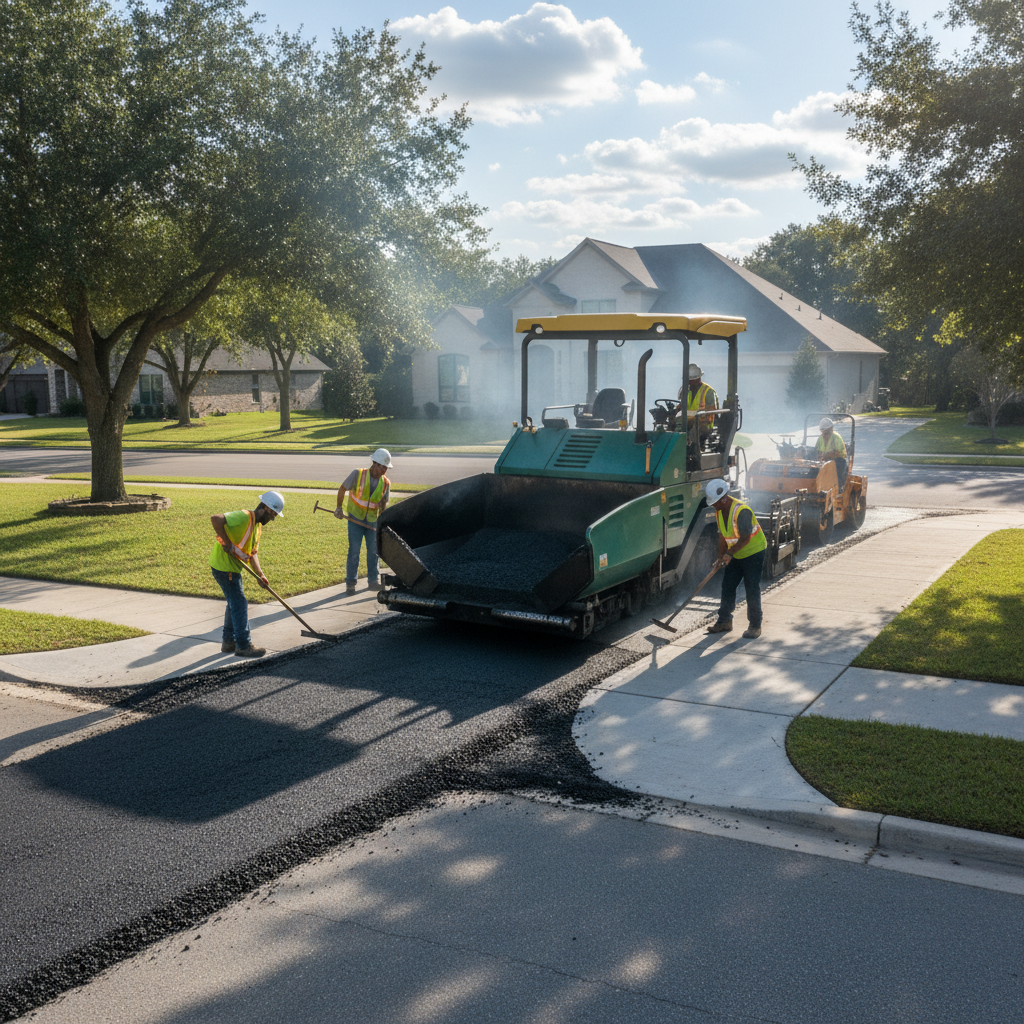
Driveway paving options and costs in Whitby
Whitby homeowners typically choose driveway paving based on the kind of house they own and how long they plan to stay. With 69.5% of dwellings in Whitby being single-detached homes (Statistics Canada, 2021 Census), most private driveways are tied to detached properties, where traffic loads from cars, occasional trucks, and salt exposure can be tougher than on condo lots. Whitby also has an older housing mix: 24.8% of homes were built before 1981 (Statistics Canada, 2021 Census). Older neighbourhoods often have more variable base conditions, meaning contractors may need additional excavation and granular rework before any surface goes down.
In the Toronto economic region, frost depth and frequent freeze–thaw cycles are primary cost drivers. Ground freezing to roughly 3–4 feet means the job is won or lost in the granular base, compaction, and drainage—water trapped under a driveway expands in winter and contributes to heaving and cracking. Also, the paving season is effectively compressed into late spring through early fall. That shorter workable window tightens scheduling, especially in high-demand areas like Lynde Creek (near Highway 7 corridor) and around the Whitby GO/Anderson Street area, so prime-date asphalt and concrete crews can be booked quickly.
Below is a homeowner-friendly comparison of common options and typical pricing ranges for Whitby so you can line up quotes by material and realistic expectations on lifespan and upkeep. Use it as a baseline before you ask for detailed scope notes (base thickness, drainage fixes, and how much tear-out is included).
| Material |
Lifespan |
Maintenance |
Best For |
Price per sq ft |
| Asphalt (new installation, proper base) |
15–25 years |
Seal every 3–5 years |
Most cost-effective all-around option with good drainage |
$3.50–$7.00 |
| Asphalt (overlay on existing gravel base) |
10–18 years |
Seal every 3–5 years; watch for base settlement |
Budget upgrades when the base is sound |
$2.75–$5.50 |
| Interlocking concrete pavers |
20–30 years |
Occasional re-leveling and joint sand top-ups |
Excellent curb appeal and modular repairs |
$7.50–$14.00 |
| Poured concrete (broom finish) |
20–30 years |
Limited sealing; manage drainage and de-icing carefully |
Clean, durable surface with fewer joints to maintain |
$6.00–$11.00 |
| Exposed aggregate concrete |
20–30 years |
Periodic cleaning; sealing recommended |
High-end look with improved traction |
$7.50–$13.00 |
| Gravel / crushed stone (budget option) |
3–8 years (varies by traffic and drainage) |
Top up annually; re-grade and add base as needed |
Short-term driveway solution or overflow parking |
$2.00–$4.25 |
Prices are estimates only and vary by project scope, site access and material selection.
What affects the price of paving in Whitby
In Whitby and across the Toronto economic region, you can see the same driveway paving scope come in 30–50% apart because contractors may be pricing different subgrade realities, not just different top surfaces. The biggest swing comes from the amount of excavation, the quality of granular base and compaction, how drainage is handled, and how much demolition is required. A quote that looks “cheap” often assumes a straightforward install, while a quote that looks “higher” may include deeper base, proper slopes, and drainage repairs that prevent callbacks.
In our climate, the frost line and freeze–thaw cycles are decisive cost factors. When ground freezing reaches roughly 3–4 feet in the Toronto area, driveways need a thicker, properly compacted granular base (often 6–12 inches of base thickness in Ontario for many typical residential installs, depending on subgrade conditions). If the base is too thin, water and fines migrate during wet seasons, then expand in winter—pushing the surface up and breaking it later. The paving season is also shorter here than in milder regions because hot-mix asphalt placements are best done when both air temperatures and ground conditions are favourable (commonly above about 10°C air temperature). That seasonality concentrates demand into late spring through early fall and tightens crew availability, which can push costs toward the higher end of the asphalt band (for example, the $3,500–$8,000 range).
Concrete pricing can also move based on how the job is engineered for freeze–thaw and drainage. For example, a plain broom-finish slab with good drainage and control joints may land closer to the $6,000–$15,000 band, while a poorly drained site with added regrading and thicker support layers typically increases cost. Likewise, interlocking pavers may cost more upfront (often aligning with the $9,000–$20,000 band), but when a section needs attention, the repair is localized rather than a full replacement—helpful on older Whitby soils where settlement can be uneven.
| Price Factor |
Why It Matters |
Cost Impact |
| Driveway area in sq ft |
Surface area drives material quantity, labour time, and equipment hours |
$3,500–$8,000 total asphalt typical band depending on size |
| Base depth required |
Frost depth requires thicker compacted granular layers to resist heaving |
Can add roughly 10–30% versus minimal base |
| Grading and drainage work |
Proper slope and drainage corrections prevent water pooling under pavement |
Often increases cost by 5–20% if significant regrading is needed |
| Tear-out of existing surface |
Concrete breaking and hauling add labour, disposal, and sometimes extra sub-base prep |
May add 10–25% depending on thickness and access |
| Edge restraints and curbing |
Prevents paver spread and asphalt edge breakup during winter expansion |
Commonly adds a smaller line item but protects the whole system |
| Sealing requirement |
Asphalt performs better when sealed after installation; Toronto winters accelerate oxidation |
Adds a future cost, typically within months 6–12 for best results |
| Site access |
Narrow lots slow equipment movement and increase manual handling |
Can add 5–15% for tight driveways |
| Asphalt mix specifications |
Freeze–thaw-rated mixes can cost more but improve durability in Ontario winters |
Usually increases asphalt line items toward the upper end of the band |
Permits & regulations in Ontario
In Ontario, paving a private driveway within your own property usually does not require a building permit, especially for work that stays entirely on your lot. However, work that affects the municipal right-of-way typically does require municipal approval. That includes new curb cuts, changes to boulevard grading, alterations to storm drainage, adjustments near a municipal sidewalk/road edge, or any work that changes how water flows toward the street. If your driveway ties into an existing apron or you’re adjusting the area between the property line and sidewalk, that’s where approvals often come into play.
Because every Whitby lot is different, the safe path is to confirm the rules before excavation: ask your contractor whether the scope touches the boulevard or storm system, and if so, request details on the approval process. Some municipalities also enforce lot-grading bylaws that restrict how close a hard surface can be to property lines or how water must be directed away from neighbours.
Before anyone digs, verify utility locates. In Ontario, use Ontario One Call so underground services can be marked. Then, to check your contractor properly, do three things step-by-step:
- Verify the contractor’s Ontario licence/registration (based on the type of work) using the appropriate provincial/business registry information.
- Request a current Certificate of Insurance naming you as applicable and confirm general liability coverage limits match the project size.
- Confirm WSIB coverage (or the contractor’s valid exemption/clearance letter if they’re exempt) before work starts.
If the contractor can’t provide documentation promptly, that’s a red flag in Whitby where excavation and winter schedules can be unforgiving.
Asphalt vs pavers vs concrete for Whitby driveways
For Whitby driveways, the best material choice comes down to balancing upfront cost, how you handle winter maintenance, and how your base is engineered for Toronto’s freeze–thaw cycles. Asphalt is typically the lowest upfront option and is often chosen when homeowners want a clean, smooth driveway without the highest material cost. In our region, asphalt needs sealing regularly—usually every 3–5 years—to slow oxidation accelerated by salt and repeated winter temperature swings.
Interlocking concrete pavers cost more up front, but they’re a strong fit for Ontario homeowners who want flexibility. If a small section is damaged from settlement or a heavy winter plow impact, pavers can be lifted, corrected, and reset without tearing out the whole surface. That’s valuable in Whitby neighbourhoods with more variable subgrade, especially where older homes (built before 1981) may not have consistent drainage histories.
Poured concrete sits in the middle on cost and durability, but it demands good design: air-entrained concrete, proper thickness, control joints, and attention to drainage are key to managing freeze–thaw expansion. Concrete that isn’t air-entrained or that has insufficient support can crack sooner, particularly with de-icing salts and repeated freeze–thaw.
In practice, the base work needed for a 3–4 foot freeze line generally means deeper, well-compacted granular layers and a drainage plan that prevents water from sitting under the driveway. Asphalt and pavers typically tolerate minor movement better than rigid concrete, which is why a properly built asphalt or paver system often holds up well to salt and plowing routines.
To make it real with dollars: if asphalt for a typical Whitby driveway comes in around $3,500–$8,000, interlocking might land closer to $9,000–$20,000. That difference is justified when you want maximum curb appeal, the ability to do localized repairs, and a driveway that looks strong for many years even if the subgrade settles slightly.
| Material |
Frost Resistance |
Curb Appeal |
Repair Method |
Lifespan |
Price Band |
| Asphalt (sealed regularly) |
Good with proper base, drainage, and freeze–thaw-rated mix |
Medium (clean and smooth; upgrades can boost look) |
Mill and patch localized areas |
15–25 years |
$3,500–$8,000 |
| Interlocking concrete pavers |
Very good; joint flexibility tolerates small movements |
High (wide colour/pattern options) |
Lift, re-grade, recompact, and relay small sections |
20–30 years |
$9,000–$20,000 |
| Poured concrete (air-entrained) |
Good when designed for freeze–thaw with drainage and joints |
Medium to high (broom finish or decorative options) |
Slab repairs are limited; often patching or partial replacement |
20–30 years |
$6,000–$15,000 |
| Exposed aggregate concrete |
Good with correct mix and proper jointing |
Very high (texture and premium curb look) |
Localized repairs can be tricky to match appearance |
20–30 years |
$7,500–$16,500 |
| Permeable pavers (drainage grid) |
Very good where subsurface drainage is planned correctly |
Medium to high (modern look) |
Replace grid/paver units as needed |
20–30 years |
$10,000–$22,000 |
| Chip seal / tar-and-chip |
Moderate; can wear faster under heavy winter traffic |
Low to medium |
Spot top-ups and re-seals |
6–12 years |
$4,000–$7,000 |
How to choose a paving contractor in Whitby
Choosing the right contractor in Whitby comes down to documentation, a detailed scope, and a realistic schedule—especially with Toronto’s tight paving window and freeze–thaw-driven construction standards. Start by verifying Ontario licensing/registration for the type of paving work being done, and confirm they carry liability insurance that fits the project size. Next, check WSIB coverage (or obtain a clearance letter if they’re exempt). Ask for these items before you share your address and before any excavation is planned.
When you request quotes, don’t ask for “the cheapest.” Ask for 2–3 itemised written estimates that break out labour and materials (base stone, asphalt/concrete, geotextile if used, forms/edging, saw-cutting/control joints where applicable). Compare apples-to-apples: the same final square footage can vary by 30–50% if one quote includes proper tear-out and the other doesn’t. Clarify what’s excluded—permit pull, utility locates, disposal/hauling, and any required repairs to soft or waterlogged subgrade.
Warranty matters in freeze–thaw climates. Look for a workmanship warranty that clearly states duration and coverage (not just “manufacturer warranty”). Confirm whether the product/manufacturer warranty is transferable if you sell your home.
On payment, never pay more than 10–15% upfront. Use a holdback until the work is complete and final cleanup/grade verification is done. Finally, get an in-writing start date and an estimated completion timeframe so you’re not left waiting through the most favourable autumn/late spring conditions.
- Ask for the Ontario licence/registration number and verify it matches the company name on the quote.
- Request a current Certificate of Insurance and confirm liability coverage limits.
- Confirm WSIB coverage or provide a clearance letter before work begins.
- Insist on itemised quotes (labour + materials), not a single lump-sum number.
- Confirm base thickness and compaction method (and whether drainage corrections are included).
- Ask what geotextile/subdrain is used, if any, and why it’s recommended.
- Specify tear-out scope: asphalt/gravel only vs concrete breaking and hauling.
- Clarify disposal fees and whether contaminated soil is handled per requirements.
- For pavers, confirm edge restraints/locking details and joint sand type.
- For concrete, confirm air-entrained mix and control joint plan.
- Ask about sealing timing for asphalt (typical 6–12 months) and who applies it.
- Get a written timeline and weather shut-down criteria for Ontario temperatures.
In Whitby, common red flags include contractors who refuse to show insurance/WSIB documentation, quotes that don’t mention base thickness or drainage, “we’ll fix it later” patch promises instead of engineered base prep, vague warranties with no written terms, and schedules that rely on “warm weather” without giving a start/completion estimate in writing.
Frequently asked questions — paving in Whitby
What causes potholes and how are they repaired?
Potholes in Whitby usually start with water. When rain or melting snow gets into small cracks or weak spots, the water migrates under the pavement. In Toronto’s freeze–thaw cycle (roughly 3–4 feet of frost depth impacts how water behaves under pavements), the water freezes, expands, and breaks up the base. Over time, vehicle loads create a cavity that becomes a pothole. Repairs should address the cause, not just fill the hole—good contractors cut back to solid material, remove unstable base, recompact, and then place a proper patch or asphalt lift. If you’re seeing recurring failures in the same spots, it often signals drainage or base compaction issues that may also need regrading before resurfacing.
How do I prepare for a paving project?
Preparation is mostly about access, documentation, and expectations. Before work starts in Whitby, confirm where equipment can park and how materials will be delivered—tight driveways around the Whitby GO/Anderson Street area can slow down crews. Clear vehicles, trailers, and obstacles from the driveway so compaction equipment and pavers/asphalt equipment can move efficiently. Mark any sprinkler heads, deck steps, or landscaping you want protected. If there’s an existing curb cut, ask whether the contractor’s scope includes apron work or drainage corrections. Finally, have the contractor confirm utility locate results (Ontario One Call) and provide their insurance/WSIB paperwork before excavation begins.
How do I compare paving quotes fairly?
Compare quotes the way you’d compare building plans: by scope, not by the final number. Ask each contractor to list base depth, granular materials, compaction method, whether drainage/grading corrections are included, and the exact tear-out scope (especially if there’s older concrete). For asphalt, also ask about the mix design suitability for freeze–thaw performance and whether sealing is included or will be recommended for a later date. Price bands in Whitby commonly fall around $3,500–$8,000 for asphalt and $6,000–$15,000 for concrete, while interlocking often starts higher. If a quote is much lower, it’s usually missing base prep, drainage, or proper thickness—those items are what protect you from winter cracking and heaving.
Can asphalt be laid in cold weather in Whitby?
Ontario asphalt placement is highly temperature-dependent, and in Whitby you generally should avoid “cold weather paving” unless the contractor has a proven process for warming and managing conditions. Hot-mix asphalt placements work best when air temperatures are above about 10°C and conditions allow the mix to be compacted to specification. As the Toronto region moves into late fall and winter, the short workable season limits when crews can build and compact properly. If a contractor lays asphalt during borderline temperatures, compaction and adhesion can suffer, leading to early raveling and faster oxidation under salt exposure. If you need paving timing advice, request a weather-window plan—start date, completion estimate, and how they handle shutdowns if temperatures dip.
What is a driveway apron and do I need one in Whitby?
A driveway apron is the paved transition area between the driveway and the road-side/sidewalk edge—often the portion that sits under the curb cut and connects to municipal surfaces. In Whitby, whether you “need” an apron depends on the condition of the approach area, how your drainage is currently handled, and whether your project involves changes near the municipal right-of-way. If work touches the boulevard, curb cut, or storm drainage direction, municipal approval may be required, and an apron may be part of the compliant repair/rebuild. Even when a homeowner stays on their property, an engineered apron transition helps manage water flow and reduces edge breakup from plowing impacts.
How do I maintain my driveway through Whitby winters?
Winter maintenance in Whitby is about limiting water and protecting the surface from harsh chemicals and repeated impact. For asphalt, follow up with sealing when recommended (typically after about 6–12 months, then every 3–5 years depending on traffic) to reduce oxidation from salt and temperature cycling. When snow clearing, keep plow/edge blade heights set so you don’t scrape the surface or disturb the edges—especially important for interlocking where edge restraint prevents movement. Use sand and moderate de-icing carefully; aggressive salt can accelerate wear on concrete and contribute to premature surface deterioration if overused. The biggest long-term win is drainage: if you notice standing water after rain, address it early before freeze–thaw amplifies the problem.