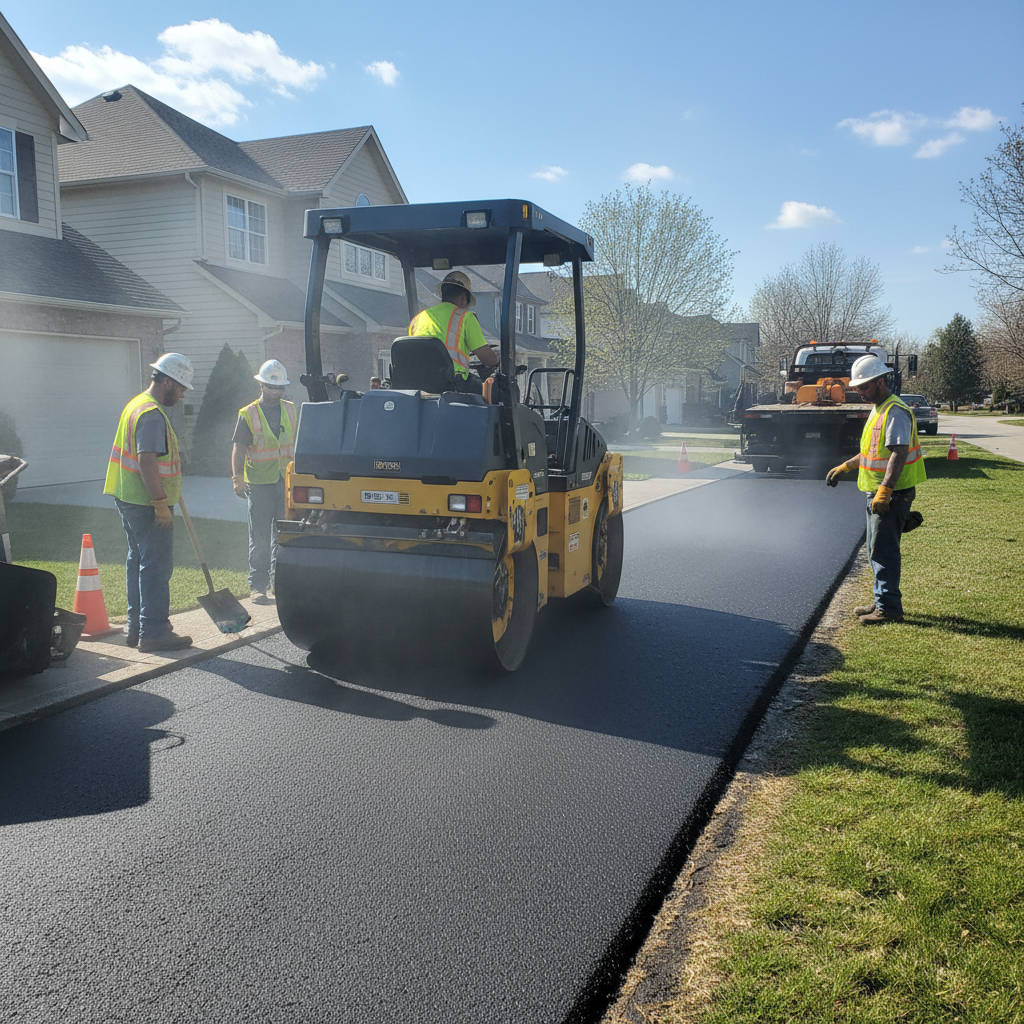
Driveway paving options and costs in Clarence-Rockland
Clarence-Rockland is a driveway-and-hardscape market where paving choices are strongly shaped by Ottawa-area freeze–thaw cycles. With 74.5% of local dwellings being single-detached homes (Statistics Canada, 2021 Census), most private driveways are tied to detached properties—meaning contractors regularly design for heavier winter traffic, long snow-storage pushes, and consistent runoff control. Even in neighbourhoods like Rockland’s downtown/Champlain Street area, where access can be tighter, you’ll see quotes vary based on excavation depth, granular base sizing, and how well water is managed away from the frost zone.
As the region’s frost penetration is commonly modeled around roughly 1.8 m in Ottawa, the most reliable asphalt and paver installations in Clarence-Rockland depend on a properly engineered granular base and drainage. That’s why the “same-looking” driveway can land 30–50% apart: deeper, well-compacted base sections and added sub-drainage work cost more—but they reduce heaving, raveling, and cracking. Also, the paving season is shorter here; hot-mix asphalt and concrete require warm, dry conditions to cure and compact correctly, tightening the scheduling window and influencing material and labour pricing.
Below is a practical comparison of the main options homeowners consider, with typical Clarence-Rockland price ranges to help you budget before site measurements. Use this table alongside a scope checklist so you can compare like-for-like in every quote.
| Material |
Lifespan |
Maintenance |
Best For |
Price per sq ft |
| Asphalt (new installation, proper base) |
15–25 years |
Seal every 3–5 years; patch minor cracks |
Clean, uniform surface; best value long-term when base is engineered |
$6.50–$12.00
|
| Asphalt (overlay on existing gravel base) |
10–18 years |
Seal sooner (often 3–4 years); more frequent patching |
When you have a strong, well-drained base and limited excavation |
$5.00–$10.00
|
| Interlocking concrete pavers |
25–35 years |
Replace individual stones; re-level if needed; maintain edge restraints |
Curb appeal and easy spot repairs after winter movement |
$10.50–$20.00
|
| Poured concrete (broom finish) |
20–30 years |
Crack sealing as needed; keep de-icing practices conservative |
Low-maintenance look; good for straightforward driveway geometry |
$12.00–$22.00
|
| Exposed aggregate concrete |
20–30 years |
Occasional sealing; crack repair and patching if movement occurs |
Anti-slip texture and premium appearance |
$14.00–$26.00
|
| Gravel / crushed stone (budget option) |
5–10 years |
Top-up and re-grade; weed control; manage ruts after thaw |
Lower initial cost; temporary solution or overflow parking |
$3.00–$6.50
|
Prices are estimates only and vary by project scope, site access and material selection.
What affects the price of paving in Clarence-Rockland
In the Ottawa economic region, it’s common to see driveway quotes differ by 30–50% even when homeowners describe the same “size and finish.” The variation usually comes down to how contractors build the section below the surface: Ottawa-area frost depth modelling (commonly around 1.8 m) and repeated freeze–thaw cycles demand a deeper, better-compacted granular base and engineered drainage to prevent heaving and cracking. In colder regions, frost-driven design typically means thicker granular layers than you’d see in milder climates—so the excavation and material haul costs go up. A well-designed base can cost more today, but it’s the difference between a driveway that stays stable through winter and one that ruts and cracks early.
Timing also matters. Hot-mix asphalt requires air temperatures typically above about 10°C for proper paving and compaction, so the shorter Clarence-Rockland/area paving season compresses demand into a tighter window. That scheduling pressure, combined with labour availability, can push asphalt and concrete projects toward the upper end of the regional bands—especially in spring and early summer when everyone is trying to get the same work done.
Concrete costs can move too. For example, older homes (with 29.1% of the housing stock built before 1981 (Statistics Canada, 2021 Census)) often come with established grading, existing drainage patterns, and settled approaches that require extra tear-out, regrading, or storm tie-ins. On the other hand, if your driveway already has solid drainage and minimal excavation, a pour (or pavers) can land closer to the lower end of the $7,000–$16,000 concrete driveway band. For asphalt, a straightforward new build with proper base is often within the $4,500–$9,000 range; overlays can be cheaper upfront, but they’re more sensitive to the condition of the underlying material.
| Price Factor |
Why It Matters |
Cost Impact |
| Driveway area in sq ft — the primary cost driver |
Most of the cost scales directly with square footage of excavation and surface |
Higher area = higher totals; can shift a project into the next pricing band |
| Base depth required — frost line determines granular thickness |
More granular depth and compaction reduce frost heave and early cracking |
Often the largest swing factor; deeper base increases excavation/material haul |
| Grading and drainage work — slope or drainage corrections add cost |
Water control protects the base from pumping, softening, and freeze–thaw damage |
Adds labour/equipment; may include sub-drain, tie-ins, and regrading |
| Tear-out of existing surface — breaking and hauling concrete or old asphalt |
Disposal and breaking equipment costs vary by material condition |
Can significantly increase costs versus “overlay only” scenarios |
| Edge restraints and curbing — needed to prevent paver spread |
Edges hold geometry during winter movement and plough impacts |
May add cost but prevents long-term failure of paver joints/lines |
| Sealing requirement — asphalt must be sealed after 6–12 months |
Sealer protects from oxidation and winter sand/moisture intrusion |
Small incremental cost now/soon, but affects lifespan and performance |
| Site access — narrow or tight lots slow equipment movement |
More time for material staging and careful excavation |
Labour-heavy access can raise per-hour costs and extend schedules |
| Asphalt mix specifications — freeze-thaw-rated mix costs more |
Better mix design resists raveling and joint movement in Ottawa-area winters |
Higher material line item, but improves winter durability |
Permits & regulations in Ontario
In Ontario, paving a private driveway within your own property typically does not require a building permit. However, if the work impacts the municipal right-of-way—such as new or modified curb cuts, changes to a boulevard area, or adjustments to storm drainage—municipal approval is usually required. Some municipalities also have lot-grading or property-drainage by-laws that restrict how close hard surfaces can be to property lines and how runoff must be handled. For Clarence-Rockland homeowners, it’s especially important to consider that driveways often tie into existing roadside drainage patterns; changing them incorrectly can create water problems for neighbours and can trigger compliance issues.
Before excavation, you should always arrange utility locates through Ontario One Call. That step is non-negotiable: even if you’ve paved there before, power, telecom, and services can be rerouted over time or sit at unexpected depths.
To verify a contractor’s qualifications, do three checks in writing:
- Ontario licence/registration: ask for the contractor’s business details and check their standing in the appropriate provincial registry through their provided business information.
- Liability insurance: request a current certificate of insurance naming you (or confirming coverage for the worksite).
- WSIB/WCB coverage: ask for proof of coverage/clearance letter (or their exemption documentation if applicable).
Then confirm your scope: permit pull (if needed), inspection expectations, and who pays for any reinstatement to municipal standards.
Asphalt vs pavers vs concrete for Clarence-Rockland driveways
Choosing between asphalt, interlocking concrete pavers, and concrete in Clarence-Rockland comes down to upfront cost versus how each material tolerates Ottawa-area freeze–thaw cycles and winter maintenance. Asphalt is usually the lowest upfront option and can look great on day one, but it needs sealing every 3–5 years to protect the surface from oxidation and moisture intrusion. If the base and drainage aren’t engineered correctly, asphalt can ravel, crack, and reflect joint movement sooner—especially after spring thaw when water finds weaknesses.
Interlocking concrete pavers typically have the highest upfront cost, but they’re the most homeowner-friendly for repairs: individual stones can be lifted and reset if frost heaves a section. That matters in Clarence-Rockland where freeze–thaw can cause joint movement when the base isn’t properly compacted or edges aren’t restrained. Pavers also give you excellent curb appeal, which is why many homeowners in more visible areas near main routes or busier neighbourhood streets choose them.
Poured concrete sits in the middle for cost and can last decades when air-entrained and properly finished (broom finish is common for traction). Still, concrete is more susceptible to surface cracking from freeze–thaw and de-icing salt if it isn’t designed for Ottawa winter exposure. Good base prep, proper joints, and drainage are critical for all three materials, but they’re the deciding factor.
Here’s a realistic cost justification example: if asphalt is quoted in the $4,500–$9,000 range and pavers are in the $6,000–$15,000 range, the extra spend often makes sense when you expect ongoing plough/snow impacts or want the ability to repair only affected sections rather than replacing the whole driveway.
| Material |
Frost Resistance |
Curb Appeal |
Repair Method |
Lifespan |
Price Band |
| Asphalt (sealed regularly) |
Good with engineered base and drainage; sensitive to underbuild |
Clean, modern look; limited pattern options |
Cut-and-patch asphalt repairs |
15–25 years |
$4,500–$9,000 |
| Interlocking concrete pavers |
Very good when base is compacted and edges are restrained |
High—wide style and colour selection |
Lift, re-level, and replace individual pavers |
25–35 years |
$6,000–$15,000 |
| Poured concrete (air-entrained) |
Good when air-entrained and jointed for freeze–thaw movement |
Medium to high (finish dependent) |
Crack sealing, patching, or slab repair |
20–30 years |
$7,000–$16,000 |
| Exposed aggregate concrete |
Good with proper base and sealing plan |
Very high texture and premium appearance |
Patch and match repairs (best effort in same finish) |
20–30 years |
$9,000–$18,000 |
| Permeable pavers (drainage grid) |
Excellent drainage when installed to spec |
High; modern “engineered drainage” look |
Replace affected units; inspect drainage layer |
25+ years |
$10,000–$20,000 |
| Chip seal / tar-and-chip |
Moderate—better suited for lower-speed or topcoat situations |
Functional; less “curb appeal” than pavers |
Re-surface with spot chip seal or patching |
8–15 years |
$3,500–$8,000 |
How to choose a paving contractor in Clarence-Rockland
When you’re hiring in Clarence-Rockland, the cheapest bid isn’t always the best value—especially because frost-depth requirements and freeze–thaw performance depend on how the contractor builds the base, handles drainage, and finishes the surface. Start by verifying the contractor’s Ontario licensing/registration (ask for their business information and check their credentials via the appropriate provincial registry). Next, request a current certificate of liability insurance and confirm the worksite is covered. Then ask for proof of WSIB/WCB coverage, usually provided as a clearance letter or documentation that confirms coverage status. Don’t accept “we’re covered” statements—ask to see the paperwork before work begins.
For pricing, get 2–3 itemised written quotes that break labour and materials separately (excavation, geotextile if used, crushed stone, asphalt or concrete, compaction, edge restraints, and sealing). Ask what’s included and what’s excluded: permit pull (if any), disposal, saw-cutting, and reinstatement at thresholds or municipal tie-ins. Confirm warranty terms: workmanship warranty length, the product/manufacturer warranty (if applicable), and whether the warranty is transferable if you sell your home.
Payment schedule matters. Never pay more than about 10–15% upfront. Hold back the remainder until the job is complete and the surface looks correct, edges are properly restrained, and any punch list items are finished. Also insist on a written timeline with an estimated start date and completion window, since the paving season can be tight in colder weeks.
- Use a site visit and measured driveway dimensions (sq ft), not estimates from photos.
- Confirm the planned base section details (depth, material type, and compaction approach).
- Ask how drainage will be corrected (slope, ditch tie-ins, sub-drain if needed).
- Require geotextile use where the base may migrate (soil type dependent).
- Check for edge restraints/curbing for pavers (prevents spreading and joint failure).
- Get a written cleanup and disposal plan (no “we’ll sweep it and go”).
- Confirm asphalt sealing timing (typically after 6–12 months when new asphalt cures).
- Ask about concrete air-entrainment and joint spacing approach.
- Verify forms of identification for the crew (professionalism and accountability).
- Insist on named project contact and a change-order process in writing.
- Ensure quotes include taxes as applicable and clearly list allowances.
- Confirm warranty claim steps and response time for repairs.
Red flags in Clarence-Rockland include: (1) bids that skip base depth/drainage details and only mention surface thickness, (2) “overlay only” suggestions without evaluating the underlying gravel/asphalt stability, (3) no proof of liability insurance or WSIB/WCB documentation, (4) pushing large upfront deposits (more than 10–15%), and (5) refusing to provide an itemised scope and timeline in writing.
Frequently asked questions — paving in Clarence-Rockland
Is it worth sealing a new driveway right away in Clarence-Rockland?
In Clarence-Rockland (Ottawa-area freeze–thaw), sealing is usually worth it, but “right away” isn’t ideal. For most new asphalt, contractors typically recommend waiting until the asphalt has cured and dried enough—often around 6–12 months—so the sealer bonds properly and doesn’t trap moisture. Sealing too early can reduce the sealer’s effectiveness and lead to premature wear around joints and edges. If you want to protect your investment, plan for sealing shortly after the initial cure period, then repeat about every 3–5 years depending on traffic, winter sanding, and how quickly the surface oxidizes.
What is a chip seal driveway and is it suited to Clarence-Rockland?
Chip seal (also called tar-and-chip) is an asphalt binder sprayed onto the road surface, followed by stone chips broadcast on top. In Clarence-Rockland, it can be a cost-conscious option for lower-traffic drive approaches or where you want a functional, quick-topcoat solution rather than a high-curb-appeal finish. It’s often better for areas that won’t receive the same plough intensity as a primary driveway, because stone loss and minor raveling can happen with repeated freeze–thaw and snow maintenance. Expect a shorter lifespan than premium asphalt or pavers; typical guidance in this region is about an $3,500–$8,000 band, but performance depends heavily on base prep and how well the contractor keys the aggregate.
How much does driveway crack repair cost in Clarence-Rockland?
Crack repair pricing varies by crack width, driveway layout, and whether the contractor is doing a simple sealant application or cutting/patching to stop water movement into the base. For small, hairline cracks, sealing and minor cleaning is often priced as a per-linear-foot or per-area repair, and totals commonly land in the regional “sealing & repair” range of $400–$2,000. If cracks have widened due to base movement, you may need localized excavation and patching, which raises the cost because labour and disposal increase. The key point in Clarence-Rockland is that freeze–thaw can keep reopening untreated pathways for water, so addressing the crack early is usually cheaper than waiting for edge failure.
What base thickness do I need for pavers in Clarence-Rockland?
Paver base thickness in Clarence-Rockland is driven by frost protection and your site conditions (soil type, drainage, and how much water sits near the driveway). In general, Ottawa-area frost exposure requires a thicker engineered granular base than you might assume, because winter movement is relentless around thaw periods. A reliable contractor will confirm base thickness based on a site evaluation and will typically include a compacted crushed stone base plus a bedding layer for pavers, with geotextile or drainage measures where needed. If someone only talks about the paver thickness and ignores base depth and compaction, treat that as incomplete—because paver failures in this climate most often come from an underbuilt base or drainage problems, not the paver units themselves.
How do I get the most accurate paving quote in Clarence-Rockland?
To get a quote that’s actually comparable, measure your driveway area (length x width) and ask contractors to price off that measured square footage. Provide photos, note any existing drainage issues (standing water after rain/snowmelt), and disclose whether you’re removing old asphalt/concrete or doing an overlay. The contractor should specify base depth, granular materials, compaction approach, edge restraints, and—if needed—how they’ll manage runoff away from your foundation. Request itemised written quotes (labour + materials), not a single lump sum, and confirm what’s included for disposal and site cleanup. Because the Ottawa-area paving season can be tight, ask for a proposed start date and completion estimate so scheduling doesn’t force rushed work.
How much does it cost to pave a driveway in Clarence-Rockland?
Driveway paving costs depend on square footage, excavation and base build-up, drainage corrections, and whether you’re tearing out an existing surface. For asphalt, many Clarence-Rockland projects fall around $4,500–$9,000 for a typical driveway scope where proper base is included. Interlocking pavers commonly run about $6,000–$15,000 depending on layout complexity and edge restraint requirements, while concrete driveway projects are often in the $7,000–$16,000 band based on thickness, finish, and any grading/drainage work. With 8,250 homeowner households (Statistics Canada, 2021 Census), there’s plenty of demand here, and winter frost design is why “cheap” bids can be misleading when base and drainage aren’t engineered for freeze–thaw.