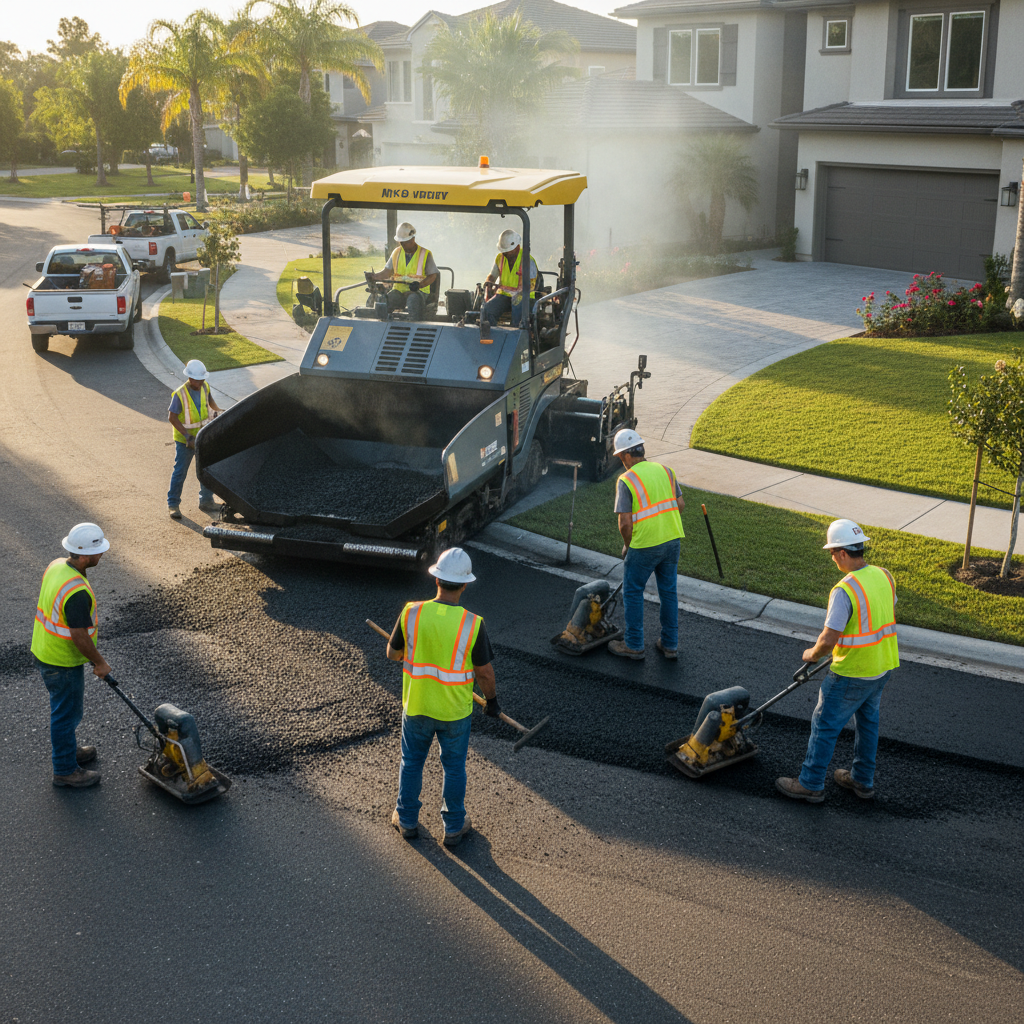
Driveway paving options and costs in Tecumseh
Tecumseh homeowners usually have three practical goals when they price a driveway: a smooth ride, a clean curb line, and a surface that survives Windsor–Sarnia’s winter freeze-thaw. With 7,945 homeowner households in the area and single-detached homes making up 81.1% of dwellings (Statistics Canada, 2021 Census), there’s a steady demand for residential driveway work—especially in neighbourhoods like McKee Park and surrounding residential streets where many lots have short access ramps and frequent salt-and-plow traffic.
In Tecumseh and the broader Windsor–Sarnia market, pricing is shaped less by “just square footage” and more by how much the contractor has to remove, rebuild, and drain. Frost still drives design: if the subgrade is wet or clay-heavy, the base often needs to be deeper and better drained to reduce heaving and early cracking. At the same time, Ontario’s paving season is shorter; hot-mix asphalt production and placement depend on warm air temperatures (typically above 10°C), so spring and late-fall scheduling can tighten and push costs up.
Because 40.2% of local homes were built before 1981 (Statistics Canada, 2021 Census), many driveways involve an older base, irregular slopes, or deteriorated edges that require excavation and regrading before any new surface can perform. The options below show typical trade-offs between lifespan, upkeep, and upfront investment, which you can then compare against your site’s removal and drainage needs in the table.
| Material |
Lifespan |
Maintenance |
Best For |
Price per sq ft |
| Asphalt (new installation, proper base) |
15–25 years |
Seal coat every 3–5 years |
Best value with smooth finish; efficient build time |
$8–$14 |
| Asphalt (overlay on existing gravel base) |
10–18 years |
Seal coat every 3–5 years; monitor joints and edges |
When the existing base is sound and thickness can be corrected |
$9–$16 |
| Interlocking concrete pavers |
25–40 years |
Occasional re-leveling of sand joints |
High curb appeal; easy spot repairs without full replacement |
$18–$32 |
| Poured concrete (broom finish) |
25–30 years (with proper design) |
Caulking/joint maintenance; periodic cleaning |
Clean look; solid surface under plow and vehicle traffic |
$12–$20 |
| Exposed aggregate concrete |
25–35 years |
Sealer as needed; keep joints maintained |
Slip-resistant finish; enhanced look |
$14–$24 |
| Gravel / crushed stone (budget option) |
5–12 years |
Top-ups and regrading 1–3 times per year |
Temporary solution or low-budget access |
$3–$6 |
Prices are estimates only and vary by project scope, site access and material selection.
What affects the price of paving in Tecumseh
In Tecumseh and across Ontario’s southern markets, quotes for the “same driveway size” can vary by 30–50% because the real cost driver is usually what’s happening underneath: excavation volume, base thickness, drainage corrections, and haul/disposal. Two homeowners can both have 1,000 sq ft, yet one lot has a stable granular base and solid subgrade, while the other has soft clay, standing water, and failing edges—so one job needs minimal rebuild and the other needs deeper frost-protection-style excavation and more granular material.
Frost line depth and freeze-thaw cycles are decisive in the Windsor–Sarnia region. Where winters repeatedly push moisture to expand, the base and drainage details matter. In Ontario, deeper, well-compacted granular base is typically required to help manage moisture movement and reduce heaving and cracking; in practice, contractors plan deeper rebuild zones for poor drainage or clay-heavy soils. Add the fact that hot-mix asphalt is weather-dependent—air temperatures above about 10°C—and you also get tighter spring schedules, which can raise labour and equipment costs.
Concrete and asphalt are also sensitive to local conditions. For example, if your driveway slopes toward the garage and you need to reshape it, grading and drainage can add cost fast (often more than the surface material difference between asphalt options). If you have old asphalt that’s alligator-cracked, full-depth tear-out and disposal can increase the job compared to simply overlaying—yet an overlay is often cheaper than reconstructing a new base from scratch. And on older homes (40.2% built before 1981), it’s common to find undersized base, so contractors may price more stone and a better edge restraint even when the surface choice stays the same.
As you compare options, use the band context: asphalt driveway paving often lands around $8–$14 per sq ft with proper base, while interlocking pavers commonly start at roughly $18–$32 per sq ft because of excavation depth, bedding sand, and labour for the panel setting pattern.
| Price Factor |
Why It Matters |
Cost Impact |
| Driveway area in sq ft |
Most line items scale with square footage: excavation, stone, asphalt/pavers |
High (primary driver) |
| Base depth required |
Frost protection depends on soil and moisture; deeper base reduces heave risk |
High (often drives big quote differences) |
| Grading and drainage work |
Slope correction, ditch tie-ins, and drainage swales prevent water pooling |
Medium to High |
| Tear-out of existing surface |
Concrete/asphalt removal requires breaking, hauling, and disposal fees |
Medium to High |
| Edge restraints and curbing |
Prevents paver spread and stabilizes asphalt edges under plow traffic |
Medium |
| Sealing requirement |
Asphalt performance improves with sealing after the mat cures |
Low to Medium (but add-on timing matters) |
| Site access |
Narrow gates or tight turns can slow equipment and increase labour time |
Medium |
| Asphalt mix specifications |
Freeze-thaw-rated mix design can cost more, but improves durability locally |
Low to Medium |
Permits & regulations in Ontario
In Ontario, paving a private driveway within your own property usually does not require a building permit—especially when you’re simply replacing an existing surface and not changing how stormwater is managed. However, work that touches the municipal right-of-way typically does require municipal approval. That includes things like creating a new curb cut, altering the boulevard/sidewalk area, or changing storm drainage tied to municipal infrastructure.
Before excavation, you should always confirm utility locations using Ontario One Call (and follow the locate markings during the build). Even on residential lots, utilities can run deeper or off-line because of prior service connections, and locating reduces the risk of damage that can delay the schedule.
For lot grading, some municipalities enforce rules that restrict how close to property lines a hard surface can be and how water must be directed. In Tecumseh, treat drainage and slope management as part of compliance: contractors should be willing to discuss where the water goes and how the driveway ties into existing grading so you don’t end up with runoff issues.
To verify a contractor in Ontario step-by-step: (1) check Ontario licensing/credentials through the appropriate online registries the contractor references; (2) request a certificate of liability insurance and confirm it’s active for the project period; and (3) obtain proof of WSIB clearance (or the correct coverage documentation if applicable to their company). Ask for these documents up front and make sure the names match the quote and contract.
Asphalt vs pavers vs concrete for Tecumseh driveways
For Tecumseh’s freeze-thaw climate, the best choice is the one that matches your tolerance for upkeep and your willingness to pay for base prep and drainage. Asphalt typically has the lowest upfront cost and delivers a smooth finish quickly; the trade-off is that it needs sealing every 3–5 years to protect against water infiltration and oxidation during winter. Interlocking concrete pavers have the highest upfront cost, but they’re repair-friendly: individual units can be lifted and reset if settlement occurs, without tearing out the whole driveway. Poured concrete sits in the middle on cost, but it can crack if joints and air-entrainment aren’t handled correctly—freeze-thaw and de-icing salts in Ontario can accelerate surface wear if the mix isn’t right.
In the Windsor–Sarnia region, frost and moisture management mean base depth and drainage design typically matter more than the surface material alone. For many yards, contractors plan deeper granular rebuild and tight compaction so water can’t freeze under the pavement and lift weak areas. If you have a clay-heavy site or the driveway holds water after rain, pavers can be forgiving due to the repair method, while asphalt and concrete depend heavily on correct drainage grading and a sound base to avoid early failure.
Here’s where the money difference can make sense: an asphalt driveway might run roughly $8–$14 per sq ft, while pavers are commonly $18–$32 per sq ft. That extra cost is justified when you want maximum curb appeal and you’d rather do localized repairs than replace the entire surface after a settlement event—especially in areas with frequent freeze-thaw impacts and active plowing.
| Material |
Frost Resistance |
Curb Appeal |
Repair Method |
Lifespan |
Price Band |
| Asphalt (sealed regularly) |
Good with proper drainage and base |
Medium |
Patch milling and re-asphalt; overlay if needed |
15–25 years |
$8–$14 |
| Interlocking concrete pavers |
Very good when edges and base are built correctly |
High |
Lift/replace individual stones or small sections |
25–40 years |
$18–$32 |
| Poured concrete (air-entrained) |
Good with joints and air-entrainment |
Medium to High |
Crack repair with caulking/patching; full replacement if severe |
25–30 years |
$12–$20 |
| Exposed aggregate concrete |
Good with correct mix and curing |
High |
Localized patching and resurfacing where feasible |
25–35 years |
$14–$24 |
| Permeable pavers (drainage grid) |
Excellent for water management when detailed correctly |
High (with modern look) |
Replace grid sections; maintain infill/surface as required |
20–35 years |
$20–$35 |
| Chip seal / tar-and-chip |
Fair to good (surface wear expected) |
Low to Medium |
Spot chip replacement and periodic re-seals |
7–12 years |
$6–$11 |
How to choose a paving contractor in Tecumseh
Choosing the right contractor in Tecumseh comes down to verification, clarity, and process—not just the lowest number. Start by checking Ontario licensing/credentials appropriate for the work they’re proposing. Then request liability insurance documentation and read it for project-period coverage and the correct legal company name. For worker coverage, ask for proof of WSIB (or the correct WCB documentation where applicable), and confirm it’s current. A contractor who can’t provide these quickly is a higher risk—especially on jobs that involve excavation, trucking, and possible work near municipal drainage areas.
Next, get 2–3 itemised written quotes. You want a breakdown showing excavation/tear-out, granular base, asphalt/pavers/concrete supply, placement and compaction, edges/curbs, disposal, and any drainage corrections—plus whether taxes are included. Avoid “lump sum only” quotes that don’t say what’s included, because that’s where cost creep usually shows up. Confirm warranty terms too: workmanship warranty length, product/manufacturer warranty (if different), and whether the warranty transfers if you sell your home.
On payment schedule, a common safe structure is keeping upfront to 10–15% or less, then paying in stages tied to completed milestones. Hold back a portion until the final cleanup and finishing items are complete. Finally, insist on a start date and completion estimate in writing so you can plan around Ontario’s shorter paving window and curing times.
- Provide a written scope that lists excavation depth, base thickness, and compaction requirements.
- Confirm whether disposal/hauling of removed asphalt/concrete is included.
- Require utility locate documentation and confirmation they’ll follow locate markings.
- Ask who supplies and compacts the granular base and what material spec is used.
- Check that edge restraints (curbs or concrete borders) are included for pavers/asphalt where needed.
- Get details on drainage tie-ins: where water goes after grading.
- Confirm sealing timeline for asphalt (seal after cure, often 6–12 months depending on conditions).
- Ask about air temperature requirements and how they’ll handle cold snaps.
- Ensure the quote states jointing plan for concrete (saw cuts, spacing, and depth approach).
- Request product data for mix design (asphalt) or air-entrainment (concrete) where applicable.
- Verify warranty is in writing and not just a verbal “best effort.”
- Use a payment schedule with a holdback until final grading, edges, and cleanup are complete.
Red flags to watch for in Tecumseh: “we don’t need base depth details,” no mention of drainage or how they’ll prevent frost heave, refusal to provide insurance/WSIB paperwork, only quoting lump-sum without unit pricing or scope, and promises to pave in cold weather without addressing curing/temperature limits.
Frequently asked questions — paving in Tecumseh
Do I need a permit to pave my driveway in Ontario?
In Ontario, most driveway paving done entirely within your own property typically does not require a building permit—especially when you’re replacing an existing surface. That said, if the work affects municipal property (the right-of-way), you may need municipal approval. Examples include new or modified curb cuts, changes to boulevard areas, or alterations that change how stormwater flows toward municipal drainage. In Tecumseh, it’s also worth confirming lot-grading expectations if your project changes slope or directs water differently than before. Before excavation, use Ontario One Call to get utility locates, and ask your contractor to show you exactly what they’re doing regarding drainage tie-ins so the work aligns with local requirements.
How long before I can drive on new asphalt?
For new asphalt in Tecumseh, the usual goal is that you can drive on it shortly after placement, provided the surface has cooled enough and is not being damaged by turning or heavy loads. In many typical residential driveway installs, cars can often use the driveway the same day, but crews will still advise avoiding tight turning, parking on soft spots, or placing heavy vehicles immediately after paving. The sealing timing is separate: asphalt is typically sealed after it has cured, often between 6 and 12 months depending on weather and surface conditions. If your quote shows asphalt at around $8–$14 per sq ft, make sure the scope clarifies curing/traffic guidance and whether sealing is included or recommended as a future step.
What causes potholes and how are they repaired?
Potholes form when water gets into weak spots and expands/contracts through freeze-thaw cycles. In Tecumseh’s winters, repeated moisture movement under the surface can loosen the base, causing voids. Often the first failure shows up near edges, utility patches, or locations with poor drainage. Repair depends on how deep the damage is: surface-level patching can work for small areas, but if the base is saturated or undermined, the contractor may need to saw-cut and remove down to stable material, then rebuild with granular base before placing new asphalt. Premium repairs usually include proper tack coat and compaction so the patch doesn’t fail again the following season. If you’re seeing repeated potholes, ask whether drainage or base issues were addressed rather than just patched.
How do I prepare for a paving project?
Preparation helps avoid delays and protects your property. Start by clearing vehicles and moving trailers so the crew can access the full driveway. Secure any landscaping that could be affected by excavation and ensure gates allow equipment entry. Mark sprinkler heads and let the contractor know about any underground drains or known utility issues. Since frost and moisture control matter, confirm how the contractor will handle drainage and where water will flow after grading—especially if your driveway currently puddles. Before demolition, make sure you understand disposal: what’s hauled away versus what’s kept. Finally, line up timing with Ontario’s schedule—cold snaps can affect asphalt placement and curing, so ask for an exact start date and daily plan in writing.
How do I compare paving quotes fairly?
Compare quotes line-by-line, not by the total number alone. Ask for an itemised breakdown that includes excavation/tare-out, granular base thickness, compaction approach, asphalt/pavers/concrete supply, edges/curbs, drainage corrections, and disposal. Confirm whether taxes are included and whether traffic management or temporary surfaces are part of the scope. Look for differences in assumptions: some contractors may price an overlay while others price full reconstruction due to base condition—those can be legitimate but shouldn’t be compared as if they’re the same job. For context, asphalt driveway paving often lands around $8–$14 per sq ft with proper base, while interlocking pavers commonly start around $18–$32 per sq ft. A “cheap” quote that omits edge restraints, base rebuild, or drainage work usually costs more later.
Can asphalt be laid in cold weather in Tecumseh?
In Ontario, asphalt placement is highly temperature-dependent. Hot-mix asphalt generally requires warm air conditions (commonly above about 10°C) so the mat can be placed and compacted correctly and the asphalt binder can achieve proper density. If it’s too cold, the mix can cool before compaction is finished, which increases the risk of early cracking and premature failure under freeze-thaw. In Tecumseh, late-season or early-spring weather swings mean crews may postpone work or adjust logistics—though “just do it anyway” shortcuts are risky. If someone quotes you without discussing weather limits, curing, and compaction conditions, ask for their cold-weather plan. A reliable contractor will schedule within Ontario’s practical placement windows or propose an alternative if conditions aren’t suitable.