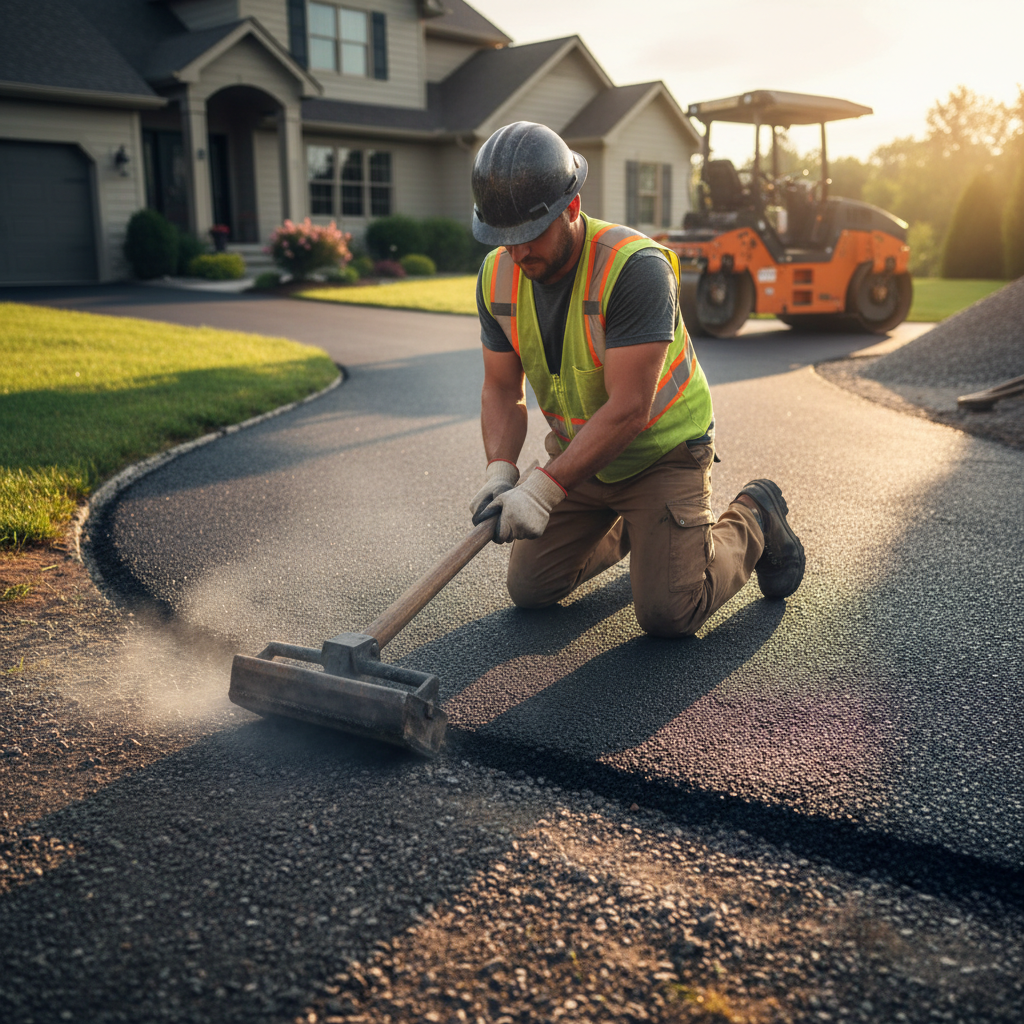
Driveway paving options and costs in Mount Pleasant East
In Mount Pleasant East, choosing a driveway finish usually starts with how your home sits on the lot—driveways here are commonly tied to detached-home properties (with 16,775 residents in the area overall, Statistics Canada, 2021 Census), which typically means longer paved runs and more vehicle turning pressure at the apron. The three most common options are asphalt, interlocking concrete pavers, and concrete, each priced differently because the base build-up and the way the material handles Toronto’s freeze–thaw weather are not the same.
Toronto-area paving is heavily influenced by frost depth and repeated freeze–thaw cycles. In this region, the ground can freeze to roughly 3–4 feet, so a “thin” base is a common reason driveways fail early. Asphalt can be cost-effective upfront, but it performs best when it’s installed over a properly compacted granular base, with good drainage so water doesn’t sit under the slab. Pavers usually cost more at the start, yet they tend to tolerate repairs better—an important advantage when winter cycling and ploughing stress the surface and joints.
Because the paving season effectively runs late spring through early fall (and the best placement conditions depend on air/soil temperatures), scheduling can tighten, especially around neighbourhood pockets like Mount Pleasant Village where contractor demand stays high. That’s why it helps to compare options side-by-side before you book site visits—use the table below as a realistic baseline for Mount Pleasant East.
| Material |
Lifespan |
Maintenance |
Best For |
Price per sq ft |
| Asphalt (new installation, proper base) |
15–25 years |
Seal every 3–5 years; crack fill as needed |
Balanced value, clean look, fast installation |
$6.00–$12.00 |
| Asphalt (overlay on existing gravel base) |
10–18 years |
Seal every 3–5 years; more frequent patching possible |
Budget refresh when base can be stabilized and regraded |
$5.00–$10.00 |
| Interlocking concrete pavers |
25–40 years |
Resand every 5–8 years; lift-and-relay repairs when needed |
Curb appeal and easier localized repairs |
$12.00–$25.00 |
| Poured concrete (broom finish) |
20–30 years |
Seal/coat every 5–10 years; address jointing and drainage |
Straight, modern look and long service life |
$10.00–$22.00 |
| Exposed aggregate concrete |
20–30 years |
Seal every 5–10 years; periodic crack monitoring |
Higher-end finish with slip resistance |
$13.00–$26.00 |
| Gravel / crushed stone (budget option) |
2–7 years (varies widely with grading) |
Top up annually; weed control; re-shape and recompact |
Short-term solution while planning a full build |
$3.00–$6.00 |
Prices are estimates only and vary by project scope, site access and material selection.
What affects the price of paving in Mount Pleasant East
In Toronto and across Ontario, quotes for the “same” driveway can swing by 30–50% because the real work happens under the surface: excavation, base compaction, drainage correction, and tear-out disposal. Two contractors can both say they’re doing asphalt, but one may be building a frost-protective base properly while the other is trying to pave over an insufficient granular section. With Mount Pleasant East’s typical lot conditions and busy contractor schedules, those differences show up quickly in the final price—especially when you’re trying to secure a prime spring start date.
Frost line depth and freeze–thaw cycles are decisive cost factors for Mount Pleasant East. With ground freezing to roughly 3–4 feet in the Toronto region, deeper frost generally means you need a thicker, well-compacted granular base (often 6–12 inches of processed granulars in Ontario-style driveway builds, plus engineering for drainage). If water is able to pond under the pavement, freeze expansion can push the surface up, leading to cracking and heaving. Asphalt mix design also matters: a freeze–thaw-rated hot-mix asphalt is engineered to handle cycling, and that can increase material costs. Concrete pricing can also rise because air-entrainment, careful joint spacing, and drainage detailing are essential for winter performance.
Concrete can get more expensive when you require saw-cut control joints, dowels/edge dowels for stability, or extra subbase to manage settlement. Asphalt can cost more when drainage corrections require additional excavation (ditches, forms, culvert tie-ins), or when existing old asphalt must be broken and hauled as concrete/asphalt waste. For budget planning, many homeowners end up choosing between asphalt in the $3,500 – $8,000 range and concrete finishes that commonly land higher, such as $6,000 – $15,000 for standard driveway concrete depending on size and site conditions.
Because many Mount Pleasant East properties are older residential stock with established grades, base reworking can be the deciding cost item—what you see (a crack or dip) is often the result of what’s happening below grade.
| Price Factor |
Why It Matters |
Cost Impact |
| Driveway area in sq ft |
Hot mix, concrete, pavers, and labour scale directly with square footage |
High: can change the total by thousands |
| Base depth required |
Frost line conditions dictate granular thickness and compaction needs |
High: deeper base means more excavation and material |
| Grading and drainage work |
Correct slope and route water away to prevent under-surface saturation |
Medium to high: culvert/tie-in work adds cost |
| Tear-out of existing surface |
Breaking and hauling asphalt or concrete is labour-intensive and disposal drives costs |
Medium: often a large line item |
| Edge restraints and curbing |
Pavers and asphalt need stable edges to resist lateral movement |
Medium: required for long-term performance |
| Sealing requirement |
Asphalt benefits from sealcoating to slow moisture and oxidation |
Low to medium: adds a scheduled maintenance cost |
| Site access |
Narrow gates, steep slopes, or limited staging slow equipment movement |
Low to medium: can still add labour hours |
| Asphalt mix specifications |
Freeze–thaw-rated mix and quality aggregate improve durability |
Medium: better materials can cost more but reduce failure risk |
Permits & regulations in Ontario
In Ontario, paving a private driveway within your own property typically does not require a building permit. Where things change is when you alter anything that affects the municipal right-of-way or municipal infrastructure. In Mount Pleasant East, that usually means work like installing a new curb cut, changing the location or size of a driveway entrance within the boulevard, altering storm drainage, or modifying any part of the road edge/drainage connection typically requires municipal approval. Some municipalities also have lot-grading rules that restrict how close hard surfaces can sit to property lines and how drainage must be managed, so it’s worth checking your local requirements before the first shovel hits the ground.
Step one for homeowners is utility locates. Call Ontario One Call before excavation—every contractor should do this, but you should also confirm it’s scheduled and documented. Step two is contractor accountability: verify the contractor’s Ontario licensing (where applicable), and confirm liability insurance and WSIB coverage. Ask for a current certificate of insurance naming you/your property as applicable, and look for a WSIB clearance letter or proof of coverage before work begins. If a contractor tells you insurance/coverage “isn’t needed,” walk away. Step three is written scope clarity: request a line stating whether debris/disposal is included and who is responsible for any permit or approvals required for right-of-way impacts.
By handling these items up front, you avoid delays when inspections or approvals are needed and protect yourself if freeze–thaw drainage performance depends on details that must be followed in the boulevard area.
Asphalt vs pavers vs concrete for Mount Pleasant East driveways
For Mount Pleasant East’s freeze–thaw climate, the best choice depends on how you want the driveway to fail—or rather, how it should hold up when winter cycling, ploughing, and salt are part of normal life. Asphalt is usually the lowest upfront cost and offers a smooth drive, but it performs best when properly installed over the right granular base and then sealed every 3–5 years. Interlocking concrete pavers cost more at the start, yet they’re often the most forgiving when it comes to localized repairs: you can lift and re-lay a small section if water causes subgrade settlement or if a turning area gets stressed. Poured concrete sits in the middle on cost and can last a long time, but it is more sensitive to jointing and drainage; without air-entrainment and a well-prepared base, freeze–thaw pressure and de-icing salt can lead to cracking.
Toronto’s primary cost driver—deep frost (roughly 3–4 feet)—means all three options need a well-engineered base and drainage design so water can’t sit under the pavement. Asphalt and concrete rely on a monolithic surface that must remain stable; pavers tolerate minor movement because individual units and jointing can flex slightly. In typical driveway applications, ploughing and salt also make sealing and surface protection more important for asphalt and any exposed finish.
To ground the decision in dollars: if your driveway is sized to land around $3,500 – $8,000 for asphalt, you’re buying lower upfront cost—often the most cost-justified option if you’re comfortable with ongoing seal maintenance. If you’re willing to invest in long-term curb appeal and easier repairability, interlocking pavers commonly fall in the $9,000 – $20,000 range depending on area and edging, and that extra cost is often justified on homes where the driveway is a visible “front door” feature in Mount Pleasant East.
| Material |
Frost Resistance |
Curb Appeal |
Repair Method |
Lifespan |
Price Band |
| Asphalt (sealed regularly) |
Good when base + drainage are correct; mix must be freeze–thaw rated |
Medium (clean black surface; limited colour variety) |
Patch/overlay; sealcoat + crack fill |
15–25 years |
$3,500 – $8,000 |
| Interlocking concrete pavers |
Very good; joints and individual units tolerate minor movement |
High (pattern, colour, and edging options) |
Lift-and-relay localized sections |
25–40 years |
$9,000 – $20,000 |
| Poured concrete (air-entrained) |
Good with air-entrainment and proper joints/drainage detailing |
Medium to high (sleek, uniform look) |
Patch/diamond-grind areas; longer-term crack management |
20–30 years |
$6,000 – $15,000 |
| Exposed aggregate concrete |
Good; finish is durable but still needs correct base and joints |
Very high (textured, premium look) |
Localized patching is possible; may require matching finish |
20–30 years |
$8,000 – $18,000 |
| Permeable pavers (drainage grid) |
Excellent drainage strategy for saturated subgrades |
High (modern look; can be designed with pattern) |
Re-level and replace units; grid access if needed |
25–35 years |
$10,000 – $22,000 |
| Chip seal / tar-and-chip |
Moderate; can ravel if base/drainage is off |
Low to medium (texture-based appearance) |
Re-chip/recoat in targeted areas |
6–12 years |
$4,000 – $7,500 |
How to choose a paving contractor in Mount Pleasant East
When you’re choosing a paving contractor in Mount Pleasant East, the biggest differentiator isn’t just price—it’s whether the crew can execute a frost-resilient build the first time. Start by verifying Ontario licensing where applicable, then confirm liability insurance and WSIB/WCB coverage. Ask for a current certificate of insurance and ensure coverage is active for the job date range. For WSIB/WCB, request a clearance letter or proof of coverage; a reputable contractor will provide it without hesitation. If a contractor refuses or delays, that’s a meaningful risk signal.
Next, request 2–3 itemised written quotes. You want a breakdown that separates labour, base/excavation, haul/disposal, asphalt/concrete/paver materials, and surfacing—including what thicknesses are included and whether drainage work is part of the scope. Compare apples-to-apples: ask whether tear-out is included (and how much), whether edging/restraints are included, whether grading is “to match existing” or engineered to manage drainage, and whether a permit/municipal approval is required and who handles it. Make sure the scope specifies sealing for asphalt: asphalt generally needs sealing after placement (often within the first season, then every 3–5 years).
For warranty, insist on workmanship duration in writing and clarify what’s covered versus what’s routine maintenance. Verify whether product/manufacturer warranty applies to you and whether it’s transferable. Payment schedule should be conservative: never pay more than 10–15% upfront, and hold back the final payment until the job is complete, cleaned, and defects are corrected. Finally, get the start date and an estimated completion window in writing—especially important in Toronto’s compressed paving season.
- Provide itemised labour/material quantities and included thicknesses for base and surfacing.
- Document drainage plan (slope, tie-ins, and where water will go).
- Include tear-out scope and disposal/hauling details.
- Confirm utility locate responsibility and provide evidence of Ontario One Call.
- Check liability insurance (active coverage) and WSIB/WCB proof (clearance letter).
- Verify the paving crew has handled freeze–thaw builds in GTA conditions, not just milder regions.
- Ask who supplies the asphalt/concrete mix and whether it’s freeze–thaw rated where required.
- Confirm edge restraints/curb detailing for pavers and asphalt stability.
- Clarify sealing timeline for asphalt and whether it’s included or an add-on.
- Get start/completion dates and weather contingencies in writing.
- Request a written warranty with definitions of workmanship versus maintenance.
- Use a payment schedule with small deposit and a holdback until punch list completion.
Red flags I see in Mount Pleasant East include: contractors quoting “pave over anything” without assessing base and drainage, missing insurance/WSIB documentation, vague scopes that don’t state thicknesses or disposal, pressure to pay most of the amount upfront, and workmanship warranties that are not written or that exclude typical failure modes caused by poor base prep.
Frequently asked questions — paving in Mount Pleasant East
Do I need a permit to pave my driveway in Ontario?
In Mount Pleasant East and across Ontario, paving within your own property usually doesn’t require a building permit. Where permits approvals often come into play is when your project affects municipal infrastructure—such as a new or widened driveway entrance in the boulevard, curb cut changes, or changes to storm drainage tied into municipal systems. Some municipalities also have lot-grading rules that restrict how you shape grades and how close hard surfaces can sit to property lines, primarily to protect drainage. Before work starts, confirm whether any right-of-way approvals are required by your specific location and driveway setup. Also ensure utility locates are completed through Ontario One Call, and ask your contractor to confirm who is responsible for any approvals if the scope touches the boulevard or drainage connection. (Statistics Canada, 2021 Census)
How long before I can drive on new asphalt?
For new asphalt in Mount Pleasant East, most driveways are ready for light vehicle traffic relatively soon after installation because the surface is designed to cool after rolling. However, “ready” depends on weather, thickness, and whether tack coat was used correctly. As a practical rule, contractors typically keep vehicles off the surface until it’s fully cooled and stable to prevent tracking and depressions. If your project includes a sealcoat step, you’ll need additional time because sealing needs proper cure time for adhesion and to avoid wash-off or blistering. Since freeze–thaw cycles are hard on driveways, good installation and correct curing matter—if the surface is damaged early, it can lead to faster cracking. If you’re budgeting, many homeowners land in the $3,500 – $8,000 asphalt band, but the schedule should be factored into your availability during Ontario’s shorter paving season.
What causes potholes and how are they repaired?
Potholes are usually the result of water getting into pavement or base voids. In Ontario’s Toronto freeze–thaw conditions, trapped moisture expands when it freezes, then weakens the road structure as it thaws again. Common triggers on driveways include inadequate drainage, insufficient granular base, and failure to compact base materials properly during installation. Potholes are often repaired by removing the distressed asphalt to reach solid, stable material, then rebuilding with properly compacted base and asphalt patching to match thickness. For larger or recurring failures, an overlay or full-depth replacement may be more cost-effective than repeated patching. A good contractor should look for the underlying cause (low spot, grade issue, or blocked drainage) before simply filling the hole. That’s why accurate quotes and drainage assessment are essential—especially when ground freezing to roughly 3–4 feet can exaggerate small base problems over multiple winters.
How do I prepare for a paving project?
Preparation in Mount Pleasant East is mostly about access and protection, and it starts before the contractor arrives. Clear the driveway area of vehicles, trailers, and landscaping obstacles so equipment can stage safely. Mark items like low-hanging trees, garden beds, and any sprinkler lines you know are near the work zone. Ensure your contractor has a clear path for moving materials and debris removal. Confirm that utilities are located before any excavation through Ontario One Call—don’t assume the crew automatically handled it. If you have older concrete or asphalt, discuss tear-out limits and where waste will be hauled. For asphalt sealing plans, ask when sealing will be scheduled (often within the first season) so you can restrict traffic. If you’re comparing options, remember total budgets differ: asphalt projects often fall around the $3,500 – $8,000 range, while pavers commonly start higher, around $9,000 – $20,000, so timing and site prep should reflect the full build duration.
How do I compare paving quotes fairly?
To compare paving quotes fairly in Mount Pleasant East, insist on itemised scopes rather than lump sums. A quote should clearly list what’s included: excavation depth, base thickness, compaction standards, drainage corrections, edge restraints/curbing, and tear-out and disposal. Ask whether the asphalt mix is freeze–thaw rated, whether concrete is air-entrained and how joints will be handled, or whether pavers include proper bedding and joint sand. Also confirm scheduling details because Ontario’s effective paving season is late spring through early fall, and rush dates can change labour costs. When you compare, check that every option is built on a comparable frost-resilient base; otherwise, the cheapest quote often underbuilds and fails sooner in freeze–thaw cycling. Finally, verify insurance and WSIB/WCB coverage and ask about warranty terms. If two quotes are within a few thousand dollars but one includes proper drainage correction and the other doesn’t, that difference is usually worth the money—especially on Toronto-area driveways.
Can asphalt be laid in cold weather in Mount Pleasant East?
In Mount Pleasant East, asphalt paving in cold weather is limited. Hot-mix asphalt placement typically requires air temperatures above about 10°C and warm enough conditions for proper paving and compaction; otherwise, the mix can cool too quickly and not achieve the intended density. Ontario’s winter cycle also makes it difficult to correct drainage after placement because water and freeze-related ground conditions can affect the base. A reputable contractor will watch the forecast, check the temperature and moisture conditions, and may reschedule if conditions aren’t suitable. If you rush paving into borderline cold, you can get early cracking and raveling because density and bond aren’t achieved properly. If you’re trying to plan around the shortest usable season, it’s smart to book early for late spring. For typical budgets, asphalt often fits the $3,500 – $8,000 band, but the timeline and weather constraints are part of getting a driveway that survives Toronto winters.