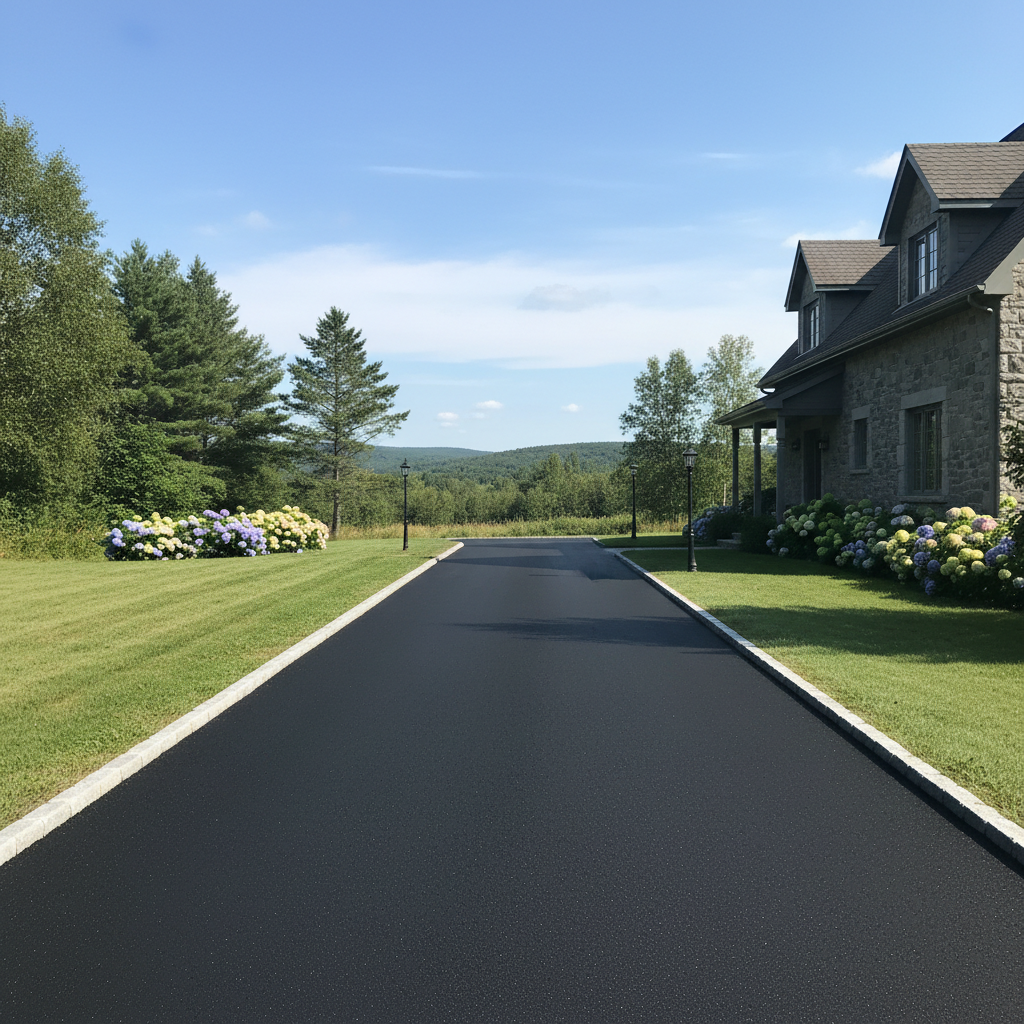
Driveway paving options and costs in Newmarket
Newmarket homeowners typically have a strong preference for clean, durable driveways because most private driveway addresses are attached to single-detached housing—about 59.8% of dwellings in the area are single-detached (Statistics Canada, 2021 Census). With 22,955 homeowner households (75.8% of households own), there’s a steady base of replacement work and upgrades, especially where original asphalt from earlier decades has started to ravel or where interlock has shifted due to water under the edges.
In the Toronto economic region, frost depth and freeze–thaw cycles are a primary cost driver, and that directly affects installed pricing. Ground freezing to roughly 3–4 feet means the driveway needs deeper, properly compacted granular base and reliable drainage so water doesn’t sit under the pavement and then expand when it freezes. On top of that, Ontario’s workable paving season is essentially late spring through early fall, so prime dates and schedule changes in the Greater Toronto area can push labour and equipment costs up (and keep contractors busier in places like Armitage, Yonge Street & Davis Drive corridors).
Because those site conditions and schedule pressures can differ from one quote to the next, the best way to compare options is by material type and what it includes. Use the table below as a practical starting point for a typical Newmarket driveway.
| Material |
Lifespan |
Maintenance |
Best For |
Price per sq ft |
| Asphalt (new installation, proper base) |
15–25 years |
Seal every 3–5 years; crack-fill as needed |
Lower upfront cost with good durability if base is engineered |
$5 – $12 |
| Asphalt (overlay on existing gravel base) |
10–18 years |
Seal every 3–5 years; monitor edge stability |
Faster upgrade where full excavation isn’t required |
$4.50 – $10 |
| Interlocking concrete pavers |
25–35 years |
Weed control; re-sand joints as needed; replace individual stones |
High curb appeal and modular repairs after freeze–thaw |
$10 – $20 |
| Poured concrete (broom finish) |
20–30 years |
Fill joints/cracks if they appear; occasional sealing |
Clean, simple finish with long service when air-entrained |
$8 – $16 |
| Exposed aggregate concrete |
20–30 years |
Sealing typically every few years; joint upkeep |
Slip resistance and upgraded look |
$11 – $18 |
| Gravel / crushed stone (budget option) |
5–10 years |
Re-grade and top-up annually; edge restraint important |
Short-term solution or remote access |
$2.50 – $6 |
Prices are estimates only and vary by project scope, site access and material selection.
What affects the price of paving in Newmarket
Even when you’re comparing the “same” driveway size in Newmarket, quotes can vary by 30–50% across the Toronto region because the real scope usually isn’t identical—base thickness, drainage correction, tear-out, and excavation depth often change once the contractor sees the subgrade. In older housing areas (and Newmarket has a meaningful pre-1981 housing stock at 30.1% of homes), the existing base and drainage can be inconsistent, which forces more work to stabilize the ground and meet freeze–thaw performance targets.
Here, frost depth and freeze–thaw cycles are decisive cost factors. In Ontario’s climate, deeper frost means you typically need a thicker compacted granular base—often in the 6–12 inch range depending on how far you must excavate to reach competent subgrade—so the pavement doesn’t heave and crack when it freezes. Asphalt also relies on local mix design for freeze–thaw durability, and hot-mix asphalt placement generally requires air temperatures above about 10°C. When the paving season is compressed into late spring through early fall, contractors tighten schedules, demand peaks in a few months, and that pressure can increase installed costs for prime dates—one reason an asphalt driveway that might start in May can cost meaningfully more if you shift it into early autumn.
Concrete pricing also shifts based on local conditions. For example, if your driveway slopes toward the garage and the existing downspout runoff is discharging near the slab, drainage correction may add labour and compacted base work. Conversely, a straightforward replacement with a clean, stable subgrade can keep concrete closer to the lower end of the $6,000–$15,000 driveway band, while a full tear-out that exposes poor subgrade can push you toward the top end.
| Price Factor |
Why It Matters |
Cost Impact |
| Driveway area in sq ft |
Most materials and paving time scale directly with square footage |
$1,200 – $6,500 typical spread depending on size |
| Base depth required |
Frost line determines how thick the granular base must be to prevent heaving |
$600 – $3,500 when extra excavation is needed |
| Grading and drainage work |
Fixing slope, adding drainage, and preventing water pooling reduces future cracking |
$500 – $2,800 |
| Tear-out of existing surface |
Breaking and hauling concrete or old asphalt adds labour and disposal fees |
$800 – $4,000 |
| Edge restraints and curbing |
Prevents paver spread and asphalt edge breakdown under winter expansion |
$400 – $1,900 |
| Sealing requirement |
Asphalt should be sealed after placement (often after 6–12 months) to protect it |
$300 – $1,500 as a planned maintenance item |
| Site access |
Narrow lots, long carries, or limited equipment access slow production and increase costs |
$250 – $1,200 |
| Asphalt mix specifications |
Freeze–thaw-rated mixes cost more but reduce early deterioration |
$200 – $900 on typical driveway scopes |
Permits & regulations in Ontario
In Ontario, paving a private driveway entirely within your own property usually doesn’t require a building permit. For a Newmarket homeowner, the common “no permit” work includes replacing asphalt, interlocking pavers, or concrete on your existing driveway footprint, provided you’re not altering the municipal area (the boulevard) or changing storm drainage patterns that tie into municipal infrastructure.
Work that does typically require municipal approval includes anything in the municipal right-of-way, such as creating or changing a curb cut, modifying the boulevard, or altering storm drainage or catch basins that affect how water leaves the property. If your project involves changes to drainage that could impact neighbouring properties or municipal services, you should expect a more formal review process.
Step-by-step, start with utility locates before anyone excavates. In Ontario you use Ontario One Call and schedule locates so contractors can safely verify where services run under the driveway area.
Then verify your contractor properly. Ask for: (1) their Ontario business details and what licence categories they hold (check their business listing and registration details online), (2) a current certificate of liability insurance showing adequate limits, and (3) proof of coverage for employees—typically WSIB for workers. A good contractor will provide certificates up front and clearly list who is responsible for permits or approvals if municipal right-of-way work is involved.
Asphalt vs pavers vs concrete for Newmarket driveways
For Newmarket driveways, the “best” material depends on how you want to handle freeze–thaw stress, snow operations, and repair expectations. Asphalt usually has the lowest upfront cost, but it performs best when laid on an engineered base and edged correctly—then it’s sealed every 3–5 years to protect against moisture and winter salt exposure. Interlocking concrete pavers cost more at the start, but they handle Toronto-area freeze–thaw with a big advantage: you can lift and replace individual stones or a small section if settlement happens, without tearing out the whole surface. Poured concrete sits in the middle on cost and can last a long time when it’s properly air-entrained and finished with good joint control, but it’s more sensitive to cracking if the base or drainage isn’t right.
Because frost depth and freeze–thaw cycles are a primary cost driver here, each option relies on the same foundation principle: deeper, well-compacted granular base and reliable drainage. In practical terms, that often means excavating and building up enough thickness to resist heaving, typically in the 6–12 inch range depending on subgrade condition. Where Newmarket costs tend to jump is when water is already a problem—downspout discharge, surface pooling, or poor slopes can trigger added grading/drainage work regardless of whether you choose asphalt or concrete.
A simple cost example: if asphalt bids at the lower end of the $3,500–$8,000 band but your contractor recommends significant base reconstruction and proper edging, you may land near the mid-to-upper range. In that situation, the higher upfront cost of interlock (often within the $9,000–$20,000 band) can be justified if you value long-term curb appeal and easier localized repairs after winter movement or plow impacts.
| Material |
Frost Resistance |
Curb Appeal |
Repair Method |
Lifespan |
Price Band |
| Asphalt (sealed regularly) |
Good with engineered base and proper mix |
Medium (clean, smooth look) |
Patch and re-tack seal; spot crack fill |
15–25 years |
$3,500 – $8,000 |
| Interlocking concrete pavers |
Very good with proper bedding and restraints |
High (upgrade look) |
Lift/replace affected stones or sections |
25–35 years |
$9,000 – $20,000 |
| Poured concrete (air-entrained) |
Good when air-entrained and jointed |
Medium to high (finish options) |
Epoxy/patch for cracks; joint repairs |
20–30 years |
$6,000 – $15,000 |
| Exposed aggregate concrete |
Good with correct mix and sealing |
High (textured, premium look) |
Targeted repairs with matching material |
20–30 years |
$7,500 – $17,500 |
| Permeable pavers (drainage grid) |
Excellent where drainage management is critical |
High (modern, functional look) |
Replace grid sections and re-lift pavers as needed |
25–35 years |
$10,000 – $22,000 |
| Chip seal / tar-and-chip |
Fair to good; needs good base and maintenance |
Low to medium (texture look) |
Spot repairs and periodic re-seal/overlay |
8–15 years |
$4,000 – $9,500 |
How to choose a paving contractor in Newmarket
Choosing the right paving contractor in Newmarket is mostly about verification and clarity. Start with Ontario licensing/business information and ask for a current certificate of liability insurance that names you as the certificate holder where appropriate. If they’ll use employees, confirm WSIB coverage (request a clearance letter or proof directly from the insurer). If they subcontract concrete/asphalt, ask who holds which responsibilities—your best practice is to ensure you’re protected from liability gaps.
Next, get 2–3 itemised written quotes rather than lump sums. You want labour and materials separated enough that you can compare base thickness, compaction approach, hauling, disposal, and surface finish. Scope clarity matters in Ontario: ask whether tear-out is included, whether grading and drainage corrections are included, and whether permit/municipal approval work is included if the project affects boulevard areas.
Warranty should be in writing. Ask for a workmanship warranty length, what product/manufacturer warranty applies (if any), and whether the warranty is transferable to future owners. For payment, a safe standard is to avoid paying more than 10–15% upfront; hold the remainder until the job is complete and cleaned up. Finally, lock in the schedule: get a start date and estimated completion time in writing, keeping in mind Ontario’s late spring to early fall paving window.
- Provide itemised breakdown (excavation, base, compaction, asphalt/concrete/pavers, delivery, disposal).
- Confirm base thickness and drainage plan in writing (not just “proper base”).
- Ask how they handle frost protection and whether they’ll meet freeze–thaw performance requirements.
- Request a site access plan if you have a narrow lot, gate constraints, or a steep approach.
- Verify certificate of liability insurance and ask for limits that match project size.
- Confirm WSIB coverage or provide the appropriate clearance documentation.
- Check that crews understand edging/restraints for your material choice (especially pavers).
- Clarify whether topsoil restoration and seeding/sod are included where needed.
- Confirm sealing expectations for asphalt (timing and cost if part of warranty).
- Ask for disposal details for old asphalt/concrete and whether hauling is included.
- Review warranty coverage for workmanship and whether it includes settlement or edge failures.
- Get the schedule and weather contingency plan in writing (freeze risk can delay work).
Concrete red flags in Newmarket: (1) they won’t specify base depth/compaction method, (2) they push a “cash discount” with no itemised scope, (3) they can’t produce insurance/WSIB documentation, (4) they promise completion regardless of temperature windows, and (5) they avoid discussing drainage—especially downspout placement and surface grading toward the road.
Frequently asked questions — paving in Newmarket
What is a driveway apron and do I need one in Newmarket?
A driveway apron is the transition section between the sidewalk/boulevard area and your private driveway—basically the “entry” that helps vehicles roll up smoothly without creating a sharp step. In many Toronto-area projects, an apron is needed or recommended when the driveway profile ties into the curb/sidewalk elevation or when you’re changing grades so water flows correctly. Whether it triggers approvals depends on whether you’re working in the municipal right-of-way (boulevard/curb cut area). In Newmarket, ask your contractor to confirm if your scope stays fully within your property or if it requires municipal approval. Climate-wise, correct apron shaping also helps reduce water pooling at the edge, which matters in freeze–thaw cycles. If you’re budgeting, it can add to job scope and base work even if asphalt pricing is otherwise in the $3,500–$8,000 range.
How do I maintain my driveway through Newmarket winters?
Winter maintenance in Newmarket is mostly about protecting edges and minimizing moisture intrusion during freeze–thaw. For asphalt, keep an eye on cracks and seal small cracks early so water doesn’t get under the surface. After the pavement cures, reseal is typically planned every 3–5 years. For snow, use a proper plow blade setup and avoid scraping the surface—edge damage and raveling happen when the first layer gets chipped off. Also manage meltwater: don’t let downspouts drain directly onto the driveway where it can freeze and expand. If you have pavers, keep joint sand topped up and remove any debris that traps water at low spots. In concrete, watch for de-icing salt overuse; it’s not that you can’t use any salt, but consistent salt-scaling and water movement can accelerate surface wear. A properly built base reduces how much winter cycling affects your pavement.
Is it worth sealing a new driveway right away in Newmarket?
In Ontario, you generally don’t seal asphalt immediately the next day. Most contractors recommend sealing after the asphalt has cured—often around 6–12 months—so you don’t trap moisture in the pavement and cause long-term adhesion or blistering issues. Sealing is still “worth it” for most homeowners because it adds a protective layer against water penetration and winter salt exposure, which helps slow raveling and surface oxidation under repeated freeze–thaw. If you’re comparing quotes, ask whether the initial price includes sealing or whether it’s an add-on later. Sealing is commonly budgeted in the $300–$1,500 range depending on driveway size and prep requirements. If your contractor is recommending early sealing, get the reasoning in writing (for example, special mix or weather conditions) and confirm timing with the asphalt manufacturer guidance.
What is a chip seal driveway and is it suited to Newmarket?
Chip seal (tar-and-chip) is a surface treatment where a binder is sprayed and then covered with stone chips. It can be a cost-effective option, but it depends heavily on base quality and drainage—because freeze–thaw cycles in the Toronto region can loosen chips if water is trapped underneath. Chip seal is sometimes used for longer, less premium-driveway runs or where you want a budget-friendly, textured surface. It’s not usually the top choice if your priority is the “sharp” curb look of interlock. In terms of budgeting, chip seal is often below higher-end options and can land around the $4,000–$9,500 band for typical scopes, but performance is best when the base is engineered and the roadway transitions are correct. If your driveway already has pooling, I’d address drainage/grading first—otherwise you may end up paying for rework sooner than with asphalt or properly laid interlock.
How much does driveway crack repair cost in Newmarket?
Crack repair in Newmarket is usually priced by the type and extent of cracking—hairline surface cracks are one thing, while deeper, wider cracks or edge failures can signal base or drainage problems. Many homeowners start with crack filling and cleaning, which can be relatively modest compared to full resurfacing. As a planning reference, small repairs can range widely based on whether there’s lineal footage only, whether routing is needed, and whether access is easy. For a higher-confidence estimate, ask your contractor to inspect for “active” movement after freeze–thaw and confirm whether the crack is just surface oxidation or a structural issue. If you’re considering broader maintenance, asphalt sealing (commonly budgeted in the $300–$1,500 range) can help slow new cracking. If cracks are opening repeatedly, expect that a targeted patch may be needed, and the long-term fix may require correcting the drainage slope before any filler goes in.
What base thickness do I need for pavers in Newmarket?
For paver driveways in Newmarket, base thickness isn’t one-size-fits-all—it depends on your subgrade condition, how much excavation is required, and how the contractor will engineer drainage for frost. In a freeze-prone region with freezing roughly 3–4 feet in the Toronto area, the key is reaching competent subgrade and then building a compacted granular base deep enough to resist heaving and settlement. Many residential installations land in the broader range where total granular build-up can be several inches to over a foot when excavation is needed; some projects require deeper correction than a “standard” template. The bedding layer and joint sand are only part of the system—drainage and compaction are the part that prevents the pavers from shifting after winter. When you get quotes, ask for the proposed base depth in inches and whether they’ll over-excavate unstable areas. A thorough base is why interlock often sits in the $9,000–$20,000 band, but it’s also what helps pavers stay repairable section-by-section.