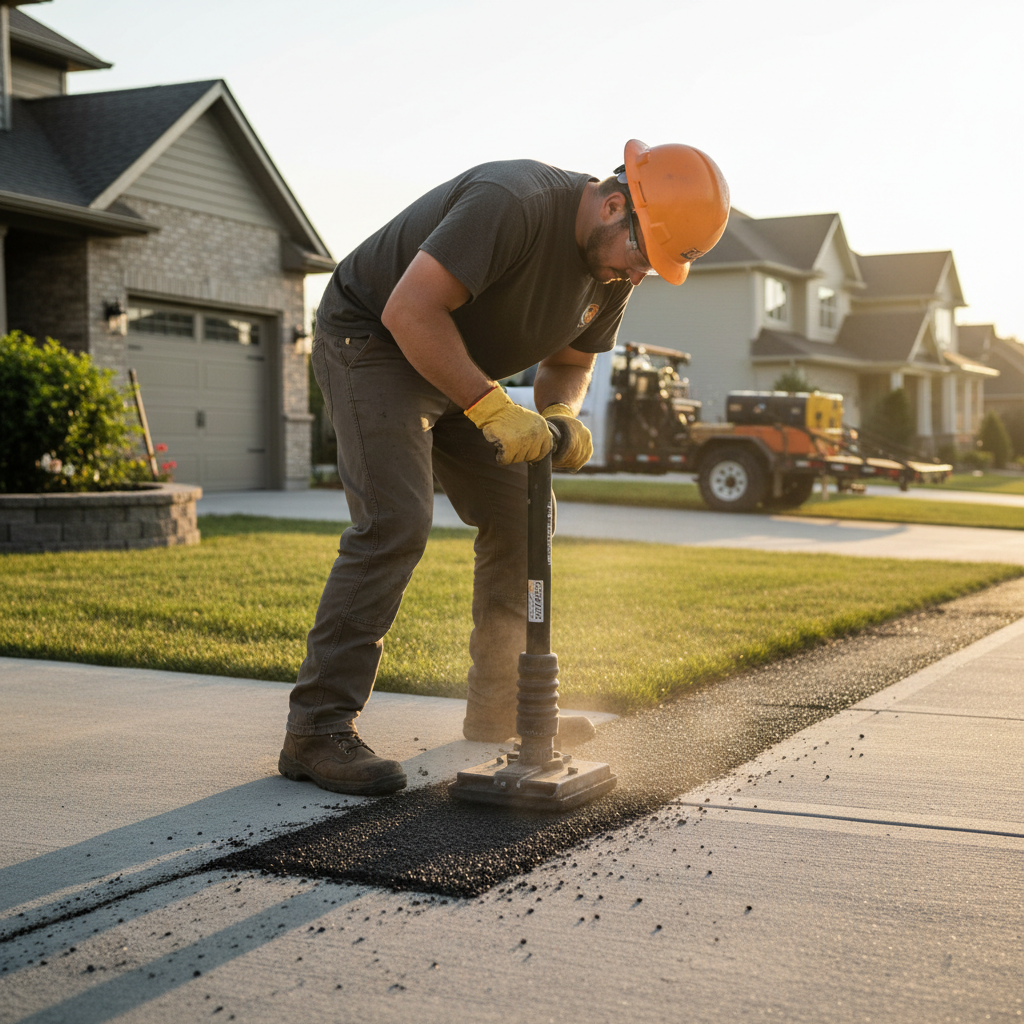
Driveway paving options and costs in Blind River
Blind River homeowners typically have a straightforward driveway decision because most private residences here are single-detached homes (77.8% of dwellings), and the homeowner market is sizeable—1,130 homeowner households (70.6% of households own) as reported by Statistics Canada (2021 Census). In practice, that means contractors see steady demand in older neighbourhood pockets and off-road parking areas where driveways were built decades ago and are now due for a rebuild or major repair.
Pricing is shaped by the Northeast climate—deep frost and repeated freeze–thaw cycles that stress asphalt and concrete surfaces. To control frost heave and surface cracking, driveways usually require more excavation and a thicker, well-compacted granular base than you’d use in milder coastal areas. The paving season is also tighter in colder regions, so crews may charge a scheduling and mobilization premium when warm, dry weather windows open up. In many cases, material freight and limited local availability further push per-square-foot pricing upward compared with larger southern markets.
Where this is especially common? In areas with older housing stock—many driveways in and around downtown/central Blind River—customers often start with asphalt repairs or overlays, then move to a full rebuild when heaving begins. The table below compares the main options and gives realistic cost ranges so you can budget before you call for a site visit.
| Material |
Lifespan |
Maintenance |
Best For |
Price per sq ft |
Price Range |
| Asphalt (new installation, proper base) |
15–25 years |
Seal every 3–5 years; address minor cracks early |
Good value, smooth ride, straightforward snow-plow use |
$7.50–$12.00 |
$4,500–$8,500 |
| Asphalt (overlay on existing gravel base) |
8–15 years |
Seal 2–4 years after paving; monitor edges |
When the base is mostly sound and you want to avoid full tear-out |
$6.50–$10.50 |
$3,500–$7,500 |
| Interlocking concrete pavers |
25–35 years |
Re-level minor settling; replace individual stones if needed |
Maximum curb appeal and repairability after freeze–thaw movement |
$15.00–$22.00 |
$8,000–$16,000 |
| Poured concrete (broom finish) |
25–30 years (with good air-entrainment) |
Seal if desired; keep joint maintenance on schedule |
Durability and clean, simple lines |
$12.00–$18.00 |
$9,000–$18,000 |
| Exposed aggregate concrete |
20–30 years |
Occasional sealing; maintain surface finish |
Slip resistance and decorative look with a more premium feel |
$13.00–$20.00 |
$10,000–$20,000 |
| Gravel / crushed stone (budget option) |
3–8 years (depends heavily on grading) |
Top up annually; re-grade and manage washboarding |
Lowest upfront cost while you plan a long-term build |
$2.50–$5.50 |
$2,000–$5,000 |
Prices are estimates only and vary by project scope, site access and material selection.
What affects the price of paving in Blind River
Even when two homeowners in the Northeast are paving a similar-size driveway, Blind River quotes can land 30–50% apart because pricing isn’t only about asphalt or concrete—it’s about what needs to happen under the surface. Frost depth and freeze–thaw cycling are decisive cost factors in the Northeast climate. Where frost penetration is deeper, you typically need a thicker, properly compacted granular base to reduce frost heave and stress cracking. In southern regions you might see base layers in the lower range, but here driveways often need more granular thickness and better drainage construction. That means more excavation, more aggregate delivery, and more labour hours to build the subgrade correctly.
Season timing also matters. Hot-mix asphalt typically requires air temperatures above about 10°C to lay and compact properly, so the available paving window is shorter in colder communities. When weather delays compress the schedule, contractors price in mobilization risk and crew overtime. Mix design is another factor: asphalt may need freeze–thaw-rated specifications and the right binder to survive local temperature swings—those mixes can cost more than generic material.
Concrete pricing can move up or down based on how many areas need correction. For example, if your driveway ties into existing curbs or grading is off, the contractor may need additional base work before a poured pad is formed. If your home sits on older fill (common in driveways built before the 1980s—67.2% of homes), you can also see variability in subgrade stability that drives deeper prep. Budget asphalt projects often still land within the broader $4,500–$8,500 band, but a full-base rebuild or premium repair approach can push toward the high end, and pavers often follow the $8,000–$16,000 range because of the thicker edge restraints and precision setting.
| Price Factor |
Why It Matters |
Cost Impact |
| Driveway area in sq ft |
Most costs scale with surface area plus sub-base excavation |
Major driver (often the biggest variable) |
| Base depth required |
Frost line dictates granular thickness to limit heave and cracking |
High impact (more haul/load/compaction) |
| Grading and drainage work |
Correct slope and positive drainage prevent water pooling and freeze action |
Medium to high impact |
| Tear-out of existing surface |
Breaking and hauling concrete or old asphalt adds disposal and labour |
Medium to high impact |
| Edge restraints and curbing |
Prevents paver spread and contains asphalt/concrete thickness |
Medium impact |
| Sealing requirement |
Asphalt benefits from sealing after cure (commonly 6–12 months) |
Low to medium impact (adds future cost) |
| Site access |
Narrow lots slow equipment movement and may require smaller equipment |
Medium impact |
| Asphalt mix specifications |
Freeze–thaw-rated mixes and proper binder content can cost more |
Low to medium impact per tonne, bigger on small jobs |
Permits & regulations in Ontario
For most Blind River homeowners, paving a private driveway on your own property generally does not require a building permit. The common exception is when your work affects the municipal right-of-way. That’s where you can trigger approvals, especially if you’re changing curb cuts, modifying a boulevard area, altering storm drainage, or making any changes that affect how municipal water flows. Some municipalities also enforce lot-grading rules that limit how close hard surfaces can be to property lines and how drainage must be handled to protect neighbouring lots and municipal infrastructure.
Before any excavation, complete utility locates through Ontario One Call. This step is non-negotiable because even seemingly “simple” driveway work can hit buried services. Once utilities are marked, you can confirm with the municipality whether your exact scope needs approvals—especially if you’re touching catch basins, municipal drainage swales, or relocating or deepening ditch lines near the road.
To verify your paving contractor is properly set up, ask for their Ontario licence information (or confirm registration where applicable), then request a certificate of insurance showing general liability coverage. For work affecting hardscape surfaces, also ask about workers’ compensation coverage (WSIB/WCB) and confirm that clearance status—ideally through proof they can provide. A reputable contractor should hand you these documents before starting and again if anything changes in scope.
Asphalt vs pavers vs concrete for Blind River driveways
Choosing between asphalt, interlocking concrete pavers, and concrete in Blind River comes down to frost resistance, maintenance tolerance, and how you want the driveway to behave under winter routine (plowing, sand, and salt). With deep freeze–thaw cycling, your base and drainage design matter as much as the surface material. Asphalt usually has the lowest upfront cost and a smooth driving surface, but it performs best when it’s sealed regularly—typically every 3–5 years—to reduce water infiltration through small cracks. If the base is well-built, asphalt can be a strong value path, often aligning with the $4,500–$8,500 driveway paving band for many standard residential jobs.
Interlocking concrete pavers cost more upfront because of thicker edge restraints, bedding layers, and the labour of careful setting. The payoff is repairability: if a localized settlement or freeze-related movement occurs, contractors can lift and reset affected stones without tearing out the entire driveway—helpful in areas where older subgrades were used. Paver projects commonly land in the $8,000–$16,000 range.
Poured concrete (especially air-entrained) is mid-range in look and cost, but it’s more sensitive to jointing and curing. Poorly designed joints or inadequate base preparation can lead to cracking from movement, and de-icing salts can accelerate surface wear if the mix isn’t properly air-entrained and protected. As an example, if asphalt and concrete bids differ by roughly $2,000–$4,000 on a driveway, concrete may be justified when you want longer service life with a single uniform surface—provided the contractor designs the joints and base for winter conditions. If you’re more worried about future spot repairs, pavers often justify their premium because the repair method stays localized.
| Material |
Frost Resistance |
Curb Appeal |
Repair Method |
Lifespan |
Price Band |
| Asphalt (sealed regularly) |
Good when base and drainage are solid |
Moderate |
Patch cuts and re-tack; crack sealing |
15–25 years |
$4,500–$8,500 |
| Interlocking concrete pavers |
Very good due to segmented surface and reset capability |
High |
Lift and replace individual pavers/small sections |
25–35 years |
$8,000–$16,000 |
| Poured concrete (air-entrained) |
Good with proper air-entrainment and joints |
Moderate to high |
Patch areas; replace slab if large failure |
25–30 years |
$9,000–$18,000 |
| Exposed aggregate concrete |
Good, but surface finish must be maintained |
High |
Patch is possible but less seamless than pavers |
20–30 years |
$10,000–$20,000 |
| Permeable pavers (drainage grid) |
Very good when drainage design is correct |
High (modern look) |
Lift/replace localized units; clear infiltration paths |
25+ years |
$10,000–$22,000 |
| Chip seal / tar-and-chip |
Moderate; depends heavily on application timing |
Lower |
Spot patch; full re-chip when worn |
7–12 years |
$3,500–$7,000 |
How to choose a paving contractor in Blind River
Start with compliance and proof. In Ontario, a legitimate contractor should provide their insurance certificate (general liability) and confirmation of workers’ compensation coverage (WSIB/WCB), along with a clearance letter or proof they can show you. Ask how to verify it: request the certificate of insurance directly and check that the coverage is current and matches the contractor’s legal name. If they refuse to provide documentation, that’s a hard stop. Next, confirm their written contract includes scope details, warranty terms, and start/completion timing.
For pricing, don’t accept a single lump-sum without a breakdown. Get 2–3 itemised written quotes showing labour and materials, and specify line items such as excavation, base supply/compaction, geotextile or stabilization (if recommended), asphalt/concrete placement, and edge restraints. Clarify what’s excluded: disposal of broken material, hauling distance limits, permit handling (if any right-of-way approval is needed), and whether saw-cutting/joint work is included for concrete. A clear scope is especially important in older Blind River neighbourhoods where driveway subgrades may be less consistent.
Warranty matters for workmanship—look for a stated length (commonly 1–5 years for workmanship, depending on the company) and confirm whether it covers lift/settlement, cracking tied to workmanship, and drainage-related failures. Product/manufacturer warranty is different and may not cover labour. Payment schedule should protect you: never pay more than 10–15% upfront, and hold back a portion until the job is complete and cleaned up. Finally, ask for a written timeline including start date and a realistic completion estimate.
- Ask for their WSIB/WCB clearance status and verify current coverage documents.
- Request a certificate of insurance and confirm it’s active before work begins.
- Get 2–3 itemised quotes (labour + materials), not just one total.
- Confirm base depth, compaction requirements, and whether geotextile/insulation is needed.
- Make drainage and slope requirements explicit in writing.
- Specify disposal and hauling: concrete/asphalt removal and where debris goes.
- Clarify edge restraints: what system will be installed to prevent spreading.
- For asphalt, require curing and sealing instructions (often sealing after 6–12 months).
- For concrete, confirm air-entrainment and joint/saw-cut plan.
- For pavers, confirm bedding sand type/thickness and restraint installation.
- Review the warranty: workmanship length, what’s covered, and exclusions.
- Limit upfront payment to 10–15% and hold back until final acceptance.
Red flags in Blind River: they won’t put scope in writing; they skip utility locates or won’t discuss how they’ll avoid buried services; they claim “no base needed” or ignore drainage; they avoid discussing asphalt mix quality or concrete air-entrainment/joints; and they push for large deposits or cash-only payments without a proper contract.
Frequently asked questions — paving in Blind River
How deep should the base be for Blind River's frost?
In Blind River and the wider Ontario Northeast, your driveway base depth should be designed to resist frost heave under freeze–thaw cycles. In practice, that usually means deeper excavation and a thicker compacted granular base than what you’d see in milder climates, because water and expansion can pump into the subgrade during winter swings. While contractors will tailor the numbers to your existing soil condition and drainage, many residential rebuilds target granular thickness that can land in a “roughly” mid-to-higher range for southern Ontario projects (often more than you’d do on a coastal-style build). If your home is on older fill (many driveways were laid decades ago), expect additional subgrade evaluation. Always ask the contractor to explain the base depth, compaction method, and drainage slope in the quote.
How often should I seal my asphalt driveway?
Asphalt sealing schedules depend on weather exposure, traffic load, and how well cracks are addressed early. For Blind River driveways, a common recommendation is to seal every 3–5 years after the pavement has fully cured. If your asphalt is newly installed, contractors typically wait until the surface has cured—often in the 6–12 month window depending on conditions—before applying sealcoat. The goal is to slow water penetration through small cracks, which is especially important during the freeze–thaw cycle that can widen damage in winter. If you’re comparing budgets, remember that an asphalt driveway that lands around $4,500–$8,500 may look cheaper upfront, but sealing is part of protecting that investment. Ask your installer what product they use and whether the warranty depends on regular sealing.
Why does my driveway crack and heave in winter?
Cracking and heaving usually come from a combination of trapped moisture, weak or poorly drained base, and expansion during freeze–thaw cycles. When water gets into fine subgrade material, it can freeze and expand, lifting the surface (heave). As temperatures swing, the expanded ice can create stress that leads to cracking, especially at edges and low spots where water pools. Older driveways—common in Blind River since many homes are older than 1981 (67.2% of dwellings were built before that year)—often have base sections that compacted differently or drainage that has changed over time. Salt and sanding can also contribute to surface wear, particularly on asphalt if sealing has been skipped. The fix is rarely just “patch and hope”—it usually requires base correction and drainage improvements.
Do I need a permit to pave my driveway in Ontario?
In Ontario, paving a private driveway on your own property typically does not require a building permit. However, you may need municipal approval if the work impacts the municipal right-of-way—examples include new or modified curb cuts, changes to boulevard areas, or altering storm drainage patterns. Some municipalities also have lot-grading rules that restrict how grading/hard surfacing is handled near property lines. For Blind River homeowners, the practical approach is: confirm if your scope stays entirely within your property limits; if it touches curb/ditch/drainage near the road, ask the municipality whether approvals are required. Regardless of permits, utility locates through Ontario One Call are essential before excavation. Your contractor should be able to outline whether any municipal approvals are expected in the scope.
How long before I can drive on new asphalt?
Asphalt cure time depends on mix type, weather, and thickness. After installation, contractors generally allow light foot traffic quickly, but vehicles should wait until the surface has cooled and the binder has properly set. In typical residential conditions, you’ll often be able to drive within about 24 to 48 hours, but cold, damp weather can extend that timeline. If your job includes additional layers, trucking and equipment weight can change the schedule. In winter-adjacent shoulder seasons, installers may also adjust plans because hot-mix asphalt needs appropriate temperatures (commonly air temperatures above about 10°C for proper placement/compaction). For budgeting conversations, if your driveway is within $4,500–$8,500, ask the crew what cure time they expect for your exact thickness and base prep.
What causes potholes and how are they repaired?
Potholes form when water enters weak spots and undermines the pavement structure. In a freeze–thaw climate like Blind River, moisture expands when it freezes, breaking the asphalt (or concrete) further and pushing debris out as temperatures cycle. Traffic—especially turning and plow impacts—then accelerates the failure until a cavity develops. Repairs usually start with removing all loose and failed material down to a stable layer, then placing new compacted base and paving/patching back to grade. For asphalt, proper tack coat and compaction are critical so the patch bonds and stays stable through winter. If the base is the real problem, a simple surface patch may return as the same water pathway remains. Reputable contractors will diagnose drainage and base conditions before recommending repair scope.