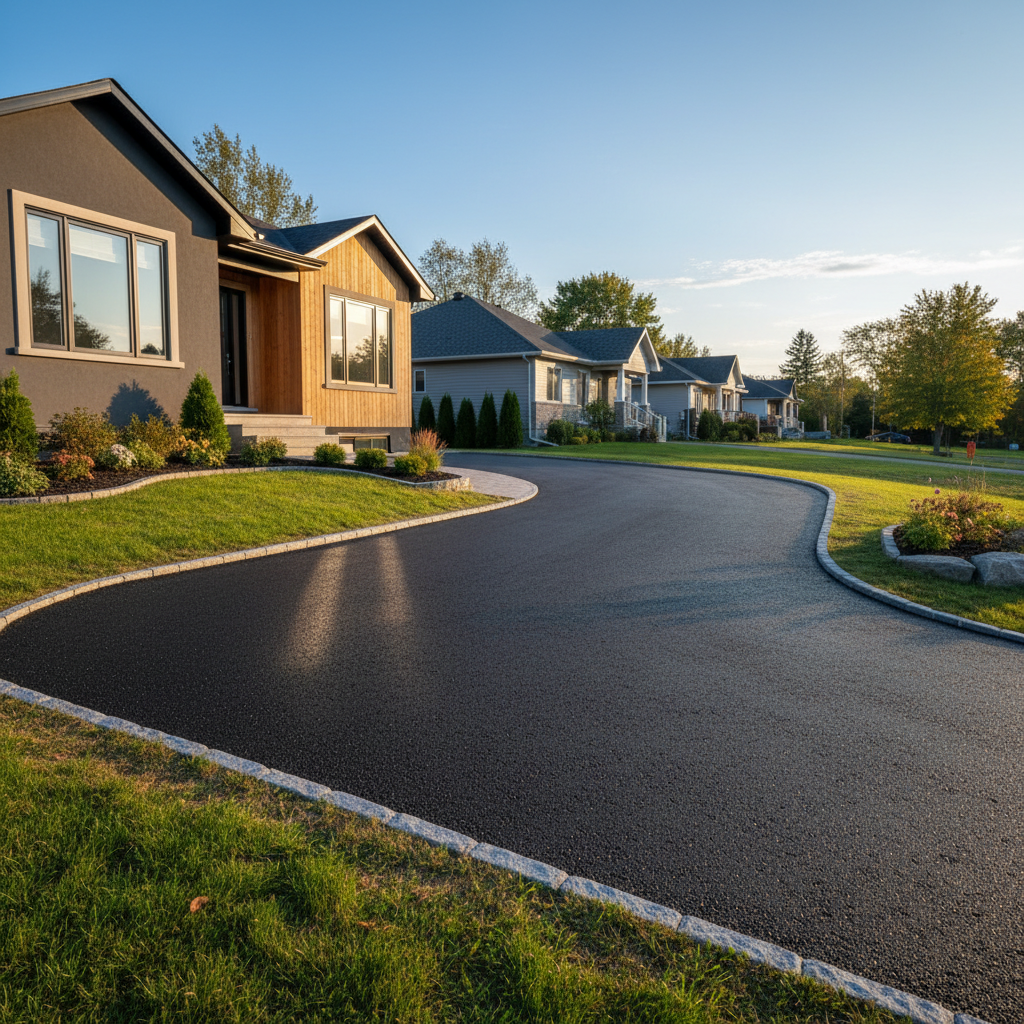
Driveway paving options and costs in Dufferin Grove
Dufferin Grove is one of those neighbourhoods where driveways see real seasonal punishment—freeze–thaw through late fall, winter and early spring, plus heavy ploughing traffic and salt. The result is that even two “same size” driveways can land in very different budget lanes. In Dufferin Grove, the local housing mix is dominated by private homes (Statistics Canada, 2021 Census), and that matters because most residential driveways are attached to single-detached or similar private lots—so the demand for reliable, well-drained surfaces is steady.
In the Toronto economic region, frost depth and freeze–thaw cycles are primary cost drivers. Ground in this area can freeze roughly 3–4 feet, so contractors typically engineer a deeper, well-compacted granular base and drainage details so water can’t sit under the pavement and lift when it freezes. That engineering takes time and material. Pricing also reflects the shorter paving window (late spring through early fall), when weather and contractor schedules line up—prime dates can cost more.
If you’re comparing options, here’s the practical way to think about it: asphalt is usually the lowest upfront install, while interlocking pavers and concrete tend to cost more but offer different maintenance and longevity trade-offs. Paved driveway demand is especially noticeable around the Davenport Road corridor and the busier lanes near St. Clair Avenue, where turnover and curb-access changes commonly trigger driveway updates. Use the table below to compare typical lifespan and budget expectations, then match the material to your site conditions and how much upkeep you’re willing to do.
| Material |
Lifespan |
Maintenance |
Best For |
Price per sq ft |
Price Range |
| Asphalt (new installation, proper base) |
15–25 years |
Seal every 3–5 years; patch as needed |
Value-focused driveways with good drainage |
$6.50–$10.50 |
$3,500–$8,000 |
| Asphalt (overlay on existing gravel base) |
8–15 years |
Seal and more frequent patching |
Budget refresh when subgrade is solid |
$5.50–$9.00 |
$3,300–$6,500 |
| Interlocking concrete pavers |
25–40 years |
Re-lay a few stones; joint sand top-ups |
Curb appeal and modular repairs |
$14.00–$22.00 |
$9,000–$20,000 |
| Poured concrete (broom finish) |
20–30 years |
Seal as recommended; crack monitoring |
Straight-edged driveways and low visual upkeep |
$11.00–$18.00 |
$6,000–$15,000 |
| Exposed aggregate concrete |
20–30 years |
Seal periodically; patching as needed |
High-end look with traction |
$13.00–$20.00 |
$7,000–$16,500 |
| Gravel / crushed stone (budget option) |
5–10 years |
Re-grade, top up annually; weed control |
Short-term solution or low-traffic areas |
$3.00–$6.00 |
$2,000–$5,500 |
Prices are estimates only and vary by project scope, site access and material selection.
What affects the price of paving in Dufferin Grove
In Dufferin Grove and the broader Toronto economic region, it’s common to see quote ranges for the “same” driveway that vary by 30–50%. The difference usually comes down to how the contractor builds for freeze–thaw, how much excavation is needed, and whether drainage and base thickness are done right the first time. Two crews can price asphalt the same way on paper, but if one quote includes deeper granular base, better subgrade preparation, and proper edge restraints, you’ll feel it immediately in total cost.
Frost line depth and freeze–thaw cycles are decisive cost factors in this region. With ground freezing roughly 3–4 feet in Toronto, the base has to be engineered thick enough to prevent heaving and cracking. In Ontario, that often means a compacted granular foundation in the ballpark of 6–12 inches (depending on your existing subgrade and drainage), rather than a thinner build that might work in milder climates. Also, asphalt placement is temperature-dependent—hot-mix asphalt generally needs suitable air temperatures (often above 10°C) which compresses paving into late spring through early fall. When schedules tighten, contractors charge more for prime dates and rush work.
Concrete costs can swing too. For example, an air-entrained concrete mix and the right jointing plan to manage Toronto’s winter conditions can add material and labour, but it reduces premature cracking. Conversely, if your existing approach can be kept with minimal tear-out and the slab can be formed efficiently, poured concrete can land closer to the mid-band (for instance, roughly $6,000–$15,000). On the asphalt side, a straight replacement with a properly compacted base can land within the typical asphalt driveway paving range (about $3,500–$8,000), while heavy tear-out and drainage corrections push the number upward fast.
| Price Factor |
Why It Matters |
Cost Impact |
| Driveway area in sq ft |
Most material and labour are area-based |
Highest driver—expect major swings from small size changes |
| Base depth required |
Frost line determines granular thickness to prevent heaving |
Deeper base typically increases excavation and material |
| Grading and drainage work |
Slope corrections and drainage keep water from pooling |
Can add significant labour, especially on uneven lots |
| Tear-out of existing surface |
Breaking/hauling old asphalt or concrete affects disposal and time |
Often among the biggest “surprise” costs |
| Edge restraints and curbing |
Prevents paver spread and asphalt raveling at the edges |
Moderate cost but protects long-term performance |
| Sealing requirement |
Asphalt should be sealed after 6–12 months to manage oxidation and water |
Adds recurring homeowner maintenance cost |
| Site access |
Narrow drives or tight turns slow equipment movement |
May increase labour hours and raise minimum charges |
| Asphalt mix specifications |
Freeze-thaw-rated mix improves performance in Ontario winters |
Material cost increases but can reduce early failures |
Permits & regulations in Ontario
In Ontario, paving a private driveway within your own property usually does not require a building permit. Where approvals often come into play is when your work touches the municipal right-of-way—especially at the curb/sidewalk interface or where you change storm drainage patterns. For example, a new curb cut, any alteration to boulevard grading, or changes that redirect runoff into municipal infrastructure typically require municipal approval.
Some municipalities also maintain lot-grading bylaws, which can restrict how close you can place a hard surface to property lines or how you must manage surface water. In Dufferin Grove, where older lots and mature trees are common, drainage routing matters—poor runoff control can create neighbour impacts and delays.
Step-by-step, here’s how a homeowner can verify your contractor before excavation:
- Confirm the contractor’s Ontario licence status via the relevant provincial registry and request proof before work starts.
- Ask for a current certificate of liability insurance (COI) showing adequate coverage for paving/earthworks.
- Ask for WSIB/WCB coverage documentation (or a clearance letter where applicable), and ensure the certificate dates are current.
- Request the COI and WSIB/WCB documents by name matching the quote and the worksite agreement.
- For any right-of-way involvement, ask who is pulling the municipal approval and whether it’s included in the scope.
Finally, always call for utility locates (Ontario One Call) before digging—this is non-negotiable for your safety and to prevent service interruptions.
Asphalt vs pavers vs concrete for Dufferin Grove driveways
For Dufferin Grove, the choice usually comes down to balancing upfront cost, winter resilience, and how you want to handle repairs. Asphalt is typically the lowest-cost driveway option, but it relies on good sealing habits. In Toronto’s freeze–thaw reality, asphalt performs best when paired with a well-built base, tight edges, and proper drainage. Sealing every 3–5 years helps slow oxidation and water intrusion, which reduces the chance of small cracks expanding.
Interlocking concrete pavers cost the most upfront in most cases, but they excel for homeowners who care about curb appeal and want modular repairs. If a section settles or a utility work zone is disturbed later, individual pavers can be lifted and reset without replacing the whole driveway—an advantage during long-term ownership.
Poured concrete sits in the middle cost range, but it’s sensitive to freeze–thaw unless it’s air-entrained and properly jointed. Concrete also needs planning for drainage and expansion/contraction so joints open in a controlled way rather than random cracking. In day-to-day Toronto maintenance—ploughing, salt, and sand—the better-performing concrete jobs are the ones that use the right mix, finishing, and joint spacing.
Base preparation matters across all three. With Toronto frost depth roughly 3–4 feet, you can’t “save” money by thinning the granular layer—water and frost will punish that choice. Where the price difference is justified: a properly installed paver driveway (often within $9,000–$20,000) can be worth it if you want a long service life and easier spot repairs. If you’re prioritizing value, asphalt can land closer to $3,500–$8,000—as long as the contractor designs drainage and builds the base correctly.
| Material |
Frost Resistance |
Curb Appeal |
Repair Method |
Lifespan |
Price Band |
| Asphalt (sealed regularly) |
Good with deep base and drainage; depends on seal maintenance |
Moderate |
Mill/patch and re-tack sections |
15–25 years |
$3,500–$8,000 |
| Interlocking concrete pavers |
Excellent when laid over compacted base with restrained edges |
Very high |
Remove/replace affected pavers and re-sand joints |
25–40 years |
$9,000–$20,000 |
| Poured concrete (air-entrained) |
Moderate to good with correct mix and joints |
Good |
Concrete patching/section replacement if needed |
20–30 years |
$6,000–$15,000 |
| Exposed aggregate concrete |
Moderate to good with proper air entrainment and joints |
High |
Patch and refinish limited areas (visibility varies) |
20–30 years |
$7,000–$16,500 |
| Permeable pavers (drainage grid) |
Good; helps manage water under freeze–thaw conditions |
High (design-dependent) |
Selective replacement of sections/grids |
20–35 years |
$10,000–$22,000 |
| Chip seal / tar-and-chip |
Variable; more sensitive to base/drainage quality |
Lower |
Spot repairs and re-sealing |
8–15 years |
$3,000–$6,000 |
How to choose a paving contractor in Dufferin Grove
Picking the right contractor in Dufferin Grove is mostly about proof. Start with Ontario licensing and insurance: request the contractor’s Ontario licence documentation, a current certificate of liability insurance (COI) that names your property address or at least covers the work type, and verification of WSIB/WCB coverage (or a clearance letter where applicable). You can also check public registry results online, but you’ll still want the paperwork in hand before work begins.
Next, get 2–3 itemised written quotes—not a “ballpark” phone number. A good quote breaks out labour and materials (excavation, base supply, compaction, asphalt/concrete/pavers, edging/constraints, traffic control, disposal), and it clearly states what’s included vs excluded. Confirm whether permit work is included if any right-of-way or drainage changes are required. Make sure disposal and hauling are explicit; old asphalt/concrete removal is often where bids diverge.
Warranty matters. Ask for a workmanship warranty length and what it covers (base settlement? surface cracking? joint performance for pavers?). Also ask whether manufacturer/product warranties apply separately and if they’re transferable if you sell the home. A common homeowner-friendly payment schedule is to keep upfront payment to no more than 10–15%, then hold back a portion until completion and cleanup.
Finally, require a start date and completion estimate in writing. With Toronto’s shorter paving season, timing and weather readiness should be part of the plan, not just a hope.
- Request Ontario licensing details and verify they match the company on your contract.
- Get a COI for liability insurance; verify coverage is active and appropriate for paving/earthworks.
- Confirm WSIB/WCB status with documentation (or clearance letter where applicable).
- Insist on an itemised quote (labour + materials), not a single lump sum.
- Confirm excavation quantity and base depth/compaction specs are stated, not vague.
- Ask about drainage: slope corrections, weeping/drainage considerations, and how water is managed.
- Clarify tear-out scope and disposal/hauling inclusion.
- Verify edge restraints/curbing requirements—especially for pavers to stop spread.
- For asphalt: ask when sealing will be scheduled (typically after 6–12 months).
- Check warranty terms in writing (workmanship, product, exclusions, and remedies).
- Confirm payment schedule (limit upfront to 10–15% and hold back until complete).
- Get start date and completion timeline in writing with weather-plan notes.
In my experience, the most common red flags in Dufferin Grove are: (1) no proof of insurance/WSIB/WCB, (2) base depth not discussed or “guesswork” during pricing, (3) vague drainage language (“we’ll make it slope”), (4) no itemised scope for tear-out and disposal, and (5) warranty offered verbally but not written into the contract.
Frequently asked questions — paving in Dufferin Grove
Asphalt vs interlocking pavers vs concrete — which is best in Dufferin Grove?
In Dufferin Grove, asphalt is usually the best value if your contractor builds a proper granular base and drainage, because it’s typically the lowest upfront install (often around $3,500–$8,000 for a standard driveway scope). Interlocking concrete pavers are ideal if curb appeal and long-term repair flexibility matter most; they’re higher upfront (commonly $9,000–$20,000) but individual sections can be lifted and reset if settlement occurs or utilities are serviced later. Poured concrete is a solid mid-range option, but it must be air-entrained and properly jointed to handle Toronto’s freeze–thaw and winter maintenance routine (salt, sand, ploughing). If your priority is “least fuss over decades,” pavers often win; if your priority is “best cost-to-performance,” well-built asphalt is hard to beat.
How long does a paved driveway last in Dufferin Grove?
Typical service life depends heavily on base design and how water is managed under the driveway during Ontario winters. With proper base and drainage, asphalt commonly lasts about 15–25 years, but seal maintenance is key—if you skip sealing, oxidation and micro-cracking accelerate and you’ll see earlier patching. Interlocking pavers often reach 25–40 years because repairs can be local instead of “replace the whole surface” every time there’s a problem. Poured concrete generally lasts about 20–30 years when it’s air-entrained, finished correctly, and jointed for movement in freeze–thaw cycles. Because Dufferin Grove is in the Toronto area with ground freezing to roughly 3–4 feet, driveways that ignore frost protection and drainage tend to fail early (heave, cracking, and edge deterioration) regardless of material.
When is the best time of year to pave in Dufferin Grove?
For asphalt and base work, late spring through early fall is the practical window in Ontario. Asphalt needs suitable air conditions for placement and compaction—often around 10°C or higher—so scheduling in winter is rarely realistic. The advantage of paving earlier in the season is that the base can be established and compacted in workable conditions, then asphalt can cure before repeated freeze cycles begin. That said, the “best” time is also about your site: if drainage repairs are needed, doing them before the hottest days helps prevent rework from saturated subgrade. In busy Toronto neighbourhoods like Dufferin Grove, prime dates can be limited, so it’s smart to book once weather forecasts start stabilizing in spring.
How deep should the base be for Dufferin Grove's frost?
Toronto’s frost depth is roughly 3–4 feet, which is why base thickness can’t be an afterthought in Dufferin Grove. In Ontario, driveway bases are often designed in the range of about 6–12 inches of compacted granular material, depending on your existing subgrade condition, drainage, and how much excavation is needed. The goal is to prevent water from sitting under the pavement and freezing, which leads to heaving and cracking. If your subgrade is soft or water-prone, the contractor should remove compromised material and increase granular thickness rather than simply topping it with gravel. A professional quote should state the base build and compaction approach clearly, not just “we’ll add some stone.”
How often should I seal my asphalt driveway?
As a general Ontario rule, seal an asphalt driveway after it’s had time to cure—commonly within the 6–12 month range after installation—then plan on resealing every 3–5 years. The exact schedule depends on how much traffic you get, how often your driveway is ploughed, and whether de-icing practices are aggressive (salt and brine can contribute to faster surface wear). Sealing doesn’t replace poor base drainage, but it does protect against oxidation and water intrusion that can worsen freeze–thaw movement. If you’re comparing budgets, remember that sealing is part of “ownership cost,” not just initial install pricing—so it helps to ask your contractor when they recommend the first seal and what product they use for Toronto freeze–thaw conditions.
Why does my driveway crack and heave in winter?
Most winter cracking and heaving in Dufferin Grove comes from water and frost working together. When drainage is inadequate—low spots, poor slope, or missing sub-drainage—water gets under the surface. As temperatures swing below freezing, that water expands and lifts the pavement or creates stress, leading to cracks, raveling edges, and uneven settlement. Heave often indicates the base/subgrade isn’t protected enough for Toronto’s freeze conditions (around 3–4 feet). Salt and ploughing then intensify deterioration by stressing the surface and accelerating surface break-down. If cracks appear quickly after a poor prep, it’s usually a sign the granular base thickness and compaction weren’t engineered for freeze–thaw. A proper repair typically addresses drainage and base first, not just surface patching.