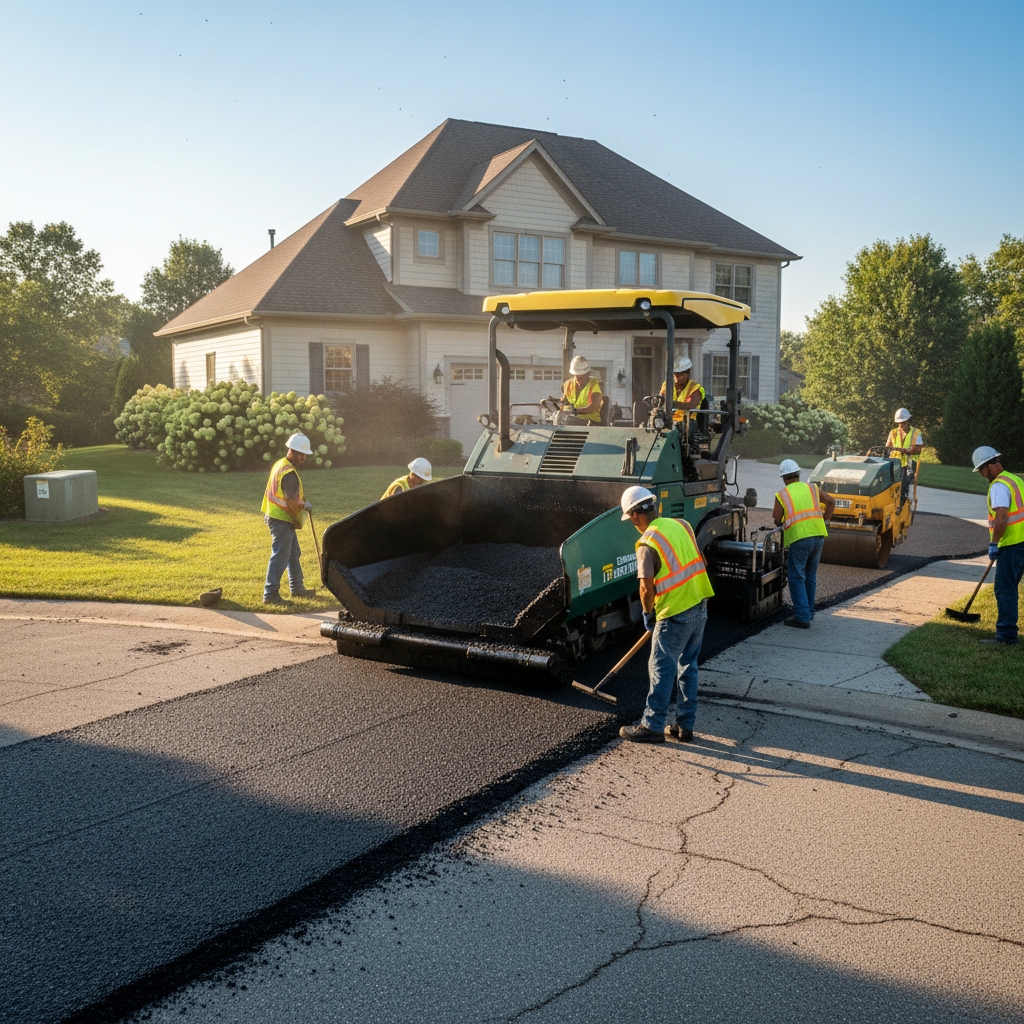
Driveway paving options and costs in Norfolk County
Norfolk County, Ontario homeowners typically choose from three main driveway paths: new asphalt, interlocking pavers, or concrete. With a population of 67,490 and an owner-occupied market where 81.6% of households own their homes (Statistics Canada, 2021 Census), there’s steady demand for asphalt repairs and full rebuilds. Most local driveways also serve single-detached homes—82.7% of dwellings—so access, drainage, and the frost-fighting base design matter more than they would for smaller multifamily sites.
The Hamilton–Niagara Peninsula climate drives pricing. In this moderate-to-cold Southern Ontario zone, frequent freeze–thaw cycles and frost penetration increase the importance of excavation, proper granular base (often 6–10 in compacted where required), and reliable drainage to reduce frost heave and early cracking. Work is also concentrated roughly April–October because hot-mix asphalt requires warm conditions and compaction control, so peak-season scheduling can push costs toward the higher end of the Ontario bands.
In Norfolk County, trade demand is especially strong around Simcoe and the other built-up pockets where older housing stock is common—62.0% of homes were built before 1981 (Statistics Canada, 2021 Census). Those properties often have dated drainage, weaker subgrades, or earlier gravel basins that need correction before any new surface goes down. That’s why two quotes that look similar on paper can diverge quickly once base depth, drainage corrections, and tear-out are priced in.
Below is a practical comparison to help you budget before you request itemised estimates.
| Material |
Lifespan |
Maintenance |
Best For |
Price per sq ft |
Price Range |
| Asphalt (new installation, proper base) |
15–25 years |
Seal coat every 3–5 years |
Most Norfolk County driveways; good flexibility under freeze–thaw |
$5.00–$10.50 |
$3,000–$8,000 |
| Asphalt (overlay on existing gravel base) |
10–18 years |
Seal coat as needed; monitor for raveling |
When the base is verified sound and excavation is limited |
$4.75–$9.00 |
$3,200–$7,000 |
| Interlocking concrete pavers |
25–40 years |
Re-sand joints; occasional panel-level repairs |
Curb appeal and repairs without full replacement |
$10.50–$18.00 |
$9,000–$20,000 |
| Poured concrete (broom finish) |
20–30 years |
Minor crack sealing; periodic cleaning |
Simple, clean surface where good base and joints are built correctly |
$9.50–$16.00 |
$7,000–$18,000 |
| Exposed aggregate concrete |
20–30 years |
Sealer (as recommended); crack monitoring |
Higher slip resistance and premium look |
$11.00–$18.50 |
$9,000–$19,500 |
| Gravel / crushed stone (budget option) |
5–10 years |
Annual top-up, regrading, weed control |
Low upfront cost; short-term solution where drainage is easy |
$3.00–$6.50 |
$1,500–$4,500 |
Prices are estimates only and vary by project scope, site access and material selection.
What affects the price of paving in Norfolk County
Even when two homeowners request “the same” driveway paving, prices in Norfolk County can land 30–50% apart across the Hamilton–Niagara Peninsula and Ontario due to how much work is required beneath the surface. Asphalt materials may be similar, but the base thickness, drainage corrections, and excavation depth are what protect your driveway through Ontario’s freeze–thaw cycle. If one estimate includes a full granular A/B base with proper compaction and the other assumes the existing subgrade is adequate, you’ll see a major difference.
Frost line depth is a decisive cost factor here. In Southern Ontario, frost penetration is commonly planned in the 1.2–1.5 m range, which typically means driveway builds need deeper, compacted granular layers—often 6–12 in in the parts of the driveway most affected by movement—to help prevent heaving and cracking. In practice, that translates into added excavation, hauling, and compaction time. The paving season is also shorter than in milder regions because hot-mix asphalt placement depends on air/road temperatures (air temperatures above 10°C are typically required), so spring and summer scheduling pressure can raise the effective cost of labour and equipment.
Concrete costs can swing based on jointing and reinforcement choices for local conditions. For example, on older Norfolk County properties built before 1981 (62.0% of homes), buried or underperforming drainage can require subdrains or regrading that pushes concrete toward the upper end of the $7,000–$18,000 band. Conversely, when an asphalt overlay is possible over a verified sound base, you may stay nearer the $3,000–$8,000 asphalt range.
Two other common variables: (1) driveway slopes/low spots that trap water and accelerate base saturation, and (2) whether the contractor must match existing grading to avoid pooling at the foundation or curb line.
| Price Factor |
Why It Matters |
Cost Impact |
| Driveway area in sq ft |
Most material and paving time scales directly with square footage |
Typically 50–70% of total cost driver |
| Base depth required |
Frost demands thicker compacted granular base to resist heaving |
Often the single biggest variable after area |
| Grading and drainage work |
Slope corrections and drainage fixes prevent trapped water and future failures |
Can add 10–30% depending on site issues |
| Tear-out of existing surface |
Breaking, hauling, and disposal of old asphalt/concrete adds time and equipment cost |
Commonly adds 5–20%+ |
| Edge restraints and curbing |
Stops pavers/spalls from spreading; improves long-term performance |
Can add 5–15% |
| Sealing requirement |
Asphalt sealing protects binder from oxidation and raveling |
Usually $400–$2,000 depending on size and product |
| Site access |
Narrow driveways, long wheelbarrow distances, and limited staging slow equipment movement |
Can add 3–15% due to extra labour time |
| Asphalt mix specifications |
Freeze–thaw-rated mix design costs more and requires proper placement/compaction |
Often shifts the job toward the higher end of the asphalt band |
Permits & regulations in Ontario
In Ontario, paving a private driveway within your own property typically does not require a building permit when it’s a like-for-like replacement. However, work that touches municipal infrastructure or changes how stormwater drains usually requires municipal approval. In Norfolk County, that generally includes situations like creating or modifying a curb cut, changing a boulevard area, altering storm drainage patterns, or reconnecting/adjusting drainage components that discharge toward municipal services. If you’re planning an apron that involves municipal curb/boulevard adjustments, don’t assume it’s “just driveway paving.”
Step one is always utility locates: contact Ontario One Call (or your preferred local provider) before any excavation so underground services are marked. Step two is verifying what the municipality expects for lot grading and stormwater flow. Some local grading bylaws restrict how close hard surfaces can be to property lines and may require maintenance of drainage swales.
Step three: verify the contractor. Ask for their Ontario licence details (where applicable through their business profile), a current certificate of insurance showing adequate liability coverage for your address, and proof of WSIB coverage or a clearance letter confirming their status for Ontario workers. You can check insurance documents for validity dates, and you should always match the contractor’s name on the insurance certificate to the company on the written quote and contract. Never start excavation until locates are complete and you’re satisfied the scope includes the required approvals.
Asphalt vs pavers vs concrete for Norfolk County driveways
For Norfolk County driveways, asphalt usually wins on upfront cost and winter resilience. In Southern Ontario’s freeze–thaw climate, asphalt’s flexibility helps it tolerate small movements in the base, but it must be sealed regularly—typically every 3–5 years—to protect against oxidation and raveling. That maintenance is part of the “real” long-term cost picture, especially where de-icing salts and sand are used.
Interlocking concrete pavers have the highest curb appeal and the advantage of repairability. If you get localized movement from a water problem or subgrade condition, you can lift and reset individual sections rather than replacing the entire driveway. That can make the higher upfront investment—often within $9,000–$20,000—worth it for homeowners who want long-term flexibility.
Poured concrete sits in the middle, but it’s more sensitive to design details. It needs the right granular base, proper thickness, and joint layout to control cracking. Air-entrained concrete helps with freeze–thaw durability, but without careful base preparation and drainage, differential movement still causes cracks and spalling over time. Exposed aggregate offers traction and a premium finish, while chip seal/tar-and-chip is usually a budget-minded option, typically with shorter lifespan.
Base preparation depth and drainage design are the common thread across all materials in the Hamilton–Niagara Peninsula. If you’re seeing a low spot that ponds after rainfall, paying for corrected grading and drainage can save you the cost of repeated surface patching. A realistic example: for a mid-size driveway, asphalt may price around $3,000–$8,000, while pavers for the same footprint often land closer to the upper part of $9,000–$20,000. That difference is justified when you want premium appearance and “section-by-section” repairs, not just a cheaper install.
| Material |
Frost Resistance |
Curb Appeal |
Repair Method |
Lifespan |
Price Band |
| Asphalt (sealed regularly) |
Good when base and drainage are right; flexible under movement |
Medium (can look very clean with fresh seal) |
Patching or full resurfacing if oxidation/raveling is widespread |
15–25 years |
$3,000–$8,000 |
| Interlocking concrete pavers |
Excellent when installed over a properly compacted base with proper bedding |
High (variety of colours and patterns) |
Lift/reset individual paver blocks and re-sand joints |
25–40 years |
$9,000–$20,000 |
| Poured concrete (air-entrained) |
Moderate-to-good with air-entrainment, good base, and joints |
Medium (clean finish with broom texture) |
Crack sealing and patching; major areas may require resurfacing |
20–30 years |
$7,000–$18,000 |
| Exposed aggregate concrete |
Moderate-to-good with correct curing and base design |
High (texture and premium look) |
Targeted patching; often blends better than plain concrete |
20–30 years |
$9,000–$19,500 |
| Permeable pavers (drainage grid) |
Good where stormwater management is designed correctly |
High (engineered look and modern options) |
Lift/reset or replace sections; maintain void-filling media |
20–35 years |
$10,000–$22,000 |
| Chip seal / tar-and-chip |
Limited compared to full-depth asphalt; performs best on stable bases |
Low-to-medium (more “road-like” finish) |
Chip spreading and localized patching; eventual re-surface |
6–12 years |
$2,500–$6,500 |
How to choose a paving contractor in Norfolk County
Choosing the right contractor in Norfolk County is less about the lowest number on the estimate and more about proof they can do the job to Ontario’s standards and your site’s frost realities. Start with licensing and insurance. In Ontario, you should be able to confirm the business details through their public registration/registry profile and verify they carry liability insurance that names your property/address appropriately. Next, check WSIB coverage or request a WSIB clearance letter (depending on their status). Don’t accept “we’ll pay cash” answers—paving involves hauling, cutting, and operating equipment where safety coverage matters.
Then get 2–3 quotes that are itemised—not just a lump sum. A fair comparison includes labour and materials separated, and it lists the base build (granular type and compacted thickness), drainage corrections (if needed), the asphalt/concrete thickness, compaction specs, and topsoil/seed/restoration scope where excavation reaches landscaped areas. Clarify exclusions: Is permit/approval work included if the driveway apron or curb/boulevard changes require municipal sign-off? Is disposal (dump fees/hauling away old material) included? If not, you’re comparing “paving” to “paving plus removal,” which can distort the price by thousands.
Warranty matters. Ask for workmanship warranty length and what it covers (labour only or labour plus materials), and whether any product/manufacturer warranty is included and transferable. Finally, payment schedules: never pay more than 10–15% upfront. Use a holdback until completion and final cleanup.
- Ask for a written scope with measurements: driveway width/length and total square footage.
- Confirm base materials and compacted thickness (don’t accept “we’ll add base” only).
- Make sure drainage and grading are explicitly included where water could pool.
- Verify tear-out and disposal are stated if you’re removing existing asphalt/concrete.
- Require edge restraints/curbing details for pavers to prevent lateral spread.
- Check asphalt mix and placement plan meets freeze–thaw expectations.
- Confirm curing time (concrete) and traffic-opening timeline (asphalt) in writing.
- Request proof of liability insurance and WSIB clearance/coverage before work starts.
- Ensure the quote includes weather-dependent scheduling limitations and communication steps.
- Ask who supplies equipment and who does labour—avoid “we’ll subcontract everything” without details.
- Require an itemised quote (labour + materials + disposal), not a single total line.
- Confirm warranty terms in writing, including exclusions for improper maintenance/salt use.
In Norfolk County, common red flags include: quotes that don’t specify base depth or compaction, unclear disposal/haul-away scope for old concrete or asphalt, crews starting without confirmed utility locates, warranties offered only verbally, and payment requests for most of the total upfront (instead of a small deposit with a holdback).
Frequently asked questions — paving in Norfolk County
How long before I can drive on new asphalt?
In Norfolk County, asphalt typically needs time to cool and firm up before you drive across it. Many crews plan for light foot traffic sooner, but vehicle access often requires a longer cool-down—commonly the same day for properly placed mat in warm conditions, and sometimes the next day if temperatures are marginal. Because our Hamilton–Niagara Peninsula season compresses work into April–October, contractors time pours to achieve good compaction and cooling. If you’ve received an asphalt quote in the $3,000–$8,000 range, ask your contractor what “traffic-ready” means for your specific day and weather. Also confirm whether any surface should be kept free of gasoline spills, aggressive turning, or heavy loads during the first 24–48 hours.
What causes potholes and how are they repaired?
Potholes usually form when water gets under the asphalt and undermines the base. In Norfolk County’s freeze–thaw climate, repeated expansion and contraction can enlarge weak areas—especially where drainage is poor or where an earlier patch wasn’t built on stable base. Common triggers include thin areas over weak granular material, cracked edges where water can migrate, and vehicle turning points that see shear stress. Repairs typically involve saw-cutting out the failed asphalt to reach sound material, re-compacting and rebuilding the granular base if needed, then paving to match grade. Good repairs are usually more than a “top-up”; they correct the source of water movement and match the asphalt thickness so the fix doesn’t fail again in the next winter cycle.
How do I prepare for a paving project?
Preparation starts with access and approvals. In Norfolk County, clear the driveway and sides so equipment can operate safely; move vehicles, planters, and grills, and make sure hoses and ornaments are removed. If your driveway involves any curb cut or storm drainage adjustments, coordinate any municipal approvals ahead of time. Before excavation, utilities must be located—Ontario One Call markings should be present before digging. During the week of work, confirm where waste material will be hauled and whether the contractor is responsible for disposal. Finally, decide how you’ll handle temporary access while the crew completes base, paving, and (if asphalt) sealing preparation. Doing these steps reduces delays that can happen in spring and early summer when crews are busy across the Hamilton–Niagara Peninsula.
How do I compare paving quotes fairly?
To compare paving quotes fairly in Norfolk County, insist on apples-to-apples scope. Ask for itemised details: total square footage, base type (Granular A/B or equivalent), compacted thickness, drainage/grading corrections, edge restraints, and tear-out/disposal. Many homeowners get surprised when one contractor includes a deeper frost-resistant base while another assumes the existing subgrade is adequate—those differences drive the price gap that can reach 30–50% in Ontario. Compare also the material specs: asphalt mix type suited for freeze–thaw, concrete air-entrainment, and jointing plan. If your quotes fall within the common asphalt $3,000–$8,000 and concrete/interlock ranges, make sure each quote includes the same preparation work. A “cheaper” quote often omits drainage or base reconstruction, and that’s where premature failures start.
Can asphalt be laid in cold weather in Norfolk County?
Ontario contractors generally avoid placing hot-mix asphalt in cold conditions because compaction and mat temperature control are critical for performance under freeze–thaw cycles. In Norfolk County, even if the road surface looks dry, colder air temperatures can prevent the mix from achieving proper density before it cools. That’s why most quality crews focus on the April–October window and target air temperatures that support compaction—often above 10°C, with weather-dependent adjustments. If a contractor is pushing asphalt late in the season, ask what temperature targets they meet and how they handle compaction and density testing. If the job truly can’t be completed safely, it’s better to schedule within the workable window than to risk early cracking, raveling, or uneven settlement.
What is a driveway apron and do I need one in Norfolk County?
A driveway apron is the transition section between your driveway and the street/municipal curb area—often where the curb cut exists and where water can concentrate. In Norfolk County, whether you “need” one depends on the existing curb/boulevard condition, how the driveway slopes, and whether municipal drainage is being affected. If there’s a curb cut and water runs toward the property instead of draining to the designed system, an apron can help protect edges and reduce washboarding. If your project includes curb/boulevard changes, municipal approval may be required before construction. Your contractor should explain whether the apron is included in the quote and how it ties into drainage—especially on older properties where pre-1981 drainage can be inconsistent (Statistics Canada, 2021 Census).