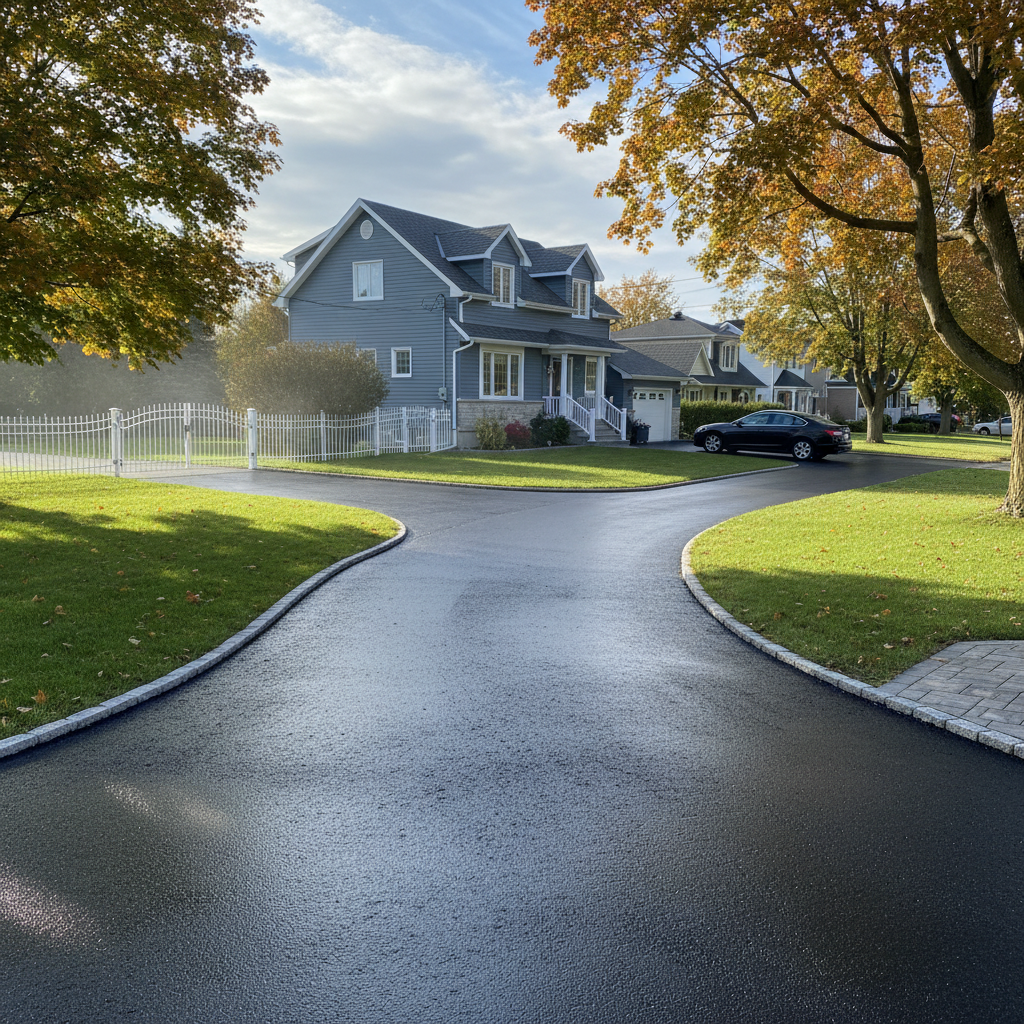
Driveway paving options and costs in East End-Danforth
In East End-Danforth, driveway paving choices usually come down to asphalt, interlocking pavers, or concrete—each with a different upfront cost and winter performance profile. With a population of 21,381 in the area (Statistics Canada, 2021 Census), you’ll find plenty of homeowners updating driveways on residential streets, especially where parking space is tight and access is frequently shared with sidewalks and garages.
Toronto’s climate is a big reason pricing swings between materials. We’re dealing with repeated freeze–thaw cycles and a frost depth that can reach roughly 3–4 feet. That means your contractor should engineer the subgrade and granular base so water drains away and the pavement doesn’t heave, rut, or crack when temperatures flip above and below freezing. If you’re near active areas of East Danforth—often where older housing stock meets busier commercial edges—contractor demand can also be higher, so “prime date” work in late spring through early fall may cost more.
Because the paving season is shorter here, scheduling pressure concentrates asphalt and concrete placements into a narrower window. Asphalt is typically the lowest upfront option (but it requires sealing), while pavers cost more to install yet are easier to lift and repair board-by-board. Concrete can be a strong long-term solution, but it depends heavily on proper drainage, air-entrainment, and jointing design to manage Toronto’s freeze–thaw.
Use the table below to compare typical lifespan, maintenance, and realistic price ranges per square foot, then we can narrow it down based on your driveway size and base conditions.
| Material |
Lifespan |
Maintenance |
Best For |
Price per sq ft |
Price Range |
| Asphalt (new installation, proper base) |
12–20 years |
Seal every 3–5 years; patch minor cracks as needed |
Best value for families who want a smooth, quiet surface |
$8.50–$14.00 |
$3,500–$8,000 |
| Asphalt (overlay on existing gravel base) |
8–15 years |
Seal every 3–5 years; more frequent spot repairs if base is weak |
When the current base is sound and you want to improve appearance faster |
$7.50–$12.50 |
$3,200–$7,200 |
| Interlocking concrete pavers |
20–30 years |
Minimal; occasional sand re-leveling; targeted repairs possible |
High-traffic driveways where curb appeal and repairability matter |
$14.00–$25.00 |
$9,000–$20,000 |
| Poured concrete (broom finish) |
20–30 years |
Crack monitoring; reseal only if specified; improve drainage to reduce hairline cracking |
Cleaner edges and a simple “set-and-forget” look |
$13.00–$22.00 |
$6,000–$15,000 |
| Exposed aggregate concrete |
20–30 years |
Reseal every few years (if selected); patching as needed |
Durable texture with better slip resistance in winter |
$16.00–$26.00 |
$7,000–$16,500 |
| Gravel / crushed stone (budget option) |
3–10 years (varies a lot with drainage) |
Re-grade and top up; weed control; more dust and ruts in freeze–thaw |
Temporary solution or low-budget access |
$5.00–$9.00 |
$2,000–$5,000 |
Prices are estimates only and vary by project scope, site access and material selection.
What affects the price of paving in East End-Danforth
In East End-Danforth and the wider Toronto area, two contractors can quote the “same” driveway and still differ by 30–50% once you look past the surface finish. That’s because pricing is driven by what’s under the pavement: excavation depth, how wet the subgrade is, how much drainage correction is required, and how much granular base and compaction your driveway needs to survive winter. Labour and equipment availability also matters, especially because the paving season is essentially late spring through early fall—once temperatures are reliably workable, demand spikes.
For Toronto, frost depth and freeze–thaw cycles are decisive cost factors. When ground freezing can reach about 3–4 feet, you typically need a deeper, properly compacted granular base so water doesn’t sit under the surface and expand when it freezes. In Ontario, the base work often becomes a larger portion of the budget compared to milder regions. That depth requirement can push project costs higher than expected, which is why a properly built asphalt driveway might land anywhere in the $3,500–$8,000 range, while a paver project designed for long-term movement and drainage can run into the $9,000–$20,000 band.
Concrete can cost more or less depending on site conditions. For example, if your driveway ties into existing garage slabs or curbs and you need significant tear-out, demolition and disposal increase labour. If the soil is clayey and holds water, contractors may need added base drainage layers and regrading to control water movement. Conversely, a straightforward, dry site with good slope and limited removals can bring concrete closer to the mid-range—especially if the concrete is air-entrained and correctly jointed to handle freeze–thaw movement.
In short: if one quote includes robust base + drainage and another doesn’t, that price gap is usually real, not “just marketing.”
| Price Factor |
Why It Matters |
Cost Impact |
| Driveway area in sq ft |
Most material and labour scale directly with surface area |
Often 50–70% of total cost |
| Base depth required |
Frost line determines granular thickness to prevent heaving and cracking |
Can add 10–30% depending on current base condition |
| Grading and drainage work |
Slope corrections and drainage layers keep water from pooling under pavement |
Commonly 5–20% higher for drainage repairs |
| Tear-out of existing surface |
Breaking, hauling, and disposal of old concrete or asphalt increases labour |
Often 10–25% depending on thickness and access |
| Edge restraints and curbing |
Prevents paver spread and asphalt edge breakdown during freeze–thaw |
Usually 3–15% depending on perimeter length |
| Sealing requirement |
Asphalt needs sealing after installation to protect binder from oxidation and water entry |
Small add-on now, but reduces failure-related repairs later |
| Site access |
Narrow lots and long drives slow equipment movement and increase labour time |
Can add 5–15% for tight access |
| Asphalt mix specifications |
Freeze–thaw-rated mix costs more but improves durability |
Can add 5–12% versus lowest-spec mix |
Permits & regulations in Ontario
For paving in Ontario, the permit rule is usually straightforward for a private driveway within your own property. In most cases, resurfacing or paving on your own lot (for example: replacing asphalt, installing interlock, or pouring a new driveway where you’re not changing the municipal sidewalk/boulevard area) typically does not require a building permit. However, work in the municipal right-of-way can require municipal approval.
In East End-Danforth, the items that more often require approval include: creating or changing a curb cut, altering the boulevard, modifying municipal storm drainage connections, or making changes that affect how water flows to catch basins/municipal infrastructure. If you’re changing the driveway’s grade so it impacts surface water direction toward the street, confirm the requirements with the City of Toronto before excavation.
Step-by-step, you should also protect yourself by verifying your contractor’s Ontario compliance and coverage before the first shovel hits the ground: (1) check the contractor’s Ontario business details and licence information where applicable through public listings; (2) request a certificate of insurance showing general liability coverage matching the project scope; and (3) confirm WSIB/WCB clearance (or provide proof of coverage/clearance) so you’re not on the hook for workplace injuries. Ask for these documents in writing—then keep copies with your quote package.
Finally, for any excavation, ensure utility locates are called in advance (Ontario One Call) so the contractor excavates safely and avoids service strikes.
Asphalt vs pavers vs concrete for East End-Danforth driveways
In East End-Danforth, all three options can work—but they behave differently under Toronto’s freeze–thaw cycles, snow clearance, and de-icing habits. Asphalt is typically the lowest upfront cost and gives you a smooth drive. The trade-off is maintenance: if you want a longer service life, asphalt should be sealed after installation (and then re-sealed every 3–5 years) to limit water penetration that can lead to potholes and edge failures.
Interlocking concrete pavers cost more at the start, but they’re often the best choice when homeowners want curb appeal and the ability to repair only affected sections. With proper base build and edging restraints, pavers can tolerate some movement without widespread surface failure. Poured concrete sits in the middle for pricing and longevity, but it’s more sensitive to cracking patterns if it isn’t air-entrained and properly jointed for freeze–thaw. Concrete can also be affected by salt and thermal cycling around the edges and joints—again, drainage and base preparation are what decide how it performs.
In Toronto, proper drainage design and base preparation are essential regardless of material. Because frost can reach about 3–4 feet, you don’t want water sitting under the driveway. For asphalt, that usually means a well-compacted granular base plus reliable drainage. For concrete, it means a stable base and controlled joints. For pavers, it means a compacted base with correct bedding sand so units don’t rock or open.
Example: if an asphalt driveway is quoted around the $3,500–$8,000 band and a paver driveway is quoted around $9,000–$20,000, the extra cost is most justified when you want easier repairs, a higher-end look, and less “tear-out all at once” risk. If you simply want the best cost per season and can commit to sealing, asphalt can be the smarter short-to-medium term bet.
| Material |
Frost Resistance |
Curb Appeal |
Repair Method |
Lifespan |
Price Band |
| Asphalt (sealed regularly) |
Good with proper base and sealing; vulnerable to water entry at edges if drainage is poor |
Moderate (clean lines if properly edged) |
Patch and resurface; crack sealing and localized repairs |
12–20 years |
$3,500–$8,000 |
| Interlocking concrete pavers |
Excellent when base is built correctly and restraints are installed |
High (wide style and colour selection) |
Lift-and-relay individual units; reset bedding |
20–30 years |
$9,000–$20,000 |
| Poured concrete (air-entrained) |
Good when air-entrained and jointed; can still crack under movement |
Moderate to high (straight, modern look) |
Crack patching, joint sealing, and spot repairs |
20–30 years |
$6,000–$15,000 |
| Exposed aggregate concrete |
Good with proper mix and base; texture can help slip resistance in winter |
High (signature finish) |
Patch and match finishing (limited compared to pavers) |
20–30 years |
$7,000–$16,500 |
| Permeable pavers (drainage grid) |
Very good for managing water; depends on subgrade permeability |
High (clean lines; modern drainage systems) |
Replace affected sections; maintain inlet areas |
20–30 years |
$10,000–$22,000 |
| Chip seal / tar-and-chip |
Fair to good; more surface maintenance with heavier winters |
Lower (function-first) |
Spot repairs and re-chip as aggregate loss occurs |
6–12 years |
$4,000–$8,500 |
How to choose a paving contractor in East End-Danforth
Choosing the right paving contractor in East End-Danforth is mostly about proof: coverage, paperwork, and a scope that matches Toronto’s freeze–thaw reality. First, verify Ontario compliance by asking for their business information, then request a certificate of insurance showing general liability—make sure the coverage amount is appropriate for the job size. Next, confirm WSIB/WCB clearance or coverage status and ask for the clearance letter or proof document before work starts. If they hesitate or can’t provide these, that’s a major signal.
For pricing, get 2–3 itemised written quotes, not a single lump sum. A solid quote breaks out labour and key materials (excavation, granular base, asphalt/pavers/concrete, edging restraints, compaction, and any seal coats). Read the exclusions: is permit work included if it’s required? Is disposal and hauling included? Are utility locates included or the homeowner’s responsibility? Also confirm the warranty terms—workmanship warranty length, whether it’s tied to material use, and whether it’s transferable if you sell the home.
Payment schedule matters in our area: never pay more than 10–15% upfront. Hold back funds until substantial completion so you’re not paying for work that isn’t finished to spec. Then insist on a timeline in writing: proposed start date, completion estimate, and what happens if weather interrupts paving (very common with Ontario’s late spring swings).
- Request proof of WSIB/WCB coverage or clearance letter before demolition.
- Ask for a current certificate of insurance and confirm the named insured matches the contracting company.
- Get 2–3 itemised quotes with labour + materials breakdown, not only totals.
- Confirm granular base depth and compaction requirements in the scope.
- Ensure drainage and grading changes are clearly listed (slope and water flow plan).
- Confirm edge restraints/curbing are included to prevent paver spread or asphalt edge failure.
- For asphalt, confirm sealing is scheduled after installation (and whether a winter-ready plan is provided).
- Ask how crack control and jointing (for concrete) will be handled.
- Verify tear-out and disposal are included (hauling can be a big hidden cost).
- Confirm site access constraints (narrow lots, long runs) and how they affect pricing.
- Check warranty terms: workmanship, exclusions, and whether it applies to freeze–thaw performance.
- Agree on the payment schedule in writing, with a holdback until completion.
Red flags in East End-Danforth: contractors who quote without asking about drainage or existing base condition, who refuse to provide itemised scopes, who won’t show insurance/WSIB documentation, who push large upfront deposits, or who promise “no maintenance required” for asphalt in a freeze–thaw climate.
Frequently asked questions — paving in East End-Danforth
Is it worth sealing a new driveway right away in East End-Danforth?
In East End-Danforth, it’s usually worth following a proper sealing plan, but “right away” depends on the asphalt cure time. Asphalt needs time for the binder to break and the surface to dry before sealcoat. When crews seal at the correct window, it helps limit water penetration—important in Toronto’s freeze–thaw cycles where trapped moisture can accelerate edge breakdown and cracking. Many homeowners see asphalt quoted in the $3,500–$8,000 range for properly built driveways; sealing later is often what protects that investment. A reputable contractor will explain the cure period, expected traffic timing, and whether a crack fill and tack coat are included before sealing.
What is a chip seal driveway and is it suited to East End-Danforth?
Chip seal (tar-and-chip) is a surface treatment where a binder layer is sprayed and covered with aggregate chips to create a textured driving surface. It can be suitable for certain low-cost applications, but in East End-Danforth the freeze–thaw cycle and winter maintenance routine (plowing, sanding and salt) can wear the surface faster than asphalt or pavers. In practice, chip seal is more common where aesthetics are less critical and where the homeowner accepts periodic maintenance. If your quote is targeting the lower end of the paving bands—often around $4,000–$8,500—chip seal may fit a budget. Just confirm the prep and base requirements, since a weak base will still fail regardless of the surface.
How much does driveway crack repair cost in East End-Danforth?
Crack repair in East End-Danforth typically costs based on length, crack type, and whether drainage or base issues are contributing. For routine sealing of clean, stable cracks, homeowners often see costs that fall into the same neighbourhood as small repair work; larger repairs that include saw-cutting, partial asphalt removal, and patching generally cost more. If you’re dealing with multiple wide cracks or edge failures tied to water drainage, the “fix” can expand into base correction. As a reference point, sealing and repair work is commonly quoted in the $300–$1,500 range for smaller scopes, but active deterioration may push toward a larger patch or even an overlay depending on thickness and how much base is affected.
What base thickness do I need for pavers in East End-Danforth?
For pavers in East End-Danforth, base design is driven by frost depth, soil conditions, and drainage. With Toronto’s frost depth reaching roughly 3–4 feet, contractors usually build a multi-layer base with proper compaction rather than a thin gravel layer. The exact thickness depends on the driveway load, subgrade condition (especially if it’s clayey or wet), and how well water is managed away from the surface. A good paver quote will specify base layers and compaction—not just “standard gravel.” If your site has poor drainage or soft spots, expect thicker granular base and additional excavation. This is also why the interlocking paver band often lands at $9,000–$20,000—strong base work is a major reason pavers last.
How do I get the most accurate paving quote in East End-Danforth?
To get an accurate paving quote in East End-Danforth, start with a site visit and a full assessment of the existing base, drainage, and slope. Ask contractors to check for soft subgrade, water pooling spots, and any prior repairs or failed edges. Then request 2–3 itemised written quotes that list excavation/take-out, granular base depth, compaction, edging restraints, and disposal. Make sure the quote states whether a permit is included if municipal right-of-way changes are required. Asphalt quotes should specify the mix type and sealing plan; paver quotes should specify bedding sand and restraints. Finally, verify they’ll handle utility locates before excavation and provide insurance and WSIB/WCB clearance documents.
How much does it cost to pave a driveway in East End-Danforth?
The cost to pave a driveway in East End-Danforth depends mostly on area, base condition, and drainage work required for Toronto’s freeze–thaw cycle. For asphalt, typical driveway paving in this tier lands around $3,500 – $8,000 when the contractor builds the base properly. Interlocking pavers are higher upfront, often around $9,000 – $20,000, but they can be easier to repair without replacing the entire surface. Concrete is usually in between at $6,000 – $15,000, with the final number affected by tear-out needs, air-entrainment, and jointing design. If you’re only sealing or doing small repairs, that’s commonly priced in the $300–$1,500 range for smaller scopes.