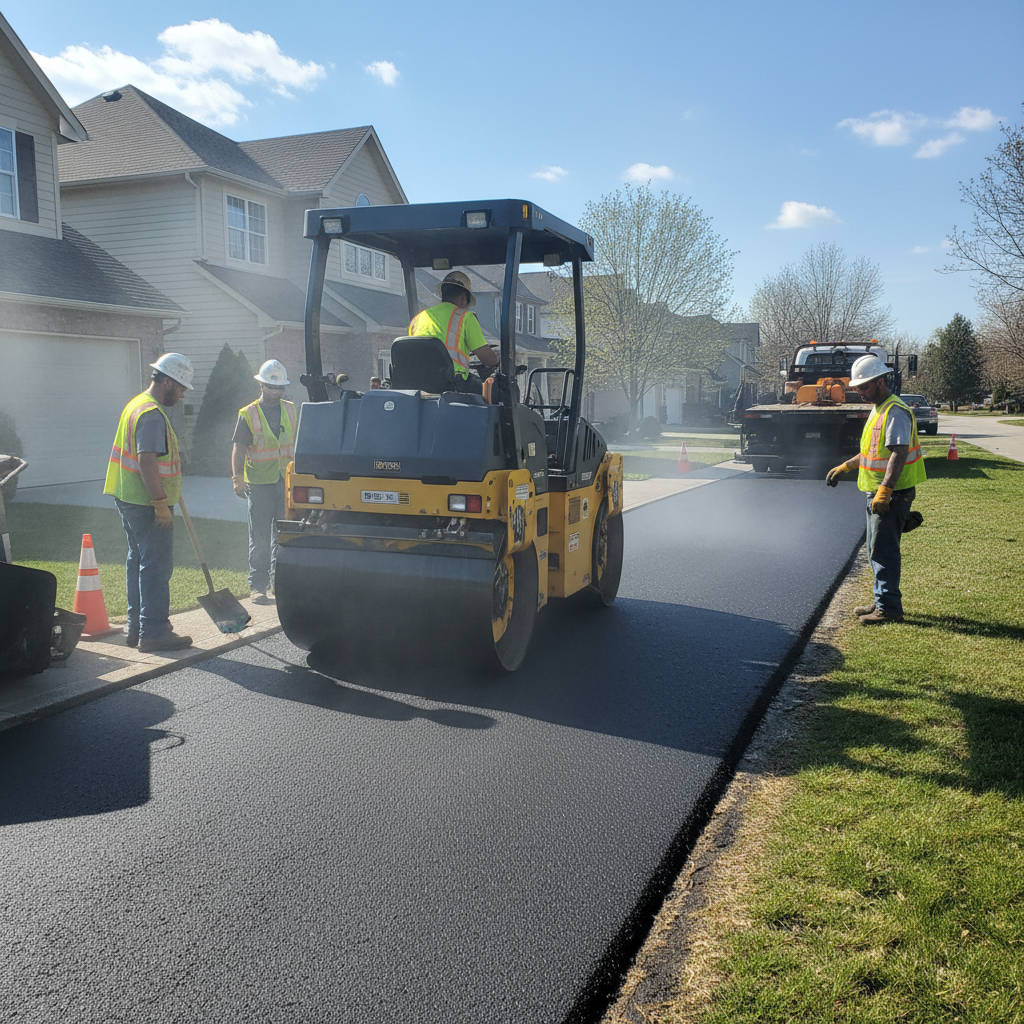
Driveway paving options and costs in Orléans
In Orléans, driveway paving choices usually start with asphalt, pavers, or concrete—and the right answer depends as much on Ottawa’s winter conditions as on your budget. With Orléans at 125,937 residents (Statistics Canada, 2021 Census), there’s active demand across established neighbourhoods and newer subdivisions, and that affects contractor availability during the short paving season. Most private driveways in the area are tied to single-detached homes, so repairs and full replacements are common as roofs, foundations, and drainage systems age in the same years.
Pricing in the Ottawa economic region is shaped by frost depth and freeze–thaw cycles. Ottawa commonly models frost penetration around 1.8 m, so a driveway needs a properly engineered granular base and reliable drainage to keep water moving and reduce heaving and cracking. That means excavation, thick crushed stone layers, and careful grading are built into most realistic quotes. It also means the spring scheduling pressure is real: hot-mix asphalt needs warm, dry weather to compact and cure correctly, so late-season weather can push projects into higher-demand weeks.
On top of that, areas with more mature trees and older drainage often see more prep work—especially around Navan Road corridors and the transition zones near commercial roadways—where contractors encounter mixed subgrades and tighter access for hauling. If you’re comparing options, the biggest differences show up in upfront cost, how the surface handles salt and ploughing, and how repairs are done later. Below is a practical cost range to help you start conversations with paving contractors in Orléans, then fine-tune with your measurements and base conditions.
| Material |
Lifespan |
Maintenance |
Best For |
Price per sq ft |
| Asphalt (new installation, proper base) |
15–25 years |
Seal every 3–5 years after cure (typically 6–12 months) |
Best value when base drainage is done right |
$6,000–$9,000 |
| Asphalt (overlay on existing gravel base) |
12–20 years |
Seal every 3–5 years; plan patching as needed |
When the existing subgrade is stable and excavation is limited |
$4,500–$7,500 |
| Interlocking concrete pavers |
25–40 years |
Replace/realign individual stones; periodic re-sanding |
Curb appeal and easy spot repairs |
$6,000–$15,000 |
| Poured concrete (broom finish) |
20–35 years |
Light sealing as recommended; joint maintenance |
Straight, clean look with long-term durability |
$7,000–$16,000 |
| Exposed aggregate concrete |
20–35 years |
Sealer as recommended; protect aggregate during early curing |
Higher-end appearance and traction |
$8,000–$18,000 |
| Gravel / crushed stone (budget option) |
3–10 years |
Regrade and top up as washouts occur |
Temporary solution or low-traffic areas |
$3,000–$6,000 |
Prices are estimates only and vary by project scope, site access and material selection.
What affects the price of paving in Orléans
Even when homeowners describe the “same” driveway, quotes in Orléans can vary by 30–50% because the pricing usually reflects hidden site realities: how much excavation is needed, whether drainage must be redesigned, how tight the access is for equipment, and whether the base is being engineered to survive Ottawa’s winter. In the Ottawa market, contractors also price risk into their work—freeze–thaw cracking, edge movement, and raveling are expensive problems to fix later, so higher-spec base and proper installation details cost more upfront.
Frost line depth and freeze–thaw cycles are decisive. With frost penetration commonly modeled around 1.8 m in Ottawa, driveways need a deeper, thicker compacted granular base and good separation (often with geotextile on weaker soils) so the system stays below the frost zone. In practice, that means thicker crushed stone sections and careful compaction—especially compared to regions where frost is shallower. Asphalt also has mix design requirements to meet freeze–thaw performance; that drives material costs.
Seasonality matters too: hot-mix asphalt generally needs air temperatures above 10°C for proper paving and compaction, so summer scheduling tightens and labour demand rises. For concrete, Ontario projects can be priced higher when air-entrainment and proper curing are required for freeze–thaw durability.
Two concrete examples of local cost movement in Orléans: a driveway replacement that includes rebuilding a settled subgrade can add thousands to the scope before you even reach paving; and driveways requiring regrading to daylight water away from the foundation often cost more than a “like-for-like” resurface. That’s why you might see asphalt new installation land closer to the $6,000–$9,000 band, while a constrained overlay budget can fall nearer the $4,500–$7,500 range—if the base is truly stable and drainage is already adequate.
| Price Factor |
Why It Matters |
Cost Impact |
| Driveway area in sq ft |
Material and labour scale directly with surface area |
Major (primary cost driver) |
| Base depth required |
Frost protection depends on engineered granular thickness |
Major (excavation + aggregate increase) |
| Grading and drainage work |
Slope corrections and water routing prevent early failure |
Medium to major |
| Tear-out of existing surface |
Breaking, hauling and disposal for old asphalt or concrete |
Medium to major |
| Edge restraints and curbing |
Prevents paver spread and asphalt edge deterioration |
Medium |
| Sealing requirement |
Asphalt needs sealing after cure to slow oxidation and raveling |
Low to medium (adds a future line item) |
| Site access |
Narrow lanes slow equipment and increase labour time |
Medium |
| Asphalt mix specifications |
Freeze–thaw-rated mixes cost more and improve performance |
Low to medium |
Permits & regulations in Ontario
For most homeowners in Orléans, paving a private driveway within your own property typically does not require a building permit. However, work that touches the municipal portion of your property can trigger approvals. In Ontario, the key question is whether your project stays fully within your lot limits or changes the boulevard and drainage systems.
Usually no permit needed: resurfacing your existing driveway surface, repaving asphalt, replacing interlock or concrete on your private pad, or rebuilding your driveway where excavation and grading occur entirely within your property footprint (as long as you’re not altering municipal drainage or curbs).
Often requires municipal approval: new or changed curb cuts, modifications to the boulevard, changes to stormwater drainage patterns, and any work in the municipal right-of-way. Some areas also enforce lot-grading rules (how close and how you can shape hard surfaces near property lines) to manage water runoff.
Step-by-step verification is worth doing before you sign: (1) request the contractor’s Ontario business details and confirm they’re properly licensed for the work they’re performing; (2) ask for a certificate of insurance and ensure coverage includes paving/contracting liability; and (3) confirm WSIB/WCB coverage where required for workers. For excavation, have utilities located through the appropriate call service (Ontario One Call) before anyone digs. Then verify lot-grading and right-of-way requirements with the local municipality so there are no surprises after the quote is accepted.
Asphalt vs pavers vs concrete for Orléans driveways
Choosing between asphalt, interlocking concrete pavers, and concrete in Orléans is really a winter-management decision. Ottawa-area freeze–thaw cycles and salt from ploughing create repeated stress at the pavement edges and joints. If the granular base and drainage aren’t built to handle that movement, asphalt can ravel and crack earlier, interlock can shift if restraints are weak, and concrete can crack if it isn’t properly air-entrained and jointed for freeze–thaw.
Asphalt is usually the lowest upfront cost and is repairable with patches, but it requires sealing every 3–5 years after it cures (often 6–12 months post-install) to slow oxidation from winter cycles. Interlocking concrete pavers cost more at the start, but they’re repair-friendly—damaged stones can be lifted, base corrected, and reset without replacing the whole driveway. This is a strong fit for homeowners who value curb appeal and want a long service life. Poured concrete generally sits mid-range, but freeze–thaw durability depends on correct air-entrainment and finishing/jointing; de-icing salt can accelerate surface wear if the mix and curing aren’t right.
Base preparation in Orléans should be engineered deeper due to the frost zone (commonly modelled around 1.8 m). Good drainage design—positive slope away from the house and away from the driveway edges—is the difference between “looks good for a few winters” and “holds up for years.”
As a practical example, if you have a driveway that’s priced around $6,000–$9,000 for asphalt versus $6,000–$15,000 for pavers, the higher paver budget can be justified if you want easy future repairs and a driveway that tolerates edge movement better after years of ploughing. If you just want the best cost-to-performance and you’re comfortable with sealing, asphalt often wins—provided the base and drainage are truly engineered.
| Material |
Frost Resistance |
Curb Appeal |
Repair Method |
Lifespan |
Price Band |
| Asphalt (sealed regularly) |
Good with frost-rated base and proper drainage |
Good (clean, continuous look) |
Patch and compact locally |
15–25 years |
$4,500–$9,000 |
| Interlocking concrete pavers |
Very good with geotextile + restraint and correct bedding sand |
Excellent (high curb impact) |
Lift-and-replace pavers; rebuild base spots |
25–40 years |
$6,000–$15,000 |
| Poured concrete (air-entrained) |
Good when properly air-entrained and jointed |
Moderate to good (varies by finish) |
Crack repair and patching at joints |
20–35 years |
$7,000–$16,000 |
| Exposed aggregate concrete |
Good to very good with correct curing and mix |
High (textured premium look) |
Targeted patching and surface repair |
20–35 years |
$8,000–$18,000 |
| Permeable pavers (drainage grid) |
Very good when designed for local soil and flow paths |
High (modern look) |
Replace sections if the grid clogs or fails |
20–35 years |
$9,000–$20,000 |
| Chip seal / tar-and-chip |
Moderate; sensitive to drainage issues |
Low to moderate (utility look) |
Re-chipping and resurfacing cycles |
5–12 years |
$4,000–$7,000 |
How to choose a paving contractor in Orléans
Start with basic proof. For Orléans driveway work, a reputable contractor should be able to show the right coverage and paperwork before any excavation begins. Verify their Ontario licensing/business details (ask for their business number and proof of authorization for the scope they’re pricing). Ask for a certificate of insurance and confirm it includes general liability for driveway paving and subcontractors. Also confirm WSIB coverage (or the correct coverage handling for their workers) and provide a clearance letter if applicable—don’t accept “we’re covered” without seeing documentation.
Then get 2–3 itemised written quotes. You want a breakdown that separates labour, excavation/haul-away, granular base layers, geotextile (if specified), asphalt or paver material, compaction, and taxes. A quote that lumps everything into one number makes it hard to compare apples to apples. Read the exclusions: is permit pull included if work impacts the municipal portion? Is disposal included for old concrete/asphalt? Are crack sealing and joint prep part of the scope?
Warranty matters for workmanship and materials. Ask how long the workmanship warranty lasts, what it covers (base settlement? edge movement? raveling?), and whether it’s transferable if you sell your home. For payment, avoid large upfront deposits—generally no more than 10–15%. Hold back a portion until the project is complete and you’ve received documentation. Finally, insist on a written timeline: a start date window and estimated completion date in the contract.
- Provide a written scope with measurements and estimated sq ft (not guesses).
- Show base design details (depth/layers) and drainage/grading plan.
- Confirm geotextile/edge restraint use if soils are weak or edges are at risk.
- List haul-away and disposal costs for existing asphalt or concrete.
- State whether utility locates are included in scheduling.
- Detail material specifications (asphalt mix type; concrete air-entrainment; paver bedding sand depth).
- Explain compaction requirements and how they verify density.
- Include curing/sealing timing on asphalt work (sealer usually after cure).
- Provide a warranty length and what events trigger coverage.
- Use a payment schedule with limited upfront payment and a completion holdback.
- Give start and completion dates in writing (weather-adjusted where needed).
- Provide proof of insurance and WSIB/WCB clearance before excavation.
In Orléans, common red flags include: “no paperwork” on insurance/WSIB, quotes that don’t specify base thickness or drainage changes, insisting on paving without proper utility locates, unusually low pricing that skips tear-out or compaction, and pressure to pay large deposits before any materials are delivered or site prep is shown.
Frequently asked questions — paving in Orléans
Is it worth sealing a new driveway right away in Orléans?
In Orléans (Ottawa area), you typically should not seal a brand-new asphalt driveway immediately after paving. Asphalt needs time to cure so the binder can properly set; sealing too early can trap moisture and accelerate raveling. A common practice is to wait about 6–12 months after installation, then seal again every 3–5 years depending on traffic, ploughing patterns, and how much salt contacts the surface. If your driveway is in a tight location where plough and sand impact the edges, plan on more frequent monitoring of raveling near the curb line. If you’re budgeting, sealing is often cheaper than replacing the surface—so it’s usually the smart move after cure.
What is a chip seal driveway and is it suited to Orléans?
A chip seal (tar-and-chip) is a roadway-style surface made by spraying binder and spreading aggregate for traction. It can work on certain low-traffic or budget-focused driveways, but in Ottawa’s freeze–thaw environment it’s more sensitive to drainage problems and surface water. If your site has poor slope, water ponding, or weak base soils, chip seal can loosen (aggregate fallout) sooner than asphalt. That said, if the granular base is engineered and you maintain grading so water flows away from the driveway edges, it can provide an interim or longer-term utility solution. For cost context, chip seal driveway pricing often sits in a lower band (for example, roughly $4,000–$7,000)—but for a driveway you want to look crisp and perform through heavy winters, asphalt or interlock are usually more reliable bets.
How much does driveway crack repair cost in Orléans?
Crack repair pricing in Orléans depends on crack width, length, and whether water is getting beneath the surface. For typical asphalt “sealing cracks” work, you might see small repairs priced from the lower end of repair budgets (often around the $400–$2,000 range) when it’s limited to cleaning, sealing, and spot patching. If the crack is tied to base movement or drainage failure, the cost climbs because you may need localized excavation and base correction before sealing. Concrete crack repairs can also vary widely based on whether joints are failing or the slab is settling. The best way to avoid paying twice is to have the contractor check for edge heaving, low spots, and water routing first—those Ottawa freeze–thaw drivers often explain why cracks return.
What base thickness do I need for pavers in Orléans?
For pavers in Orléans, base thickness can’t be one fixed number because it depends on subgrade strength, drainage, and how the driveway sits relative to the frost zone and water flow. However, with Ottawa-area freeze–thaw cycles and frost penetration commonly modelled around 1.8 m, installers typically engineer a deeper granular base and ensure proper separation and compaction. In many residential designs, that means multiple crushed stone layers with edge restraint to prevent movement over winter. If your soils are weaker or you’re seeing pumping or settlement, contractors often increase base depth and may include geotextile. The key isn’t just “depth,” it’s building the correct system: correct bedding sand, restrained edges, and drainage grading that keeps water from saturating the base. Ask for the exact layer depths in your quote.
How do I get the most accurate paving quote in Orléans?
To get an accurate quote in Orléans, start by measuring your driveway area (length × width) and confirm whether there’s an uphill/downhill grade that affects drainage. Then provide clear photos showing existing cracks, edge conditions, and where water runs after rain or melting snow. Request 2–3 itemised, written quotes so you can compare excavation, base layers, haul-away/disposal, and drainage corrections—not just the surface material. Make sure the contractor includes utility locate scheduling and states whether disposal is part of the scope for old asphalt or concrete tear-out. Finally, ask how they’ll manage the paving season constraints—warm, dry conditions matter for asphalt curing and compaction in Ottawa’s spring/summer window. The most accurate quotes come from contractors who inspect and propose a drainage-and-base plan, not just a new surface.
How much does it cost to pave a driveway in Orléans?
Driveway paving costs in Orléans usually fall within the regional price bands based on material choice and the level of base/drainage work needed. For asphalt driveway paving, many projects land between $4,500–$9,000 depending on whether it’s a full new installation with proper base or a more limited overlay if the existing base is stable. Interlocking concrete pavers commonly run between $6,000–$15,000, while poured concrete often sits in the $7,000–$16,000 band. If drainage or tear-out is required, the project can move toward the higher end of the range because of extra excavation, compacted aggregate, and disposal. Sealing and repair are additional considerations—repair work often starts around $400–$2,000 for smaller jobs.