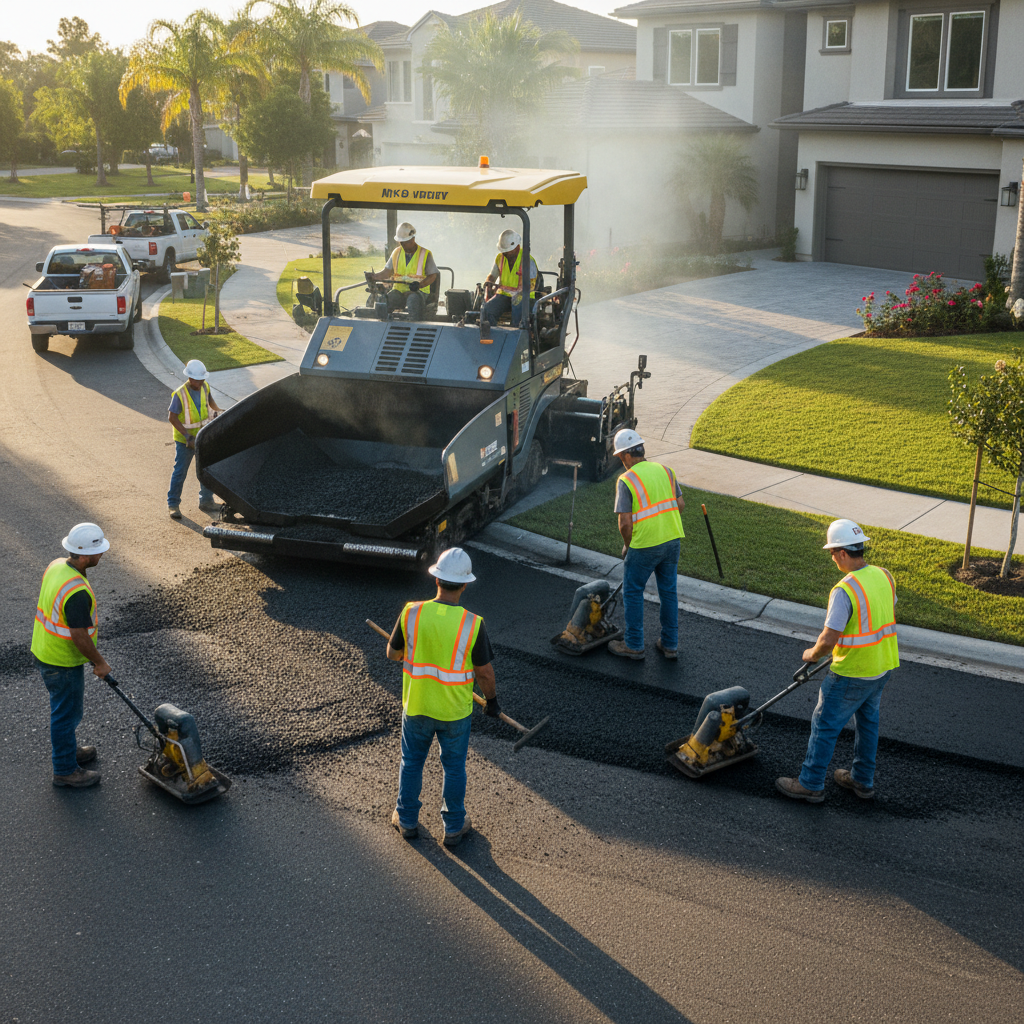
Driveway paving options and costs in Vaughan
Vaughan homeowners typically have three strong driveway paths—new asphalt, interlocking pavers, or concrete—plus a few budget/gravel options—because Vaughan’s housing stock is dominated by single-detached homes (62.5% of dwellings), and most private driveways tie directly to detached properties. With 89,290 homeowner households in the city’s broader profile (Statistics Canada, 2021 Census), there’s consistently steady demand for resurfacing, full replacements, and curb-adjacent drainage fixes in neighbourhoods like Maple, Kleinburg, and Vaughan Metropolitan Centre.
Pricing in Vaughan is also shaped by Toronto’s freeze–thaw reality. Frost can extend roughly 3–4 feet in the ground, so driveways usually need deeper, well-compacted granular base and dependable drainage so water doesn’t sit under pavement. That base work and labour are a big reason quotes can differ meaningfully even when driveways look similar on a brochure. On top of that, hot-mix asphalt placement is limited to periods when air temperatures are warm enough (commonly above 10°C), so the usable paving season effectively compresses into late spring through early fall. In peak weeks, contractor scheduling can tighten, pushing total installed costs toward the upper end of the typical Toronto economic region bands.
Below is a homeowner-friendly comparison of common driveway materials—lifespan expectations, maintenance needs, best use cases, and typical price per square foot—so you can line up bids consistently before you sign anything.
| Material |
Lifespan |
Maintenance |
Best For |
Price per sq ft |
Price Range |
| Asphalt (new installation, proper base) |
15–25 years |
Seal every 3–5 years |
Balanced cost and performance with correct base and drainage |
$3.50–$7.00 |
$3,500–$8,000 |
| Asphalt (overlay on existing gravel base) |
10–18 years |
Seal every 3–5 years; monitor edges |
When you truly have a sound granular base and limited excavation |
$4.50–$7.50 |
$4,000–$9,500 |
| Interlocking concrete pavers |
25–35 years |
Resand/relevel as needed; re-sleeve joints if settling occurs |
High curb appeal and easier spot repairs |
$11.00–$18.50 |
$9,000–$20,000 |
| Poured concrete (broom finish) |
25–40 years |
Crack control joint monitoring; reseal optional |
Low ongoing maintenance with proper jointing and drainage |
$9.50–$15.00 |
$6,000–$15,000 |
| Exposed aggregate concrete |
20–35 years |
Reseal periodically to protect surface and colour |
Slip-resistant finish and premium look |
$12.00–$18.00 |
$7,500–$17,500 |
| Gravel / crushed stone (budget option) |
3–10 years |
Top up and regrade annually; weed control |
Short-term or access-only where aesthetics are secondary |
$2.25–$4.00 |
$1,500–$5,000 |
Prices are estimates only and vary by project scope, site access and material selection.
What affects the price of paving in Vaughan
In Vaughan, two contractors can price the “same” driveway very differently because the scope behind the scenes isn’t identical—and that’s why bids can swing by 30–50% across the broader Toronto area when you compare apples to apples. The biggest drivers are the frost-depth-proofing details (base thickness, compaction, drainage) and how much tear-out and regrading is required. Even when your driveway footprint is the same, contractors may be accounting for different labour time, hauling distance for removed material, disposal fees, and the cost of adding proper edge restraints to prevent spreading under freeze–thaw movement.
In the Toronto economic region, frost depth and freeze–thaw cycles are decisive. When you’re targeting Toronto’s frost conditions, a deeper, thicker compacted granular base is typically required so the pavement doesn’t heave and crack. A practical rule contractors use in Ontario is that granular base depth often ends up in the 6–12 inch range (depending on existing subgrade and site drainage), rather than the thinner builds you might see in milder climates. Also, the paving season is shorter—hot-mix asphalt placement generally requires air temperatures above about 10°C—so schedule pressure in late spring and summer can push asphalt work toward the higher end of the typical $3,500–$8,000 driveway band. Concrete can be competitive on materials, but it’s very sensitive to how the mix is designed, how joints are controlled, and whether drainage is managed before the slab goes in.
Concrete examples that move the price in Vaughan: older homes (with many driveways built prior to 1981; 7.6% of the local housing profile) often have variable subgrade, buried organics, or drainage issues that require extra excavation before concrete can be poured. If you also need a new driveway apron/approach and rework around a curb line, you’re adding formwork, concrete removal, and potential drainage corrections—often pushing the job toward the upper end of $6,000–$15,000. Conversely, if your base is sound and excavation is limited, asphalt overlays can stay closer to the lower end.
| Price Factor |
Why It Matters |
Cost Impact |
| Driveway area in sq ft |
Material and surface prep scale directly with area |
Largest driver; commonly 40–70% of total variation |
| Base depth required |
Frost protection depends on compacted granular thickness |
More excavation/aggregate can add significant labour and haul costs |
| Grading and drainage work |
Proper slope and water management reduce heaving risk |
Can add regrading, sub-drainage, and extra labour |
| Tear-out of existing surface |
Removing old asphalt or concrete adds breaking and disposal time |
Higher if concrete is heavily reinforced or access is tight |
| Edge restraints and curbing |
Pavers/asphalt need containment to resist lateral movement |
Adds materials and layout time; helps avoid premature failures |
| Sealing requirement |
Asphalt generally requires sealing to reduce oxidation and wear |
Small added cost now, but necessary to protect lifespan |
| Site access |
Narrow lots slow equipment and increase labour/handwork |
Can raise unit costs due to longer setup and staging |
| Asphalt mix specifications |
Freeze–thaw-rated mixes better resist deterioration in Ontario winters |
May increase material cost but improves long-term performance |
Permits & regulations in Ontario
In Ontario, paving a private driveway within your own property (for example, replacing an existing asphalt or concrete surface wholly inside your lot lines) usually doesn’t trigger a building permit. However, if the work touches the municipal right-of-way, approvals are often required—especially when you’re modifying the area between your property line and the street. That can include new or changed curb cuts, altered boulevard grading, changes to storm drainage, or any work that affects how runoff flows toward the street and catch basins.
In Vaughan specifically, homeowners should also be mindful of lot-grading rules. Some municipalities regulate how close hard surfaces and regraded slopes can be to property lines and may require that drainage is directed properly so it doesn’t move toward neighbours’ lots. The practical step is to ask your contractor to identify whether your driveway changes involve right-of-way work before they schedule excavation.
Before any digging, call for utility locates through Ontario One Call (or use the utility provider locates your contractor arranges). Then, verify your contractor properly before paying anything: in Vaughan/Ontario, you can confirm the business is licensed appropriately for their trade work, check their liability insurance certificate (ensure the policy is current and adequate), and confirm coverage for workers via WSIB (WCB) where applicable. For extra assurance, ask for the clearance letter or current WSIB clearance status and keep copies of all certificates with your contract paperwork.
Asphalt vs pavers vs concrete for Vaughan driveways
For Vaughan’s freeze–thaw climate, asphalt typically wins on upfront cost and speed of installation, but it needs a plan: sealing every 3–5 years is the difference between “good for a while” and “holding up through winter after winter.” Interlocking concrete pavers are the premium curb-appeal choice; they cost more initially, yet they’re easier to repair because you can lift and replace individual stones rather than redoing an entire section. Poured concrete lands mid-range for many driveways, but it is more sensitive to mix design, air entrainment, and joint/control planning—especially when de-icing salt and ploughing meet the slab over decades.
Across Toronto’s frost conditions, all three benefit from the same foundation discipline: deeper base protection (often ending up in the 6–12 inch compacted granular range depending on your subgrade) and reliable drainage so water can’t sit under the surface and expand when it freezes. In routine Ontario winter maintenance, salt and repeated plough contact reward a well-engineered edge restraint and good base drainage; pavers can be more forgiving for spot fixes after settlement, while asphalt can show fatigue cracking if the base wasn’t prepared correctly. Concrete failures in Vaughan are more often “repairable prevention” matters—if joints aren’t placed and sealed properly, freeze–thaw can open micro-cracks.
Budget example: if your driveway is sized so the all-in asphalt install lands near $3,500–$8,000, moving to pavers may land in the $9,000–$20,000 band. That extra cost is most often justified when you want maximum curb appeal in high-visibility areas (like the street-facing frontage of a detached home) and when you want the option of targeted repairs instead of full resurfacing later.
| Material |
Frost Resistance |
Curb Appeal |
Repair Method |
Lifespan |
Price Band |
| Asphalt (sealed regularly) |
Good with proper base + sealing plan |
Medium |
Mill and pave a section if needed |
15–25 years |
$3,500–$8,000 |
| Interlocking concrete pavers |
Excellent with edge restraint and re-sanding |
High |
Remove and replace individual pavers or sections |
25–35 years |
$9,000–$20,000 |
| Poured concrete (air-entrained) |
Good with air entrainment + correct jointing |
Medium–High |
Patch/surface repair; sometimes slab replacement if severe |
25–40 years |
$6,000–$15,000 |
| Exposed aggregate concrete |
Good with correct base and drainage |
Very High |
Limited patching options; often overlay/refinish depending on damage |
20–35 years |
$7,500–$17,500 |
| Permeable pavers (drainage grid) |
Excellent drainage strategy when engineered correctly |
High |
Replace affected blocks; clear/maintain drainage infill |
20–30 years |
$10,500–$22,000 |
| Chip seal / tar-and-chip |
Fair to good; depends heavily on base quality |
Low–Medium |
Spot repairs; periodic re-seal/chip refresh |
6–12 years |
$2,500–$6,500 |
How to choose a paving contractor in Vaughan
Choosing the right paving contractor in Vaughan is mostly about verification and scope clarity. First, confirm Ontario coverage and credentials: ask for the company’s liability insurance certificate (and verify dates), and confirm WSIB/WCB coverage for workers when applicable. When you receive their certificate of insurance, check the insured business name matches the contractor quoting your job. For Ontario licensing/authority to perform the work, look for the contractor’s registration details where they’re required and confirm the business is active and reputable (not expired or mismatched).
Next, get 2–3 itemised written quotes. You want a breakdown that separates labour, excavation/take-off, base material, asphalt/concrete/pavers, geotextile (if used), compaction, edge restraints, and disposal. Don’t accept “lump sum” if key line items are missing—especially in Toronto’s freeze–thaw climate where base and drainage decisions drive long-term performance. Read exclusions carefully: is permit handling included (only needed if your work affects right-of-way or drainage), is disposal included, and what happens if they uncover unsuitable subgrade or buried debris?
Warranty matters too: confirm the workmanship warranty length and whether it aligns with the material’s expected performance window. Payment should be staged—never more than about 10–15% upfront, then hold back a portion until the job is fully complete and cleaned up. Finally, insist on a written timeline with a start date and realistic completion estimate, including what “weather delay” means for Ontario spring conditions.
- Provide an itemised quote (materials + labour) and clearly list disposal costs.
- Confirm the base build details (depth and compaction method) and drainage approach.
- Ask how they handle unsuitable subgrade or unexpected soft spots after excavation.
- Verify liability insurance certificate is current and matches the contracting company.
- Confirm WSIB/WCB coverage (and request clearance letter where available).
- Check workmanship warranty terms in writing (what’s covered, for how long, response time).
- Ask if material/manufacturer warranty applies and whether it transfers to you as homeowner.
- Ensure contract states what edges/restraints will be installed (especially for pavers).
- Clarify sealing: asphalt should be sealed after cure time (often 6–12 months in practice).
- Require photos before and during excavation/compaction so you can confirm base quality.
- Confirm schedule and weather plan for Vaughan’s short paving windows.
- Use a payment schedule with a holdback until final inspection/cleanup is done.
Red flags I see in Vaughan include: quotes that skip base thickness details, vague drainage promises (“we’ll make it work”), no insurance/WSIB documentation provided up front, payments requesting large deposits early, and contracts that exclude disposal or require “extra” charges for common site conditions after excavation.
Frequently asked questions — paving in Vaughan
How do I compare paving quotes fairly?
Start by comparing scope line by line, not just the total price. In Vaughan and the wider Toronto economic region, the quote should specify the base build (granular depth, geotextile if used), compaction expectations, and how drainage will be corrected so water can’t sit under the driveway and worsen freeze–thaw heaving. Ask whether the contractor includes tear-out and disposal, what edge restraints will be used (especially for pavers), and whether sealing is included or excluded for asphalt. A fair apples-to-apples comparison might place asphalt new installation around $3,500–$8,000 and pavers in the $9,000–$20,000 band, but only if the base and drainage work are truly equivalent.
Can asphalt be laid in cold weather in Vaughan?
Asphalt placement is limited by air temperatures and paving conditions. For Ontario work, hot-mix asphalt is generally placed when air temperatures are high enough to allow proper compaction; commonly, contractors target conditions above about 10°C. In Vaughan, trying to pave in colder spells can lead to poor bonding, reduced density, and early surface deterioration—especially because Toronto’s freeze–thaw cycles start again as temperatures swing. If a contractor offers “cold weather paving” without describing mix heating, placement controls, and how they’ll ensure density and cure, that’s a concern. The safer approach is scheduling within Vaughan’s workable window (late spring through early fall) and making sure the base and drainage are engineered first.
What is a driveway apron and do I need one in Vaughan?
A driveway apron is the transition area at the driveway entrance—often where your private driveway meets the curb/boulevard area. In practice, it’s where slope, drainage, and the curb line come together. Whether you “need” an apron depends on what’s being modified: if you’re changing the driveway approach, adjusting the entrance grade, or doing right-of-way-related work, an apron or similar transition treatment is commonly required for a safe and stable connection. In Vaughan, ask your contractor whether any curb cut changes or storm drainage modifications are involved, because work touching municipal right-of-way typically requires approvals. Even when no permit is required for work fully within your lot, good apron detailing helps prevent rutting and settlement at the street edge.
How do I maintain my driveway through Vaughan winters?
Winter maintenance in Vaughan is mostly about reducing water damage and avoiding unnecessary surface wear. Keep the driveway clear of standing meltwater when possible, and remove snow with care to minimize gouging. Use sand and de-icing thoughtfully: salt is common in Ontario, but excess can accelerate surface ageing—particularly for asphalt—so follow the manufacturer’s guidance for whichever product you use. For asphalt, plan sealing maintenance on a cycle of about every 3–5 years so the binder stays protected against oxidation from winter stress. For pavers, avoid heavy salt buildup between joints and check for any joint sand loss after the first freeze-thaw season. Good base drainage is still the foundation—maintenance supports the design, but it can’t fix missing drainage.
Is it worth sealing a new driveway right away in Vaughan?
For asphalt, sealing “right away” is usually not the right timing. Asphalt needs time to cure so the binder can properly set; many homeowners in Ontario end up sealing after an appropriate cure window—often about 6–12 months in typical practice—depending on weather, mix, and how much traffic the driveway sees. Sealing too early can trap moisture and interfere with proper curing. That said, sealing is worth it because it slows oxidation and helps protect against water infiltration during freeze–thaw cycles in Toronto’s climate. If your contractor’s asphalt estimate is around $3,500–$8,000, ask whether sealing is included, when it should be done, and what product they recommend for Vaughan winters.
What is a chip seal driveway and is it suited to Vaughan?
A chip seal driveway (also called tar-and-chip) is typically a binder sprayed onto a prepared base, followed by aggregate chips compacted into the binder. It’s often used for budget-friendly or rural-style surfaces and can be suitable when the base is built correctly and drainage is well managed. In Vaughan, it can work, but it’s generally less durable than asphalt or properly engineered pavers for long-term appearance and smoothness—because freeze–thaw stresses can loosen aggregate if the base and adhesion aren’t engineered to handle Ontario conditions. If your goal is low upfront cost, it may land in the lower paving bands (often around $2,500–$6,500), but expect periodic maintenance and a shorter lifespan compared with sealed asphalt or pavers.