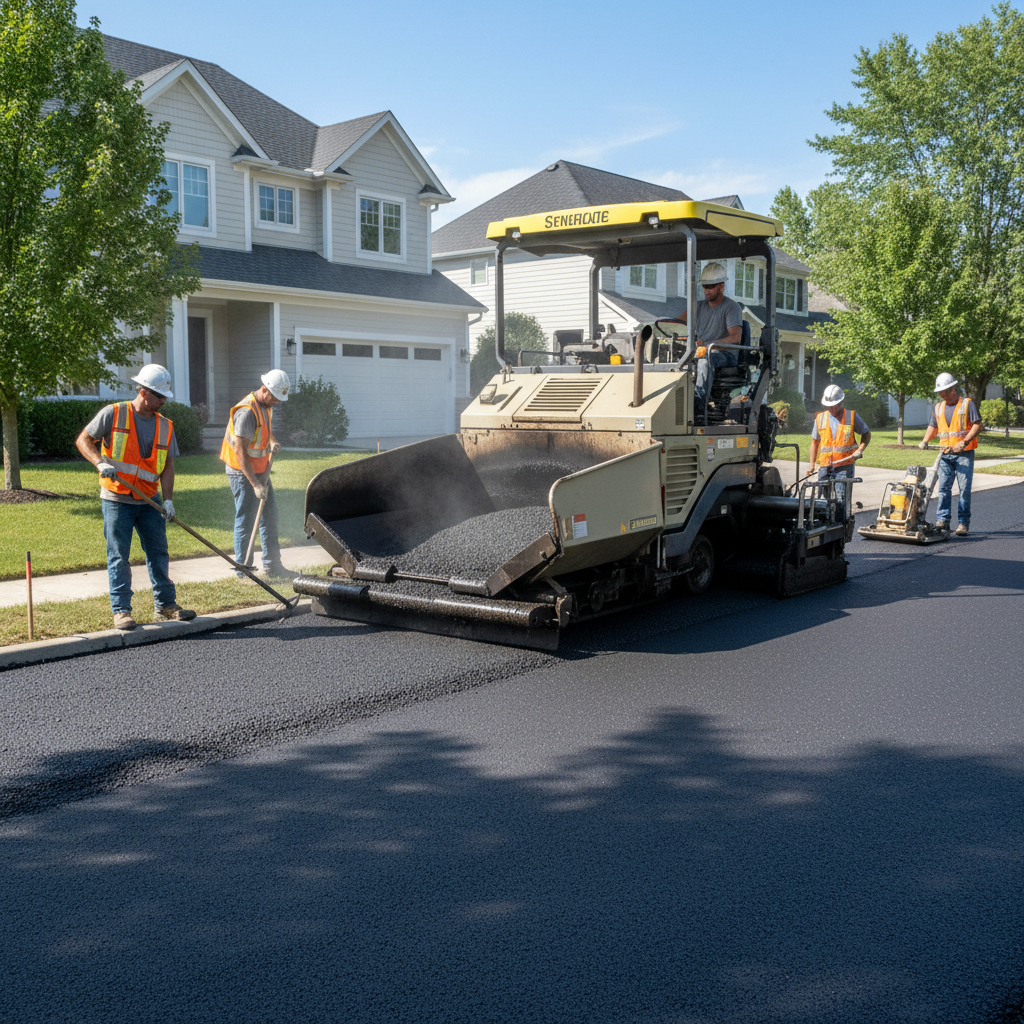
Driveway paving options and costs in Tillsonburg
Tillsonburg homeowners typically choose their driveway material based on three realities: most driveways serve single-detached homes, London-region winters deliver aggressive freeze–thaw, and the frost depth means you can’t “skip” the granular base. With 67.7% of dwellings being single-detached homes in Tillsonburg (Statistics Canada, 2021 Census), the addressable market is largely private driveway work—so you’ll see contractors busy across neighbourhoods like the west end and near Tillson Avenue, especially when schedules open up in late spring. Also, nearly half of the housing stock (49.3% built before 1981) tends to sit on older lot grading, which can require re-shaping the subgrade so water doesn’t pond under the new surface.
In the London economic region, the frost line is roughly 1.0–1.2 m, so paving is priced around keeping materials below the active frost zone with a deeper, well-compacted base and proper drainage. Clay-heavy soils common locally can add excavation in problem areas. Labour availability is tighter in the late-spring to early-fall window because hot-mix asphalt needs warmer placement conditions, which can push pricing toward the higher end of the bands during peak months. That’s why two “similar” driveway jobs in Tillsonburg can land quite differently once base thickness, tear-out, drainage corrections, and site access are assessed.
Below is a practical comparison of the main options homeowners consider in Tillsonburg, aligned to the local London-area price bands.
| Material |
Lifespan |
Maintenance |
Best For |
Price per sq ft |
Price Range |
| Asphalt (new installation, proper base) |
15–25 years |
Seal every 3–5 years; patch minor raveling |
Most common choice; best value when base and drainage are done right |
$3.50–$6.50 |
$4,500–$9,000 |
| Asphalt (overlay on existing gravel base) |
12–20 years |
Seal every 3–5 years; monitor gravel settlement |
When the existing base is stable and you want to avoid full tear-out |
$3.00–$5.75 |
$4,500–$8,000 |
| Interlocking concrete pavers |
25–40 years |
Re-level joints as needed; replace individual stones if damaged |
Curb appeal and easy localized repairs |
$8.00–$14.00 |
$8,000–$16,000 |
| Poured concrete (broom finish) |
20–30 years |
Seal every 5–8 years; minor patching |
Clean, simple look; good for straightforward driveway geometry |
$7.00–$12.00 |
$9,000–$18,000 |
| Exposed aggregate concrete |
20–35 years |
Seal periodically; patch selectively |
Better slip resistance and a textured finish |
$9.00–$15.00 |
$10,000–$19,000 |
| Gravel / crushed stone (budget option) |
5–12 years |
Rake, top up annually; manage drainage channels |
Lowest upfront cost; temporary solution or overflow parking |
$2.00–$4.00 |
$3,000–$6,000 |
Prices are estimates only and vary by project scope, site access and material selection.
What affects the price of paving in Tillsonburg
In Tillsonburg and across the London economic region, it’s common to see driveway quote differences of 30–50% for what looks like the “same” surface. The big reason is that asphalt and concrete pricing is structural, not just cosmetic: your base thickness, drainage corrections, and tear-out scope can swing the cost more than the surface material itself. Labour availability also tightens during the late-spring to early-fall work window because hot-mix asphalt requires placement conditions (typically air temps above 10°C). When crews are booked, unit pricing rises—especially for long-haul sites, small lots, or jobs with limited equipment access.
Frost line depth and freeze–thaw cycles are decisive cost factors. With a roughly 1.0–1.2 m frost line in southern Ontario, deeper compacted granular base is required to keep the pavement system below the active frost zone and limit heaving and cracking. In practice, that often means excavation and aggregate thickness in the “6–12 inches” range for Ontario installations when the subgrade is clay or unstable, plus an engineered drainage plan. Concrete and pavers can also move if water is trapped under the slab or bedding layers—so drainage work frequently adds cost before a single paver goes down.
In Tillsonburg, I see two situations that change the number quickly: (1) older lots (like many homes built before 1981) often have uneven lot grading, so we may need re-slope, add subdrains, or rebuild swales; and (2) clay-heavy spots can require extra base and more compaction passes to stabilize. On the other hand, a straightforward replacement on firm, well-drained ground can land near the lower end of local asphalt paving pricing—around the $4,500–$9,000 band—while drainage corrections and full tear-out can push toward the upper end. For homeowners who want maximum curb appeal and repairability, pavers often start higher—commonly in the $8,000–$16,000 range—because base build-up, restraints, and jointing materials are more involved.
| Price Factor |
Why It Matters |
Cost Impact |
| Driveway area in sq ft |
Most material and labour scale directly with surface area |
Can vary by 20–40% between similar homes |
| Base depth required |
Frost line demands thicker granular layers to prevent heaving |
Extra 6 inches of excavation/stone can add major cost |
| Grading and drainage work |
Water under pavement accelerates freeze–thaw damage |
Adds line-item costs for re-slope, swales, or subdrains |
| Tear-out of existing surface |
Breaking, hauling, and disposal are time-consuming |
Often increases total by thousands depending on material |
| Edge restraints and curbing |
Stops paver spread and controls concrete/asphalt edges |
Can add 5–15% depending on layout |
| Sealing requirement |
Asphalt needs sealing after cure to protect from oxidation |
Typical seal line item; affects long-term performance |
| Site access |
Narrow lots slow equipment movement and increase labour hours |
Can add time and truck charges |
| Asphalt mix specifications |
Freeze–thaw-rated mix design improves durability in Ontario winters |
Higher material specification can lift asphalt unit cost |
Permits & regulations in Ontario
In Ontario, paving a private driveway within your own property typically does not require a building permit. In practice, most Tillsonburg driveway upgrades (new asphalt, pavers, or concrete on your lot) are handled as private property improvements without a permit. The key exception is work in the municipal right-of-way. If your job includes a new curb cut, changes to the boulevard, altering the ditch line, or modifications that affect municipal storm drainage, you’ll likely need municipal approval before excavation.
Before any digging, call for utility locates through Ontario One Call. This is the step that most protects your schedule and your safety, because it flags buried services that contractors must work around. Also confirm whether there are lot-grading or hard-surface requirements that control how close a driveway can be to property lines or how surface water must be managed—rules vary by municipality and are often enforced through grading bylaws.
To verify a contractor in Tillsonburg, follow a simple checklist. First, confirm Ontario licensing/registration status through the appropriate provincial business information and the contractor’s stated trade credentials. Second, request a certificate of liability insurance naming you as the owner and showing coverage limits suitable for paving work. Third, check WSIB coverage (or the contractor’s WCB-equivalent status, depending on their classification) to ensure workers are protected on-site. Finally, ask for a clearance letter if they provide one. If they can’t produce documents or won’t share proof before pricing, that’s a major red flag.
Asphalt vs pavers vs concrete for Tillsonburg driveways
For Tillsonburg’s freeze–thaw winters, the best driveway choice is the one that stays dry and properly compacted beneath the surface. Asphalt is usually the lowest upfront option, but it performs best when it’s built with a deep granular base and then sealed regularly—often every 3–5 years. Interlocking concrete pavers cost more at the start, yet they’re very repairable: if a section settles, you can lift and re-bed without replacing the whole driveway. Poured concrete sits in the middle for upfront cost, but it needs the right mix design (including air entrainment) and good drainage to resist cracking from expansion, contraction, and de-icing chemicals used in Ontario winters. In London-region clay soils, drainage is not optional—water that migrates under a slab or bedding layer can turn into heaving.
Because the frost line is about 1.0–1.2 m locally, all three options need a base engineered to keep the pavement system below the active frost zone. In most Tillsonburg driveways, that means careful excavation, well-graded stone, and a drainage plan that directs water away from the pavement edge. For winter maintenance, the most forgiving routine tends to be the one that matches the surface: asphalt tolerates plowing well when edges are properly restrained and the surface is maintained; pavers handle shovels and plows reliably as individual units can be corrected; concrete can chip or crack if salt is aggressively used and jointing/drainage were poor.
To put it plainly with dollars: if a 600 sq ft driveway lands near $4,500–$9,000 for asphalt, pavers might come in around the $8,000–$16,000 band—often justified when you want higher curb appeal, better long-term repairability, and a driveway finish that still looks crisp after years of winter wear. Concrete may be closer to asphalt than pavers in many straightforward layouts, but if you have drainage challenges or old lot grading, the cost can converge quickly because the base work has to be done regardless.
| Material |
Frost Resistance |
Curb Appeal |
Repair Method |
Lifespan |
Price Band |
| Asphalt (sealed regularly) |
Good when base/drainage are correct; medium risk if water trapped |
Moderate (clean, uniform) |
Patch and resurface; localized mill-and-pave |
15–25 years |
$4,500–$9,000 |
| Interlocking concrete pavers |
Excellent when bedding is well-compacted and drainage is managed |
High (variety of patterns and colours) |
Lift/replace individual pavers; re-level with new bedding |
25–40 years |
$8,000–$16,000 |
| Poured concrete (air-entrained) |
Good with air entrainment, expansion joints, and drainage |
Moderate to high (clean lines) |
Patch cracks; occasionally saw-cut and repair panels |
20–30 years |
$9,000–$18,000 |
| Exposed aggregate concrete |
Good when properly finished and drained; texture can hide minor surface wear |
High (decorative, slip-resistant) |
Patch in sections; matching finish requires craftsmanship |
20–35 years |
$10,000–$19,000 |
| Permeable pavers (drainage grid) |
Excellent in wet subgrade situations when designed and underdrained correctly |
High (modern look) |
Replace modules; flush/inspect drainage layer |
20–35 years |
$12,000–$20,000 |
| Chip seal / tar-and-chip |
Variable; can rut if base prep is weak; sensitive to winter ageing |
Low to moderate |
Re-surface with fresh binder/stone |
7–15 years |
$4,000–$7,000 |
How to choose a paving contractor in Tillsonburg
When you’re comparing paving contractors in Tillsonburg, start with proof—not promises. For Ontario work, verify they have the correct Ontario business registration/credentials for the services they’re advertising, and ask for their certificate of liability insurance with coverage limits clearly listed. Next, confirm WSIB/WCB coverage: request the current clearance letter or proof of coverage so you know workers are protected on-site. If they use subcontractors, the paperwork should still be provided for the people doing the work.
Then get 2–3 itemised written quotes that break down labour and materials. You want separate line items for excavation, base stone (and depth), grading/drainage, geotextile (if required), asphalt/pavers/concrete, disposal, and edge restraints. Avoid “lump sum” pricing unless the scope is very detailed. Read the exclusions carefully: is permit work included (if the job touches the municipal right-of-way), is disposal included, and what happens if they uncover poor subgrade or existing buried services? For warranty, ask for workmanship warranty length and what it covers (settlement, cracking, joint performance, patch quality), plus any product/manufacturer warranty. Clarify whether warranties are transferable to a new homeowner.
For payment schedule, never pay more than 10–15% upfront. Hold back a portion until completion and punch-list items are signed off. Finally, get an in-writing start date and a realistic completion estimate tied to weather constraints in Ontario’s shorter paving season.
- Verify Ontario licensing/credentials for the exact paving scope they’re proposing.
- Request certificate of liability insurance and confirm you’re covered as the property owner.
- Confirm WSIB/WCB clearance or proof of coverage before work begins.
- Ask for an itemised quote: base depth, materials, drainage corrections, and haul/disposal.
- Ensure excavation and compaction specifications are written (not verbal).
- Confirm geotextile and soil separation requirements if clay is present.
- Ask how they handle poor subgrade discoveries (price adjustment terms).
- Clarify edge restraints, curbs, and how paver/asphalt/concrete edges are restrained.
- Confirm disposal is included for old asphalt/concrete and that haul distance is accounted for.
- Ask when asphalt will be sealed (typically after cure) and whether it’s included in scope.
- Review warranty details in writing, including transferability.
- Use a payment schedule with 10–15% max upfront and a holdback until final acceptance.
Red flags I see in Tillsonburg include: no written base specification (only “new asphalt” promised), refusing to provide insurance/WSIB proof, quotes that omit drainage/grading even when slopes look wrong, large upfront payments, and missing timelines tied to weather constraints.
Frequently asked questions — paving in Tillsonburg
How do I prepare for a paving project?
For Tillsonburg homeowners, preparation is mostly about access and drainage. Clear vehicles from the driveway for the full work window (including any cure/return visits), and remove basketball hoops, sheds, or movable landscaping items near the work area. If you suspect water ponds near the garage apron or at the driveway edge, tell your contractor—those symptoms usually mean extra grading and base work, not just a surface replacement. Make sure you understand how the contractor will handle existing drainage (swales, ditches, and any downspouts), because freeze–thaw damage starts when water sits under the pavement. Lastly, plan for utility locates through Ontario One Call before excavation so there are no surprises.
How do I compare paving quotes fairly?
Compare quotes line-by-line, not by the final number. Ask each contractor for itemised scope: excavation depth, granular base thickness, compaction method, drainage/grading corrections, disposal, and edge restraints. For asphalt, confirm the mix is freeze–thaw rated and whether sealing is included after the initial cure. For pavers or concrete, confirm jointing strategy and whether bedding layers are specified. It’s also fair to compare whether they include site access measures (equipment staging and haul distance) because narrow lots in Tillsonburg can add labour. As a reality check, asphalt driveway paving often lands in the $4,500–$9,000 band, while pavers typically fall closer to $8,000–$16,000 depending on drainage and base build-up. The better quote is usually the one with clearer specs.
Can asphalt be laid in cold weather in Tillsonburg?
In Tillsonburg, asphalt paving is strongly limited by temperature. Hot-mix asphalt needs workable air temperatures (commonly above 10°C) and a dry surface so the mix can be compacted properly. In colder shoulder periods, the mix may cool too quickly, compaction may be inconsistent, and you can get early failures that show up as raveling or wheel tracking after the next freeze–thaw. Even if the day is sunny, ground temperatures can lag and moisture can be trapped under the surface. If the contractor wants to pave outside the safe window, ask how they manage temperature, surface moisture, and compaction. Scheduling during late spring through early fall is usually what keeps longevity realistic in southern Ontario climates.
What is a driveway apron and do I need one in Tillsonburg?
A driveway apron is the paved section that transitions your driveway to the street/municipal side—often at the curb cut area, and sometimes extending partway along the property frontage. Whether you “need” one depends on how your current driveway ties into the roadway, how water is managed at the edge, and whether there’s a curb cut or municipal drainage connection. In Ontario, work that touches municipal right-of-way (like new/altered curb cuts or changes to boulevard/ditch drainage) typically requires approval, so the apron question isn’t just aesthetic. In Tillsonburg winters, a well-built apron helps prevent edge break-up where meltwater and plow splash concentrate. Your contractor should explain if you’re staying within your property limits or if municipal approval is required before any cutback or reconstruction.
How do I maintain my driveway through Tillsonburg winters?
Winter maintenance in Tillsonburg is about reducing water and protecting edges. Plow carefully to avoid scraping the surface and especially the outer edge restraints; once edges are damaged, water can infiltrate and accelerate freeze–thaw. Use sand thoughtfully—too much fines can hold moisture against asphalt or bedding layers. If you use salt, apply sparingly and avoid heavy “piles” at the same spots because repeated chemical exposure can weaken top surfaces over time. Clear snow promptly after storms, and don’t let ice meltwater run and re-freeze in low points. The strongest move you can make is maintaining proper drainage the way it was designed: if you see standing water after a rain, schedule an inspection so the base and drainage system stay protected.
Is it worth sealing a new driveway right away in Tillsonburg?
Generally, sealing is worth it in Tillsonburg, but not immediately. Asphalt typically needs time to cure and allow the surface to oxidize and stabilize; sealing too early can trap moisture or hinder proper bond, especially if the surface is still volatile after placement. Most homeowners plan sealing about 6–12 months after installation depending on weather and contractor recommendations, then re-seal every 3–5 years to keep oxidation and moisture intrusion under control. This is particularly relevant in southern Ontario’s freeze–thaw cycles, where water exposure is what drives premature cracking. If your new driveway is within the $4,500–$9,000 asphalt paving band, ask whether sealing is included in your package or budget it as a separate maintenance step.