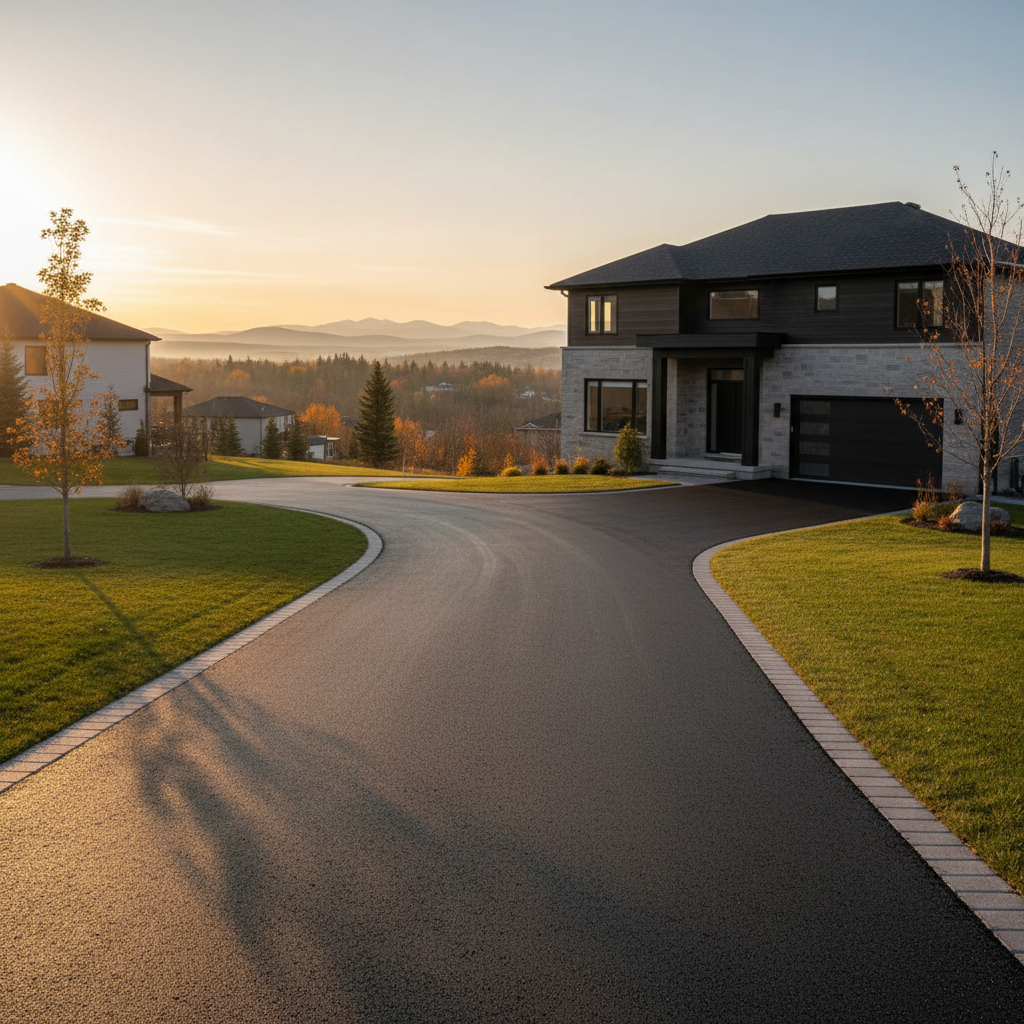
Driveway paving options and costs in Timmins
Timmins homeowners typically choose a driveway material based on upfront budget, how long they want to wait for a major redo, and how well the surface survives Northeast winters. With 65.1% of dwellings being single-detached homes (Statistics Canada, 2021 Census), most driveways here are tied to private lots that need durable, good-draining construction—because thin bases and poor drainage tend to fail first in freeze–thaw conditions. In the Northeast economic region, pricing is driven by deeper frost exposure and repeated spring surface movement, so contractors spend more on excavation, compacted granular base, and often geotextile or insulation strategies where subgrade is weak.
Local timing matters too. In Timmins, the effective paving season is shorter than in southern Ontario, and hot-mix asphalt generally requires warm conditions (commonly above 10°C air temps) for proper placement and compaction. That compresses scheduling, increases mobilization pressure, and can add cost when crews have to wait for suitable weather. Labour availability is also tighter during peak weeks, which is why it’s common to see asphalt projects quote differently from one contractor to another even when the driveway size looks similar.
You’ll often see the highest demand around the newer residential growth pockets and established neighbourhoods close to key arterial roads—such as areas like Timmins South—where homeowners replace older gravel or patchy asphalt to improve curb function and winter safety. Use the comparison below to understand where each material fits and how the price bands typically translate to driveway-scale projects in Timmins.
| Material |
Lifespan |
Maintenance |
Best For |
Price per sq ft |
| Asphalt (new installation, proper base) |
15–25 years |
Sealcoat about every 3–5 years; patch as needed |
Most common choice when you want the lowest upfront cost with solid durability |
$7 – $13 |
| Asphalt (overlay on existing gravel base) |
10–18 years |
More frequent monitoring and sealing; repair weak spots sooner |
When the existing base is stable enough to support a hot-mix overlay |
$6 – $11 |
| Interlocking concrete pavers |
25–35 years |
Resand joints as needed; individual-unit repairs |
Homes that prioritize curb appeal and repairable sections |
$13 – $22 |
| Poured concrete (broom finish) |
20–30 years |
Seal every 5–8 years; joint/edge crack checks |
Long-lasting, low-maintenance slabs with good traction |
$14 – $24 |
| Exposed aggregate concrete |
20–30 years |
Seal to keep colour and reduce surface wear |
Premium look with better slip resistance than smooth finishes |
$16 – $28 |
| Gravel / crushed stone (budget option) |
5–12 years |
Top-up annually; regrade; manage washouts |
Short-term budget or temporary driveway solution |
$4 – $7 |
Prices are estimates only and vary by project scope, site access and material selection.
What affects the price of paving in Timmins
In Timmins and across Ontario’s colder belts, you’ll often see quotes for the “same” driveway vary by 30–50% once you price in the real work: subgrade remediation, base thickness, haul distance for aggregate, disposal, and the contractor’s weather risk. Two driveways can look identical at the property line but still end up costing very differently because frost heave doesn’t care about your curb appeal—it responds to soil conditions, drainage, and how the base is built.
In the Northeast (including the broader northern climate pattern), frost line depth and freeze–thaw cycles are decisive cost factors. Where frost penetrates deeper, a thicker compacted granular base is needed to prevent movement. In practice, many Ontario/Alberta-style builds call for roughly 6–12 inches of well-compacted granular layers under asphalt or concrete, while milder coastal regions may get by with thinner sections. The shorter paving season here also matters: hot-mix asphalt typically needs air temperatures above about 10°C for proper placement and compaction. That means scheduling pressure in spring can add mobilization and overtime, and it can force contractors to build in weather delay risk. Asphalt mix design must also meet freeze–thaw performance needs, which can affect mix costs.
Concrete examples you’ll feel during pricing in Timmins include: (1) older homes built before 1981 (71.7% of dwellings in the area, Statistics Canada, 2021 Census) often have driveways with inconsistent subgrade fill, requiring additional excavation and re-compaction; (2) driveways with poor slope toward a swale can require extra grading to daylight water before winter, adding labour and aggregate; and (3) if the existing surface is already failing, full tear-out and hauling can raise costs quickly compared with a simple patch-and-level.
That’s why an asphalt driveway might land within a broader band like $4,500 – $8,500 when the base is straightforward, but can move toward the high end when excavation and drainage corrections are included. Similarly, if you jump to interlocking pavers, the foundation and edge restraints are still required, which is why paver projects commonly track higher bands such as $8,000 – $16,000.
| Price Factor |
Why It Matters |
Cost Impact |
| Driveway area in sq ft |
More square footage increases excavation, base, asphalt/concrete tonnage, and labour time |
High (usually the largest driver) |
| Base depth required |
Frost-prone soils need thicker compacted granular layers to limit heave and cracking |
High (more material + more compaction time) |
| Grading and drainage work |
Proper slope and interception of runoff reduces freeze–thaw pumping at the surface |
Medium to high (often under-estimated) |
| Tear-out of existing surface |
Breaking, removal, and disposal of old asphalt or concrete adds labour and hauling |
Medium to high |
| Edge restraints and curbing |
Prevents paver spread and asphalt edge raveling; keeps geometry stable over winters |
Medium |
| Sealing requirement |
Asphalt needs sealing after installation to slow oxidation and water intrusion |
Medium (and recurring cost) |
| Site access |
Narrow lanes, stairs, or tight turning radii slow equipment and increase manual handling |
Medium |
| Asphalt mix specifications |
Freeze–thaw-rated mixes perform better under Ontario winter stress |
Low to medium per ton, higher when combined with thicker sections |
Permits & regulations in Ontario
In Ontario, paving a private driveway within your own property usually does not require a building permit. Most homeowners can replace an existing driveway surface (like asphalt over a driveway area on private land) without a formal permit, as long as you’re not altering municipal infrastructure. Where approvals become necessary is when the work affects the municipal right-of-way or municipal services.
Typically, you DO need municipal approval (and sometimes a permit/road occupancy depending on the municipality) if you plan to do any of the following: create or change a driveway apron and curb cut within the boulevard, alter storm drainage, work within the road allowance, or make changes that could redirect runoff toward the street or neighbouring properties. Even if your contractor handles the paperwork, it’s smart for you to confirm what scope they’re submitting—don’t assume.
Step-by-step for Timmins homeowners: (1) ask the contractor for their Ontario business details and evidence of coverage before excavation; (2) confirm utilities are located by calling Ontario One Call before any digging; (3) verify lot-grading expectations—some areas restrict how close a hard surface can be to property lines and how drainage must be handled; and (4) verify the contractor’s Ontario licence where applicable, plus proof of liability insurance and WSIB coverage (for workers). To check these, look for the contractor’s registry information online, request an up-to-date certificate of insurance, and ask for a current clearance letter/report before the start date.
Asphalt vs pavers vs concrete for Timmins driveways
For Timmins driveways, all three main choices—alphalt, interlocking concrete pavers, and poured concrete—can perform well when the base and drainage are built correctly, but they behave differently under freeze–thaw and winter maintenance. Asphalt generally has the lowest upfront cost and a smooth installation window, but it is a “surface system”: it needs sealcoat about every 3–5 years to reduce water intrusion and oxidation. Interlocking concrete pavers are higher cost upfront, yet they’re very forgiving for repairs because individual stones can be lifted, re-levelled, and reset—useful when frost movement or localized settling shows up over time. Poured concrete sits in the mid-range for many driveways, but it can crack if the slab and joints aren’t designed for freeze–thaw and if drainage lets water sit under or at slab edges.
With Northeast-style frost exposure, base preparation is not optional. If you don’t build for frost, asphalt can get raveling and pothole initiation, pavers can shift at edges, and concrete can develop cracking patterns that leak water. Good drainage design—sloping the driveway away from the house and managing runoff toward a safe outlet—helps all three materials. For winter operations common in Timmins (plowing and salt use), asphalt and concrete both benefit from keeping water off the surface and sealing on schedule, while pavers typically tolerate temperature swings well and repair quickly without replacing the whole driveway.
Where the price difference is justified: if a standard asphalt driveway fits near $4,500 – $8,500, you may prefer asphalt if budget is a top priority and you’re willing to maintain with sealcoat and timely patching. If you’re comparing to interlocking pavers at roughly $8,000 – $16,000, the added cost often pays back when you want long-term curb appeal and “no major tear-out” repairs after frost-related minor settlement.
| Material |
Frost Resistance |
Curb Appeal |
Repair Method |
Lifespan |
Price Band |
| Asphalt (sealed regularly) |
Good with proper granular base and drainage; sensitive to water infiltration if not sealed |
Good (clean, dark finish) |
Cut-and-replace patches; mill and overlay if widespread issues |
15–25 years |
$4,500 – $8,500 |
| Interlocking concrete pavers |
Very good; accommodates minor movement when installed over correct base |
Excellent (high curb appeal options) |
Lift individual stones/sections; re-level base and re-set pavers |
25–35 years |
$8,000 – $16,000 |
| Poured concrete (air-entrained) |
Good with air-entrainment and proper joints; vulnerable if drainage traps water |
Good (depending on finish) |
Crack repairs and patching; larger sections may require partial removal |
20–30 years |
$9,000 – $18,000 |
| Exposed aggregate concrete |
Good; durable surface texture with correct finishing and curing |
Excellent (premium look) |
Targeted patching; sealing maintenance recommended |
20–30 years |
$10,000 – $19,000 |
| Permeable pavers (drainage grid) |
Excellent when detailed correctly; reduces water sitting and freeze-driven pumping |
Very good (functional + attractive) |
Lift/rebuild as needed; address base and drainage if clogging occurs |
25–35 years |
$10,000 – $20,000 |
| Chip seal / tar-and-chip |
Fair to good; relies heavily on correct base and maintenance |
Moderate |
Spot maintenance; re-seal when surface binder fails |
8–15 years |
$4,000 – $7,000 |
How to choose a paving contractor in Timmins
Choosing the right contractor in Timmins comes down to verification and clarity. First, confirm Ontario business details and insurance. Ask for proof of liability insurance (so you’re not exposed if a worker or their equipment damages your property) and confirm WSIB coverage for workers, not just general “we’re insured” assurances. In practice, you can request a current certificate of insurance and a WSIB clearance report/letter, then check that the listed coverage is active and matches the company name on the quote.
Next, get 2–3 itemised written quotes—not just lump sums. You want a breakdown that shows labour, aggregate/base materials, asphalt or concrete thickness, compaction steps, edge restraints, disposal, and any required drainage/grading corrections. Ask whether the quote includes permit/approval work if the project touches the boulevard or storm drainage, and whether tear-out and hauling are included if they’re removing existing asphalt or concrete. A fair quote will also state what’s excluded (for example: unforeseen subgrade replacement, extra saw cutting, additional utility locates, or work required due to utility conflicts).
Warranty should be specific: workmanship warranty length, what “defects” mean, and whether it covers labour to repair—plus any manufacturer/product warranty details. Also ask if warranties are transferable if you sell your house.
Payment schedule matters: never pay more than about 10–15% upfront. Use a holdback until completion and final cleanup, and insist on a start date and estimated completion timeline in writing.
- Request licence/coverage documentation before signing.
- Confirm WSIB coverage and request a clearance letter/report.
- Verify liability insurance limits on the certificate of insurance.
- Ask for 2–3 itemised quotes with material thicknesses and quantities.
- Require base design details (granular depth and compaction method).
- Confirm whether geotextile, insulation, or additional base is included if needed.
- Make sure drainage/grading corrections are explicitly listed.
- Confirm tear-out, breaking, and hauling/disposal are included if removing existing surface.
- Check edge restraint details (especially for pavers and aprons).
- Clarify sealing scope for asphalt and timing of the first sealcoat.
- Ask about warranty terms in writing and what triggers repairs.
- Never agree to large upfront payments; keep a holdback for completion.
In Timmins, common red flags include: vague quotes that don’t state thickness/base steps, contractors who won’t provide WSIB clearance or a current certificate of insurance, no written warranty terms, schedules that change without weather contingencies, and crews that start before Ontario One Call locates are completed.
Frequently asked questions — paving in Timmins
What causes potholes and how are they repaired?
Potholes in Timmins are usually a freeze–thaw story. Water gets into the asphalt or at the edges of weak spots, then expands during freezing and loosens the surrounding material. With spring thaw, traffic and plowing action can break the loosened area into a hole. The biggest cause we see is water intrusion combined with an under-built base or drainage that doesn’t shed runoff.
Repairs typically start with inspection: we locate the failed zone, remove loose material, and then rebuild the base (not just “fill and hope”). For asphalt, a proper patch usually includes cutting to a sound edge, compacting fresh granular base, and installing hot-mix asphalt in lifts. If the driveway is generally oxidized and failing, an overlay may be more economical than repeated patching. If you’re comparing budgets, an asphalt driveway in the practical range of $4,500 – $8,500 tends to include the base and drainage steps that reduce pothole recurrence.
How do I prepare for a paving project?
Preparation is mostly about access and decisions, not heavy DIY. Before the crew arrives in Timmins, clear the driveway area of vehicles, trailers, and landscaping obstructions within the work zone. Identify where downspouts and lot drainage discharge so the contractor can verify slope and drainage routing. If you have a fence or garden edging that could be impacted by heavy equipment, flag it in advance.
Next, plan for how utilities are handled. Ensure Ontario One Call locates are completed before excavation begins, especially if you expect to replace base or tie into an apron area. If you’re replacing existing asphalt or concrete, ask your contractor whether they will do tear-out and disposal included in the quote.
Finally, make sure you’re aligned on schedule. Because the paving season can be tight in colder weeks, your start date may depend on weather, and that’s normal. Confirm timelines in writing and ask what happens if conditions aren’t met for asphalt placement.
How do I compare paving quotes fairly?
To compare quotes fairly in Timmins, avoid “price per sq ft” without context. Ask each contractor to provide an itemised scope showing granular base depth, compaction steps, thickness of asphalt or concrete, edge restraint details, and whether geotextile is included where needed. For freeze–thaw performance, the base and drainage work can be the difference between a short-lived job and a driveway that lasts 15–25 years.
Check inclusions: Is tear-out and hauling/disposal included? Is grading and drainage correction included or treated as extra? Is sealing included (for asphalt) and when will it be applied? Also, confirm whether the quote assumes your driveway apron/curb area is within a simple scope or whether municipal right-of-way approvals are involved.
If you’re choosing asphalt versus pavers, remember that pavers can commonly land around $8,000 – $16,000, while asphalt is often in the $4,500 – $8,500 band when the base is straightforward. A fair comparison matches scope, not just material.
Can asphalt be laid in cold weather in Timmins?
Asphalt placement in cold weather is limited. In Ontario, asphalt needs suitable temperatures for proper spreading and compaction; many crews aim for conditions where the surface and air temperature are high enough (often around 10°C or more air temp) to achieve density. If it’s too cold or the surface is damp, you risk poor compaction, which can accelerate raveling and pothole formation under Timmins freeze–thaw cycles.
That doesn’t mean “never,” but it does mean your contractor has to manage conditions carefully—warming strategies, protecting the mat, and ensuring the base isn’t frozen. Even then, the risk of early failure increases if you place asphalt on a subgrade that isn’t ready.
Because Timmins winters are harsh and the paving window is shorter, reputable contractors schedule asphalt for the warm, dry part of the season. If a contractor promises asphalt anytime in the cold without clear temperature/conditions controls, that’s a concern.
What is a driveway apron and do I need one in Timmins?
A driveway apron is the transition area where your driveway meets the street or boulevard—often involving the curb cut and paving/finish that bridges from roadway infrastructure to your private driveway. In Timmins, whether you “need” an apron depends on what’s already there and whether you’re changing the driveway access, modifying a curb cut, or adjusting drainage patterns near the street.
If your driveway ties into the municipal right-of-way, changes may require municipal approval because it affects drainage, curb geometry, or safety at the intersection. A proper apron helps manage water flow at the transition and reduces edge failure that can happen when water gets trapped and freezes.
To know if you need it, ask your contractor to assess the existing curb cut and grade. If your quote scope includes apron work, confirm who handles the approvals and whether the work is covered by municipal requirements. This is especially important if your current driveway access is older or poorly graded—common in housing stock built before 1981, when construction and drainage practices varied.
How do I maintain my driveway through Timmins winters?
Maintenance in Timmins is about preventing water entry and minimizing surface damage. Start with sealing: for asphalt, plan a sealcoat within the appropriate window after installation and then about every 3–5 years, depending on wear. Sealing reduces oxidation and water penetration, which helps prevent freeze-driven deterioration and potholes.
During winter, plow with care. Avoid aggressive blade contact on edges—edge raveling is a fast path to failure in freeze–thaw climates. If you use de-icing, keep salt use reasonable and avoid piling large amounts at one spot for long periods. Sand is often preferable in small amounts where it suits traction needs, since excessive salt can contribute to surface degradation.
After thaw periods, inspect for small cracks, depressions, or soft areas and get small repairs done quickly. A driveway that’s corrected early costs far less than waiting until failure expands. If you’re staying within a typical asphalt budget band around $4,500 – $8,500, maintenance is what helps you protect that investment.