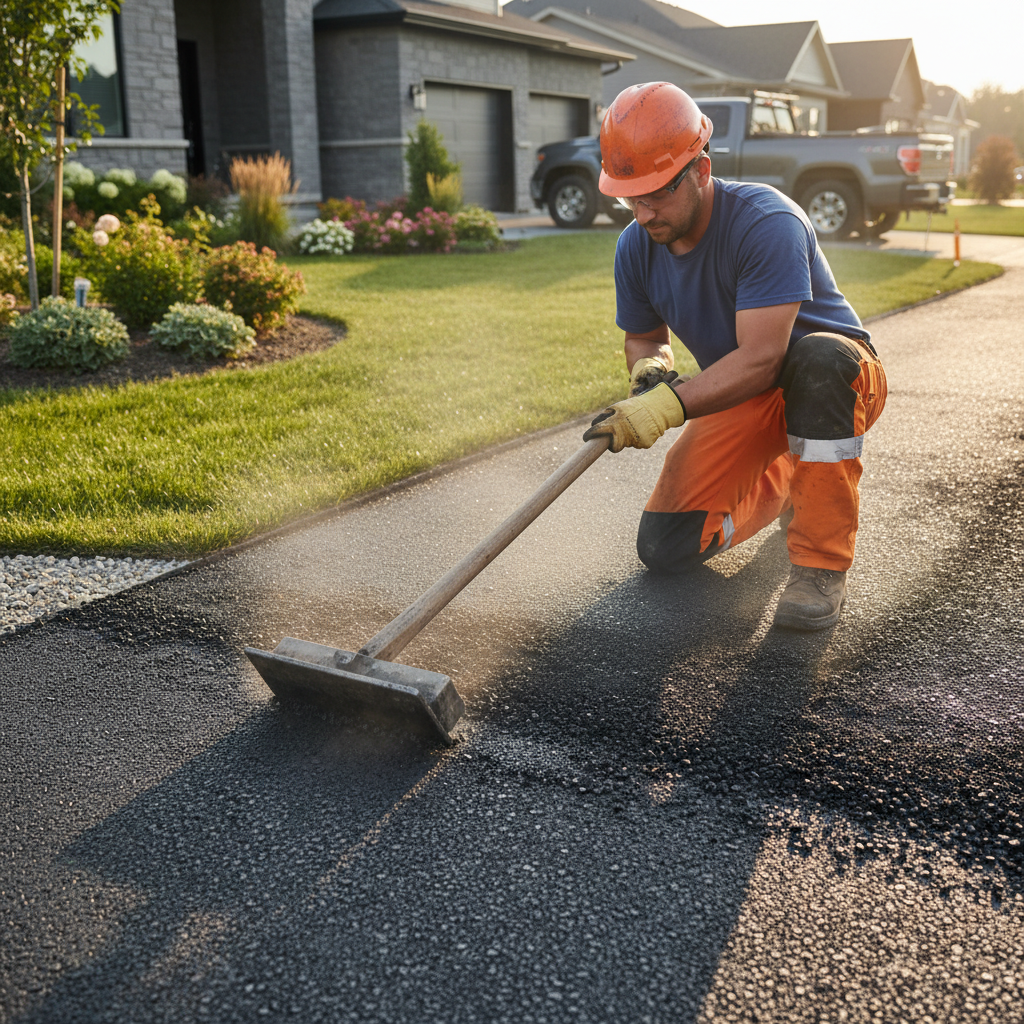
Driveway paving options and costs in Burlington
Burlington homeowners have a lot of driveway choices, but the “right” one usually comes down to freeze–thaw performance, drainage, and how much groundwork you’re willing to fund. In Burlington, most private driveways serve single-detached homes—single-detached dwellings make up 50.3% of the housing stock (Statistics Canada, 2021 Census)—so there’s steady demand on streets like Aldershot and the west-end near Appleby Line where driveways are often older and due for rework. Across the Hamilton–Niagara Peninsula, you also see a large share of homes built before 1981 (47.4%), which matters because older lots often have thinner granular bases, weaker drainage, and more challenging excavation for tie-ins and grading.
In our moderate-to-cold Southern Ontario climate, asphalt typically costs less upfront than pavers or concrete, but the real cost driver is what’s under the surface. Frost penetration and repeated freeze–thaw cycles push contractors to build a deeper, well-compacted granular base (commonly 6–10 in compacted for many residential installations) with dependable drainage. That base and drainage work can represent 35–45% of the residential driveway budget, which is why two quotes for the “same” driveway can differ significantly.
Below is a practical comparison of common options for Burlington—using the local tier pricing homeowners typically see—so you can line up bids and scope before you decide.
| Material |
Lifespan |
Maintenance |
Best For |
Price per sq ft |
Price Range |
| Asphalt (new installation, proper base) |
15–25 years |
Seal every 3–5 years; crack seal as needed |
Most cost-conscious homeowners who want solid performance |
$6.50–$10.50 |
$3,500 – $8,000 |
| Asphalt (overlay on existing gravel base) |
10–18 years |
Seal every 3–5 years; patching for settlement points |
When the existing base is sound and thickness isn’t compromised |
$5.50–$9.50 |
$3,000 – $7,000 |
| Interlocking concrete pavers |
25–40 years |
Re-sand jointing occasionally; lift-and-replace for localized repairs |
Maximum curb appeal and easy spot repairs |
$13.00–$20.00 |
$9,000 – $20,000 |
| Poured concrete (broom finish) |
20–30 years |
Seal if desired; joint maintenance and crack monitoring |
Straightforward look with good long-term durability |
$10.00–$17.00 |
$7,000 – $18,000 |
| Exposed aggregate concrete |
20–35 years |
Seal more consistently; occasional patching for spalls |
Texture and appearance with strong slip resistance |
$12.00–$20.00 |
$8,000 – $20,000 |
| Gravel / crushed stone (budget option) |
5–12 years |
Re-grade and top up annually; weed control |
Short-term or low-budget entry while drainage is corrected |
$3.50–$6.00 |
$2,500 – $6,500 |
Prices are estimates only and vary by project scope, site access and material selection.
What affects the price of paving in Burlington
Even when you describe the same driveway size to contractors in Burlington, Hamilton–Niagara Peninsula bids can swing by 30–50%. The difference is usually not the asphalt or pavers—it’s the thickness and quality of the granular base, how drainage is handled, how much tear-out is required, and whether the contractor includes grading, disposal, and proper edge restraints in the price. Contractors also price differently based on timing within the season; in colder regions like Burlington, hot-mix asphalt production depends on suitable air temperatures (commonly above 10°C), so spring and early summer scheduling pressure can push pricing upward.
Frost line depth and freeze–thaw cycles are decisive cost factors in Burlington. Colder Southern Ontario exposure means you typically need a deeper compacted granular base—often 6–12 in depending on subgrade and design—to resist frost heave and reduce cracking. Concrete and interlock can perform well, but they’re less forgiving of a weak base; if the base isn’t engineered, joints, edges, and surface levels can move. That’s why base and drainage work can represent 35–45% of the total driveway budget, turning a “standard” driveway into a premium-scope job.
In older neighbourhoods (many pre-1981 homes), the cost can rise because excavation finds irregular subsoils, older fill, or limited drainage. Conversely, costs can come down when access is straightforward and your existing granular base is already stable—meaning an asphalt overlay may land closer to the $3,000 – $7,000 range rather than full replacement closer to the $3,500 – $8,000 range. Burlington’s drainage patterns and clay/silty tendencies can also add or reduce excavation depth, depending on how water currently behaves.
| Price Factor |
Why It Matters |
Cost Impact |
| Driveway area in sq ft |
Materials and labour scale directly with surface area |
Can change the total by thousands dollars for larger driveways |
| Base depth required |
Frost protection depends on granular thickness and compaction |
Often the biggest swing factor; deeper base adds excavation and material |
| Grading and drainage work |
Correct slope and drainage routing prevent ponding and frost damage |
Can add significant cost if regrading, swales, or drainage repairs are needed |
| Tear-out of existing surface |
Breaking, hauling, and disposal add labour and equipment time |
More expensive for thick concrete slabs than for asphalt milling |
| Edge restraints and curbing |
Prevents paver spread and asphalt edge raveling |
Moderate cost, but crucial for long-term performance |
| Sealing requirement |
Asphalt absorbs water and oxidizes faster without sealing |
Small add now, but supports lifespan and can reduce future repair spend |
| Site access |
Narrow lots slow equipment movement and increase manual handling |
Can add labour time for unloading, carrying, and repositioning |
| Asphalt mix specifications |
Freeze–thaw-rated mixes improve durability through Burlington winters |
Typically increases material cost but reduces early failures |
Permits & regulations in Ontario
In Ontario, paving a private driveway within your own property usually does not require a building permit. Where you do need approvals is when work touches the municipal right-of-way or changes how water and infrastructure function. In Burlington, that can include adding or modifying a curb cut/driveway approach, changing the boulevard area, or altering storm drainage tied into municipal systems. Some streets also have lot-grading expectations that restrict how close a hard surface can be built to property lines or how drainage must be managed. If your scope includes new drainage connections, swale changes, or anything that affects runoff patterns toward the street, you’ll want municipal confirmation.
Before any excavation, you should confirm utility locates through Ontario One Call (and wait for markings). A proper contractor should schedule locates, follow marking requirements, and adjust the excavation plan if utilities are encountered.
To verify a Burlington contractor in Ontario, do these steps: (1) check the contractor’s Ontario business details via an online registry search; (2) ask for a current certificate of insurance naming you as the certificate holder if applicable, and confirm general liability limits; (3) confirm WSIB coverage (or clearance letter) for the contractor’s workers before work starts; and (4) request proof they will handle excavation safely—especially in older neighbourhoods where unknown services or buried drain lines are more common.
Asphalt vs pavers vs concrete for Burlington driveways
In Burlington’s freeze–thaw climate, asphalt, interlocking pavers, and concrete can all work—but they fail differently when the base or drainage isn’t right. Asphalt is usually the lowest upfront option and offers flexibility under winter movement; however, it relies on a good seal plan. With proper base preparation and sealing every 3–5 years, many driveways land in the $3,500 – $8,000 installed range and hold up well through Ontario winters. If you skip sealing, asphalt oxidizes faster and you’ll see cracking sooner, especially where de-icing salt and plowing blades hit the surface edges.
Interlocking concrete pavers cost more up front, but they’re repair-friendly: a contractor can lift and replace individual units if settlement happens. For homeowners who want curb appeal and easier localized repairs, pavers often justify the added expense, especially if you’re already addressing drainage and building a properly compacted base. The trade-off is that pavers demand meticulous edge restraints and jointing—otherwise, winter movement can cause edge loss or shifting.
Concrete sits mid-to-upper in cost and can last decades with the right design, but it’s more sensitive to base movement. Poured concrete needs good subgrade prep, correct air entrainment, and proper joints. If you’re dealing with older pre-1981 lots where drainage is less reliable, concrete can crack earlier than expected without a carefully engineered base.
A practical example: for a similar-sized Burlington driveway, choosing interlocking pavers at roughly $9,000 – $20,000 can be worth it if you want a higher-end look and repairs that don’t require replacing the whole surface. If your priority is cost control and you’re willing to seal asphalt, asphalt in the $3,000 – $8,000 tier is typically the smarter value—provided the contractor builds the deeper granular foundation needed for frost performance.
| Material |
Frost Resistance |
Curb Appeal |
Repair Method |
Lifespan |
Price Band |
| Asphalt (sealed regularly) |
Good with proper base and freeze–thaw-rated mix |
Moderate (clean, uniform finish) |
Crack seal, patch, or mill-and-overlay |
15–25 years |
$3,000 – $8,000 |
| Interlocking concrete pavers |
Excellent with deep compacted base and tight edge restraints |
High (premium visual options) |
Lift-and-replace individual units or small sections |
25–40 years |
$9,000 – $20,000 |
| Poured concrete (air-entrained) |
Good, but requires correct base, joints, and air entrainment |
Moderate to high (varies by finish) |
Crack repair/patching; larger failures may require section replacement |
20–30 years |
$7,000 – $18,000 |
| Exposed aggregate concrete |
Good if base/joints are designed for movement |
High (textured, upscale appearance) |
Patch and grind localized areas |
20–35 years |
$8,000 – $20,000 |
| Permeable pavers (drainage grid) |
Good when installed with engineered underdrain and stone |
High (modern look) |
Targeted repairs; underdrain inspection if clogging occurs |
20–30 years |
$10,000 – $22,000 |
| Chip seal / tar-and-chip |
Moderate; more sensitive to maintenance and traffic |
Low to moderate |
Spot chip repairs and rework cycles |
7–12 years |
$2,500 – $6,500 |
How to choose a paving contractor in Burlington
Picking the right paving contractor in Burlington is mostly about proving they’re accountable, scoped clearly, and experienced with Southern Ontario frost conditions—not just about the lowest number. Start with Ontario licensing basics and insurance: ask for their proof of general liability coverage (certificate of insurance), then confirm WSIB clearance or WSIB coverage for workers. In the case of pavers and concrete, also ask who is responsible for base and drainage design decisions, since that’s what protects you from frost heave and early failures in a climate like ours.
Next, request 2–3 itemised written quotes. You want line items for excavation, base materials (Granular A/B and compaction), drainage corrections, forms/edge restraints, the asphalt/concrete/paver supply, installation, and disposal. Avoid quotes that only list a lump sum with no mention of thicknesses or what’s included.
Read the scope: is permit work included if any portion hits municipal right-of-way? Is tear-out disposal included? Will they protect landscaping and control runoff during excavation? Warranty should be in writing: confirm workmanship warranty length, whether it’s backed by the installer, and whether any product/manufacturer warranty is separate. Ask if the warranty is transferable if you sell the home.
For payment, never agree to a large upfront deposit. A common homeowner safeguard is keeping upfront payments to 10–15% maximum, with the remainder tied to milestones and a holdback until completion. Finally, insist on a start date and completion estimate in writing—weather and asphalt plant schedules can shift, but timelines should be documented.
- Ask for their current certificate of insurance and WSIB clearance/coverage information.
- Confirm who pulls locates and confirms utility markings before digging (Ontario One Call).
- Get quotes broken into labour, materials, base depth, and disposal—no vague lump sums.
- Verify stated base thickness and compaction method (not just “proper base”).
- Confirm drainage plan (slope to a lawful outlet, fixes for ponding, not just patching).
- For pavers, ensure edge restraints are included to prevent movement.
- For asphalt, confirm sealing timing and whether sealcoat is offered after curing.
- Check whether tear-out includes breaking, hauling, and proper load disposal.
- Require clear site protection details (topsoil, sod, fencing, driveway approach).
- Ask about cleanup standards at the end of each workday.
- Review warranty terms in writing, including workmanship start date and exclusions.
- Agree on payment milestones (max 10–15% upfront; hold back until completion).
Red flags in Burlington include: a contractor who won’t provide itemized scope; quoting “proper base” without stating thickness/compaction; refusing to show WSIB clearance or insurance documents; starting excavation without confirmed utility locates; and pushing a large upfront payment or skipping written timelines and warranty details.
Frequently asked questions — paving in Burlington
What base thickness do I need for pavers in Burlington?
For Burlington, paver performance depends on frost protection and base compaction, not just the surface thickness. In a Southern Ontario freeze–thaw climate, most quality driveways are built on a deeper granular foundation—commonly in the 6–10 in compacted range for many residential cases—plus proper drainage and slope so water doesn’t sit under the edge. If your driveway area has clay/silty subsoils, poor drainage, or signs of settlement from prior winters (raised joints, rocking sections), you may need more excavation and a thicker engineered base. A good contractor will assess your subgrade and tell you the intended base thickness and compaction specs in writing before quoting. (Statistics Canada, 2021 Census)
How do I get the most accurate paving quote in Burlington?
To get an accurate quote in Burlington, provide photos and measurements, and ask contractors to confirm the driveway size in square feet on-site. The biggest accuracy gains come from scoping drainage and base conditions: ask whether they’ll evaluate ponding, check slope, and include any drainage corrections. For older homes (including many built before 1981), expect more variability in subgrade and tear-out needs, which can swing costs. Require itemized quotes covering excavation, granular base depth, compaction, edge restraints, disposal, and the paving work itself. If asphalt sealing is relevant, ask how it’s handled after installation. When comparing bids, use realistic tier pricing—quality asphalt typically falls in the $3,000 – $8,000 range, while pavers commonly start around the $9,000 – $20,000 tier for full installations.
How much does it cost to pave a driveway in Burlington?
Driveway paving costs in Burlington depend mostly on square footage and what the job includes: excavation, granular base depth, drainage corrections, and tear-out. As a local planning guide, asphalt driveway paving is commonly estimated within the $3,000 – $8,000 range, while interlocking pavers often land in the $9,000 – $20,000 range. Poured concrete typically sits in the $7,000 – $18,000 band depending on finish and site conditions. If you already have a strong base and drainage is correct, you may see lower bids; if the contractor finds settlement, weak subgrade, or needs deeper frost protection, the number moves up quickly. In Burlington’s climate, deeper base and drainage work can be a large share of the budget because it prevents freeze–thaw failures.
Asphalt vs interlocking pavers vs concrete — which is best in Burlington?
“Best” usually depends on your priorities. Asphalt is typically the best value upfront for Burlington homeowners who will seal regularly; it’s also forgiving when base preparation is correct. Interlocking concrete pavers offer the highest curb appeal and the most repair flexibility—if a localized area settles in winter, pavers can be lifted and reset without replacing the whole driveway. Poured concrete is a good long-term option but is more sensitive to base movement and joint detailing; if drainage or frost protection is inadequate, cracking can show up sooner. In a driveway with heavy plowing and salt exposure, all materials perform best when the contractor designs drainage and provides adequate compacted base thickness for frost performance. If you’re comparing price, asphalt at $3,000 – $8,000 may be the smarter spend unless you strongly value paver aesthetics and repairability in the $9,000 – $20,000 tier.
How long does a paved driveway last in Burlington?
In Burlington’s freeze–thaw Southern Ontario climate, lifespan is driven by base quality, drainage, and maintenance—not just material choice. Asphalt installed with a proper granular base and sealed on schedule can commonly last about 15–25 years; skipping sealcoat often shortens that. Interlocking pavers can last 25–40 years because localized repairs are possible when sections shift. Poured concrete generally lands around 20–30 years, assuming air entrainment, good base prep, and correctly built joints. Concrete and pavers also depend on edge restraints and consistent bedding so winter movement doesn’t create voids. Maintenance matters: asphalt should be sealed every 3–5 years (and crack sealed as needed), while pavers may need occasional joint re-sanding after settling. (Statistics Canada, 2021 Census)
When is the best time of year to pave in Burlington?
The paving window in Burlington is effectively April to October, because asphalt requires suitable temperatures and compaction conditions. In spring, crews aim to avoid wet subgrade and unstable base; in summer, the demand peak can be busy, which is why booking earlier improves availability and can help with scheduling. If you have asphalt, sealing should be planned after proper curing—typically not immediately the same week as paving. Concrete work is more sensitive to freeze risk as temperatures drop, so late-season pours may face weather constraints. For pavers, installation can often happen earlier and later than asphalt, but base compaction and drainage still need stable conditions. If you’re in an older neighbourhood where excavation is likely, scheduling earlier in the season helps contractors complete grading and base work before freeze conditions return.