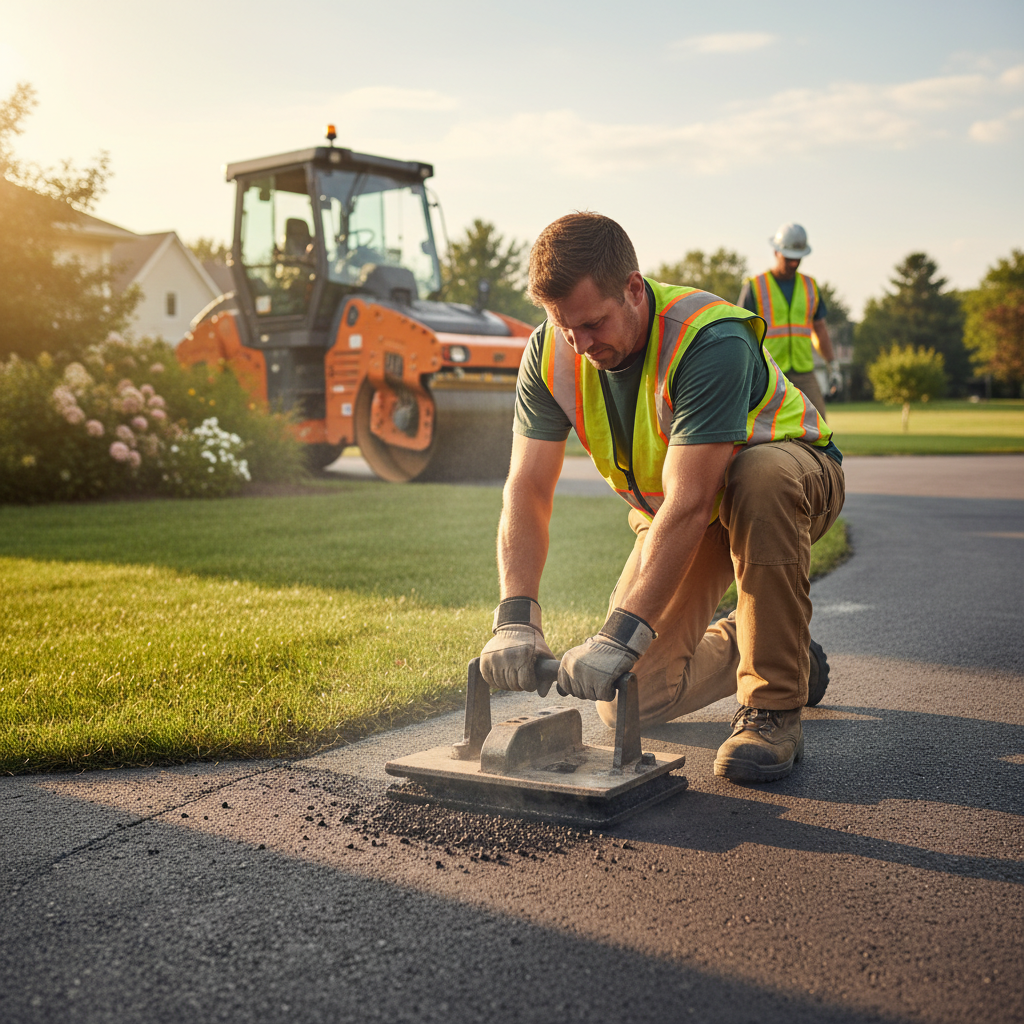
Driveway paving options and costs in Brantford
Brantford homeowners typically have three main driveway paths to choose from: asphalt, interlocking pavers, or concrete. With 60.6% of dwellings in the city being single-detached homes, most private driveways you’ll see on our streets are directly tied to detached lots—and that shapes both demand and how contractors plan excavation, base placement, and equipment access. It also matters that 62.8% of Brantford’s homes were built before 1981, because older properties often have thinner original subbase, settled soils, and drainage issues that need correcting before any new surface goes down.
In the Hamilton–Niagara Peninsula climate zone, freeze–thaw cycles are a major cost driver. Driveways in Brantford usually require deeper, well-compacted granular base (commonly 6–10 inches compacted, depending on subsoil and design) and proper drainage to reduce frost heave and cracking. That base and drainage work can represent roughly 35–45% of a typical residential driveway budget, which is why “same-size” quotes can still differ. Work also clusters into the April–October paving season because asphalt compaction and curing need consistently warmer air temperatures, and crews are scheduled around plant availability.
You’ll notice this trade is especially busy in established, mature neighbourhoods like West Brant, where lots are tighter and driveway upgrades often include tear-out, edge restraint, and drainage fixes. From there, comparing the surface types side-by-side is the fastest way to align budget with expected lifespan, maintenance, and winter performance—so use the table below as your starting point.
| Material |
Lifespan |
Maintenance |
Best For |
Price per sq ft |
Price Range |
| Asphalt (new installation, proper base) |
15–25 years |
Seal every 3–5 years; patching as needed |
Best overall balance of cost and flexibility under freeze–thaw |
$5.00–$10.00 |
$3,500 – $8,000 |
| Asphalt (overlay on existing gravel base) |
10–18 years |
More frequent patching; seal every 3–5 years |
When you have a stable gravel base and want lower upfront cost |
$4.50–$9.00 |
$3,000 – $6,500 |
| Interlocking concrete pavers |
25–35 years |
Rinse/clean; replace a few stones when needed |
Curb appeal and easy localized repairs |
$10.00–$20.00 |
$9,000 – $20,000 |
| Poured concrete (broom finish) |
20–30 years |
Seal optional (often every 5–8 years); crack monitoring |
Low visual maintenance with strong structural finish |
$9.00–$16.00 |
$7,000 – $18,000 |
| Exposed aggregate concrete |
20–30 years |
Seal recommended; occasional cleaning of surface stain |
Slip resistance and a decorative, “finished” look |
$12.00–$20.00 |
$10,000 – $20,000 |
| Gravel / crushed stone (budget option) |
3–7 years (until grading and topping) |
Re-grade and top up; weed control |
Short-term driveway improvement before full paving |
$3.00–$6.00 |
$1,200 – $3,500 |
Prices are estimates only and vary by project scope, site access and material selection.
What affects the price of paving in Brantford
Even when two homeowners in Brantford are paving a driveway that looks identical in size, quotes can diverge by 30–50%. The gap is usually not the asphalt or concrete itself—it’s what’s happening under it: excavation depth, base thickness, drainage corrections, and how much of the existing surface must be removed and hauled away. In Hamilton–Niagara Peninsula, those differences show up because older driveways (and many pre-1981 homes) often come with settled soils, poor runoff control, and subbase variability from lot to lot.
Freeze–thaw is the decisive cost factor in this region. Frost penetration and repeated freeze–thaw cycles push contractors to increase compacted granular base—often 6–12 inches in Ontario—to prevent frost heave and reduce cracking at the surface. In a colder Southern Ontario season, hot-mix asphalt also depends on warm working temperatures (air temperatures typically above about 10°C), so the paving season runs effectively April to October. That shortened schedule concentrates demand, and scheduling pressure during peak months can raise labour and equipment costs. Asphalt mix design must also be freeze–thaw rated for durability, which can add material cost compared with generic mixes.
Concrete costs can move up or down based on how challenging the site is. For example, a driveway with existing curb/boulevard tie-ins and corrected grading may land closer to the $7,000–$18,000 range for poured concrete, while a straightforward replacement on well-drained subgrade can be closer to the lower end. Conversely, a paver job can jump quickly when edge restraint, wider excavation for bedding, or drainage upgrades are needed—often pushing interlocking concrete toward the $9,000–$20,000 band.
In short: build the base correctly for Brantford’s winters, and you’ll usually protect your investment for the long term.
| Price Factor |
Why It Matters |
Cost Impact |
| Driveway area in sq ft |
Most material and labour scale directly with coverage |
Can account for 45–70% of total cost |
| Base depth required |
Frost line drives granular thickness and compaction requirements |
Often a 10–25% swing depending on soil and design |
| Grading and drainage work |
Slope, swales, and daylighting reduce water pooling and freeze damage |
Commonly +5–20% when corrections are significant |
| Tear-out of existing surface |
Breaking, disposal, and disposal fees add time and equipment use |
Typically +10–30% depending on thickness and access |
| Edge restraints and curbing |
Prevents paver spread and holds asphalt/concrete alignment |
Often +3–12% for proper restraint detail |
| Sealing requirement |
Asphalt needs sealing after curing (commonly 6–12 months) for protection |
Usually adds $400–$1,200 later; immediate cost varies |
| Site access |
Narrow lanes, overhead wires, or steep drive approaches slow equipment movement |
Commonly +5–15% for logistical constraints |
| Asphalt mix specifications |
Freeze–thaw rated mix improves performance in Southern Ontario winters |
Can add a few dollars per sq ft; overall +3–10% |
Permits & regulations in Ontario
In Ontario, paving a private driveway within your own property usually does not require a building permit. That said, certain work does require municipal approval because it impacts the municipal right-of-way—typically the boulevard area between the curb and your lot line. Examples that often do require approval include creating a new curb cut, widening an existing driveway entrance into the boulevard, changing drainage patterns in the boulevard, or doing work that affects stormwater flow. Some municipalities also have lot-grading expectations or by-laws that restrict how close a hard surface can be to property lines and how surface water must be managed.
Before anyone excavates, always verify utility locates using Ontario One Call. This is a non-negotiable safety step and helps avoid service disruptions and costly rework. Once the locates are complete, ask the contractor to describe (in writing) whether they will be working inside the boulevard and whether they plan to handle any required approvals.
To check an Ontario contractor, start with their licensing and professional status where applicable, then confirm liability insurance and WSIB/WCB coverage. Practical verification steps:
- Request a copy of their certificate of insurance and confirm it’s current for general liability.
- Ask for proof of WSIB coverage (or a valid clearance letter if they’re exempt).
- Verify workplace safety compliance information matches the company name on the quote/contract.
- Check that the name on the insurance and WSIB/clearance aligns with the contract holder.
- Get the quote and scope in writing before any work starts.
Asphalt vs pavers vs concrete for Brantford driveways
For Brantford’s freeze–thaw winter, asphalt, interlocking concrete pavers, and concrete can all perform well—if the base and drainage are done right. Asphalt is usually the lowest upfront cost and tends to handle temperature swings well because it’s flexible. The trade-off is routine maintenance: sealing is typically recommended every 3–5 years to protect the surface from moisture and winter salt exposure. Interlocking pavers cost more up front, but the advantage is repairability—individual stones can be reset without replacing the entire driveway, which is helpful when localized subsidence occurs. Poured concrete sits in the middle for price and appearance, but it requires proper jointing and air-entrainment to manage freeze–thaw movement and salt exposure.
In the Hamilton–Niagara Peninsula market, the base build is where differences become meaningful. Contractors typically plan deeper granular base and reliable drainage to protect against frost heave—especially on clay or silty subsoils common across older neighbourhoods. If the slope is wrong or runoff is trapped, all three options can fail early, but pavers often show it first through uneven settling; asphalt may rut or break; concrete can crack at weak points.
As a concrete cost example: if an asphalt driveway is priced in the $3,000–$8,000 range, interlocking pavers often land closer to $9,000–$20,000. The premium is justified when you want long-term curb appeal, easy spot repairs, and you’re prepared for the higher material/labour intensity. If your goal is to maximize performance-per-dollar for a typical Brantford detached home driveway, properly built asphalt or air-entrained concrete are usually the most predictable choices.
| Material |
Frost Resistance |
Curb Appeal |
Repair Method |
Lifespan |
Price Band |
| Asphalt (sealed regularly) |
Good with proper base and freeze–thaw-rated mix |
Moderate (smooth, clean finish) |
Cut, patch, and repave localized areas |
15–25 years |
$3,000 – $8,000 |
| Interlocking concrete pavers |
Very good with correct bedding and restraint |
High (varies by pattern/colour) |
Remove and reset individual blocks or sections |
25–35 years |
$9,000 – $20,000 |
| Poured concrete (air-entrained) |
Good with air-entrainment and joints |
Moderate to high |
Crack repair/seal; section replacement if needed |
20–30 years |
$7,000 – $18,000 |
| Exposed aggregate concrete |
Good with correct mix design and base |
Very high (decorative texture) |
Repair patches and re-seal as needed |
20–30 years |
$10,000 – $20,000 |
| Permeable pavers (drainage grid) |
Good when designed with proper sub-drainage |
Moderate to high |
Reset stones; maintain infiltration pathways |
20–30 years (design dependent) |
$9,500 – $22,000 |
| Chip seal / tar-and-chip |
Fair to good for limited-use drive surfaces |
Low to moderate |
Spot re-chip and re-surface as aggregate wears |
5–12 years |
$2,000 – $5,500 |
How to choose a paving contractor in Brantford
Choosing the right contractor matters a lot in Brantford because freeze–thaw damage is unforgiving when base prep or documentation is sloppy. Start by verifying Ontario compliance: ask for their certificate of insurance (general liability) and confirm the coverage is current and matches the legal company name. Next, verify WSIB/WCB status—request proof of coverage, or a valid clearance letter if they’re exempt. If a contractor can’t provide either, treat that as a serious warning sign.
Then get 2–3 itemised written quotes. You want a labour + materials breakdown, not a one-line total. Itemisation should show excavation depth, granular base type and compacted thickness, drainage corrections, disposal/tier charges, and the paving surface specification (including asphalt mix rating for freeze–thaw performance, if asphalt is your option). Ask whether permits (if needed) are included, and what’s excluded—often landscaping restoration, topsoil, sod replacement, or additional trenching for drainage can be left out unless specified.
Warranty should be clear and understandable. Confirm workmanship warranty length and whether there’s a separate product/manufacturer warranty. Also ask if the warranty is transferable if you sell your home. For payment, never pay more than 10–15% upfront; keep a holdback until completion and final inspection. Finally, request a firm start date and a completion window in writing, so you’re not left waiting through spring weather swings.
- Confirm WSIB/WCB proof (coverage card or clearance letter) before signing.
- Verify liability insurance and the policy expiry date.
- Get quotes that state base materials and compacted depth in inches.
- Confirm disposal is included (and how old concrete/asphalt is hauled away).
- Ask about drainage: slope, ditch tie-ins, and where water will go.
- Ensure edge restraints/curbing are included where needed for pavers or clean asphalt geometry.
- Check whether utility locates are part of the job planning (and you’re informed of timing).
- Verify asphalt mix specifications or concrete air-entrainment/jointing details.
- Ask who supplies geotextile (if required) and why it’s specified.
- Confirm compaction testing/verification methods (not just “we compacted”).
- Review warranty coverage for workmanship and surface materials separately.
- Use a payment schedule with a holdback until punch-list items are complete.
Red flags in Brantford include: quoting without stating base thickness and drainage; refusing to provide WSIB/WCB or insurance documentation; offering only lump-sum pricing without an itemised scope; starting work before utility locates are completed; and giving a vague timeline like “weather permitting” with no target start/completion dates.
Frequently asked questions — paving in Brantford
Asphalt vs interlocking pavers vs concrete — which is best in Brantford?
In Brantford and Southern Ontario’s freeze–thaw climate, the “best” choice depends on your priorities, but the winner is usually whichever has the correct base build and drainage design for your lot. Asphalt is often the best value upfront and handles temperature swings well, but plan for sealing every 3–5 years. Interlocking concrete pavers cost more, typically aligning with the $9,000–$20,000 range, but they’re easy to repair section-by-section if a spot settles. Poured concrete is commonly in the $7,000–$18,000 range and can last decades when air-entrained and properly jointed; however, poor grading or trapped water can still lead to cracking over time.
How long does a paved driveway last in Brantford?
With good workmanship and a properly compacted granular base, you can expect roughly 15–25 years from asphalt, 20–30 years from concrete, and 25–35 years from interlocking pavers. Brantford’s older housing stock—62.8% built before 1981—means subgrades vary a lot, which is why base prep drives lifespan. Freeze–thaw cycles and winter maintenance (salt, sand, and plowing) can accelerate wear if water isn’t directed away and if the surface isn’t maintained. For asphalt, sealing is a key part of protecting the binder; skipping it often shortens service life even if the base was correct.
When is the best time of year to pave in Brantford?
The practical paving window for Brantford is usually April through October. Hot-mix asphalt needs warm enough air and pavement temperatures to compact and cure properly—often with conditions above about 10°C. Scheduling is also influenced by plant availability and how quickly crews can mobilize. If you’re planning a full replacement, waiting for stable weather typically improves compaction quality and reduces the risk of early raveling or inconsistent bond. If you’re doing pavers or concrete, you still want reasonable temperatures for base compaction and curing, but you’ll generally see less “rush” than asphalt on a day-to-day basis.
How deep should the base be for Brantford's frost?
A deeper compacted granular base is usually required in Brantford because freeze–thaw movement puts stress on the surface layer. In Southern Ontario, typical driveway designs often use about 6–10 inches compacted granular base, and in more challenging soil/drainage conditions you may see the high end or even additional thickness depending on the contractor’s engineered approach. The key is not just the total depth—it’s the uniformity of excavation, compaction, and drainage so water doesn’t sit under the driveway. If you’re overlaying asphalt, base conditions must be verified; “paving over soft spots” is one of the fastest ways to get cracking and unevenness after the first couple of winters.
How often should I seal my asphalt driveway?
For Brantford asphalt driveways, sealing is typically scheduled after the asphalt has cured—often about 6–12 months after installation—then every 3–5 years depending on traffic, weather exposure, and how much winter salt contacts the surface. If your driveway is heavily sanded or plowed close to the edges, you’ll usually want to lean toward the shorter interval. Sealing doesn’t stop frost altogether, but it helps protect against moisture intrusion and binder aging, which is what leads to raveling and pothole development in freeze–thaw cycles. The cost to seal is often much smaller than replacing a failed surface, so it’s usually one of the smartest maintenance steps.
Why does my driveway crack and heave in winter?
Most driveway cracking and heaving in Brantford comes down to water and freeze–thaw. If the base is too thin, poorly compacted, or if drainage is inadequate, water can migrate under the driveway. When temperatures drop, that water freezes and expands, lifting the surface (heave) or stressing it until cracks form. Older homes (many built before 1981) often have subgrade variability, so the same driveway can have weak spots. Salt and plowing add stress to edges and joints too. Another common cause is inadequate edge restraint—when materials can shift, stress concentrates and makes winter movement worse. The fix is usually base and drainage corrections, not just surface patching.