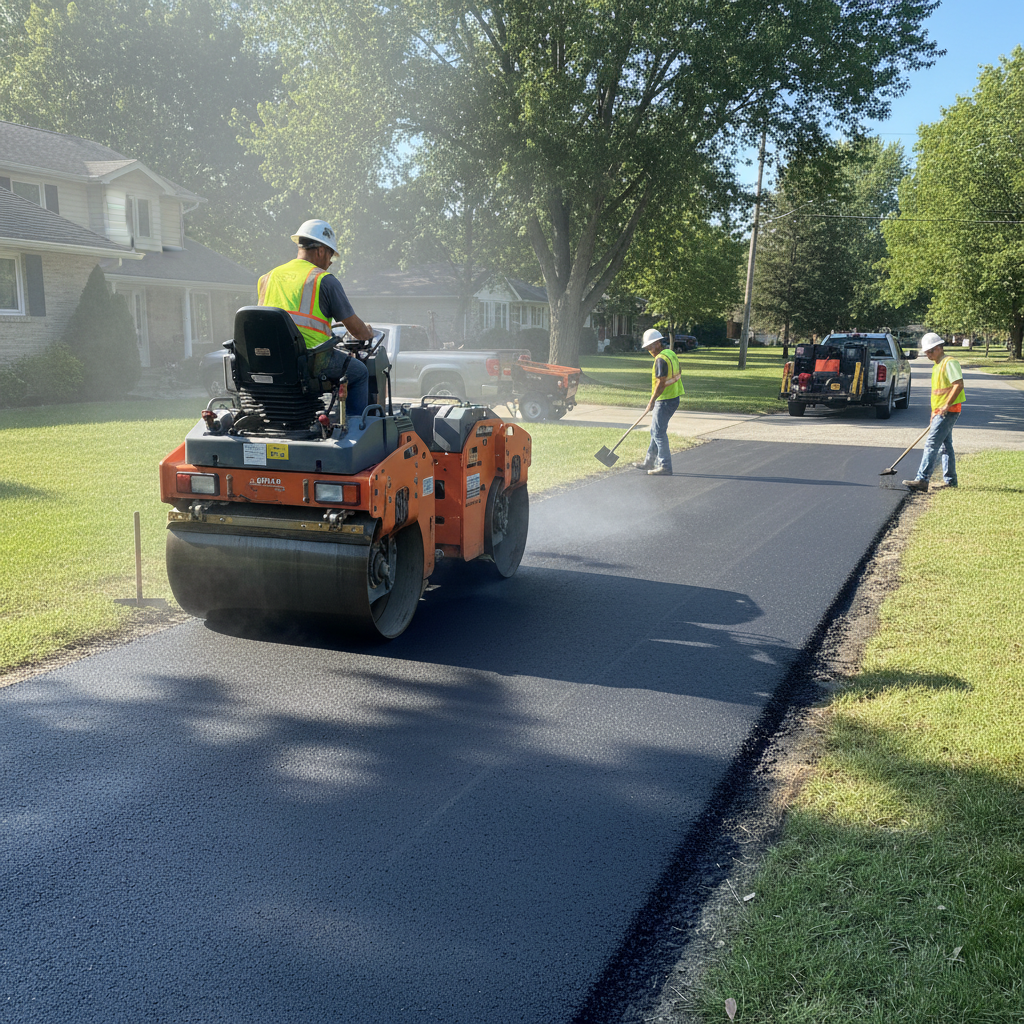
Driveway paving options and costs in Ohsweken
Ohsweken driveway paving needs to work hard in Ontario’s freeze–thaw climate—long winters, repeated ground freezing, and plenty of meltwater. With a population of about 1,500 (Statistics Canada, 2021 Census), the local contractor pool can be tighter than in the GTA core, and prime summer dates book quickly. Most private driveways in the area are on residential properties where off-street parking is essential, so homeowners typically care about safe snow clearing, curb-appeal, and minimizing future heaving. In the broader Toronto economic region, ground freezing and the associated freeze–thaw cycles are primary cost drivers, so the foundation (subgrade prep, drainage, and granular base) often makes the biggest difference between a driveway that lasts and one that “fails early.”
In practice, that means even before you pick asphalt or interlock, the quote is heavily influenced by excavation depth, how well water can drain away from the slab or pavement, and whether we’re correcting a gentle slope issue. Late spring through early fall is the practical paving season; asphalt placement also needs adequate air/aggregate temperatures, which concentrates demand and can push pricing higher on rush jobs. If you’re paving near Six Nations of the Grand River area roads, many homeowners schedule around plough cycles and service access, and that can affect mobilization and layout time.
Below are typical homeowner cost ranges you’ll see for Ohsweken projects with the proper base and installation approach. Use the table to compare materials by service life and ongoing upkeep, then we can fine-tune pricing to your site.
| Material |
Lifespan |
Maintenance |
Best For |
Price per sq ft |
| Asphalt (new installation, proper base) |
12–20 years |
Seal coat every 3–5 years; spot crack repair as needed |
Lowest upfront cost with good, consistent performance when drainage is right |
$6–$14 |
| Asphalt (overlay on existing gravel base) |
10–15 years |
Seal coat every 3–5 years; monitor for base settlement |
When subgrade is stable and you’re upgrading an existing gravel approach |
$5–$12 |
| Interlocking concrete pavers |
25–40 years |
Joint sand refresh 1–2 times; occasional re-leveling of a section |
High curb appeal; easy repair without replacing the whole driveway |
$12–$25 |
| Poured concrete (broom finish) |
20–30 years |
Sealer optional; crack sealing as needed; monitor scaling in winter |
Smooth, durable surface if air-entrainment and jointing are done correctly |
$10–$22 |
| Exposed aggregate concrete |
20–30 years |
Sealer recommended; periodic crack sealing |
Better slip resistance and a more premium finish than plain broom concrete |
$13–$26 |
| Gravel / crushed stone (budget option) |
3–8 years |
Rake/top up 1–2 times per season; weed control |
Short-term solution or when drainage must be improved before paving |
$2–$6 |
Prices are estimates only and vary by project scope, site access and material selection.
What affects the price of paving in Ohsweken
Even when neighbours pick the same material, driveway quotes in Ontario can easily differ by 30–50%. The main reason is that “paving” in the Toronto region is rarely just laying asphalt or concrete—it’s excavation, granular base, compaction, drainage correction, and correct mix design for freeze–thaw performance. In Ohsweken and the Toronto economic region, the frost depth and freeze–thaw cycles are decisive cost factors. Toronto frost studies commonly estimate ground freezing roughly 3–4 feet, so installers typically need a deeper, properly compacted granular base to limit heaving and cracking. Deeper frost means more base material and more labour, and it also increases the importance of keeping water away from the pavement.
Another cost driver is the compressed paving season. Hot-mix asphalt placement generally requires air temperatures above about 10°C, so spring scheduling becomes tight and prime dates can cost more. That’s one reason a straightforward asphalt driveway might land in the $3,500–$8,000 band, while a more involved full-depth rebuild (especially with tear-out and drainage fixes) can push toward the upper end. On the concrete side, the same freeze–thaw environment can mean higher costs for air-entrainment and jointing work; a typical concrete driveway often sits in the $6,000–$15,000 range depending on finish and whether we’re correcting grades.
Concrete examples that commonly change cost in Ohsweken: (1) adding proper slope and edge drainage can add work up front, but it reduces future cracking and salt-related deterioration; (2) removing an old slab that’s rocking can add break-and-haul time; and (3) choosing exposed aggregate can increase material and finishing time. Housing age also matters: older properties may have softer subgrades, thicker buried organics, or outdated drainage paths—fixes that show up in the dollar amount quickly.
| Price Factor |
Why It Matters |
Cost Impact |
| Driveway area in sq ft |
Materials and asphalt/concrete tonnage scale directly with area |
Highest impact; often the biggest single line item |
| Base depth required |
Frost line determines granular thickness to limit heaving |
Can add major excavation and base material costs |
| Grading and drainage work |
Water control reduces freeze–thaw damage and surface deterioration |
Often a significant add if the site is flat or low |
| Tear-out of existing surface |
Breaking and hauling adds labour, disposal fees, and equipment time |
May push the project toward the upper end of your material band |
| Edge restraints and curbing |
Prevents paver spread and maintains straight, clean borders |
Higher cost for pavers; typically worthwhile for longevity |
| Sealing requirement |
Asphalt needs sealing after curing to slow moisture ingress |
Adds a future maintenance budget; improves life |
| Site access |
Narrow/tight lots slow equipment movement and increase labour time |
Can increase installation time and mobilization cost |
| Asphalt mix specifications |
Freeze–thaw-rated mix costs more but resists Ontario conditions |
Moderate increase; helps reduce early fatigue cracking |
Permits & regulations in Ontario
In Ontario, paving a private driveway within your own property typically does not require a building permit—especially when you’re replacing an existing surface and staying within your property limits. Where permits and approvals often come in is when work affects the municipal right-of-way (boulevard) or changes how stormwater drains. That can include a new or altered curb cut, any changes to boulevard grading, or adjustments that redirect storm drainage. In many cases, you’ll need municipal approval before any work begins in that area, and the municipality may require documentation showing how water will be handled.
Some municipalities also have lot-grading bylaws. These can restrict how close a hard surface can be installed to property lines or how runoff is managed so it doesn’t flow onto neighbouring properties. Before excavation, you should always arrange utility locates through Ontario One Call to mark buried services. That step is non-negotiable for safe trenching and for avoiding service strikes.
To verify your contractor in Ohsweken (and across Ontario), ask for proof and check it yourself: (1) confirm their Ontario licence/registration where applicable for paving/excavation work—use the contractor licensing/registry resources listed by the appropriate Ontario body; (2) request a current certificate of insurance (liability) showing adequate coverage for driveway work; (3) confirm WSIB coverage or that they have an acceptable clearance letter—this is especially important if sub-trades are involved; and (4) ensure the certificate matches the legal name on the contract. Then keep copies with your contract and warranty paperwork.
Asphalt vs pavers vs concrete for Ohsweken driveways
For Ohsweken driveways, asphalt, interlocking pavers, and concrete all can perform well, but they fail differently in freeze–thaw. Asphalt is usually the lowest upfront option, and when installed with a proper granular base and good drainage it handles winter traffic reasonably well; it does, however, need sealing every 3–5 years to slow moisture penetration and reduce oxidation. Interlocking concrete pavers cost more initially, but they’re the most forgiving in Ontario conditions because individual stones can be lifted, re-leveled, and reset without replacing the entire surface—useful if you ever have a subgrade repair. Poured concrete sits in the mid-range for upfront cost, but it’s more sensitive to cracking if air-entrainment, correct finishing timing, and control joints aren’t done correctly for Ontario’s freeze–thaw and de-icing habits.
In the Toronto market, the frost-impacted approach is similar across materials: plan for deeper base and dependable water management so water doesn’t sit under the pavement and then expand when it freezes. With asphalt and pavers, edge restraints and proper subdrainage are critical in preventing movement. With concrete, joint spacing and slab design determine how it relieves stress—otherwise cracks can open after repeated cycles.
For a typical homeowner decision, the price difference is often justified by expected maintenance and repair strategy. For example, if asphalt lands in the $3,500–$8,000 range but pavers come in around the $9,000–$20,000 band, pavers can be worth it when you want maximum curb appeal and the ability to repair a small section after a base issue—especially where plowing and salt exposure are consistent each winter.
| Material |
Frost Resistance |
Curb Appeal |
Repair Method |
Lifespan |
Price Band |
| Asphalt (sealed regularly) |
Good with correct base and sealing; performance depends on drainage and mix |
Medium |
Seal/crack-fill; patch sections; overlays if needed |
12–20 years |
$3,500–$8,000 |
| Interlocking concrete pavers |
Excellent because stones can move slightly with proper base; joints help relieve stress |
High |
Lift/reset individual units; localized base repairs without full replacement |
25–40 years |
$9,000–$20,000 |
| Poured concrete (air-entrained) |
Good when air-entrained and jointed; otherwise cracking risk increases |
Medium |
Crack sealing and patching; larger repairs may require section removal |
20–30 years |
$6,000–$15,000 |
| Exposed aggregate concrete |
Good with proper design and curing; surface texture holds up well under winter use |
High |
Targeted patching; sealing to maintain appearance and reduce scaling |
20–30 years |
$8,000–$18,000 |
| Permeable pavers (drainage grid) |
Very good for water management when the underlying drainage system is engineered |
High (modern look) |
Section lift/reset and drainage inspection if clogging occurs |
20–35 years |
$10,000–$22,000 |
| Chip seal / tar-and-chip |
Moderate; tends to be less preferred for driveways with heavy salt/plow frequency |
Low to medium |
Spot repairs; recoat cycles as aggregate wears |
7–15 years |
$4,000–$9,000 |
How to choose a paving contractor in Ohsweken
Choosing the right paving contractor in Ohsweken is mostly about proof and process. First, verify Ontario coverage: ask for a current certificate of insurance (liability) and confirm their WSIB coverage or a clearance letter. If they use sub-trades, you want to see that coverage reflected in the paperwork or documented clearly in the contract—otherwise you can end up responsible for issues on site. Next, check licensing/registration where applicable using the appropriate Ontario online resources and confirm the contractor name matches the agreement.
Then get 2–3 itemised written quotes. You want a breakdown that separates labour and materials, and clearly shows base thickness, excavation depth, compaction, drainage corrections, and disposal/haul-away. Avoid “lump sum” quotes that don’t say what’s included. Carefully read exclusions: will they remove topsoil and organics? Is disposal of old concrete/asphalt included? Is the contractor responsible for any permit/municipal approval work if the job touches the boulevard/right-of-way? Also confirm whether the quote includes edge restraints, geotextile (if needed), and the correct granular specification for Ontario frost.
Look at warranty terms: workmanship warranty length, product/manufacturer warranty details, and whether the warranty is transferable if you sell the property. For payment schedule, never pay more than 10–15% upfront; hold back a portion until the job is complete and you’ve received final documentation. Finally, ask for a written start date and realistic completion estimate so you can plan around the short paving window.
- Confirm WSIB coverage (or clearance letter) and keep a copy of the document.
- Request liability insurance certificates showing current coverage and policy limits.
- Verify the contractor’s Ontario registration/licence details using the official online registry.
- Get 2–3 itemised quotes with labour and materials separated—not just one total price.
- Ensure the scope lists excavation, base material type, compaction steps, and thickness.
- Confirm drainage plan: slope correction, ditching, or subdrain where required.
- Clarify tear-out scope and disposal/haul-away for old concrete/asphalt.
- Check whether permits/municipal approvals (if any) are included or the homeowner is responsible.
- Verify edge restraints/curbing for pavers so joints don’t spread under freeze–thaw.
- Ask about asphalt mix and whether it’s designed for Ontario freeze–thaw conditions.
- Confirm the warranty: workmanship length, what triggers a claim, and exclusions.
- Set payment terms: keep upfront payment to 10–15%, and hold back until final walkthrough.
In Ohsweken, red flags I’ve seen include: contractors who won’t show insurance/WSIB documents; quotes that omit base thickness and drainage; no written start/completion dates; “cheap” pricing with no plan for frost-impacted granular foundation; and pressure to pay most of the balance before the final inspection and cleanup.
Frequently asked questions — paving in Ohsweken
What is a driveway apron and do I need one in Ohsweken?
A driveway apron is the transition area between your driveway and the road/boulevard—often the paved portion that sits around the curb cut and helps manage slope, drainage, and plow impacts. In Ohsweken, whether you “need” one depends on how your current approach meets the municipal road allowance and how water is handled at that transition. If you’re simply resurfacing within your property limits, an apron may not be part of the scope. But if you’re changing the curb cut, altering boulevard grading, or redirecting storm drainage, approvals in Ontario may be required. For any work near the municipal right-of-way, confirm with your municipality first and have utility locates completed before excavation.
How do I maintain my driveway through Ohsweken winters?
Ontario winters beat on driveways through freeze–thaw cycles, meltwater, and repeated plowing. For asphalt in Ohsweken, keep an eye on cracks and seal them promptly so water can’t migrate down into the base; if your driveway is within the $3,500–$8,000 range, it’s especially important not to skip maintenance, because early water intrusion shortens lifespan. During snow clearing, avoid aggressive metal-blade scraping and try to remove snow soon after storms to reduce the chance of ice build-up. Use sand where practical; excessive salt can accelerate surface wear on concrete. After thawing, watch for ponding—if water lingers, drainage is likely not right and may require base grading corrections rather than repeated surface patches.
Is it worth sealing a new driveway right away in Ohsweken?
Typically, yes—provided the asphalt has cured. Sealing too early can trap moisture and lead to premature failures, so the key is timing and weather. In Ohsweken, wait for the asphalt to cure according to the product instructions and contractor recommendations, then apply a proper seal coat within the first 6–12 months. After that, plan on re-sealing every 3–5 years depending on traffic and winter maintenance practices. If you chose asphalt to stay closer to the $3,500–$8,000 band, sealing is one of the most cost-effective ways to protect your investment because it slows oxidation and reduces water penetration. Ask your contractor what cure time they used and what seal product they recommend for Ontario freeze–thaw conditions.
What is a chip seal driveway and is it suited to Ohsweken?
Chip seal (also called tar-and-chip) is an asphalt binder sprayed onto the surface followed by aggregate chips rolled into place. It can be cost-effective for certain low-volume applications, but in Ohsweken the frequent freeze–thaw cycles and winter maintenance can be harder on chip seal than on fully paved systems with engineered base prep. If your home has heavy plowing, consistent salt exposure, or a driveway that already has drainage issues, chip seal may not be the best long-term choice. It can also look rougher as aggregate wears. If you’re comparing options near the $4,000–$9,000 band, we can evaluate whether a proper base rebuild and asphalt paving would offer better durability and fewer maintenance calls over time.
How much does driveway crack repair cost in Ohsweken?
Crack repair cost varies with crack length, width, and whether the base is moving. For Ohsweken, minor “hairline” cracks that are cleaned and sealed are usually less than patching a broken section. Larger cracks, alligator cracking, or areas where edges have spalled can require saw-cutting and partial replacement, which costs more because it involves deeper prep. A common homeowner expectation is that smaller repairs can be handled within a few hundred dollars, while bigger segmented repairs can climb significantly depending on surface area and disposal. As a reference point, sealing & repair work often falls roughly in the $300–$1,500 range for typical touch-ups, but any repair should also include a base/drainage diagnosis so you’re not paying to patch the same problem season after season in Ontario’s freeze–thaw climate.
What base thickness do I need for pavers in Ohsweken?
For pavers in Ohsweken, the correct base thickness is driven by frost depth, drainage, and subgrade condition. In the Toronto economic region, frost-impacted design commonly targets enough granular thickness to reduce heaving—often meaning a deeper granular base and strict compaction. A typical approach is: remove organics and unsuitable material, compact the subgrade, place geotextile where appropriate, then build a granular base (with a compacted layer depth that can vary based on site conditions). On top of that, pavers sit on a bedding sand layer to allow minor leveling adjustments. Because your driveway’s existing soil and drainage matter, the safest way to determine exact thickness is an on-site assessment and measurement—not a one-size number. Your installer should explain how they’re engineering for freeze–thaw and how they’ll ensure water doesn’t sit under the pavers.