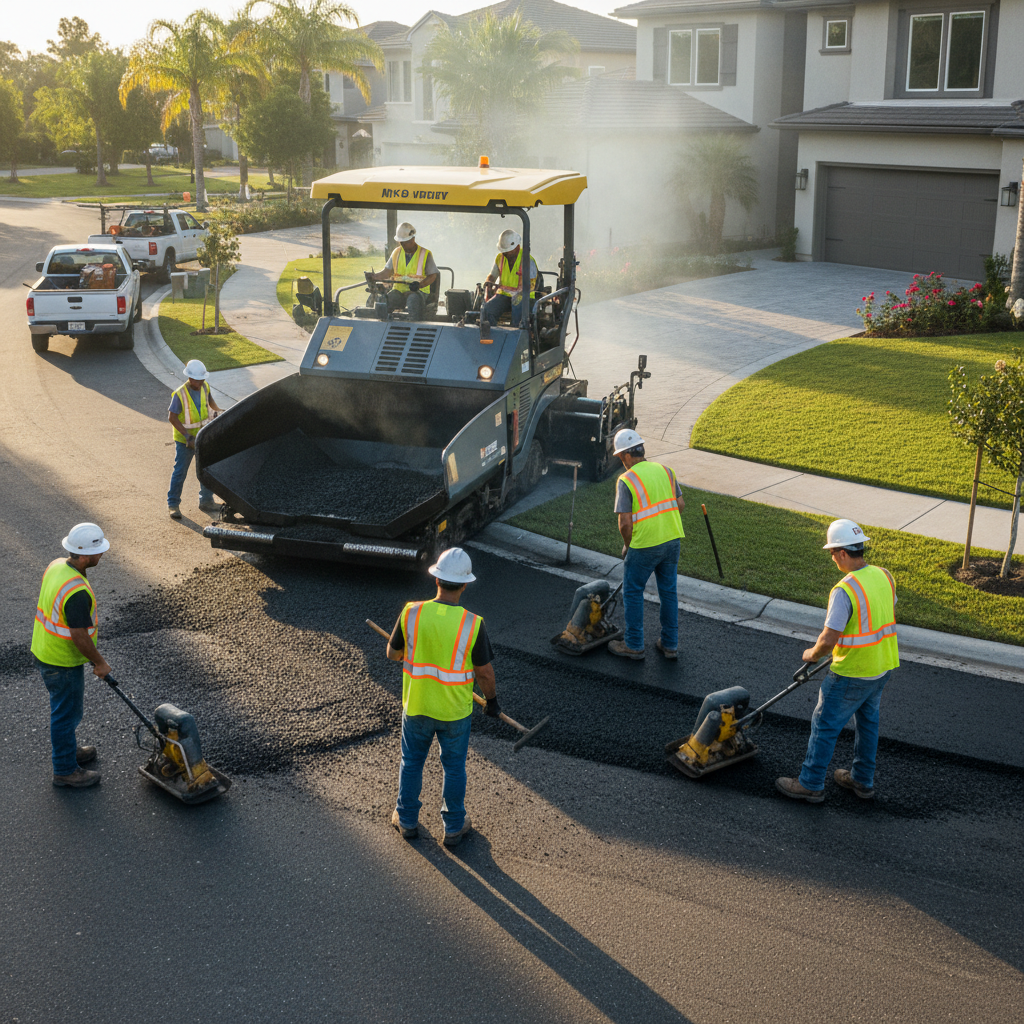
Driveway paving options and costs in Ottawa
Ottawa driveways come with a distinct mix of owner expectations and winter realities. With Ottawa’s homeowner households at 260,220—and 63.9% of households own (Statistics Canada, 2021 Census)—there’s a steady demand for upgrades like asphalt resurfacing, interlock replacement, and concrete rebuilds. In the city, many properties are single-detached homes, representing 41.7% of dwellings (Statistics Canada, 2021 Census), so the addressable market for private driveway work is large and competitive among contractors.
Pricing in Ottawa is shaped by freeze–thaw cycles and frost depth (commonly modelled around 1.8 m), which means contractors can’t “skip” excavation and drainage. A properly engineered base is the difference between a driveway that ravelled in three winters and one that holds up for 15+ years. The shorter paving season also matters: hot-mix asphalt needs warm air for paving and compaction, so scheduling in spring and summer is tighter, which can push costs toward the higher end of the typical bands.
Service demand is especially strong in established residential areas with older housing stock—think neighbourhoods like Orléans and the inner-city core around Vanier, where many driveways were built decades ago and are due for major base correction. From there, you can compare the realistic material choices below, based on what we typically see for residential driveway sizes in Ottawa.
| Material |
Lifespan |
Maintenance |
Best For |
Price per sq ft |
| Asphalt (new installation, proper base) |
12–20 years |
Sealcoat about every 3–5 years |
Value-focused homeowners who want a smooth, dark finish |
$5.50–$9.50 |
| Asphalt (overlay on existing gravel base) |
8–14 years |
Sealcoat sooner if surface oxidizes |
When the base is adequate and you’re reducing excavation |
$4.50–$8.00 |
| Interlocking concrete pavers |
20–30 years |
Weed control; occasional stone re-leveling |
Premium curb appeal and easy spot repairs |
$10.00–$18.00 |
| Poured concrete (broom finish) |
25–35 years |
Minimal; watch for scaling in the first winter |
Low-maintenance hardwearing driveway |
$11.00–$19.50 |
| Exposed aggregate concrete |
25–35 years |
Low; occasional sealing depending on surface |
Better slip resistance and a decorative look |
$13.00–$22.50 |
| Gravel / crushed stone (budget option) |
3–8 years |
Re-grade and top up every 1–3 years |
Short-term solution or overflow parking |
$3.00–$6.00 |
Prices are estimates only and vary by project scope, site access and material selection.
What affects the price of paving in Ottawa
In Ottawa, two homes with the same driveway width can land in very different price ranges because the “hidden work” varies. It’s common to see quote-to-quote swings of roughly 30–50% across Ottawa and Ontario when one contractor prices an all-in base rebuild and another assumes the existing base is usable. Labour rates, equipment mobilization, and disposal requirements also move the total—especially in a market where frost-driven excavation is expected, not optional.
Frost depth and freeze–thaw cycles are decisive cost factors. Ottawa’s structure design is commonly planned around a frost penetration model of about 1.8 m. That typically pushes you toward a thicker compacted granular base and careful drainage. A deeper, properly compacted base (often 6–12 inches of granular structure in Ontario applications, depending on soil and design) reduces heaving and cracking that show up after winter. It also means more stone, more hauling, more compaction passes, and more time on site.
The paving season is also shorter: hot-mix asphalt needs warm conditions (air temperatures generally above 10°C) for proper laying and compaction, and contractors try to stack jobs into the best window. In a tight schedule, demand can push asphalt driveway paving toward the middle or upper portion of the typical band of $4,500 – $9,000 for many residential projects. Concrete and pavers can be cost-competitive when base reconstruction is already required, but poorly drained sites can increase excavation and edging costs for all materials.
Concrete examples: a driveway with a wet spring turnout may require sub-drainage and pump-out prep (raising costs). Conversely, a straightforward tear-out with good access and stable subgrade can keep concrete closer to the mid-range (often aligning with the $7,000 – $16,000 driveway band) because less base correction is needed.
| Price Factor |
Why It Matters |
Cost Impact |
| Driveway area in sq ft |
Most material and labour scale directly with surface area |
Highest cost driver |
| Base depth required |
Frost line demands thicker compacted granular layers to prevent heaving |
Can add significant excavation and stone cost |
| Grading and drainage work |
Slope correction and drainage improvements control water before it freezes |
Often noticeable on sloped lots and wet areas |
| Tear-out of existing surface |
Breaking, loading, and hauling old asphalt or concrete adds labour and disposal fees |
Can materially raise the total |
| Edge restraints and curbing |
Pavers need edge support so joints stay tight under freeze–thaw movement |
Moderate to major depending on design |
| Sealing requirement |
Asphalt should be sealed after about 6–12 months to protect against oxidation |
Adds planned recurring cost |
| Site access |
Narrow gates or soft shoulders slow equipment movement and increase labour time |
Often increases labour hours |
| Asphalt mix specifications |
Freeze–thaw-rated mixes help resist raveling and cracking in Ottawa winters |
Can push asphalt cost toward the upper band |
Permits & regulations in Ontario
For Ottawa homeowners, the “permit vs no permit” answer usually depends on whether you’re working strictly within your own property or affecting the city’s right-of-way. In most cases, paving a private driveway within your own property footprint (for example, replacing asphalt or pavers on your lot) typically does not require a building permit. However, work in the municipal right-of-way commonly does require municipal approval—this includes new or modified curb cuts, changing boulevard areas, or altering storm drainage elements such as catch basins, culverts, or drainage patterns connected to municipal infrastructure. If your driveway ties directly into the curb line or modifies how runoff leaves the property, assume you’ll need approval first.
Step-by-step, start with utility locates before excavation: call Ontario One Call (formerly 1-800-DIG-SAFE) so buried services are marked. Next, confirm any lot-grading rules that may limit how close the hard surface can be to property lines and how runoff must be directed.
Before signing, verify the contractor’s Ontario credentials. Ask for: (1) their Ontario business registration and any applicable paving-related licensing/registration where required in their trade category; (2) liability insurance with current dates; and (3) WSIB/WCB clearance or coverage details. For reference, you should be able to produce a certificate of insurance showing your address named (or at least your property location covered) and a clearance letter or proof of active coverage. If a contractor can’t provide these documents quickly, it’s a red flag.
Asphalt vs pavers vs concrete for Ottawa driveways
Choosing a driveway material in Ottawa is really about balancing upfront cost, winter performance, and how you want repairs handled after a few tough seasons. Asphalt is often the lowest upfront option, but it’s a maintenance system: it should be sealed after about 6–12 months, then typically every 3–5 years. In Ottawa’s freeze–thaw climate, that seal helps slow moisture infiltration and oxidation that can lead to raveling and cracking. When installed on a properly engineered base and well-drained subgrade, asphalt in our region commonly targets the $4,500 – $9,000 driveway band for many residential jobs.
Interlocking concrete pavers cost more upfront, but Ottawa homeowners like them because they’re repairable without tearing out the entire driveway. If a section settles due to poor drainage or localized soil movement, you can lift and re-set affected stones. That matters in a market shaped by frost and repeated cycles across the area. Pavers generally fall into the higher band of $6,000 – $15,000, and the extra cost is often justified where curb aesthetics matter or where you expect future spot repairs.
Poured concrete (including air-entrained mixes) usually lands mid-range to upper-midrange. Concrete can be long-lasting—especially when the mix is air-entrained and joints are done correctly—but it’s still susceptible to freeze–thaw-related cracking if drainage is poor or if de-icing is aggressive in early winters. For Ottawa’s routine of plowing and salt exposure, drainage design and base depth are what separate “durable” from “problematic,” regardless of whether you pick asphalt, pavers, or concrete.
Concrete example: If an asphalt driveway quote is near the low end because it assumes a thin base, you might pay less at day one. But if the site needs deeper granular structure and drainage correction, the final difference between materials can shrink—sometimes making pavers or concrete competitive once base work is accounted for.
| Material |
Frost Resistance |
Curb Appeal |
Repair Method |
Lifespan |
Price Band |
| Asphalt (sealed regularly) |
Good with engineered base and drainage |
Moderate (clean, dark finish) |
Patch and seal localized failures |
12–20 years |
$4,500 – $9,000 |
| Interlocking concrete pavers |
Very good when restrained and well-drained |
High (design variety) |
Lift/replace affected units |
20–30 years |
$6,000 – $15,000 |
| Poured concrete (air-entrained) |
Good with air-entrainment and joints |
Moderate to high (finish options) |
Patch for small spalls; larger issues may require section replacement |
25–35 years |
$7,000 – $16,000 |
| Exposed aggregate concrete |
Good with proper curing and base prep |
Very high (textured, decorative) |
Patch with matching material; often limited visible repair |
25–35 years |
$8,000 – $18,000 |
| Permeable pavers (drainage grid) |
Excellent moisture management when designed correctly |
High (modern look) |
Replace grid/pavers as needed |
20–30 years |
$7,500 – $18,500 |
| Chip seal / tar-and-chip |
Variable; depends heavily on base and binder |
Low to moderate (texture) |
Spot work and re-seal over time |
6–12 years |
$4,000 – $8,000 |
How to choose a paving contractor in Ottawa
Picking the right paving contractor in Ottawa comes down to verification and clarity. Start by confirming Ontario coverage and legitimacy. Ask for their liability insurance certificate (current insurer, policy dates, and coverage limits). For workers, request proof of WSIB/WCB coverage or clearance—so you’re not left responsible if a worker is injured on your driveway. If you don’t see documents quickly, ask again; a reputable crew should provide them without pressure. Also verify they carry coverage that matches the type of work (excavation, asphalt, concrete, paver installation) and that the certificate is valid for the project term.
Then, get 2–3 itemised written quotes—not just a lump sum. You want labour and materials broken out so you can compare like-for-like: excavation depth, base materials (and compaction method), geotextile usage if specified, disposal fees, and whether disposal is included. Confirm what’s excluded too: tree root removal, restoring grass beyond a set limit, snow/ice removal before start, and any permit work if your driveway ties into the boulevard.
Warranty matters in Ottawa because freeze–thaw failures can show up after a couple of winters. Ask for workmanship warranty length, product/manufacturer warranty details, and whether any warranty is transferable if you sell. For payment, never do a large upfront deposit; keep it to about 10–15% and use a holdback until the job is complete and cleaned up. Finally, insist on a start date and completion estimate in writing—Ottawa’s weather window is real, and delays happen less when the timeline is agreed early.
- Ask for WSIB/WCB proof and ensure it’s valid for your project dates.
- Provide a certificate of insurance for liability; verify coverage amount and expiry date.
- Confirm the scope includes utility locates and states who coordinates them.
- Request an itemised quote: excavation, base, asphalt/concrete/pavers, edging, compaction, disposal.
- Check whether geotextile is included where subgrade is questionable.
- Confirm grading and drainage plan: slope, outlet direction, and any sub-drain where required.
- Ask what compaction testing method is used (or how they ensure density) and whether they follow a spec.
- Clarify tear-out details: breaking method, hauling, and whether disposal is included.
- Verify asphalt sealing: when it’s applied (often after 6–12 months) and if included or recommended.
- Confirm paver restraint/edge details to reduce shifting during freeze–thaw cycles.
- Get warranty terms in writing, including start date, coverage, and exclusions.
- Use a payment schedule with a holdback until final walkthrough and cleanup.
Common red flags in Ottawa include: quotes that don’t specify base depth or drainage work, missing insurance/WSIB documentation, vague scopes that omit disposal, pressure for large upfront payments, and crews that won’t commit to a start date/completion window for the short paving season.
Frequently asked questions — paving in Ottawa
How long does a paved driveway last in Ottawa?
In Ottawa and the Ottawa economic region, typical driveway life depends less on the “label” of asphalt or concrete and more on frost-proofing details—especially base thickness and drainage. With a properly built asphalt driveway on a well-graded, compacted granular base, many homeowners see about 12–20 years. Pavers often reach 20–30 years because individual units can be reset if localized movement occurs. Poured concrete, when air-entrained and correctly jointed, commonly targets 25–35 years. If a driveway failed early, it’s frequently because water got trapped under the surface during freeze–thaw cycles. That’s why quotes in Ottawa should show the drainage/grading plan and compaction approach, not just the finished material.
When is the best time of year to pave in Ottawa?
The best window is typically late spring through summer when temperatures are reliably warm and dry enough for paving and compaction. For asphalt, hot-mix requires adequate air temperatures—commonly above 10°C—to achieve proper placement and density. If crews try to push too early, you can get poor compaction and early surface distress. In Ottawa, scheduling matters because the paving season is shorter than in milder regions, so demand builds quickly. Plan to book after winter in early warm weeks, and confirm your contractor’s timeline in writing. For concrete, timing is also weather-dependent because curing and finishing are sensitive to temperature and wind exposure.
How deep should the base be for Ottawa's frost?
Base depth is project-specific, but Ottawa’s frost protection typically requires engineered granular structure designed to manage freeze–thaw movement. With frost depth often modelled around 1.8 m, contractors commonly design a thicker compacted granular base than you’d see in milder climates to reduce heaving and cracking. In Ontario applications, that granular structure can often translate to roughly 6–12 inches of compacted stone layers, depending on soil condition and drainage. The exact depth should come from your contractor’s site evaluation and base design, especially if you have poor drainage, a high water table, or clay. A quote should tell you base layers and compaction expectations—if it only gives a final material thickness, ask follow-up questions.
How often should I seal my asphalt driveway?
For Ottawa driveways, sealing is part of protecting your asphalt against oxidation and moisture intrusion. Most contractors recommend waiting until the new asphalt has cured—often about 6–12 months—then applying a sealcoat. After that first seal, many homeowners plan to reseal about every 3–5 years, depending on how much traffic, how harsh the winter exposure is, and how quickly the surface shows fading or minor raveling. If you’re comparing quotes, ask whether sealing is included in the initial price or treated as a separate maintenance step. As a practical reference point, asphalt driveway paving in Ottawa is commonly estimated around $4,500 – $9,000 for many residential scopes, but long-term performance depends on the later sealing schedule.
Why does my driveway crack and heave in winter?
Cracking and heaving in Ottawa usually come from moisture and frost acting on the structure. Freeze–thaw cycles expand water in the ground and in any weak, saturated layers beneath the pavement, which can push surfaces upward and open up cracks. Common causes include an undersized or poorly compacted granular base, insufficient drainage or grading so water stays pooled, and lack of proper edge restraint. Older housing stock in Ottawa—plus driveways built before modern drainage practices—can also contribute to subgrade variability, especially where soil is clay-heavy or where the driveway intercepts runoff from the yard. De-icing salt can worsen surface scaling on some materials, but the root driver is almost always moisture management. A contractor should assess drainage pathways before recommending “patching only.”
Do I need a permit to pave my driveway in Ontario?
Often, a private driveway paving project within your own property footprint does not require a building permit in Ontario. In Ottawa, however, you typically need municipal approval when the work affects the municipal right-of-way—such as a new or modified curb cut, changes to boulevard areas, or alterations to storm drainage tied into municipal infrastructure. Before excavation, arrange utility locates through Ontario One Call, and confirm any lot-grading or stormwater runoff rules with the local municipality. When you request quotes, ask whether the contractor includes any permit/approval handling if your driveway connects to the curb or drainage system. A professional quote should clearly state what approvals are needed and who is responsible.