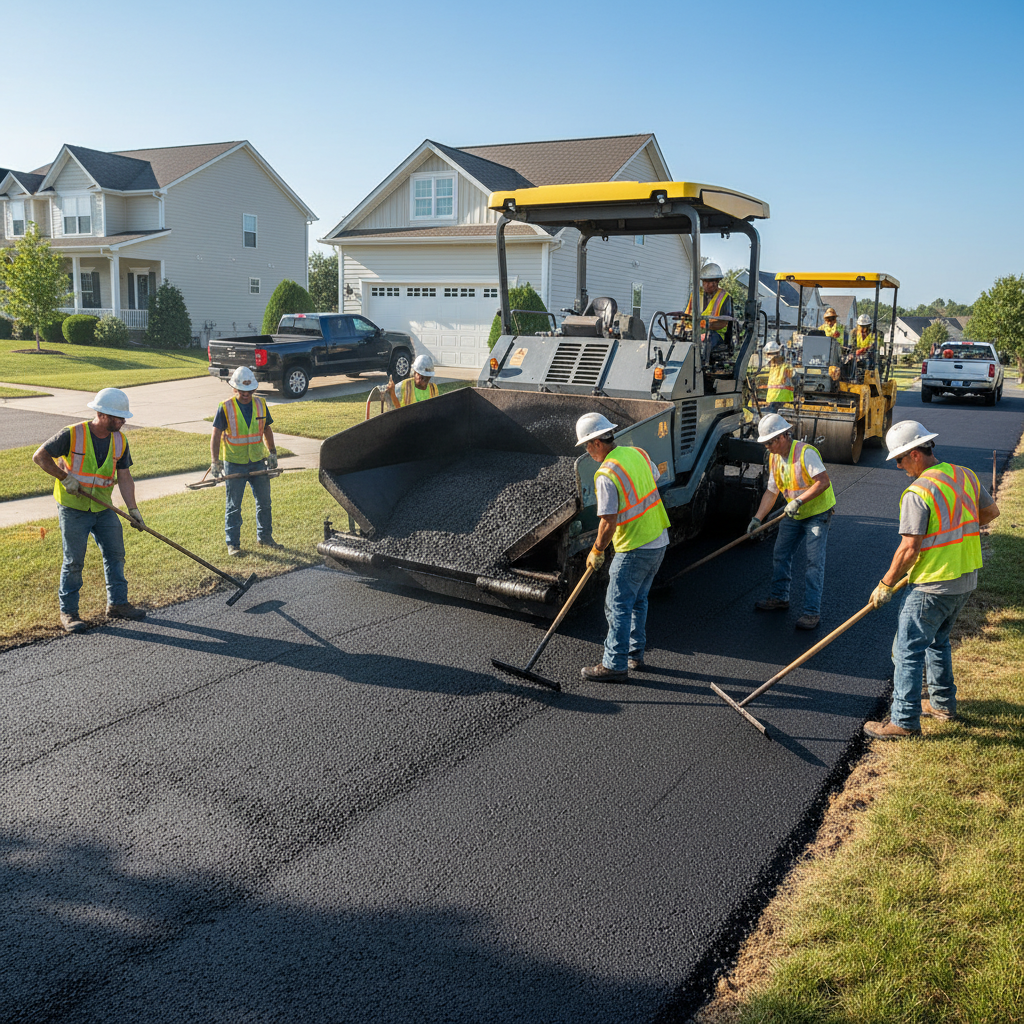
Driveway paving options and costs in St. Catharines
In St. Catharines, driveway paving decisions usually start with one question: what will hold up through our Hamilton–Niagara Peninsula winter? With 136,803 residents in 2021 and 55.6% of homes being single-detached, most private driveways are tied to older housing stock—71.0% of homes were built before 1981—so you’re often dealing with uneven subgrades, aging drainage, and thicker frost exposure at the surface. That matters because in our moderate-to-cold Southern Ontario climate, freeze–thaw cycles are a major cost driver. Contractors typically plan for frost penetration around 1.2–1.5 m, which means a deeper compacted granular base (often 6–10" in residential work) and reliable runoff control to prevent frost heave, settlement, and early cracking.
Pricing also reflects how the market books out: the effective paving window here runs roughly April to October, and asphalt production depends on warm-enough conditions and compaction. When spring demand spikes, labour and equipment get tighter, and you’ll see mid-to-upper Ontario price ranges—especially in neighbourhoods like Port Dalhousie and the older core areas where excavation and drainage corrections are common. The good news is that proper base and drainage can represent 35–45% of your driveway budget, which is why “cheap paving” isn’t really cheap if it skips preparation.
Use the options below as a baseline, then compare quotes using the same thicknesses, base depth, drainage scope, and edge restraint details.
| Material |
Lifespan |
Maintenance |
Best For |
Price per sq ft |
| Asphalt (new installation, proper base) |
12–20 years |
Seal every 3–5 years |
Most cost-effective all-round choice for freeze–thaw |
$6 – $11 |
| Asphalt (overlay on existing gravel base) |
8–15 years |
Seal every 3–5 years; monitor edges |
When base is sound and thickness can be matched |
$5 – $9 |
| Interlocking concrete pavers |
25+ years |
Weed/clean as needed; re-sand and re-level spots |
Curb appeal and “repair without full replacement” |
$12 – $22 |
| Poured concrete (broom finish) |
20–30 years (with proper reinforcement) |
Occasional cleaning; seal if desired |
Low-spray maintenance look |
$10 – $17 |
| Exposed aggregate concrete |
20–30 years |
Seal periodically; clean/scrub staining |
Textured, slip-resistant finish |
$12 – $19 |
| Gravel / crushed stone (budget option) |
2–7 years (depends on drainage and traffic) |
Top up and re-grade annually |
Temporary solution or very low budget |
$3 – $6 |
Prices are estimates only and vary by project scope, site access and material selection.
What affects the price of paving in St. Catharines
Two homeowners in the same St. Catharines area can get quotes that differ by 30–50% for what looks like a “similar driveway,” and the reason is usually preparation. Asphalt, pavers, and concrete materials don’t account for most of the variability—your granular base, drainage corrections, and excavation do. In the Hamilton–Niagara Peninsula region, deeper frost exposure plus frequent freeze–thaw cycles mean contractors must build a driveway that stays stable when water expands in winter. If the granular base is too thin or the drainage can’t move water away from the subgrade, you’ll see potholing, settlement, and cracking sooner—so quality bids will price the extra base and proper compaction.
Seasonality pushes pricing too. Hot-mix asphalt generally requires favourable air temperatures (commonly above 10°C) for safe compaction, and our effective paving season is shortened. That tight window increases scheduling pressure in spring and early summer, particularly when multiple streets in a neighbourhood need similar prep and traffic control.
Concrete examples that change cost in St. Catharines: (1) older homes (many built before 1981) often have perimeter drainage that no longer directs water away, so contractors may need to regrade, add subdrains, or rebuild swales; (2) if your driveway ties into an existing garage slab or basement walkway, sawcutting and careful jointing add labour; and (3) if the subsoil is silty or clayey, moisture management and base rebuild can be more extensive. Those factors can move you from a “mid-band” asphalt install into the upper asphalt range, or make pavers look better in life-cycle terms even when the interlock price band is higher (for example, interlocking commonly lands in the $9,000 – $20,000 range for residential driveways).
Below are the factors that most often explain why one quote comes in lower while another is more realistic for our freeze–thaw conditions.
| Price Factor |
Why It Matters |
Cost Impact |
| Driveway area in sq ft |
Material and labour scale directly with surface area |
High |
| Base depth required |
Frost exposure requires adequate compacted granular thickness |
Very high |
| Grading and drainage work |
Correct slope and drainage reduce water that fuels freeze–thaw damage |
High |
| Tear-out of existing surface |
Breaking and hauling old asphalt or concrete adds labour and disposal |
Medium to high |
| Edge restraints and curbing |
Prevents paver spread and maintains asphalt/concrete shape |
Medium |
| Sealing requirement |
Asphalt performance depends on sealing after curing |
Low to medium (but important) |
| Site access |
Narrow lots slow equipment movement and increase hand labour |
Medium |
| Asphalt mix specifications |
Freeze–thaw rated mixes better resist Ontario winter cracking |
Medium |
Permits & regulations in Ontario
In Ontario, paving a private driveway within your own property typically does not require a building permit, especially when you’re simply replacing existing asphalt or concrete on the same footprint. However, work that affects the municipal right-of-way can trigger approvals and rules. In St. Catharines, that can include new or changed curb cuts, changes to boulevard grading, modifications that alter storm drainage patterns, or any construction that ties into municipal infrastructure. If you’re planning to change the driveway apron area at the street edge, confirm requirements with the City before work starts.
Some municipalities also have lot-grading and drainage expectations—rules that can restrict how close hard surfaces can be to property lines and how stormwater must be managed. The best practice is to ask your contractor to outline the planned grading and drainage plan in writing and then verify it with the local authority.
Step-by-step verification is simple and worth doing:
- Call Ontario One Call (utility locates) before excavation so buried services are marked.
- Confirm the contractor’s licensing status using Ontario’s relevant online resources (and ensure the certificate is current if they advertise being registered/insured for the trade).
- Ask for a Certificate of Insurance showing liability coverage and request WSIB/WCB clearance documentation (or the applicable coverage proof) before they start.
- Request disposal and debris handling details so you know who hauls away old material.
That paperwork and clear scope are what protect you if something goes wrong—especially in older St. Catharines neighbourhoods where utilities and drainage routes can be harder to predict.
Asphalt vs pavers vs concrete for St. Catharines driveways
For St. Catharines homeowners, asphalt, interlocking pavers, and concrete all “work,” but freeze–thaw performance and winter maintenance routines influence which one fits best. Asphalt is usually the lowest upfront cost and handles temperature swings with flexibility—so it’s popular in Southern Ontario. The tradeoff is maintenance: a proper asphalt driveway needs sealing after the initial cure (commonly within 6–12 months, then typically every 3–5 years) to protect against moisture intrusion and surface oxidation.
Interlocking concrete pavers have the highest curb appeal and the biggest upfront investment, but they’re also the most repairable: if a section settles, you can lift and re-level it without removing the entire driveway. That’s valuable in St. Catharines where older subgrades and drainage issues can create localized movement. Pavers also look great in neighbourhood streetscapes—think Lakeside-area aesthetics—but only if the base is built deeply enough and edged properly to prevent lateral spread.
Poured concrete is often mid-range and provides a clean finish, yet it’s more sensitive to movement if the base, reinforcement, and joints aren’t designed for winter. Concrete cracking can occur in freeze–thaw climates, particularly with improper air-entrainment or if de-icing salt exposure is heavy. Exposed aggregate can improve traction, but it still needs the same freeze–thaw-ready base and concrete design.
On the Hamilton–Niagara Peninsula, base prep depth and drainage are the deciding factors more than the surface choice. For example, a quality asphalt driveway might land in the $3,000 – $8,000 range, while interlocking commonly runs $9,000 – $20,000. That difference is justified when you value long-term curb appeal and want the option to repair individual blocks rather than re-surface everything after a few years.
| Material |
Frost Resistance |
Curb Appeal |
Repair Method |
Lifespan |
Price Band |
| Asphalt (sealed regularly) |
Good when base/drainage are correct |
Medium |
Patching and localized mill/overlay |
12–20 years |
$3,000 – $8,000 |
| Interlocking concrete pavers |
Very good with proper base and edge restraints |
High |
Remove and replace individual pavers/section |
25+ years |
$9,000 – $20,000 |
| Poured concrete (air-entrained) |
Good with the right mix and joints |
Medium |
Slab patching; larger cracks may need section removal |
20–30 years |
$7,000 – $18,000 |
| Exposed aggregate concrete |
Good when designed for freeze–thaw |
High (textured look) |
Patch/replace affected areas; match texture and finish |
20–30 years |
$8,000 – $18,500 |
| Permeable pavers (drainage grid) |
Best when used with engineered sub-base and drainage |
Medium to high |
Replace sections and clean filters/grids |
20+ years |
$10,000 – $22,000 |
| Chip seal / tar-and-chip |
Fair to good; performance depends on grading |
Low to medium |
Spot resurface and re-chip sections |
5–12 years |
$2,500 – $6,500 |
How to choose a paving contractor in St. Catharines
Choosing a paving contractor in St. Catharines is less about flashy photos and more about verifying the basics: coverage, competence, and scope clarity. First, ask for proof of Ontario licensing (if applicable to their trade), then request Certificates of Insurance showing liability coverage. For worker protection, confirm WSIB/WCB coverage (or provide the correct clearance documentation). A reputable crew won’t hesitate—if they do, consider it a red flag.
Next, get 2–3 itemised written quotes, not one lump-sum number. You want a breakdown that separates labour and equipment, excavation, granular base type and depth, drainage/grading, geotextile (if used), the asphalt or concrete thickness, and edge restraint. Make sure the quote states whether permit/approvals are included (when required), who handles debris disposal, and what happens if they find an underground service or unexpected soft subgrade.
Warranty is another key differentiator. Ask for the workmanship warranty length and what it covers (compaction, settlement, premature cracking/potholes tied to installation). Also confirm product/manufacturer warranty terms and whether it’s transferable if you sell the home.
Finally, payment schedule matters: never pay more than 10–15% upfront. Hold back the balance until the job is complete, inspected, and all site clean-up is done. In our freeze–thaw climate, timeline commitments should be in writing—start date, traffic restrictions, and an estimated completion date.
- Verify WSIB/WCB clearance and liability insurance before any excavation.
- Confirm contractor contact details and a physical service address.
- Request itemised labour/material quantities and thicknesses.
- Confirm granular base type (e.g., Granular A/B) and compacted depth.
- Ask how drainage will be handled (slope, outlets, subdrain needs).
- Confirm whether geotextile fabric is included where soft soil is expected.
- Check edge restraints/curbs are included for pavers and critical asphalt edges.
- Ensure tear-out includes breaking/hauling and disposal fees.
- Ask about asphalt mix specs for freeze–thaw and air-temp compaction conditions.
- Clarify warranty terms for workmanship and any exclusions (salt, poor drainage, lack of sealing).
- Confirm the sealing plan for asphalt: timing after curing and frequency thereafter.
- Get start/completion dates in writing, including weather contingency.
Red flags in St. Catharines: contractors who refuse to show insurance/WSIB proof, quotes that don’t specify base depth or drainage work, “cheap asphalt” that skips edge restraints, promises to pave outside the practical season without proper compaction plan, and payment terms that ask for large upfront deposits.
Frequently asked questions — paving in St. Catharines
How do I compare paving quotes fairly?
In St. Catharines, the fairest way to compare asphalt, pavers, and concrete quotes is to match “apples to apples” on preparation, not just surface price. Ask each contractor for itemised details: granular base type and the compacted depth, whether they’re correcting grade and drainage, what thickness they’re placing, and whether edge restraints are included. For asphalt, confirm sealing is addressed—many quality jobs plan sealing after curing rather than treating it as optional. Also compare what’s included in tear-out and disposal, and whether traffic control is part of the scope. Finally, use the local price bands as a sanity check: for asphalt installations, many St. Catharines driveways land roughly in the $3,000 – $8,000 range depending on size and base work.
Can asphalt be laid in cold weather in St. Catharines?
Ontario’s freeze–thaw cycle makes cold-weather asphalt a risk, and St. Catharines crews generally avoid paving when temperatures are too low to achieve proper compaction and cohesion. While contractors sometimes complete small patch work during shoulder conditions, full driveway paving is typically planned for the April–October window when air temperatures support compaction (often aiming for conditions that can be maintained long enough for proper placement). If the weather turns cold during a job, a reputable contractor adjusts schedules or limits work areas rather than rushing. The key cost driver is still preparation: even with good asphalt, inadequate base and drainage can lead to early cracking and potholing as water freezes and thaws.
What is a driveway apron and do I need one in St. Catharines?
A driveway apron is the finished section at the street edge where your driveway meets the curb/boulevard area. In St. Catharines, whether you “need one” depends on how your existing driveway currently transitions to the street and whether you’re changing the curb cut or drainage pathway. If you’re modifying the entrance near the municipal right-of-way, you may need approval before construction because it can affect storm drainage and municipal features. A good contractor will explain what portion is on private property versus where municipal standards apply, then coordinate the correct scope. That’s also where inspections and approval timing can influence your schedule and quote—especially for older neighbourhoods with established drainage patterns.
How do I maintain my driveway through St. Catharines winters?
Winter maintenance in St. Catharines is mostly about preventing water from sitting in low spots and limiting surface damage from salt and traffic. For asphalt, don’t skip sealing: sealing after the initial cure and then every 3–5 years helps keep moisture out of the surface. During snowfalls, clear snow promptly and avoid gouging with metal edges. If you use de-icing products, use them strategically—excess salt can accelerate deterioration over time, especially if the driveway has fine cracks or poor drainage. The bigger win is to inspect after thaw cycles: look for areas that pond, depress, or develop soft edges. Those symptoms often point to drainage or base issues that can be corrected before they become expensive.
Is it worth sealing a new driveway right away in St. Catharines?
Usually, it’s worth sealing asphalt, but timing matters. Many asphalt driveways should be allowed to cure first—often within a 6–12 month window depending on weather, mix design, and how quickly the surface opens to traffic—before applying sealcoat. Sealing too early can trap moisture and reduce adhesion, while skipping it increases the chance of oxidation and water infiltration, which can lead to cracking through our freeze–thaw cycles. Your contractor should propose a schedule that fits St. Catharines conditions and the driveway’s exposure. If you’re comparing quotes, check whether sealing is included or quoted separately; sealing & repair typically sits around $400 – $2,000 depending on driveway size and condition.
What is a chip seal driveway and is it suited to St. Catharines?
Chip seal (also called tar-and-chip) is a surface treatment where a binder is applied and covered with aggregate chips. It can be a cost-effective option, but it’s not always the best match for every St. Catharines driveway—especially where you need a smooth driving surface for vehicles or where drainage is difficult. Chip seal performance depends heavily on correct grading and compaction and on using the right binder and aggregate for freeze–thaw conditions. In general, it’s better suited as a budget driveway solution or for low-traffic situations, while asphalt, pavers, or air-entrained concrete tend to provide more consistent long-term results. If you’re considering chip seal, ask what base depth they’re using and how they’ll address drainage so water doesn’t undermine the surface during winter cycles.