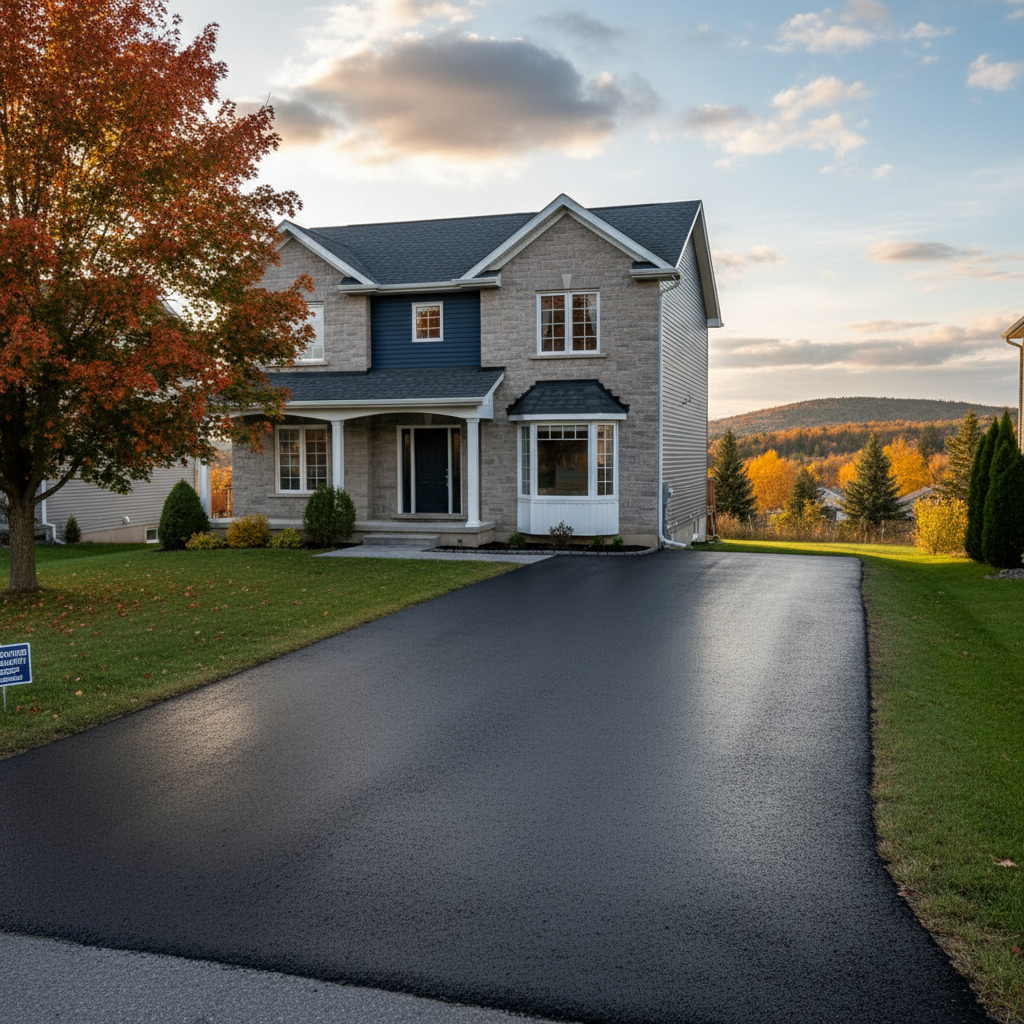
Driveway paving options and costs in Niagara Falls
Niagara Falls homeowners usually have three main choices when they’re resurfacing or replacing a driveway: asphalt, interlocking pavers, or concrete. In this city, most driveways are tied to single-detached homes—these make up 66.1% of dwellings—so the same paving decisions show up on thousands of streets across neighbourhoods like Chippawa and the older residential pockets near Victoria Avenue. (Statistics Canada, 2021 Census). Niagara Falls also has a sizable older housing stock (60.8% built before 1981), which matters because older lots often have uneven subgrades, weaker soils, or more variable drainage; when contractors correct those issues, your driveway cost rises.
In the Hamilton–Niagara Peninsula region, pricing is shaped by a moderate-to-cold Southern Ontario freeze–thaw climate. Contractors plan for frost penetration that can realistically push you toward a deeper, well-compacted granular base (often 6–10 inches) and reliable drainage—especially on clay and silty subsoils that are common locally. That base and drainage work can represent roughly 35–45% of a residential driveway budget. The other major driver is the paving season: asphalt paving is effectively April–October, and cold spring conditions can tighten scheduling and push mid-to-upper Ontario pricing for quality installations.
Below are practical budget ranges for common driveway builds in Niagara Falls so you can compare quotes apples-to-apples, then dial in the scope (base depth, drainage fixes, and tear-out) that most affects your final number.
| Material |
Lifespan |
Maintenance |
Best For |
Price per sq ft |
Price Range |
| Asphalt (new installation, proper base) |
15–25 years |
Seal every 3–5 years; crack fill as needed |
Value-focused driveways with good base/drainage |
$5.50–$9.00 |
$3,500 – $8,000 |
| Asphalt (overlay on existing gravel base) |
10–18 years |
Seal sooner (often 3–4 years); address settlement quickly |
Budget upgrades when base is confirmed sound |
$4.50–$7.50 |
$3,000 – $6,500 |
| Interlocking concrete pavers |
25–30 years |
Re-sand joints every so often; replace individual stones if needed |
Premium look and easy localized repairs |
$12.00–$18.50 |
$9,000 – $20,000 |
| Poured concrete (broom finish) |
20–30 years |
Seal/maintain periodically; joint upkeep |
Clean, simple, long-lasting surface |
$10.50–$16.00 |
$7,000 – $18,000 |
| Exposed aggregate concrete |
20–30 years |
Seal stain protection; keep joints maintained |
More traction and upscale finish |
$12.00–$18.50 |
$8,000 – $19,500 |
| Gravel / crushed stone (budget option) |
3–7 years |
Top up annually; weed control; re-grade |
Short-term solution or low budget |
$3.50–$6.00 |
$2,000 – $5,500 |
Prices are estimates only and vary by project scope, site access and material selection.
What affects the price of paving in Niagara Falls
Even when two neighbours in Niagara Falls want “the same driveway,” quotes can swing by 30–50% across the Hamilton–Niagara Peninsula and broader Ontario. The difference is usually not the asphalt or pavers—it’s the prep. Contractors price the whole system: excavation depth, the engineered base, drainage corrections, hauling, and the time needed to compact properly in spring and early summer. On older lots (and Niagara has plenty), additional grading and subgrade remediation can be the deciding cost factor.
In our moderate-to-cold climate, frost line depth and freeze–thaw cycles are decisive cost drivers. A deeper compacted granular base (often 6–12 inches) and good drainage help prevent frost heave and cracking. If a contractor is forced to rebuild more base due to weak soils or poor drainage, your budget can move from a typical asphalt range of $3,000–$8,000 toward the higher end once tear-out, regrading, and added base are included. Seasonality adds another layer: hot-mix asphalt requires air temperatures above roughly 10°C, so work concentrates April–October, and scheduling pressure during peak months can raise labour and equipment costs.
Concrete examples of local pricing impacts: (1) If your driveway ties into an older slope or downspout discharge area, drainage corrections can add excavation and pipe work—this may push concrete builds from mid-range $7,000–$18,000 higher. (2) If there are settled sections or failed subgrade in a drive apron area, the tear-out effort (especially breaking older concrete) can add hauling and disposal costs. On the flip side, driveways with good existing drainage and stable base can sometimes keep you closer to the lower end, because less base rebuild is needed.
| Price Factor |
Why It Matters |
Cost Impact |
| Driveway area in sq ft |
Most material and compaction time scales with surface area |
Often the biggest driver; can swing total cost by thousands |
| Base depth required |
Frost heave risk determines granular thickness and compaction effort |
Can add major cost if you need extra 2–4 inches or more |
| Grading and drainage work |
Proper slope and drainage protect the base during melt cycles |
Common source of quote differences; may include swales/pipe/culverts |
| Tear-out of existing surface |
Breaking and hauling concrete or old asphalt adds labour and disposal |
Can add several hundred to multiple thousands depending on thickness |
| Edge restraints and curbing |
Prevents paver spread and helps asphalt edges resist raveling |
Moderate cost; important for long-term performance |
| Sealing requirement |
Asphalt needs sealing after 6–12 months to slow aging |
Small line item, but impacts lifecycle and long-term value |
| Site access |
Narrow/tight lots increase labour time and equipment limitations |
Can raise labour costs and reduce production speed |
| Asphalt mix specifications |
Freeze-thaw-rated mixes help performance in Ontario winters |
Often modest-per-sq-ft increase for the right spec |
Permits & regulations in Ontario
For most Niagara Falls homeowners, private driveway paving on your own property typically does not require a building permit. However, there are common exceptions: work that changes items in the municipal right-of-way generally needs municipal approval. That can include installing or changing an apron/curb cut, altering the boulevard, or making changes that affect storm drainage (for example, reconnecting or rerouting a drain leading toward the street).
Also confirm any lot-grading rules that restrict how close a hard surface can be to property lines or how drainage must be handled. In practice, these are the kinds of issues that show up more often on older neighbourhood properties.
Before excavation, always get utility locates through Ontario One Call. A good contractor will schedule this and share the locate ticket/markings.
To verify the contractor’s compliance in Ontario, do it in a simple checklist: (1) confirm their Ontario licence/registration information through the relevant provincial contractor listing, (2) request a current certificate of liability insurance naming you as applicable, (3) confirm workers are covered under WSIB (or provide clear proof of coverage/clearance letter). Ask for these documents before work starts, and keep copies with your contract.
Asphalt vs pavers vs concrete for Niagara Falls driveways
In Niagara Falls’ freeze–thaw winters, all three driveway materials can work—if the base and drainage are designed for the frost cycles typical of Southern Ontario. Asphalt is the lowest upfront cost and tends to handle temperature movement better than rigid surfaces, but it needs regular maintenance: sealing every 3–5 years and prompt crack filling helps it resist oxidation and water intrusion. Interlocking concrete pavers usually cost the most to install, but they offer excellent curb appeal and the big advantage of repairability; if a section settles, contractors can lift and reset just that area without replacing the full driveway.
Poured concrete typically sits mid-range on price and looks clean, but it can crack if joints and air-void design aren’t right for freeze–thaw and de-icing salt exposure. Exposed aggregate concrete offers improved traction, though it still relies heavily on proper jointing and subbase preparation to prevent differential movement. For the Hamilton–Niagara Peninsula region, the shared starting point is deeper granular base and well-managed drainage; without it, asphalt can rut and concrete/pavers can heave.
Budget-wise, here’s a realistic way to justify the difference: if your driveway quote for asphalt comes in around $3,000–$8,000 and interlocking pavers are quoted closer to $9,000–$20,000, the higher spend typically makes sense if you want long-term curb appeal, plan to stay in the home longer, and value the ability to repair localized failures. If you want lowest upfront cost and can commit to sealing, asphalt is often the best match for many older Niagara lots.
| Material |
Frost Resistance |
Curb Appeal |
Repair Method |
Lifespan |
Price Band |
| Asphalt (sealed regularly) |
Good (flexible, base/drainage dependent) |
Medium |
Crack fill, patching, full resurfacing later if needed |
15–25 years |
$3,000 – $8,000 |
| Interlocking concrete pavers |
Very good (requires proper base and restraints) |
High |
Lift/reset affected pavers; re-sand joints locally |
25–30 years |
$9,000 – $20,000 |
| Poured concrete (air-entrained) |
Good to very good (jointing critical) |
Medium to high |
Patch/partial replacement; large failures may require removal |
20–30 years |
$7,000 – $18,000 |
| Exposed aggregate concrete |
Good (same freeze-thaw reliance as concrete) |
High |
Patch blend-in is possible; often partial rework |
20–30 years |
$8,000 – $19,500 |
| Permeable pavers (drainage grid) |
Very good when designed correctly |
High |
Localized repairs plus maintenance to keep voids clean |
15–25 years |
$10,000 – $22,000 |
| Chip seal / tar-and-chip |
Moderate (depends on base condition) |
Low to medium |
Spot treatments and eventual re-chip |
7–12 years |
$2,500 – $6,500 |
How to choose a paving contractor in Niagara Falls
Choosing the right contractor in Niagara Falls comes down to proof, scope, and matching the quote to your site conditions. Start with Ontario compliance checks. Ask for their Ontario licence/registration details, a current certificate of liability insurance, and proof of WSIB coverage (or a WSIB clearance letter where applicable). Where to look: use the contractor’s provided registration details (or the relevant provincial online listings) to confirm the number, and review the insurance certificate for policy status, coverage, and the expiry date. For WSIB, don’t accept “we’ll cover it”—ask to see current documentation before work begins.
Next, get 2–3 itemised written quotes rather than a single lump sum. You want the breakdown: excavation, haul-off, granular base type (Granular A/B), compaction steps, geotextile (if included), drainage corrections, forms/edge restraints, paving thickness, and concrete/paver installation materials. Confirm what’s excluded: permit fees, utility locates, disposal, topsoil restoration, or replacing damaged curbs/sidewalks.
Warranty matters too. Ask for the workmanship warranty length (and what it covers), plus the product/manufacturer warranty. See whether it’s transferable to you if you sell the property.
Finally, payment schedule and timeline: never pay more than 10–15% upfront. Use a holdback until the job is complete and final cleanup is done. Insist on a start date window and completion estimate in writing, because the April–October season can affect scheduling for Ontario crews.
- Ask for licence/registration proof before signing.
- Verify liability insurance with an up-to-date certificate.
- Confirm WSIB coverage (or clearance letter) for your project.
- Require itemised pricing: excavation, base, drainage, material, and paving/install.
- Check base depth and compaction method are stated (not vague “proper base”).
- Confirm drainage strategy: slope, swales, and any pipe/catch basin tie-ins.
- Clarify tear-out scope (what thickness is assumed and what disposal includes).
- Ensure edge restraints/curbing are included where needed.
- For asphalt, confirm seal timing and whether it’s included as a separate line.
- Confirm jointing plan for concrete (saw cuts/control joints) and thickness.
- Get a written schedule and the concrete/asphalt delivery windows.
- Use a payment schedule with a holdback until final inspection/cleanup.
Red flags I see too often in Niagara Falls: contractors who won’t put base thickness and drainage work in writing, quotes that only list “materials and labour” with no measurements, no proof of insurance/WSIB, vague warranty language (“we stand behind our work”), and crews pushing to start outside the proper temperature window without discussing asphalt placement requirements.
Frequently asked questions — paving in Niagara Falls
How long before I can drive on new asphalt?
In Niagara Falls, most asphalt driveways can be driven on relatively soon, but the “safe to drive” time depends on temperature, mix type, and whether the surface was compacted and finished correctly. As a practical rule, light foot traffic may be immediate, but vehicles are typically allowed after a short curing period—often within the same day—when the surface is cool enough and the asphalt isn’t tacky. If crews place asphalt late in the day or during cooler spring conditions, they may extend the no-driving window. A reputable contractor will specify the exact opening time in writing, and they’ll also avoid overloading the edges where compaction is critical for frost-season performance.
What causes potholes and how are they repaired?
Potholes usually start with water. In Southern Ontario, meltwater can seep through small cracks, weaken the granular base, and then freeze–thaw cycles expand the void—eventually the asphalt breaks and the pothole forms. In Niagara Falls, older driveways can also have drainage issues or settled spots that accelerate the failure. Repairs typically involve saw-cutting around the damaged area, removing the failed asphalt and any soft base material, re-compacting new base, and patching with properly graded asphalt. If the base is still weak underneath, a simple patch won’t last; a good contractor will identify whether it’s a localized issue or a larger base/drainage correction.
How do I prepare for a paving project?
Preparation in Niagara Falls is mostly about access and decisions. Clear the driveway of vehicles, plan for equipment access (especially if you’re in an older, narrower area near busy corridors like Victoria Avenue), and ensure hoses, planters, and fences are protected or moved. Confirm the location of any utilities (Ontario One Call locates) before excavation starts. If you have downspouts or water pooling near the driveway edges, flag it to your contractor—drainage fixes can change the scope and cost. Finally, review the quote scope: ask whether tear-out and disposal are included, whether permit/municipal approvals are handled if needed, and how long the work will take during the April–October season.
How do I compare paving quotes fairly?
Compare quotes like a contractor would: line by line. For asphalt, look for stated asphalt thickness, the granular base type, and base depth (not just “proper base”), plus compaction steps and drainage grading. For concrete or pavers, check thickness, jointing plan (concrete), edge restraints (pavers), and whether tear-out and haul-off are included. It’s also fair to compare overall totals against the typical Niagara Falls price bands—quality asphalt often lands around $3,000–$8,000, while interlocking pavers commonly sit in the $9,000–$20,000 range when base prep is done properly. If one quote is dramatically lower, ask what was excluded.
Can asphalt be laid in cold weather in Niagara Falls?
Asphalt placement is temperature-sensitive in Niagara Falls. Hot-mix asphalt typically requires air temperatures above about 10°C to ensure proper paving and compaction. If it’s colder, the mix can cool too quickly, leading to poor compaction, lower density, and reduced durability through freeze–thaw cycles. That’s why crews generally schedule driveway work April–October, and why spring weather can affect timelines and pricing. A quality contractor will monitor weather conditions and equipment readiness, and they’ll explain how they ensure the mix can be compacted to spec. If a contractor wants to pave regardless of temperature, that’s a big concern.
What is a driveway apron and do I need one in Niagara Falls?
A driveway apron is the section at the driveway’s approach—often at the curb area—that transitions the driveway surface to match grade and reduce edge failure. Whether you “need” one depends on how your driveway meets the road, your existing curb cut, and whether there’s municipal involvement in the right-of-way. If your driveway requires a curb cut change, drainage rework, or modifications near the boulevard, municipal approval may be required. In many Niagara Falls residential cases, adding or replacing an apron improves durability at the area that sees the most stress from plows, vehicles turning, and water runoff. If your contractor is proposing apron work, confirm whether it’s included in the scope and whether any municipal permits are involved.