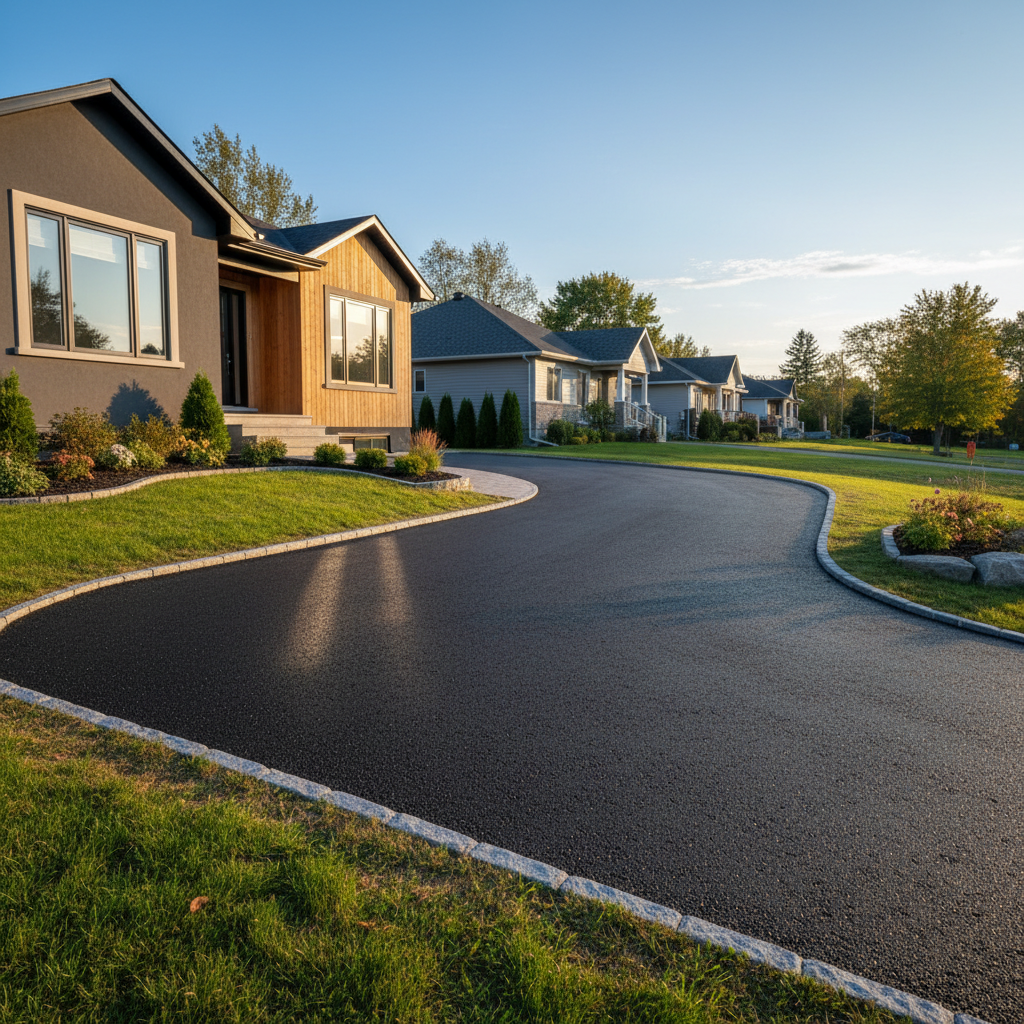
Driveway paving options and costs in Gravenhurst
Gravenhurst homeowners have real choices when it comes to paving a driveway, but the numbers you get in Muskoka–Kawarthas usually start with one question: how much frost protection your base needs. Here, most residential driveways are tied to single-detached homes—78.4% of dwellings are detached—so driveway projects are a major part of the local hardscape workload. With 4,315 homeowner households in the town (Statistics Canada, 2021 Census), there’s consistent demand in the areas where properties are older and lots are mature, including parts of downtown and around the Muskoka Lakes area roads where access can be tighter.
Pricing is shaped by the region’s freeze–thaw cycle and typical frost influence. Local practice commonly assumes frost penetration around 1.2 m (about 4 ft), and that drives excavation depth, thicker compacted granular base (often 12+ inches for residential asphalt), and more careful drainage slopes. The colder climate also tightens the paving season; hot-mix asphalt work is usually concentrated in late spring through early fall, so spring scheduling and weather risk can affect availability and labour. Asphalt and concrete contractors also need to keep equipment working efficiently on variable soils—common around rocky or mixed subgrades—so prep time is a cost.
Below are practical cost bands for common driveway builds. Use them to compare proposals before you ask for the detailed, itemised scope that tells you what your quote includes.
| Material |
Lifespan |
Maintenance |
Best For |
Price per sq ft |
Price Range |
| Asphalt (new installation, proper base) |
15–25 years |
Seal after 6–12 months, then every 3–5 years |
Lower upfront cost with smooth ride |
$5.00–$9.50 |
$4,500–$9,000 |
| Asphalt (overlay on existing gravel base) |
10–20 years |
Seal every 3–5 years; watch for settlement |
Budget refresh when base is sound |
$4.50–$8.50 |
$4,200–$8,400 |
| Interlocking concrete pavers |
25–40 years |
Re-sand joints as needed; occasional re-level |
Best curb appeal and easy spot repairs |
$10.00–$16.00 |
$7,000–$15,000 |
| Poured concrete (broom finish) |
20–30 years |
Seal for longevity; crack monitoring |
Clean look, simple maintenance |
$9.50–$15.00 |
$8,000–$16,000 |
| Exposed aggregate concrete |
20–35 years |
Seal periodically; keep surface free of debris |
Slip resistance and premium appearance |
$12.00–$18.50 |
$9,500–$18,000 |
| Gravel / crushed stone (budget option) |
5–12 years |
Re-grade and top up; control washouts |
Temporary solution or steep budget constraints |
$3.00–$6.00 |
$2,000–$6,500 |
Prices are estimates only and vary by project scope, site access and material selection.
What affects the price of paving in Gravenhurst
In Gravenhurst, it’s common to see quotes for the “same” driveway swing by 30–50% across Muskoka–Kawarthas and other parts of Ontario because the true cost driver isn’t just asphalt vs. concrete—it’s the amount of prep required to survive the winter. Two contractors can both advertise an asphalt driveway, but one may include proper subgrade proofing, a frost-protective granular base, edge containment, and drainage corrections, while the other only prices a surface lift. When you compare the job properly, that gap is often labour + excavation depth + aggregate quantity.
Frost line depth and freeze–thaw cycles are decisive. In colder regions, deeper frost influence means thicker compacted granular layers to prevent heaving and cracking; the typical design thinking in Ontario/Alberta is often 6–12 inches of granular material where appropriate, and in Muskoka–Kawarthas many residential builds end up with 12+ inches of compacted base when drainage and site conditions demand it. Also, the paving season is shorter. Asphalt placement needs favourable weather (air temperatures above about 10°C), so late-spring and early-fall scheduling pressure can raise labour and equipment rates compared with milder areas. Asphalt mix design matters too—freeze–thaw-rated mixes and consistent compaction control cost and performance.
Concrete examples: older lots with compacted topsoil may cost more to rebuild because we have to strip and replace to get a stable subgrade. Conversely, a straightforward, well-draining site on clay-sand blend may come in closer to the lower end of the driveway bands—like asphalt in the $4,500–$9,000 range—or stay within a tighter concrete band if base and curing are straightforward (often aligning with $8,000–$16,000). With about 54.9% of homes built before 1981 (Statistics Canada, 2021 Census), Gravenhurst also has plenty of driveways on aging drainage patterns, so correcting slopes can add cost but also extend service life.
| Price Factor |
Why It Matters |
Cost Impact |
| Driveway area in sq ft |
Most materials and paving time scale directly with square footage |
High—commonly the biggest swing |
| Base depth required |
Frost influence determines granular thickness to limit heaving and cracking |
High—extra excavation and aggregate add up quickly |
| Grading and drainage work |
Correct slopes and away-drainage keep water out of the structure |
Medium to high—often overlooked in early quotes |
| Tear-out of existing surface |
Breaking, hauling, and disposal add labour and equipment time |
Medium to high—especially for old concrete |
| Edge restraints and curbing |
Prevents lateral movement and paver spread during freeze–thaw cycles |
Medium—minor lines of work with real impact |
| Sealing requirement |
Asphalt needs sealing to reduce oxidation and water penetration |
Low to medium—usually a small line item with big performance value |
| Site access |
Narrow lanes, steep driveways, or limited staging slow equipment movement |
Medium—affects productivity and safety procedures |
| Asphalt mix specifications |
Freeze–thaw rated mix design and proper gradation improves durability |
Medium—premium mix and testing may be required |
Permits & regulations in Ontario
For most Gravenhurst homeowners, paving your own private driveway within your property usually does not require a building permit. The typical scenario we see is simple: you’re replacing the driveway surface, and you’re working entirely on your lot without changing municipal infrastructure. However, work in the municipal right-of-way can trigger municipal approval requirements even when it’s “just driveway work.” Examples that often do require approval include new or modified curb cuts, changing the boulevard area, altering storm drainage or ditch flow, and any work that affects how water is conveyed along the road allowance.
Step-by-step, verify before excavation: (1) confirm where your property line and the road allowance boundary sit (stake the lot if needed), (2) call for utility locates through Ontario One Call before any digging, and (3) ask the municipality about any lot-grading restrictions that limit how close a hard surface can come to property lines or how grading can be reshaped—some communities have rules that can affect the drainage you’re allowed to create.
Then verify the contractor you’re hiring. In Ontario, a legitimate contractor should provide: (1) their Ontario licence number and business details, (2) proof of liability insurance (often a certificate of insurance showing limits), and (3) evidence of required workplace coverage. You can check the licence/busines status in the appropriate online registry, then request and review insurance certificates directly (your contractor should match the certificate’s named insured to their legal business name). Ask for the document clearance/coverage letter they use for jobsite compliance, and make sure it’s current before work starts.
Asphalt vs pavers vs concrete for Gravenhurst driveways
When you’re choosing between asphalt, interlocking pavers, and concrete in Gravenhurst, the decision usually comes down to upfront cost versus how you want the driveway to behave after years of winter. Asphalt is the lowest upfront option, and with correct base construction it handles winter well; the trade-off is maintenance. In Muskoka–Kawarthas, asphalt typically needs sealing after 6–12 months, then every 3–5 years to slow oxidation and reduce water getting into the structure.
Interlocking concrete pavers cost more upfront, but they’re the most flexible long-term: individual stones can be lifted and re-laid for repairs without replacing the entire surface. That matters on older lots where drainage may change or where you might need to adjust utility runs in the future. Pavers also look sharp—excellent curb appeal on detached-home neighbourhood streets.
Poured concrete sits in the middle for cost and can look great, but it’s susceptible to cracking if joints, air-entrainment, and base are not done correctly for freeze–thaw. De-icing salt and water infiltration accelerate surface wear. With frost influence around 1.2 m and freeze–thaw cycling, drainage design and base preparation aren’t optional—they’re what protect any of these materials.
Here’s a practical example: if your asphalt quote lands near $4,500–$9,000 for a similar scope, switching to pavers may bring you to the $7,000–$15,000 band. That difference is justified when you want easy future repairs, a premium look, or a driveway layout with curves and transitions where paver flexibility beats a fixed slab.
| Material |
Frost Resistance |
Curb Appeal |
Repair Method |
Lifespan |
Price Band |
| Asphalt (sealed regularly) |
Good with proper frost-protective base and drainage |
Moderate—clean, smooth finish |
Patch cut and hot-mix patch; full overlay if needed |
15–25 years |
$4,500–$9,000 |
| Interlocking concrete pavers |
Very good when installed on the right bedding and compacted base |
High—strong “finished” look |
Lift/re-set individual pavers; re-sand joints |
25–40 years |
$7,000–$15,000 |
| Poured concrete (air-entrained) |
Good with air-entrainment and correct joints |
Moderate to high |
Concrete patch or resurfacing; slab replacement for major settlement |
20–30 years |
$8,000–$16,000 |
| Exposed aggregate concrete |
Good with strong base and seal plan |
Very high—premium texture and colour |
Limited patching (often requires careful match); may resurface |
20–35 years |
$9,500–$18,000 |
| Permeable pavers (drainage grid) |
Very good if designed to manage local water properly |
High—modern look |
Targeted paver replacement; clean-out and re-stabilise stone layers |
20–35 years |
$10,500–$20,000 |
| Chip seal / tar-and-chip |
Fair—works best on lower-traffic areas and with good drainage |
Low to moderate |
Re-seal/re-surface overlays |
8–15 years |
$3,500–$7,500 |
How to choose a paving contractor in Gravenhurst
Choosing the right paving contractor in Gravenhurst starts with proving they can legally and reliably do the work. Ask for their Ontario business details and licence information, then request proof of liability insurance and workplace coverage for their crews. You’ll typically receive a certificate of insurance showing the insured company name, coverage limits, and effective dates—confirm it matches the contractor signing the agreement. For workplace coverage, ask for current documentation used for jobsite compliance (and make sure it’s not expired). If they won’t provide documents promptly, that’s a red flag.
Next, get 2–3 itemised written quotes. A solid quote breaks down labour and materials, including excavation, granular base, drainage/grading, geotextile (if used), edge restraints/curbing, asphalt or concrete thickness, jointing (for concrete), and disposal. Push for line items rather than a single lump sum—driveway pricing often changes most when you see how much base is included and what “site prep” really means.
Read the scope carefully: what’s excluded (rock removal, over-excavation, dealing with unsuitable soils, crack filling prep, saw-cutting), whether a permit/municipal approval is included if needed, and if haul-away/disposal is part of the price. For warranty, confirm workmanship warranty length, whether the surface course/manufacturer warranty applies, and whether it transfers if you sell the home. For payment, keep it practical: never pay more than 10–15% upfront, and hold back a portion until the job is complete and deficiencies are corrected. Get the timeline in writing—start date and completion estimate—so you’re not left waiting through peak-season weather delays.
- Ask for licence/business proof and match it to the contract
- Request certificate of liability insurance and verify dates
- Confirm workplace coverage for crews (documentation on request)
- Get 2–3 itemised quotes with labour + materials breakdown
- Ensure base thickness is stated in inches and matches frost needs
- Confirm drainage slopes and edge restraint details are included
- Ask how they handle unsuitable subgrade or excess rock
- Clarify disposal/haul-away: included or extra?
- For asphalt, confirm sealing plan (initial curing and timing)
- For concrete, confirm air-entrainment and jointing plan
- Ask about compaction testing/proofing methods
- Review warranty coverage for both workmanship and materials
Red flags I see around Gravenhurst include: quotes with no base thickness details, crews starting without utility locates, “too good to be true” pricing that skips proper drainage or edge containment, pressure to pay large deposits up front, and vague scope language like “site prep as needed” without defining how changes are priced.
Frequently asked questions — paving in Gravenhurst
How often should I seal my asphalt driveway?
In Gravenhurst and across Muskoka–Kawarthas, sealing is mainly about protecting asphalt from water penetration and oxidation caused by freeze–thaw cycling. After a new asphalt driveway is installed, most contractors recommend waiting until it’s cured—commonly 6–12 months—before the first seal coat, then re-sealing on a routine cycle of about every 3–5 years depending on sun exposure, traffic, and how much sand/salt you get during winter. If you see fading, minor surface raveling, or small darkening spots, it’s often time to schedule sealing before the surface starts to hold moisture. If your driveway was quoted in the $4,500–$9,000 band, plan sealing as a separate line item (often in the $400–$2,000 range depending on size and preparation) so your quote reflects ongoing maintenance, not just the initial paving.
Why does my driveway crack and heave in winter?
Cracking and heaving are usually the result of water and frost working together—especially if the driveway base isn’t built to handle Muskoka–Kawarthas winter conditions. When the granular base is too thin for frost influence, or if drainage is off (low spots, poor slopes, blocked edge areas), water gets into the pavement structure. During cold snaps, freeze–thaw cycles expand and contract that trapped moisture, which can lift sections (heaving) and create cracks. Older driveways—common in a town where many homes were built before 1981 (Statistics Canada, 2021 Census)—often have drainage patterns that no longer perform with today’s runoff volumes and vehicle loads. Fixing the problem isn’t just patching cracks; it typically requires base correction, proper slope, and edge containment so water can’t reach the frost-sensitive layers.
Do I need a permit to pave my driveway in Ontario?
In most cases in Ontario, paving or resurfacing a private driveway within your own property generally doesn’t require a building permit. That said, Gravenhurst work that affects municipal infrastructure or the road allowance often needs municipal approval. Common examples include creating or changing a curb cut, altering boulevard/ditch drainage, or modifying storm drainage flow. Before any excavation, verify utility locations through Ontario One Call so you’re not damaging buried services. The practical way to confirm what you need is to tell your contractor exactly where the work happens (property line vs. road allowance/ditch) and ask the municipality about approvals or any lot-grading rules that affect how close and how you can re-grade near property boundaries.
How long before I can drive on new asphalt?
New asphalt typically needs time to cool and cure before you drive on it. In most residential projects, light traffic may be allowed after a short cool-down period—often the same day—if the surface is dry and stable, but heavier loads or turning movements should be avoided for longer. A key factor is temperature, weather, and whether the contractor applied tack coat or a binder. Because Gravenhurst winters are unforgiving, contractors also time paving to the proper season; work is usually planned when conditions support proper compaction and curing, which helps reduce early deterioration. If your driveway is part of a $4,500–$9,000 project, ask the crew about the exact cure/traffic instructions for your specific temperature window and thickness so you don’t mark the surface early. Always follow the contractor’s written guidance for best results.
What causes potholes and how are they repaired?
Potholes are usually caused by water infiltration that softens the base, followed by vehicle loading that breaks down the asphalt. In Muskoka–Kawarthas winters, water can enter through cracks, seams, or poorly sealed areas; freeze–thaw then expands the damage until a section collapses. That’s why sealing and timely crack patching matter—small failures grow fast when drainage isn’t working. Repair methods depend on depth: for minor surface damage, crews may cut out the affected area and patch with hot mix; for deeper failures, they’ll remove additional material down to the stable base, re-compact and sometimes add granular base, then pave over the restored subgrade. The best repair is the one that stops the water pathway, not just replaces the asphalt surface.
How do I prepare for a paving project?
Preparation helps the job go smoothly, especially in Gravenhurst where site access and weather timing can affect the schedule. Start by clearing vehicles, garden items, and any obstacles from the driveway and adjacent work zone. Mark any planned utility access points and ensure fences/landscaping boundaries are protected so edge containment and excavation can be done cleanly. Ask your contractor to confirm utility locates through Ontario One Call before digging. Next, review the scope and decide how you want to handle changes (for example, if unsuitable subgrade or extra rock is found). Confirm in writing whether disposal is included and who will restore any disturbed areas. Finally, plan for short-term restrictions: asphalt needs protection during curing and concrete may need additional curing time before heavy use. If you’re budgeting, remember maintenance matters too—sealing is commonly part of keeping an asphalt driveway in the $4,500–$9,000 value range over time.