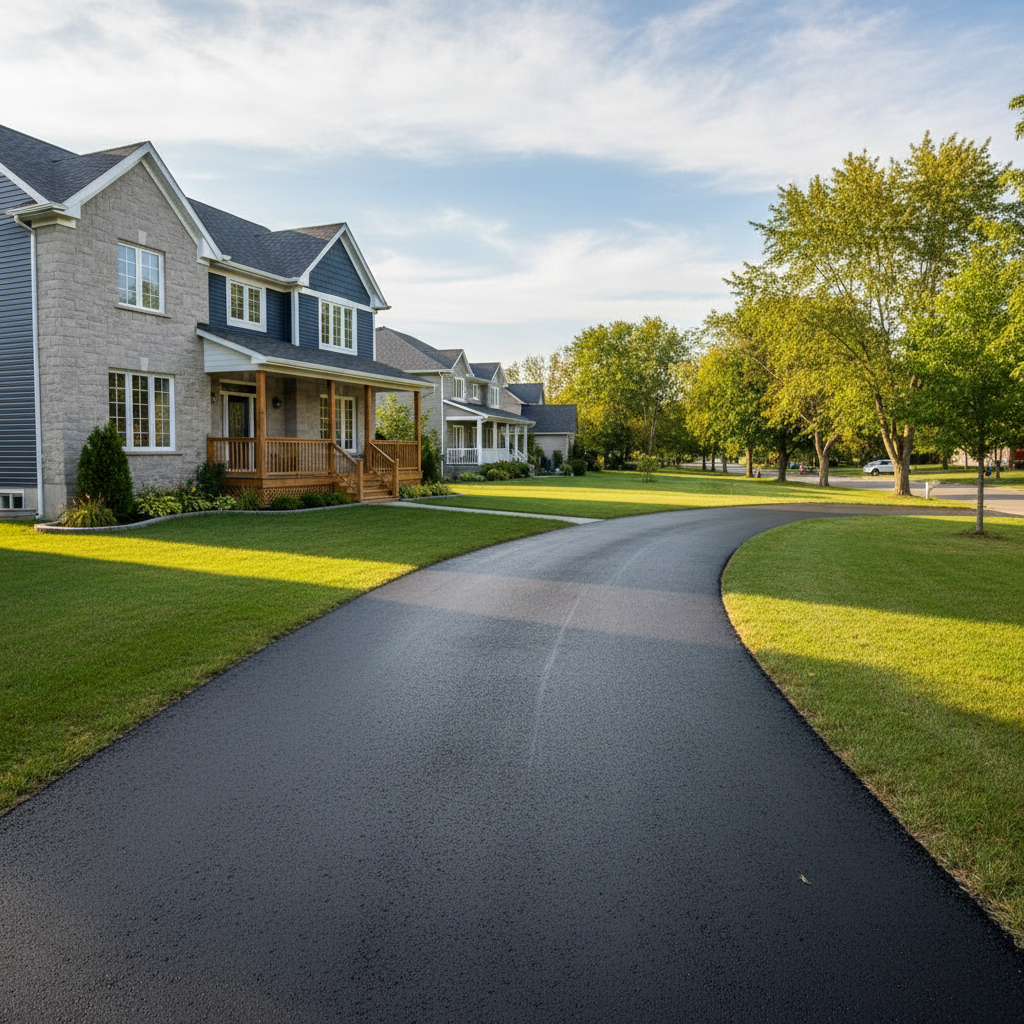
Driveway paving options and costs in Brooklin
Brooklin homeowners typically face a familiar choice: asphalt, interlocking pavers, or concrete. With Brooklin sitting in the Toronto economic region and a population of about 25,000 (Statistics Canada, 2021 Census), there’s steady demand for new driveways and replacements—especially around established residential pockets like the north end near Taunton Road. Because many private driveways serve single properties rather than shared lots, driveway work is a major part of the local paving market. In practice, most homeowners are looking at similar square footage and the same harsh Ontario winter, but the final price can still swing widely depending on how the base is built for Toronto’s freeze–thaw cycle.
Toronto’s primary cost driver is frost depth: ground freezing is roughly 3–4 feet in the region. That means contractors must plan deeper excavation, reliable subgrade compaction, and real drainage so water can’t sit under the surface and cause heaving and cracking. The paving season is also effectively compressed into late spring through early fall, so scheduling pressure can push labour and equipment costs higher for prime dates.
Asphalt usually lands at the lower end of the market—often in the range of $3,500–$8,000 for a full driveway—but it must be sealed after installation (commonly within the first 6–12 months) and then maintained every few years. Pavers and concrete can cost more upfront, yet they offer different trade-offs in curb appeal and repair approach. Below is a quick comparison table to anchor your budget before you request itemised quotes.
| Material |
Lifespan |
Maintenance |
Best For |
Price per sq ft |
Price Range |
| Asphalt (new installation, proper base) |
15–25 years |
Sealcoat every 3–5 years |
Best value with good drainage and a properly compacted base |
$6.00–$11.50 |
$3,500–$8,000 |
| Asphalt (overlay on existing gravel base) |
10–18 years |
Sealcoat and monitor for settlement |
When you can salvage an acceptable base and want lower demo cost |
$5.50–$10.00 |
$3,200–$6,500 |
| Interlocking concrete pavers |
25–30+ years |
Occasional panel replacement; re-sanding as needed |
Premium curb appeal and repairable sections |
$12.00–$22.00 |
$9,000–$20,000 |
| Poured concrete (broom finish) |
20–30 years |
Seal if desired; maintain joints and drainage |
Clean, modern look with fewer joints than pavers |
$10.50–$16.00 |
$6,000–$15,000 |
| Exposed aggregate concrete |
20–30 years |
Seal (if specified) and keep drainage clear |
Higher slip resistance and decorative finish |
$12.50–$20.00 |
$7,500–$17,500 |
| Gravel / crushed stone (budget option) |
3–8 years |
Re-grade and top up annually; weed control |
Short-term solution or low-budget areas |
$3.00–$6.50 |
$1,800–$4,500 |
Prices are estimates only and vary by project scope, site access and material selection.
What affects the price of paving in Brooklin
In Brooklin and across the Toronto economic region, quotes for the “same” driveway can differ by 30–50% because pricing is tied to what’s happening below the surface. Even if two homes have similar driveway dimensions, one site may need deeper excavation, more base stone, and drainage corrections to survive Toronto’s freeze–thaw cycle, while another may have a stable subgrade that only needs minor grading. Short seasonal work windows also influence labour availability: hot-mix asphalt placement generally requires air temperatures above about 10°C, so spring and early-fall scheduling can become competitive and cost more.
Frost depth and freeze–thaw cycles are decisive cost factors in this region. With ground freezing to roughly 3–4 feet, contractors often must build a thicker, compacted granular base and maintain proper slope and drainage so water doesn’t sit under the pavement. In deeper frost conditions like Toronto, base and bedding layers can become a major line item—because if the base isn’t engineered for heave resistance, you’ll see cracking, rutting, and premature failures. That’s also why asphalt mix design matters: freeze–thaw-rated mixes typically cost more than generic mixes, and they’re still only as durable as the base and drainage.
Concrete can be priced higher when air-entrainment and joint planning are done correctly for Ontario winters. For example, a broom-finished poured slab might start in a $6,000–$15,000 band, but adding proper reinforcement and saw-cut control joints (plus drainage fixes) can push the total upward. On the other hand, if you’re overlaying asphalt where the existing base is solid, costs can land closer to the lower end of $3,500–$8,000 because demo and rebuild are reduced.
| Price Factor |
Why It Matters |
Cost Impact |
| Driveway area in sq ft |
Most labour and material quantities scale directly with square footage |
Typically the biggest driver |
| Base depth required |
Frost line determines granular thickness to reduce heaving/cracking risk |
Major impact; thicker base = more stone and excavation |
| Grading and drainage work |
Slope correction and drainage solutions prevent standing water under the surface |
Can add significant labour and materials |
| Tear-out of existing surface |
Breaking/hauling concrete or old asphalt increases disposal and equipment time |
Often adds cost quickly |
| Edge restraints and curbing |
Proper edging prevents paver spread and asphalt migration over freeze–thaw |
Moderate increase; essential for long-term performance |
| Sealing requirement |
Asphalt typically needs sealcoat after installation to protect from moisture and oxidation |
Ongoing maintenance cost across the lifespan |
| Site access |
Narrow driveways or limited staging slow equipment movement and can raise labour hours |
Can materially increase installed cost |
| Asphalt mix specifications |
Freeze–thaw-rated mixes improve durability in Ontario winters |
Higher material cost, but often fewer early repairs |
Permits & regulations in Ontario
In Ontario, most driveway paving within your own property typically does not require a building permit. A straightforward asphalt or paver replacement on your existing driveway footprint—assuming you’re not changing the municipal drainage patterns—often falls under private property maintenance. However, work that touches the public right-of-way usually does require municipal approval. In practical terms, the following items commonly need approval: new or modified driveway apron/curb cut access, changes to boulevard grading, altering catch basins/storm connections, or any work that affects stormwater flow in the municipal ditch/roadside area. If your contractor is adjusting slopes so runoff changes direction, that can also trigger review.
A good homeowner approach in Brooklin is to verify things before excavation: first, confirm the exact scope line-by-line (especially “curb cut/apron”, “storm tie-in”, and “boulevard grading”). Next, call for utility locates using the Ontario One Call process so excavation doesn’t hit buried services. For homeowner timing, have locates done at least a few days before dig day.
To check your contractor’s legitimacy, ask for proof of Ontario licensing where applicable, then verify liability insurance and workers’ protection coverage. For insurance, request a Certificate of Insurance showing the limit and coverage and confirm Brooklin address/job location is covered; for workers’ compensation, request a clearance letter showing WSIB coverage (or the applicable workers’ protection status). Also confirm the certificate isn’t expired and that the company name on the insurance matches the contract.
Asphalt vs pavers vs concrete for Brooklin driveways
Choosing a driveway surface in Brooklin comes down to balancing upfront cost, winter durability, and how much hassle you can tolerate over the next 10–25 years. In our freeze–thaw climate, all three systems can perform well if the base is engineered for Toronto’s frost depth (roughly 3–4 feet) and if drainage is correct. But the “weak links” differ by material.
Asphalt usually has the lowest upfront price, making it attractive for homeowners watching budgets. It’s also a practical choice if you want a smooth surface and minimal reconstruction. The catch is that asphalt is more maintenance-sensitive: it typically needs sealcoat after installation (commonly within 6–12 months), then every 3–5 years depending on traffic and how often the driveway is treated with salt and sand. Interlocking concrete pavers cost more to build, but they’re highly repairable—if a section settles or a few units lift, you can reset panels rather than replace the entire surface. Poured concrete sits mid-to-upper range and can last decades, especially when it’s air-entrained and built with proper control joints. Still, concrete can crack under Ontario freeze–thaw if the mix design, joint spacing, and drainage aren’t right.
Against winter maintenance realities—plowing, sanding, and salt—pavers and properly finished concrete often hold up better aesthetically, while asphalt can look “fine” early on but needs disciplined sealing to stay water-resistant. For a concrete example: if an asphalt driveway estimate comes in near $3,500–$8,000 and pavers come in near the higher $9,000–$20,000 band, the price gap is usually justified when you want long-term curb appeal and easier spot repairs rather than periodic asphalt maintenance.
| Material |
Frost Resistance |
Curb Appeal |
Repair Method |
Lifespan |
Price Band |
| Asphalt (sealed regularly) |
Good when base/drainage are engineered and mix is freeze–thaw rated |
Medium (clean, smooth look) |
Patch and re-tack; larger issues may require overlay |
15–25 years |
$3,500–$8,000 |
| Interlocking concrete pavers |
Very good with proper bedding and edge restraint |
High (varied patterns and colour choices) |
Lift/reset affected units or sections |
25–30+ years |
$9,000–$20,000 |
| Poured concrete (air-entrained) |
Good when air-entrained and joints are correctly planned |
Medium (broom finish or decorative options) |
Crack repair and patch; may require resurfacing in extreme cases |
20–30 years |
$6,000–$15,000 |
| Exposed aggregate concrete |
Good when drained and finished properly |
High (textured decorative face) |
Limited patching; often relies on patch + re-seal |
20–30 years |
$7,500–$17,500 |
| Permeable pavers (drainage grid) |
Very good where designed for infiltration and freeze–thaw stability |
High (modern look) |
Replace localized sections; maintain underlying drainage media |
20–30+ years |
$11,000–$24,000 |
| Chip seal / tar-and-chip |
Moderate; performance depends heavily on prep and binder selection |
Low to medium (textured roadway look) |
Re-chip/seal patching rather than full resurfacing |
7–15 years |
$3,000–$6,500 |
How to choose a paving contractor in Brooklin
Start by verifying coverage and compliance. In Ontario, ask for proof of liability insurance and workers’ protection coverage before any work begins. Request a Certificate of Insurance (make sure the company name matches the contract and confirm the policy has active coverage). For workers’ protection, ask for a WSIB clearance letter (or the applicable proof if they’re using a compliant arrangement), and verify it’s current. You should also be able to provide an Ontario business registration reference and documentation that the company is set up to do the type of work being quoted.
Next, get 2–3 itemised written quotes. Look for a breakdown that separates labour, base materials, asphalt/paver/concrete, disposal, and any drainage or grading work. Avoid “all-in” numbers that don’t show what’s included. Pay close attention to exclusions: is the contractor including curb cut/apron work, permit approvals if needed, utility protection, load/unload distance, and disposal of demolished material? A proper scope should also specify compaction testing approach (where applicable), base depth targets, and the type of asphalt mix or concrete air-entrainment.
Warranty should be clear: workmanship warranty length (and what it covers), product/manufacturer warranty details, and whether the warranty transfers if you sell the home. For payment, never pay more than 10–15% upfront. Use progress payments tied to milestones, and hold back a portion until the job is fully complete and cleaned up. Finally, confirm an in writing start date and completion estimate—seasonal constraints in Ontario mean crews plan around workable temperatures.
- Ask for current Certificates of Insurance and confirm the dates.
- Request WSIB clearance letter (WSIB coverage status) before the first day on site.
- Get at least 2–3 itemised quotes (labour + materials, not a single lump).
- Confirm base excavation depth targets and compaction method.
- Verify drainage plan: slope, ditch tie-ins, and whether standing water is addressed.
- Check how they handle existing problems (settlement, frost heave, poor subgrade).
- Make sure edging/curbing restraints are included where needed.
- Confirm asphalt: sealcoat schedule after installation and materials used.
- Confirm concrete: air-entrainment and joint/control plan details.
- Ask who pulls permits if work touches the right-of-way or storm drainage.
- Clarify disposal: is demo and hauling included or an add-on?
- Use a written timeline with start date, weather contingency, and completion target.
Specific red flags in Brooklin include: quotes that won’t state base depth in inches; vague language like “proper drainage” without a plan; refusing to provide insurance/WSIB proof; payment requests requiring large upfront deposits; and skipping a written schedule for placement and cure/seal timing.
Frequently asked questions — paving in Brooklin
How long before I can drive on new asphalt?
In Brooklin (and across Ontario), most contractors will let light foot traffic and limited access happen relatively quickly, but driving time depends on thickness and weather. If the job is done in late spring to early fall with warm conditions, you can often drive on the asphalt within 24–48 hours after placement—assuming the surface cools properly and the contractor confirms it’s safe. If it’s cooler, windy, or damp, curing can take longer. Plan to keep vehicles off the new surface during the early cure period to prevent tire tracking and surface damage. A good contractor will also outline when you can park and how to avoid sharp turns, which matters for longevity. If your driveway is in the typical asphalt $3,500–$8,000 range, ask whether the quote includes the correct initial cooling time and when they recommend your first sealcoat (commonly within 6–12 months).
What causes potholes and how are they repaired?
Potholes form when water enters weak spots—usually from poor drainage, cracks, or base settlement—then freeze–thaw in winter expands the damage. In Brooklin’s climate, freeze–thaw cycling and road salt/sand accelerate deterioration, especially where the asphalt is thin or the base isn’t properly compacted. Repair is typically patching: the contractor removes the failed asphalt back to stable material, cleans and dries the area, reinstalls base material as needed, compacts it, and then places asphalt to match the surrounding thickness. For larger failures, you may need a more extensive cut-out and rebuild of affected sections or even an overlay. A proper repair should include addressing the underlying drainage or edge restraint issue—otherwise the pothole tends to return in the same location. For long-term protection, sealcoat maintenance is one of the simplest steps that reduces moisture intrusion.
How do I prepare for a paving project?
Preparation in Brooklin is mostly about access and decision-making so the crew doesn’t lose time during the short paving season. Clear vehicles, trailers, and storage items from the driveway and ensure the contractor has enough staging space for equipment. If you have landscaping close to the edges, discuss protection or removal ahead of time. Mark any underground utilities or irrigation lines you know about, and make sure utility locates are scheduled (Ontario One Call is typically used before excavation). Decide early whether you’re overlaying (if the base is sound) or doing full tear-out, because that affects dust, traffic, and disposal needs. Confirm what’s included in the quote: demo and hauling, grading adjustments, and whether storm drainage changes require municipal approval. Finally, plan for weather: because placement depends on suitable temperatures for asphalt, scheduling may shift if spring is colder than average.
How do I compare paving quotes fairly?
To compare quotes fairly in Ontario, you need apples-to-apples details. Start by comparing square footage and how much excavation is included. Then look for base specs: base depth, granular type, and compaction requirements. For asphalt, check whether the quote includes a freeze–thaw-rated mix and whether sealcoat is planned within the recommended first year. For concrete, confirm air-entrainment, joint/control plan, and any subdrainage corrections. For pavers, verify bedding thickness, edge restraints, and how they’ll handle settlement points. Also ensure disposal and tear-out are included—quotes that exclude demo hauling can look cheaper but cost more at the end. A common budget anchor is the regional asphalt band of $3,500–$8,000, while pavers often sit higher (often $9,000–$20,000), so ask what upgrades justify the difference.
Can asphalt be laid in cold weather in Brooklin?
Generally, asphalt placement should not be done when conditions are too cold or damp. In Ontario, hot-mix asphalt performance depends on the air and pavement temperature at placement; many crews target workable conditions with air temperatures above roughly 10°C. In Brooklin, that typically means late spring through early fall, and contractors will often avoid placing during cold snaps because poor compaction and improper bonding can lead to early cracking and surface issues. If a contractor claims they can pave “any time,” ask how they control mix temperature, wind conditions, and compaction timing. Also ask about weather contingency wording in the contract. Even if the driveway looks fine at first, freeze–thaw exposure in winter can magnify small installation problems into bigger failures.
What is a driveway apron and do I need one in Brooklin?
A driveway apron is the portion at the entrance where your driveway meets the street or municipal curb area—often involving a curb cut and sometimes changes to grading or stormwater routing. In Brooklin, whether you need an apron depends on your existing curb/entrance setup and whether your project changes the approach. If you’re replacing like-for-like within your property footprint, an apron may already exist and only repairs may be needed. If you’re creating a new curb cut, modifying the boulevard profile, or connecting/adjusting storm drainage in the right-of-way, that work commonly requires municipal approval. Your paving contractor should tell you if your scope involves right-of-way changes and who will handle any required approvals. Always confirm this in writing before excavation, because it impacts scheduling and can affect cost.