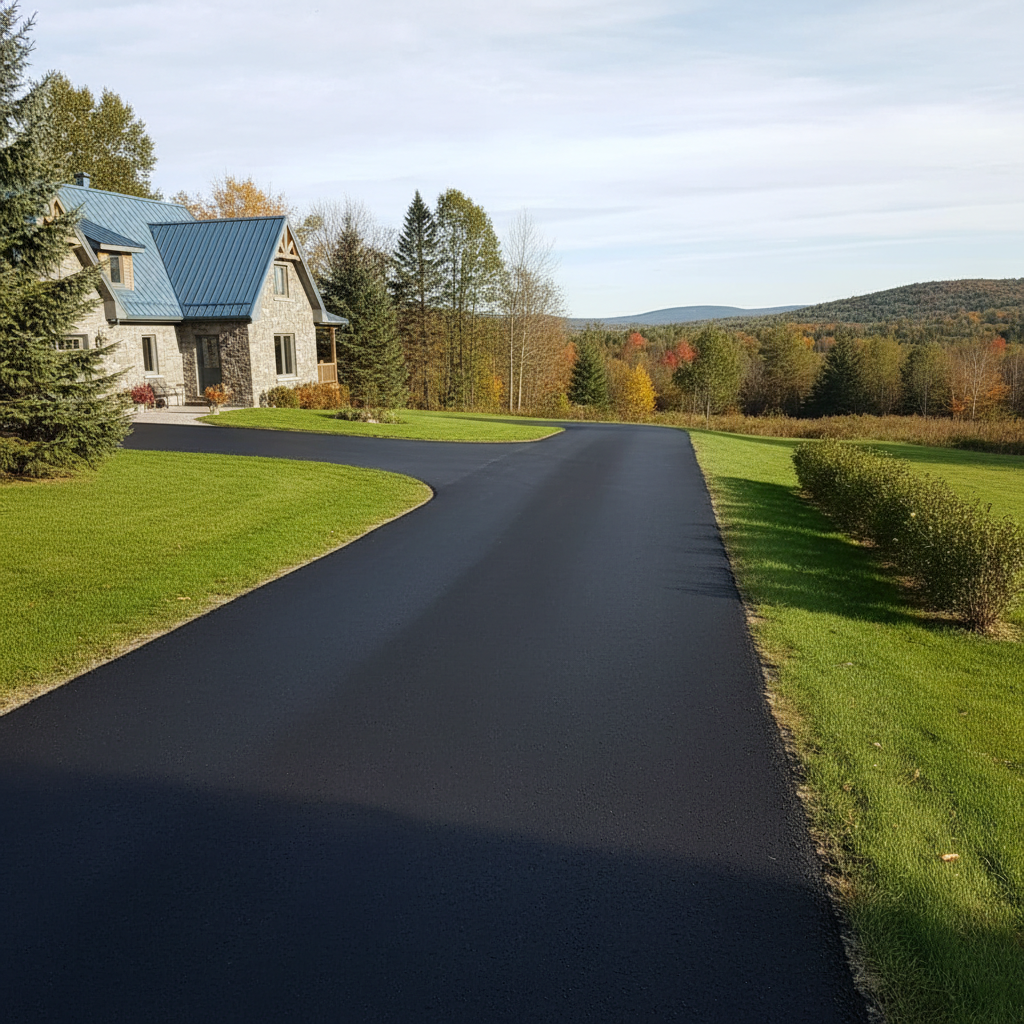
Driveway paving options and costs in Aylmer
Aylmer homeowners typically have a single driveway that’s tied to the type of housing here: with 66.1% of dwellings being single-detached, most private driveways start from a family-lot scenario (wide enough for equipment, with clear homeowner access to the street). That matters for pricing because paving is labour- and base-intensive, and site constraints can swing costs. With 68.7% of households owning their homes, there’s also a higher likelihood of long-term driveway planning—so people often compare asphalt versus pavers versus concrete based on how the surface will behave through southern Ontario winters. (Statistics Canada, 2021 Census)
In the London economic region, we design around frost depth and aggressive freeze–thaw cycles. In Aylmer, frost line is roughly 1.0–1.2 m, so a paved surface needs a deeper, well-compacted granular base and strong drainage to keep water from sitting under the pavement. That extra excavation and aggregate—commonly 6 inches or more in problem areas—pushes material and production costs up compared with milder climates. The paving season is also shorter: hot-mix asphalt requires air temperatures above 10°C, and cool nights plus shoulder-season rain tightens workable days, which can concentrate scheduling. If you’re on a busier road corridor near downtown Aylmer or along more developed residential pockets like Talbot Street East, you’ll also see slightly different pricing due to access and haul distances.
Below are the typical options and realistic cost bands for Aylmer, then we’ll break down what moves those numbers up or down in the London market.
| Material |
Lifespan |
Maintenance |
Best For |
Price per sq ft |
Price Range |
| Asphalt (new installation, proper base) |
15–25 years |
Seal every 3–5 years |
Value-focused driveways with good base and drainage |
$7.00–$10.50 |
$4,500–$9,000 |
| Asphalt (overlay on existing gravel base) |
10–18 years |
Seal every 3–5 years; monitor settlement |
When existing material is mostly stable and costs need to be contained |
$6.00–$9.25 |
$4,000–$8,250 |
| Interlocking concrete pavers |
25–40 years |
Weed control; occasional panel re-level |
Curb appeal and repairability without full replacement |
$13.00–$20.00 |
$8,000–$16,000 |
| Poured concrete (broom finish) |
20–35 years |
Seal as needed; crack monitoring |
Low visual fuss, strong structural option when well-designed |
$12.00–$18.00 |
$9,000–$18,000 |
| Exposed aggregate concrete |
20–35 years |
Seal for colour and stain resistance |
Texture and skid resistance for winter conditions |
$14.00–$22.00 |
$10,000–$19,500 |
| Gravel / crushed stone (budget option) |
5–12 years |
Re-grade; top up annually or as needed |
Short-term or very budget-conscious builds |
$3.50–$6.50 |
$3,000–$6,500 |
Prices are estimates only and vary by project scope, site access and material selection.
What affects the price of paving in Aylmer
Even when two homeowners ask for the “same” driveway, quotes in the London area can differ by 30–50% because the underlying job scope changes—especially the base, drainage, and removal work. In Ontario, paving isn’t just surface material; it’s a frost-protection system. Contractors price differently based on how they interpret subgrade conditions, how much excavation they expect, and whether they’re correcting drainage before the asphalt or concrete goes down.
Frost depth and freeze–thaw cycles are decisive cost factors in southern Ontario. Deeper frost means a thicker compacted granular base to prevent heaving and cracking. In practice, we often plan for additional excavation and base depth compared to coastal climates—frequently 6–12 inches of added aggregate in problematic clay-heavy zones—so the pavement stays below the active frost zone. The paving season is also compressed: hot-mix asphalt needs air temperatures above 10°C, and cool nights plus shoulder-season rain can reduce production days, tightening labour availability. That’s why some spring jobs cost more if crews are already booked and the mix schedule gets rushed.
Concrete examples that change cost in Aylmer: (1) older homes (and many lots built before 1981) often have older, inconsistent base materials and thicker organic topsoil layers, which can add excavation and disposal; (2) poor drainage—low spots that hold water near the garage apron—can require swales, additional base stone, or sometimes a French drain; (3) tight access off local streets may require smaller equipment and slower placement, increasing labour time.
These realities help explain why a basic asphalt driveway might land near the lower end of the $4,500–$9,000 band, while a properly rebuilt paver or concrete base with drainage corrections can push into the $8,000–$16,000 or $9,000–$18,000 ranges. (Statistics Canada, 2021 Census)
| Price Factor |
Why It Matters |
Cost Impact |
| Driveway area in sq ft |
Most material and labour scale directly with square footage |
Low to high; can swing the total by thousands |
| Base depth required |
Frost line protection depends on granular thickness and compaction |
Higher base depth can add major excavation and stone costs |
| Grading and drainage work |
Correct slopes and water management prevent freeze–thaw failure |
Can add several hundred to over a thousand depending on scope |
| Tear-out of existing surface |
Removal and hauling for old asphalt or concrete drives disposal costs |
Often one of the largest “unknowns” in early quotes |
| Edge restraints and curbing |
Prevents paver spreading and maintains line and elevations |
Adds labour/material; especially important on sloped sites |
| Sealing requirement |
Asphalt needs sealing after 6–12 months to protect binder |
Typical annual budgeting can affect long-term value |
| Site access |
Narrow lots slow equipment movement and can restrict haul size |
Labour increases; sometimes requires more trips |
| Asphalt mix specifications |
Freeze–thaw-rated mix design increases performance but costs more |
Moderate uplift for better long-term resilience |
Permits & regulations in Ontario
In Ontario, paving a private driveway within your own property typically does not require a building permit. However, certain works intersect with the municipal right-of-way—especially where your driveway meets the street. If you’re planning new curb cuts, changing boulevard elevations, or any alteration to storm drainage (such as changing how water exits toward the ditch/municipal system), you should expect to need municipal approval before construction starts.
Even when no permit is required, there may be lot-grading or drainage restrictions that limit how close to property lines you can place a hard surface and how you can manage surface water. The safe approach is to confirm grading rules with the municipality and ensure your design keeps runoff directed appropriately—not toward foundations or neighbouring properties.
Step-by-step for homeowners in Aylmer: (1) Call for utility locates before excavation—Ontario One Call is the correct starting point. (2) Ask for the contractor’s Ontario licence (where applicable) and confirm the company’s business details. (3) Request liability insurance and a current WSIB clearance letter (or the appropriate coverage documentation if the contractor is not required to register). (4) Verify the certificate of insurance matches the work address and effective dates. (5) Keep everything in writing—scope, exclusions, and any approvals—before the first delivery arrives.
Asphalt vs pavers vs concrete for Aylmer driveways
For Aylmer driveways, the decision often comes down to upfront budget versus long-term winter resilience. Asphalt is usually the lowest upfront option, but it needs regular sealing every 3–5 years to protect the binder from salt, moisture, and temperature swings. Interlocking concrete pavers cost more at the start, yet they’re highly repairable: if a small area settles or a drain line fails, you can lift and replace only the affected section rather than demolishing the whole driveway. Poured concrete sits in the middle for cost, but it must be properly designed with air-entrainment and joints to control cracking through freeze–thaw and de-icing salt. If you’re relying on plowing and you get heavy winter abrasion, pavers with solid restraints typically take abuse better at the surface level.
Because Aylmer sits in southern Ontario’s frost zone (roughly 1.0–1.2 m), all three need the same foundation mindset: a deeper, well-compacted granular base and drainage that prevents water from pooling under the slab or asphalt. Where asphalt can be impacted by water movement under the surface, concrete needs correct subbase preparation and finishing plan to reduce shrinkage and frost heave effects. Pavers benefit from open drainage paths when built correctly, though edging and base compaction are still critical.
Here’s a practical example: if asphalt lands near the $4,500–$9,000 band and pavers come in around the $8,000–$16,000 range, spending the additional money is justified when you value curb appeal, anticipate potential future maintenance, or want the ability to repair a localized problem without total replacement. If your priority is lowest initial cost and you’re committed to sealing, asphalt often performs well in the London-area climate when the base and drainage are built to spec.
| Material |
Frost Resistance |
Curb Appeal |
Repair Method |
Lifespan |
Price Band |
| Asphalt (sealed regularly) |
Good with proper base and drainage |
Low to moderate |
Patch and re-compact; seal top layer |
15–25 years |
$4,500–$9,000 |
| Interlocking concrete pavers |
Very good; flexible surface over well-compacted base |
High |
Lift-and-replace individual stones or sections |
25–40 years |
$8,000–$16,000 |
| Poured concrete (air-entrained) |
Good if air-entrained and properly jointed |
Moderate |
Crack repair and patching; occasional slab replacement |
20–35 years |
$9,000–$18,000 |
| Exposed aggregate concrete |
Good to very good with proper base and finishing |
High |
Patch and match finish; may require section rework |
20–35 years |
$10,000–$19,500 |
| Permeable pavers (drainage grid) |
Very good where drainage is controlled |
High |
Replace affected grid/paver units |
25–40 years |
$9,000–$18,500 |
| Chip seal / tar-and-chip |
Moderate; depends on maintenance and base |
Low to moderate |
Spot patch and reseal |
7–12 years |
$4,000–$7,500 |
How to choose a paving contractor in Aylmer
Choosing the right contractor in Aylmer comes down to verifying coverage and matching what’s on the proposal to what will actually be built. First, confirm Ontario licensing where applicable and verify liability insurance is in place with coverage that suits driveway construction. Next, check WSIB: request a current clearance letter (or the applicable coverage documentation if the contractor isn’t required to register). You can usually verify the company’s business details through official online resources or the contractor’s own documentation, then validate the coverage dates directly on the certificate. Don’t accept “we’re covered” without paperwork.
Second, insist on 2–3 itemised written quotes. A good quote breaks down labour and materials (base stone, asphalt or concrete, geotextile if used, excavation, hauling/disposal, compaction, edging, and any drainage components). Make sure it’s not a single lump sum that leaves you guessing whether they included tear-out, disposal, or the right base thickness for freeze–thaw conditions.
Third, read the scope exclusions: Is the permit pull included if work touches the municipal right-of-way? Is disposal included for old asphalt or concrete? Are adjustments for extra excavation due to unsuitable subgrade part of the price, or quoted as add-ons? Fourth, confirm warranty terms: workmanship warranty length, product/manufacturer warranty details, and whether it transfers to future owners. Finally, use sensible payment structure—never more than 10–15% upfront, and hold back a portion until completion and cleanup are verified. Ask for a written start date and completion estimate—Ontario scheduling in spring can be tight, and good contractors manage it proactively.
- Request proof of liability insurance and match it to your job address.
- Ask for a current WSIB clearance letter (or documented exemption where applicable).
- Verify the contractor’s Ontario business details and licensing (where required).
- Get 2–3 quotes that list base depth, stone type, and compaction steps.
- Ensure tear-out and disposal are explicitly included or clearly excluded.
- Confirm drainage/grading scope: slopes, swales, and any French drain work.
- For pavers, confirm edge restraints and how jointing sand will be handled.
- For asphalt, confirm sealing timeline (after curing, typically 6–12 months).
- Ask who supplies geotextile if the subgrade is clay-heavy or unstable.
- Check that work includes proper tack coat/bonding where overlays are proposed.
- Use a written payment schedule with a holdback until final inspection.
- Get the timeline in writing, including weather-related stoppage terms.
Red flags in Aylmer: quotes that omit base depth, “too-good-to-be-true” pricing that won’t include tear-out and drainage, no proof of insurance/WSIB paperwork, vague warranties (“workmanship guaranteed” with no duration), and contractors who won’t provide an itemised scope or a written start/completion window.
Frequently asked questions — paving in Aylmer
How do I maintain my driveway through Aylmer winters?
In Aylmer and across Ontario, the biggest winter maintenance goal is to limit water and binder damage during freeze–thaw. Keep the surface clear of snow to reduce loading from plows and avoid scraping the edge. Use de-icing products carefully: salt can accelerate surface wear, especially on asphalt, so apply sparingly and avoid piling it along the driveway edges where water can collect. For asphalt, plan for sealing every 3–5 years—sealing helps protect against moisture penetration and oxidation. For pavers or concrete, inspect after thaw cycles: if you see a low spot or opening at joints, address it early to stop water from migrating under the surface.
Is it worth sealing a new driveway right away in Aylmer?
Typically, no—you don’t want to seal “too soon.” With asphalt, sealing too early can trap moisture and interfere with curing, which risks premature wear. In southern Ontario conditions like Aylmer, most crews target sealing after the asphalt has cured, commonly about 6–12 months depending on weather and mix design. If you’re aiming to protect your investment, sealing on schedule is one of the best value steps you can take. If your driveway is in the asphalt range (often $4,500–$9,000 depending on scope and base), the sealing decision can be the difference between long-term stability and faster surface deterioration. Ask your contractor what curing window they follow for your job.
What is a chip seal driveway and is it suited to Aylmer?
Chip seal (tar-and-chip) is a roadway-style treatment where asphalt binder is sprayed and aggregate is broadcast to form a textured surface. It can be suitable for some driveways where you want a lower upfront cost, especially when a full rebuild budget isn’t available. In Aylmer’s freeze–thaw climate, performance depends heavily on base quality and proper installation; if water can move under the surface, chip seal can fail sooner. It’s usually best viewed as a more temporary or budget approach compared to new asphalt, and it requires ongoing spot maintenance. If you’re looking at options around $4,500–$9,000 for asphalt, consider whether chip seal will meet your long-term expectations—many homeowners in winter-heavy areas prefer asphalt or pavers for more predictable durability.
How much does driveway crack repair cost in Aylmer?
Crack repair pricing depends on crack width, length, and whether the issue is surface-only (sealing) or structural (settlement or base drainage problems). For smaller cracks on a sound asphalt driveway, you may be looking at patching and sealing work that fits within the broader repair/sealing budget range (often $400–$1,600 for typical sealing and repair scopes). If cracks have formed because water is migrating or the base has shifted, a contractor may recommend more extensive patching, grinding, or even localized base work—costs rise accordingly. In Aylmer, if your driveway is older (and many lots here include homes built before 1981), the chance of underlying subgrade variation is higher, so diagnosis matters as much as the repair.
What base thickness do I need for pavers in Aylmer?
In Aylmer, base thickness is driven by frost protection and drainage. While the exact numbers depend on soil conditions, a proper paver base in southern Ontario is typically built with a deeper granular structure than in milder climates—often requiring an excavation and granular base designed to resist heaving through the frost zone. Many contractors follow a plan that includes both a compacted granular layer and a well-graded bedding layer, with careful compaction at each stage. If your site has clay-heavy soil or low drainage spots, you may need additional excavation and stone (sometimes 6 inches or more in problem zones) to prevent settlement and water retention. The best way to confirm your requirement is a contractor assessment of subgrade stability and drainage, not a one-size-fits-all thickness.
How do I get the most accurate paving quote in Aylmer?
To get an accurate paving quote in Aylmer, provide access details and documentation upfront and ask for an itemised scope. Confirm the driveway square footage and share any observations: pooling water, recent sinkage, or areas where plows scrape. Make sure the contractor includes excavation scope, base depth/stone type, drainage/grading work, and tear-out/disposal if you have an existing surface. Ask whether the quote includes utility locates (you should still arrange Ontario One Call before excavation) and whether municipal approvals are needed if the work affects the right-of-way. Then verify the contractor’s coverage: liability insurance and a current WSIB clearance letter where applicable. With those details, quotes tend to reflect the true London-area frost-and-drainage costs rather than guessing.