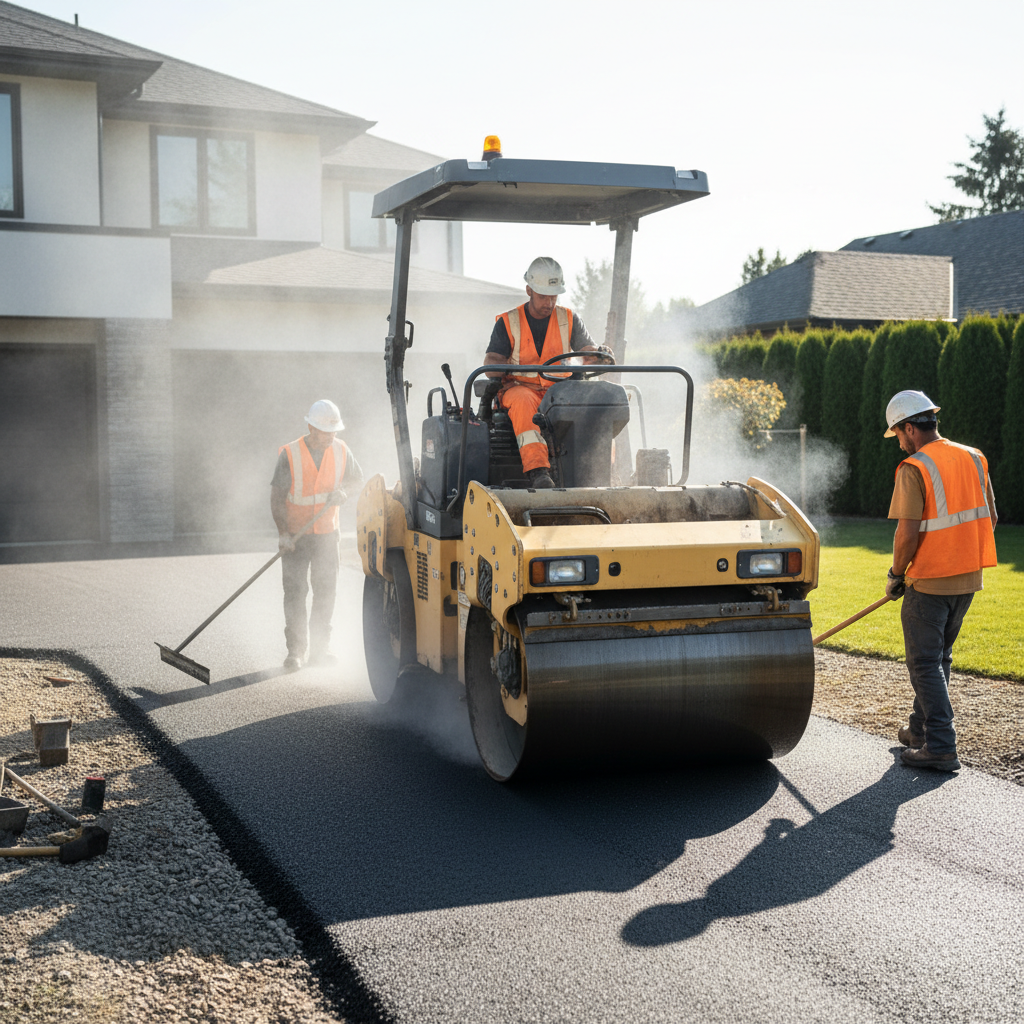
Driveway paving options and costs in Smooth Rock Falls
Smooth Rock Falls is a small northern community where private driveways are mostly attached to single-detached homes—about 86.2% of dwellings are that type, and homeowner households make up 80.2% of local households (Statistics Canada, 2021 Census). That matters for driveway paving, because most projects are full rebuilds or major overlays that must be built to survive winter stresses, not just “finish the surface.”
In the Northeast, pricing is shaped by deep frost and repeated freeze–thaw cycles. Contractors in this area typically budget for extra excavation and a thicker, well-compacted granular base so the asphalt or concrete doesn’t heave and crack. The paving season is also shorter—hot-mix asphalt generally needs air temperatures above 10°C—so mobilization and scheduling are often priced with weather risk in mind. Labour and material availability can be tighter than in southern Ontario, so you’ll often see quotes that reflect more than the surface material price alone.
In Smooth Rock Falls, you also tend to see strong demand around established residential pockets where residents use driveways year-round for access and snow clearing—places like the downtown/central residential areas where lots are relatively close together and equipment access can be more limited. Next, compare typical material choices and real-world expectations in the table below.
| Material |
Lifespan |
Maintenance |
Best For |
Price per sq ft |
| Asphalt (new installation, proper base) |
15–25 years |
Seal coat every 3–5 years; patching as needed |
Most durable “best value” option for northern driveways |
$4.50 – $8.50 |
| Asphalt (overlay on existing gravel base) |
10–18 years |
Seal coat every 3–5 years; more frequent patching if base is weak |
When existing material is sound and grade/drainage are corrected |
$4.00 – $7.50 |
| Interlocking concrete pavers |
20–30 years |
Replace individual stones/areas; re-sand joints periodically |
High curb appeal and easy localized repairs |
$8.00 – $16.00 |
| Poured concrete (broom finish) |
20–30 years |
Seal (optional but recommended); crack maintenance as needed |
Long-term, low fuss surface with a clean look |
$9.00 – $18.00 |
| Exposed aggregate concrete |
20–30 years |
Occasional stain/seal touch-ups; repair spalls promptly |
Slip-resistant texture and premium appearance |
$10.00 – $20.00 |
| Gravel / crushed stone (budget option) |
3–10 years (varies widely) |
Re-grade annually; top up with stone; manage washboarding |
Temporary solution or lower-cost access while planning a rebuild |
$2.50 – $5.00 |
Prices are estimates only and vary by project scope, site access and material selection.
What affects the price of paving in Smooth Rock Falls
In Smooth Rock Falls (and across the Northeast), it’s common to see the “same” driveway quoted 30–50% apart. The difference usually isn’t the surface material itself—it’s the site prep and the risk allowances contractors bake into a tight window of warm weather. When you’re working in winter-freezing conditions, weak drainage, an uneven subgrade, or a base that’s too thin becomes expensive later, so contractors either build extra structural thickness now or price the job higher to account for uncertain conditions.
Frost line depth and freeze–thaw cycles are decisive cost factors in this region. Deeper frost requires a thicker compacted granular base (often 6–12 inches in Ontario/Alberta-type requirements, versus 4–6 inches in milder coastal BC). More excavation means more haul-away, more aggregate, and more compaction passes—plus sometimes geotextile separation or insulation if soils are problematic. Asphalt also needs to be mixed and placed to meet freeze–thaw performance targets; a freeze–thaw-rated mix can cost more than a basic blend.
The paving season is also shorter because hot-mix asphalt generally needs air temperatures above 10°C. That concentrates demand into fewer weeks, and weather delays can push crews into overtime and back-to-back mobilizations. On concrete, costs swing based on whether you need deeper base preparation, thicker slabs, and whether the mix is air-entrained for durability.
For homeowners built with older housing stock—87.1% of homes were built before 1981—you’ll often find older grading patterns and drainage issues. If a contractor must correct drainage or remove compromised material, the job can move from a lower band (around $4,500 – $8,500 for asphalt-driveway paving) toward the higher bands seen with heavier-duty rebuilds (and pavers can run into the $8,000 – $16,000 range when base and restraints are upgraded).
| Price Factor |
Why It Matters |
Cost Impact |
| Driveway area in sq ft |
Most material and labour scale directly with square footage |
Major driver (often the biggest line item) |
| Base depth required |
Frost protection depends on compacted granular thickness and quality |
Moderate to major (can significantly increase excavation/aggregate) |
| Grading and drainage work |
Correct slopes and positive drainage reduce water freezing and heaving |
Moderate (more excavation, re-shaping, sometimes drains) |
| Tear-out of existing surface |
Breaking, hauling, and disposal add equipment time and dump fees |
Moderate to major depending on thickness/condition |
| Edge restraints and curbing |
Pavers need restraints; asphalt needs form/edge integrity to prevent spreading |
Moderate (often essential on longer/wider drives) |
| Sealing requirement |
Asphalt needs seal coat within the first year or two to protect from water and oxidation |
Low to moderate, but impacts long-term performance and planning |
| Site access |
Narrow lots slow equipment movement and may require smaller machinery |
Moderate (labour time increases) |
| Asphalt mix specifications |
Freeze–thaw-rated mixes and proper binder content cost more than basic mixes |
Low to moderate (but crucial for longevity) |
Permits & regulations in Ontario
In Ontario, paving a private driveway on your own property usually does not require a building permit. The common exception is when the work affects the municipal right-of-way—this includes new or modified curb cuts, changes to boulevard grading, adjustments near municipal sidewalk areas, or any alterations that impact storm drainage and water flow within the right-of-way. If your driveway ties into municipal infrastructure, assume you’ll need municipal approval before the contractor excavates.
Start with utilities: before any digging, confirm utility locates through Ontario One Call so buried services are marked. Then, verify lot-grading expectations: some municipalities have lot-grading rules that restrict how close hard surfaces can come to property lines or how water must be directed (for example, avoiding runoff onto neighbouring lots).
To protect yourself in Smooth Rock Falls, verify the contractor’s credentials step-by-step:
- Ontario licence: check the contractor’s registration status through the appropriate provincial/consumer-facing registry or business profile they provide.
- Liability insurance: request a current Certificate of Insurance and confirm coverage limits are appropriate for the scope (excavation and equipment work should be covered).
- WSIB/WCB coverage: ask for proof of coverage (or clearance letter where applicable). This is especially important for crews doing heavy base work.
- Ask for a written scope and confirm that permit/approval responsibilities are clearly stated in the contract.
- Keep copies of insurance documents and the executed contract.
Asphalt vs pavers vs concrete for Smooth Rock Falls driveways
For Smooth Rock Falls, the “right” driveway material comes down to how you manage freeze–thaw stress, drainage, and winter maintenance. Asphalt is usually the lowest upfront cost and delivers a smooth driving surface, but it has to be sealed regularly—typically every 3–5 years—to keep water from penetrating and accelerating deterioration in northern cycles. Interlocking concrete pavers cost more at the start, yet they’re highly repairable: if a small section fails from settlement or frost heave, you can lift and reset that area without replacing the entire driveway. Poured concrete often lands mid-range, and when properly air-entrained it holds up well, but it can crack over time if base prep, thickness, joints and drainage aren’t designed for repeated winter expansion and contraction.
Because Northeast frost conditions demand structural base protection, all three options depend on thicker, well-compacted granular base preparation and positive drainage. Where pavers can perform particularly well is when you anticipate localized movement from older soils or drainage patterns—common in a housing stock where 87.1% of homes were built before 1981. With asphalt and concrete, a drainage mistake tends to show up as wider surface cracking or heaving patches later.
Which holds up best to winter routine—salt, sanding, and plowing? In practice: asphalt responds best to consistent sealing and patching; pavers handle plowing impacts well because individual units can be replaced; and concrete needs air-entrained mix design and jointing discipline to manage freeze–thaw. If you’re choosing between a lower-cost surface and higher curb appeal, the price difference can be justified. For example, if asphalt paving quotes land around $4,500 – $8,500 but pavers come in closer to $8,000 – $16,000, pavers can make sense if you value repairability and appearance in a community where driveways are visible year-round.
| Material |
Frost Resistance |
Curb Appeal |
Repair Method |
Lifespan |
Price Band |
| Asphalt (sealed regularly) |
Good with proper base and drainage; improved by sealing |
Moderate |
Patch and re-tack areas; full resurfaces later |
15–25 years |
$4,500 – $8,500 |
| Interlocking concrete pavers |
Very good when base is stabilized and restrained |
High |
Lift out and replace individual pavers/sections |
20–30 years |
$8,000 – $16,000 |
| Poured concrete (air-entrained) |
Good with air-entrainment, proper thickness, and joints |
Moderate to high |
Spot repair or partial replacement if cracks worsen |
20–30 years |
$9,000 – $18,000 |
| Exposed aggregate concrete |
Good to very good with correct base and finishing |
Very high |
Repair spalls/cracks; limited aesthetic touch-up |
20–30 years |
$10,000 – $20,000 |
| Permeable pavers (drainage grid) |
Excellent drainage control if designed correctly |
High (modern look) |
Replace localized units; clean infiltration channels |
20–30 years |
$10,000 – $22,000 |
| Chip seal / tar-and-chip |
Fair to good; more sensitive to snowplow impacts |
Lower (utility look) |
Re-chip or spot repairs; patching more frequent |
7–12 years |
$3,500 – $7,000 |
How to choose a paving contractor in Smooth Rock Falls
Choosing the right paving contractor in Smooth Rock Falls is about verifying credentials and controlling what you’re actually paying for. First, confirm Ontario licence status (where applicable to their business type) and request proof of liability insurance with an active policy date. Next, verify WSIB/WCB coverage: ask for a clearance letter or current proof of coverage so you’re not left responsible if an injury occurs on site. For excavation and base work, this is non-negotiable.
Then get 2–3 itemised written quotes—not just a total price. You want breakdowns that show labour, aggregate layers (and depths), geotextile/insulation if included, asphalt/concrete thickness, compaction, disposal/tip fees, and finishing details. A detailed scope should also state what’s excluded: for example, are tree root removals or major grading corrections included? Is permit/municipal approval handling included if work touches right-of-way areas? Ask whether tear-out disposal is priced in, and confirm whether edges/restraints are part of the plan.
Review warranty terms. A workmanship warranty should be in writing (often covering defects for a set number of years). Distinguish it from manufacturer warranties for asphalt/concrete products (which may not cover installation). Confirm whether the warranty is transferable if you sell the property.
On payment, never start with more than 10–15% upfront. Use a holdback until the job is complete and final grading/cleanup are done. Also demand a start date and completion estimate in writing so scheduling changes don’t become extra charges.
- Ask for current insurance certificates (liability) and expiry dates.
- Request WSIB/WCB proof or clearance letter before work starts.
- Check for a written, itemised quote with line-by-line materials and labour.
- Confirm excavation and base depth (not just “proper base”).
- Make drainage and slope corrections part of the written scope.
- Ensure disposal/tip fees for old asphalt or concrete are included.
- Verify edge restraints/curb requirements (especially for pavers).
- Ask for compaction method details (proof of rolling/validation approach).
- Confirm asphalt mix type meets freeze–thaw expectations.
- For concrete, require air-entrained mix and jointing plan.
- Clarify warranty length and what counts as “defect.”
- Keep payment tied to milestones: base inspection, placement, final finish.
Red flags in Smooth Rock Falls include: refusing to provide itemised pricing, quoting without stating base thickness and drainage corrections, asking for a large upfront deposit (beyond 10–15%), lacking proof of insurance/WSIB coverage, and missing a written schedule and scope that spells out exclusions and disposal.
Frequently asked questions — paving in Smooth Rock Falls
Asphalt vs interlocking pavers vs concrete — which is best in Smooth Rock Falls?
In Smooth Rock Falls, “best” depends on how you want to trade upfront cost for long-term flexibility. Asphalt is usually the lowest upfront choice and can perform very well when the contractor builds a thicker, well-drained granular base and you seal it every 3–5 years. Interlocking concrete pavers cost more (often within the $8,000 – $16,000 band), but they’re the easiest to repair in small sections if frost or settlement creates a localized issue. Poured concrete typically falls in the $9,000 – $18,000 range and can last 20–30 years if the mix is air-entrained and joints plus drainage are done correctly for freeze–thaw. For many homeowners with older properties (87.1% built before 1981), pavers are attractive because repairs can be targeted without tearing out the full driveway.
How long does a paved driveway last in Smooth Rock Falls?
With northern freeze–thaw conditions, lifespan depends less on the top layer alone and more on base preparation and drainage. A well-built asphalt driveway commonly lasts 15–25 years, especially if you seal it within the first 1–2 seasons and then re-seal every 3–5 years. Pavers often reach 20–30 years because individual units can be replaced if movement occurs. Poured concrete is also frequently 20–30 years when air-entrained and properly jointed. If you skip sealing, water can penetrate and freeze, accelerating cracking; and if drainage is off, frost heave can show up regardless of the surface choice. That’s why quotes that include drainage corrections typically cost more upfront—but they’re often what determines whether you get a “full” service life.
When is the best time of year to pave in Smooth Rock Falls?
For asphalt, contractors usually aim for late spring through summer when both air temperatures and pavement conditions are stable—hot-mix asphalt placement generally needs air temperatures above 10°C. In Smooth Rock Falls, work windows can be shorter due to weather variability, so scheduling earlier is important. Paving too early (or during wet/cold spells) can trap moisture or prevent proper compaction, which leads to premature surface failure. Concrete can be placed when temperatures stay within workable ranges and curing can be managed; however, cold snaps can still affect curing quality. In practical homeowner terms: plan for paving during consistently warm, dry weather, and ask your contractor what weather thresholds they use and how they handle delays.
How deep should the base be for Smooth Rock Falls's frost?
There isn’t a single “one depth fits all” answer, because base depth depends on subgrade quality, drainage, and how much frost-risk your driveway sees. In northern Ontario-type freeze conditions, many contractors design for a thicker compacted granular base—commonly in the 6–12 inches range for frost protection—rather than thinner assemblies used in milder climates. The key is to remove unsuitable material, install well-graded granular layers, and compact each lift properly. If soils are soft or have poor drainage history, your contractor may add separation (geotextile) or additional thickness. If a quote only mentions “proper base” without stating depths and compaction/layer plan, ask for details before signing—base depth is what most directly determines whether you’ll see heaving and cracking after winter cycles.
How often should I seal my asphalt driveway?
Typically, you seal an asphalt driveway every 3–5 years, but timing depends on how the contractor builds and how the surface ages. Many crews recommend sealing after the initial cure period—often within the first 1–2 seasons—then moving into a regular cycle. In Smooth Rock Falls, freeze–thaw and snow-clearing increase the need for ongoing protection because water intrusion and oxidation are what drive deterioration. If you notice raveling, fading, or fine cracking, sealing can be an early intervention to slow damage, but it’s not a fix for structural failure from a weak base. A good contractor will inspect the surface condition and recommend whether a full seal coat is appropriate or whether you need patching first to keep the seal from failing early.
Why does my driveway crack and heave in winter?
Cracking and heaving in winter usually come from a drainage and frost mechanism: water gets into (or forms on) the base or subgrade, freezes, expands, and lifts the pavement. When that happens repeatedly through freeze–thaw cycles, cracks open and the surface can buckle. In Smooth Rock Falls, older lot grading and drainage patterns (with many homes built before 1981) can leave low spots that hold water, and that’s a common cause. Another factor is an insufficient granular base depth or poor compaction, which reduces frost resistance. If edges aren’t restrained (more common on some asphalt installs), the structure can move slightly and stresses concentrate. A properly designed rebuild with corrected slope/drainage, thicker compacted base, and correct material specifications is what prevents the same failure pattern from returning.